
container stacking fundamentals in container terminals
Container stacking defines how a yard stores arriving boxes to meet retrieval demand. In plain terms, the objective is to minimise reshuffles and maximise yard density while keeping operations predictable and fast. Terminals manage stacks of varied heights and lengths, and each decision about where to place one container affects subsequent moves. When planners choose a placement they must consider stack capacity, retrieval sequences, equipment reach, and safety rules. Good placement reduces rehandles, shortens travel, and improves port efficiency.
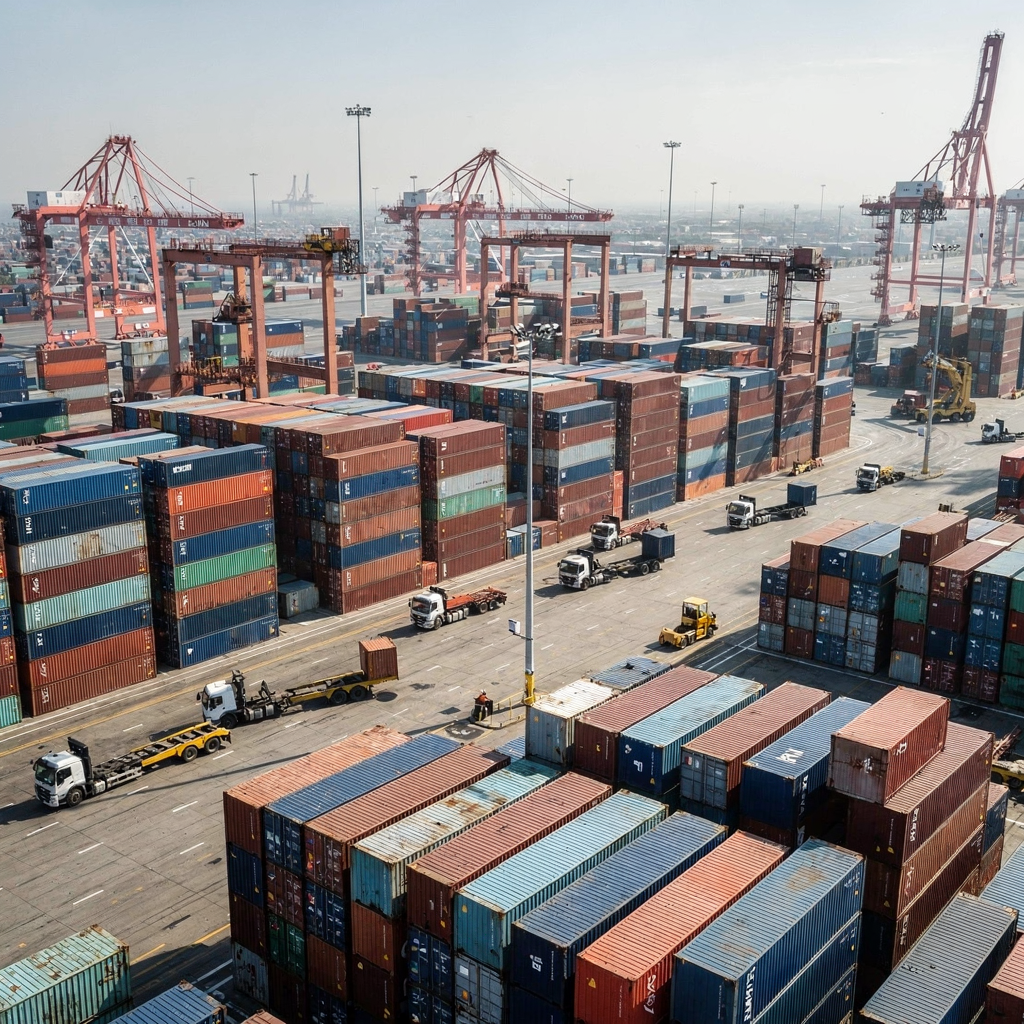
Yard layout matters. A well designed container yard gathers similar destination or feeder traffic in nearby blocks. Stacks sit in bays and rows; each stack has a maximum height and a known footprint. Terminals typically limit stack height to protect handling equipment and to stay within safety codes. The retrieval sequence flows from vessel stowage plans, gate arrivals, and intermodal schedules. Operators use simple heuristics, or more advanced optimization model approaches, to map incoming boxes to specific stacks so that expected retrievals sit near the top.
Key metrics guide choices. Moves per container captures how many times a box is handled on average. Throughput measures how many lifts a quay or yard completes per hour. Handling time measures the interval from arrival to dispatch of a box. Planners target fewer moves per container to control cost optimization and to reduce fuel consumption. In practice research shows that reshuffles can account for up to 30% of moves in busy yards, so every saved rehandle has measurable impact Minimizing Reshuffling/Shifting in Container Stacking.
Operational context shapes the problem. Port container mixes, variable vessel arrival patterns, and gate peaks create peaks and troughs. Terminal operators must balance density versus accessibility, and they must account for equipment such as straddle carriers and RTGs that influence stacking choices. For practical planning, consider simple rules first, then layer in complexity. For instance, stacking by expected retrieval window reduces reshuffles but can lower density; stacking by destination improves consolidation but can increase repositioning requirements.
Transition: first, next, then, and also, additionally, subsequently, therefore, thus, finally, meanwhile, however, in addition, specifically, for example, similarly, consequently, notably, importantly, ultimately, next.
heuristic and modeling of stack configurations
Integer linear programming delivers precise answers to a constrained stacking problem, but exact models often struggle to run fast enough for live yards. An optimization model can encode constraints and an objective function to seek an optimal solution. However, the optimization problem quickly grows combinatorial as arrivals, stack heights, and equipment assignments multiply. Practitioners therefore use heuristics when they must make decisions in seconds. Heuristic rules give good solutions fast; integer programming gives best solutions slowly. Terminal planners must weigh the trade-off between optimal solution quality and computational time.
Genetic algorithms offer a middle ground by searching large solution spaces using evolutionary operators. They can approach global optima while remaining more computationally practical than full enumeration. Rule-based heuristics remain common in production because they are explainable and robust under noisy data. For example, a simple distance-based priority assigning rule places boxes expected to be retrieved soon on top of stacks near gates and quay cranes. That rule reduces reshuffles in many layouts and can be tuned with a few parameters. When you need speed, a heuristic or a hybrid approach often produces the best operational balance.
Modeling must capture realistic constraints. Stack height is a basic constraint; a stack cannot exceed the safe lift limit. Retrieval order imposes temporal constraints: earlier retrievals should ideally sit above later ones. Equipment limits restrict which stacks a crane or straddle carrier can reach. Other constraint examples include weight limits, special handling for cargo, and segregation rules for empty container flows. These constraints appear in the model as hard rules and in heuristics as guardrails. The relocation problem grows from these constraints: a move to access one container forces additional moves to restore order.
Practically, many terminals adopt hybrid pipelines. They use optimization offline to generate schedules and heuristics online to implement and adjust plans. Loadmaster.ai provides RL-based agents that train in a digital twin and then augment yard strategists, helping StackAI place and reshuffle to balance the yard while minimizing travel and protecting future plans. For deeper simulation work try a detailed modelling link such as our AnyLogic terminal simulation library for scenario testing AnyLogic terminal simulation library.
Drowning in a full terminal with replans, exceptions and last-minute changes?
Discover what AI-driven planning can do for your terminal
simulation for port and crane operations
Discrete-event simulation helps evaluate stacking policies under varying demand. Simulation can replay vessel arrival spikes, gate surges, and equipment failures so planners can see how a policy performs before they adopt it. Use cases include testing crane assignment rules, travel-path optimization, and handling-time distributions. A well parameterised model will simulate quay cranes, yard vehicles, and stacking decisions, enabling users to observe cascading congestion and to quantify throughput changes. Simulation helps terminal managers evaluate trade-offs and supports a data-driven approach to yard design.
Crane modelling must include assignment, travel time, and lift cycle time. Cranes impact stacking because quay sequences translate into yard retrievals that the yard must satisfy. Simulating crane cycles alongside yard operations clarifies bottlenecks: sometimes quay throughput exceeds yard extraction capacity, which causes stacking backlogs. Discrete-event models let users change crane allocation rules to study effects on vessel turnaround and yard congestion. For terminals seeking practical templates our Arena and FlexSim-based resources describe modelling best practices; see our Arena port terminal page Arena simulation for port terminal and our FlexSim modelling guidance FlexSim container terminal modelling.
Simulation results often show the same themes. Better allocation and scheduling improves resource utilisation and reduces idle time. For example, optimized crane assignment that coordinates with yard pickups lowers driving distance and smooths workload across RTGs. Simulation helps to quantify vessel turnaround gains and to plan buffer sizing in the container terminal yard. Planners can also evaluatewhat-if scenarios such as a sudden influx of empty container returns or weekend gate closures. These runs inform decisions on staffing, equipment allocation, and service contracts for shipping companies.
Finally, simulation supports rollout. Before deploying a new stacking rule, simulate that rule across peak and off-peak patterns to evaluate robustness. Use simulation to evaluate the relocation problem and to find policies that limit reshuffles without sacrificing density. This process helps terminal operators achieve measurable improvements in port efficiency and in handling operations.
ai-based optimisation of container stacking
AI introduces adaptive opportunities for stacking strategy creation. Deep Reinforcement Learning (DRL) agents learn policies that map observed yard states to placement actions. Unlike supervised models that imitate past decisions, DRL searches for high-performing policies by trial and error against explainable KPIs. This capability enables agents to dynamically trade quay productivity against yard congestion and driving distances, rather than settling for average historical behaviour. As a result, agents can outperform static heuristics in complex, changing environments.
Self-attention mechanisms improve how agents anticipate yard dynamics by highlighting the most relevant elements of the yard state. Attention helps an agent focus on critical stacks, imminent retrievals, and constrained equipment. In practice this yields smoother plans and fewer unnecessary shifters. Research shows that AI-driven stacking strategies can cut reshuffles by up to 25% and reduce handling time by roughly 15% in experimental settings Container stacking optimization based on Deep Reinforcement Learning. Those gains translate into faster turnaround and lower operational costs.
Application of artificial intelligence requires a digital twin or simulator where agents can train. Loadmaster.ai trains three agents—StowAI, StackAI, and JobAI—in a closed-loop digital twin so the policies learn millions of scenarios without relying on historical data. This approach avoids the pitfall where traditional machine learning models need vast clean history, which may not represent future conditions. Instead, the agents learn to generalise across vessel mixes and disruptions, then deploy with guardrails that ensure safe execution.
AI integration brings measurable environmental benefits as well. Fewer rehandles and shorter travel distances reduce fuel consumption and support sustainability targets. Shipping companies and terminal operators that adopt AI policies often report improved consistency across shifts and more stable performance regardless of who is on duty. For terminals interested in integrating AI with their TOS, explore our guidance on TOS integration and decoupling fleet control logic decoupling fleet control logic from TOS.
Drowning in a full terminal with replans, exceptions and last-minute changes?
Discover what AI-driven planning can do for your terminal
solve maritime reshuffle challenges
Reshuffle minimisation matters for cost and schedule control. To solve the maritime reshuffle challenges you must combine strategic stacking rules, targeted reshuffle policies, and equipment coordination. Start by defining an objective function that balances moves per container, yard density, and crane productivity. Then impose realistic constraints such as maximum stack height, equipment reach, and segregation for hazardous or reefer cargo. This creates an optimization problem that reflects the true operating environment.
Practical strategies include distance-based priority assigning and early consolidation of similar transshipment flows. Distance-based rules place imminent retrievals in stacks near exit routes to reduce travel. Consolidating transshipment boxes into common blocks reduces internal reshuffles and streamlines gate and quay handovers. Research and case studies report substantial gains: optimized stacking policies have reduced the number of stacks required by up to 20%, freeing vital yard space and increasing throughput capacity Optimizing Container Stacking at Terminals.
Operational proof points support these strategies. For example, terminals that adopt smart stacking algorithms report productivity gains of 10–15% and lower fuel consumption due to fewer container moves Optimizing Container Stacking for Yard Operations. AI-driven approaches further reduce handling times by 15–25% in trials, improving vessel turnaround and reducing berth occupancy AI-based solutions for efficient operations.
Economic and environmental gains follow. Less repositioning lowers direct labour and equipment costs, while fewer fuel-intensive moves reduce emissions and support sustainability goals. Terminals that apply a combined strategy—rules for predictable flows, simulation for verification, and AI for adaptation—achieve the best long-term returns. To solve the problem at scale, terminal operators should consider a phased rollout that tests policies in simulation, validates in a sandbox, and then moves to live deployment with guardrails. This controlled path protects service while unlocking efficiency.
integrating ai and simulation in container terminals
Combining AI-driven policies with simulation creates a digital twin that enables safe experimentation and fast deployment. Simulation provides the environment where agents learn and where planners evaluate edge cases. When AI policies train inside a realistic simulator they learn to anticipate congestion, coordinate allocation and scheduling, and to protect quay productivity. The closed-loop training approach enables RL agents to improve over simulated millions of decisions without needing historic logs.
Integrating simulation and AI also enables real-time adjustments. Agents can adapt plans dynamically as conditions change: when a vessel is delayed, when a gate surge appears, or when a crane trips offline. This means the system can reassign jobs, rebalance stacks, and reprioritise moves to keep throughput stable. The combination of simulation and AI helps terminals to streamline coordination between quay cranes and yard equipment, and to evaluate new rules safely before live trials. For teams building simulation-driven pilots, our suite of simulation resources covers tools such as JaamSim and Simio to evaluate policies in a controlled environment JaamSim discrete-event simulation and Simio container simulation.
Future trends point to tighter coupling across the supply chain. Expect more integration with shipping companies, rail operators, and truck carriers so that yard strategies align with downstream modes of transportation and intermodal flows. Data-driven decision making will enable better allocation and scheduling, and more sophisticated solutions will address the relocation problem with minimal disruption. The result is improved port efficiency, reduced congestion, and more environmentally sustainable terminals. Considering future deployments, terminal managers should pilot AI in a sandbox, enable operational guardrails, and measure gains in reduced handling time and reducing emissions.
Transition: therefore, finally, additionally, and also, subsequently, thus, consequently, specifically, for instance, next, importantly, ultimately, similarly, meanwhile.
FAQ
What is the main goal of container stacking optimisation?
The main goal is to minimise reshuffles while maximising yard density and throughput. Efficient stacking reduces moves per container, shortens handling time, and lowers operational costs and fuel consumption.
How do heuristics compare with integer programming for stack configuration?
Heuristics run fast and provide robust, explainable actions suitable for real-time use. Integer linear programming can find an optimal solution for small instances but often cannot scale to live terminal complexity without excessive compute time.
Can simulation evaluate new stacking policies accurately?
Yes, discrete-event simulation models crane cycles, vehicle travel paths, and yard interactions to evaluate policies under varied demand. Simulation helps planners quantify impacts on vessel turnaround and yard congestion before live rollout.
How does AI reduce reshuffles in practice?
AI agents, especially those trained with reinforcement learning, learn policies that anticipate future retrievals and protect critical stacks. Studies show AI can cut reshuffles by up to 25% and reduce handling time by about 15% in experimental settings source.
What constraints must a stacking model include?
Models must include stack height limits, equipment reach, retrieval order, and special handling rules for cargo such as reefers or hazardous goods. These constraints ensure safety and practicability in the yard.
How should terminals start integrating AI and simulation?
Start by building a digital twin of the terminal and run pilot scenarios in simulation. Then train AI agents against explainable KPIs and deploy them with operational guardrails so planners retain control during early stages.
Do AI solutions need historical data to work?
Not necessarily. Reinforcement learning solutions can train in simulation without real historical data, avoiding the bias of past mistakes. This approach supports cold-start readiness and rapid adaptation.
What environmental benefits come from better stacking?
Fewer rehandles and shorter travel distances reduce fuel consumption and emissions, supporting sustainability and eco-friendly port goals. Reduced congestion also lowers idle times for equipment, which further cuts fuel use.
How do stacking decisions affect vessel turnaround?
Poor stacking increases reshuffles and delays retrievals, which extends quay occupancy and harms turnaround. Optimised stacking aligns yard readiness with quay schedules to speed loading and unloading.
What role do terminal operators play when AI is introduced?
Terminal operators set KPI priorities, enforce constraints, and provide operational oversight. AI should augment human expertise, enabling planners to focus on strategic choices while the system handles complex, routine coordination.
our products
 stowAI
 stackAI
 jobAI
jobAI
Innovates vessel planning. Faster rotation time of ships, increased flexibility towards shipping lines and customers.
Build the stack in the most efficient way. Increase moves per hour by reducing shifters and increase crane efficiency.
Get the most out of your equipment. Increase moves per hour by minimising waste and delays.
stowAI
Innovates vessel planning. Faster rotation time of ships, increased flexibility towards shipping lines and customers.
stackAI
Build the stack in the most efficient way. Increase moves per hour by reducing shifters and increase crane efficiency.
jobAI
Get the most out of your equipment. Increase moves per hour by minimising waste and delays.