
Simulation-based Modeling Approach in Container Port Planning
Discrete-event simulation offers a practical way to model the dynamic flow of ships, cranes, trucks and stacks. In this chapter I describe a clear modeling approach using AnyLogic and standard steps that planners use to build a working simulation model. First, collect data about arrivals, service time, stack density and equipment shifts. Next, define parameters such as crane cycle times, yard handling rules and truck interarrival distributions. Then, build entity flows and logic in AnyLogic so the model matches the terminal layout and the rules the operator enforces. Finally, set up scenarios that span expected throughput, peak demand and equipment failure modes.
Data collection matters. Use historical move counts, vessel calls, gate logs and telemetry to set distributions and to define service levels. Calibrate the model by comparing simulated KPIs to recorded quay cycles, turnarounds and waiting time. If simulated quay productivity and measured values diverge, adjust service time distributions or resource routing logic until the model developed maps to reality. Validate with at least one full week of operations so seasonal patterns appear. A discrete event simulation run can then answer planning questions without interrupting live operations.
Practically, planners often use AnyLogic because it supports DES and agent-based extensions within a single environment and it integrates with external data feeds for follow-up analysis. For baseline capacity studies, DES helps estimate port capacity and berth occupancy across multiple vessel mixes. Researchers note that “The simulation modelling of shore- and sea-side port operations constitutes a fundamental prerequisite for effective project planning in port development” (study). Use shorter experiments for design phase checks and longer runs for investment cases. Also, combine simulation software with optimization routines to search for good resource allocations.
When building the model, document system requirements, performance indicators and the means of simulation. Keep modules for quay operations, yard handling, gate and feeder links separate so you can change one without reworking the whole model. Include stochastic arrival patterns and equipment breakdown processes so the final model can evaluate robustness. For further reading on simulation models for automated terminal operations, consult an internal resource on simulation-models-for-automated-terminal-operations (link).
Port Terminal Operations and Resource Allocation Challenges
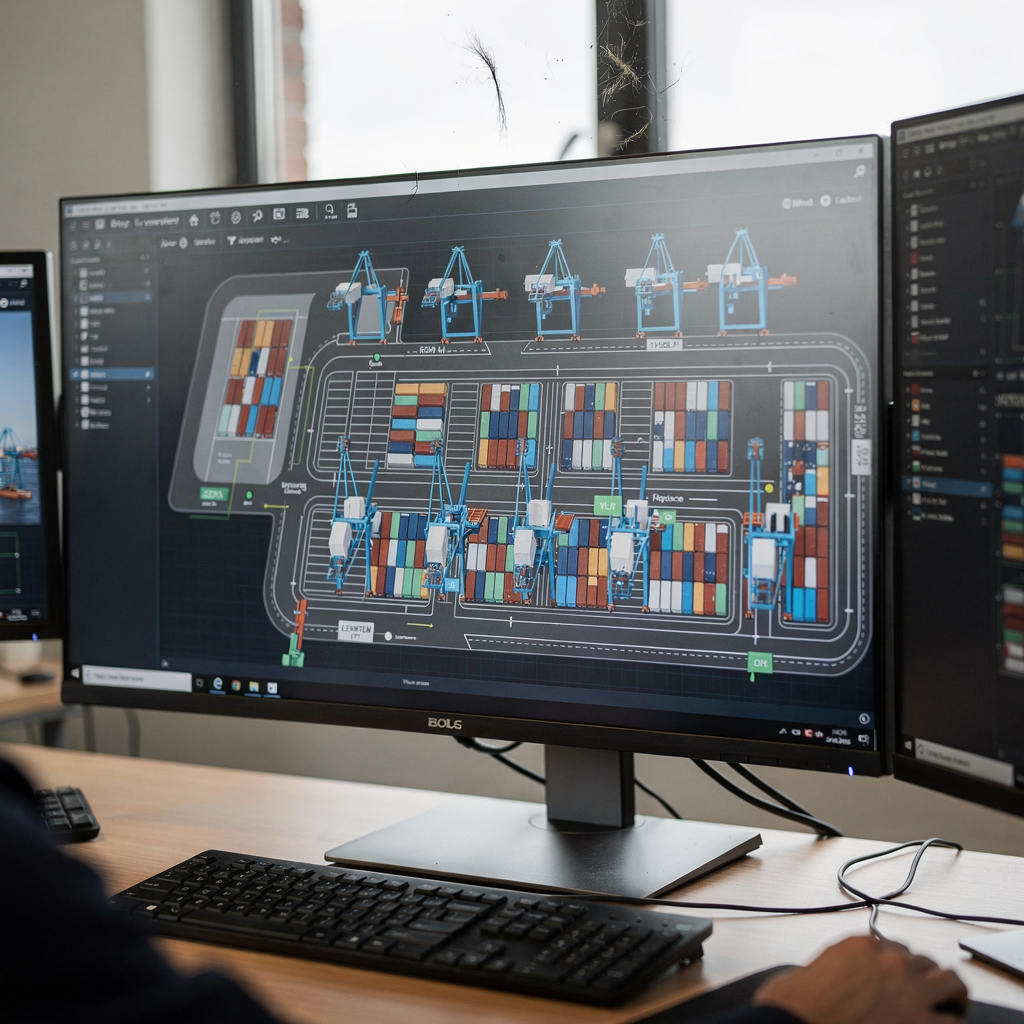
Port and terminal operations combine many interacting parts. Berths host vessels while quay cranes load and unload containers. Yard blocks store boxes and trucks move containers to and from gates. Each element creates constraints that limit throughput. Resource allocation becomes a multi-objective trade-off where quay productivity and yard congestion compete. Terminal operators must prioritize either faster quay cycles or lower yard reshuffles. These trade-offs affect performance level, equipment utilization and customer satisfaction.
Common bottlenecks include limited berth space, uneven crane allocation and congested yard aisles. For example, high berth utilization can raise waiting time for arriving vessels. Conversely, low berth utilization wastes quay capacity. A well-designed simulation run reveals how changing crane counts, shifting gate hours or reconfiguring the terminal layout changes expected throughput and berth utilization. Scenario analysis can show that adding one crane might cut vessel turnaround by a measurable margin, while also increasing yard reshuffles.
Consider resource allocation across multiple blocks and cranes. You will notice that equipment utilization and service level respond to scheduling rules. Planners must set priorities for transshipment versus import/export flows. A model that captures container loading and discharging logic helps to evaluate the impact of different dispatch rules. Additionally, model results support decisions regarding port expansion and investment in automation, such as automated guided vehicles or RTGs. To read about balancing quay productivity and yard quality, see a focused study on the trade-offs between crane productivity and yard quality (link).
Operational changes often surface during peak demand. A container terminal that handles a varied vessel mix must adapt quickly. Simulation helps test peak scenarios and the effect of bringing additional cranes or hiring extra staff. With clear metrics for service time, waiting time and equipment utilization, you can prioritize changes. Supply chain partners notice the difference when the terminal reduces delays and evens out workload across shifts. Finally, use sensitivity analysis to identify the limits of each solution and to avoid interventions that shift the bottleneck from quay to yard.
Drowning in a full terminal with replans, exceptions and last-minute changes?
Discover what AI-driven planning can do for your terminal
Simulation Model for Port Capacity and Throughput Analysis
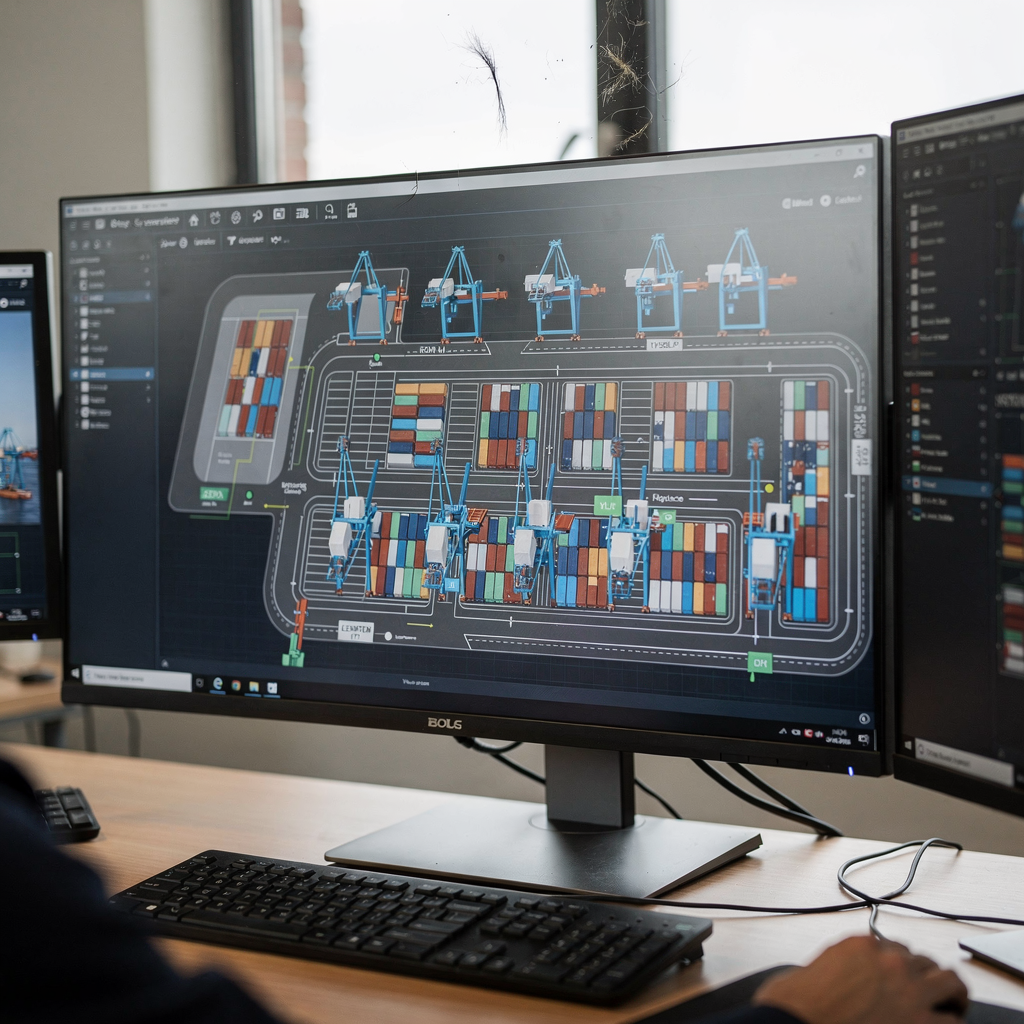
This chapter presents a structured simulation model to assess terminal capacity in TEU/day. Start by mapping quay segments, berth positions and yard blocks into model modules. Each vessel arrival triggers a job set that assigns crane tasks. Crane cycles depend on container type and stowage plans. Trucks arrive with stochastic interarrival times and feed gate processing. Model inputs include turn times, crane productivity and handling systems efficiency. Outputs show throughput, berth occupancy and quay idle time. Use throughput capacity measures to compare layouts or equipment levels.
Define throughput metrics clearly. Track TEU moved per day, moves per crane-hour and average vessel turnaround times. Link these KPIs to berth occupancy and crane productivity so stakeholders see where gains originate. For instance, simulation results can show that a 10% increase in crane productivity yields a 7% rise in TEU/day due to yard constraints. You should also measure berth utilization and equipment utilization rates to avoid solutions that overload adjacent systems. Simulation lets you evaluate the impact of terminal layout changes, such as shifting a yard block closer to the quay to reduce travel times.
What-if runs help quantify capacity under alternative scenarios. Run a baseline plus at least three alternatives: add cranes, change the terminal layout, and alter gate schedules. Measure expected throughput and port efficiency across all runs. Use Monte Carlo repetitions to capture variability. A well-calibrated simulation model will reproduce historical weekly TEU and quay cycles. In practice, research shows simulation can “associate a capacity value to a given resource configuration and/or indicate which resource configurations are optimal to given expected throughputs” (study).
Include terminal capacity constraints like maximum capacity of stacks and maximum number of trucks handled per hour. Model the intermodal moves to represent barge calls and feeder traffic. When you simulate transshipment flows, you can see how short-distance transfers affect system performance. For port authorities and terminal operators, these numbers inform port capacity and capacity planning decisions. If you want to connect port simulation results to yard routing or truck scheduling optimization, see resources on yard truck routing optimization (link).
Optimize Terminal Performance with Simulation-based Optimization
Set clear optimization goals before integrating search methods with the simulation. Typical objectives include reduced vessel turnaround, lower crane idle time and fewer rehandles. Define constraint sets like maximum crane count or limited yard reshuffles. Next, pick an optimizer that works with stochastic outputs. Genetic algorithms and particle swarm methods are common because they can handle non-linear trade-offs and multiple objectives. Use a repeated simulation loop so the optimizer evaluates candidate solutions under variability.
Simulation optimization helps you discover configurations that human planners may miss. For example, an optimize-and-test loop can trade two cranes and one yard reshuffle to produce a net gain in throughput. This is especially useful where manual rules fail under new vessel mixes. Loadmaster.ai uses reinforcement learning agents trained in a digital twin to search policy spaces and to balance quay productivity against yard quality. The agents learn by simulating millions of decisions and then deploy with operational guardrails. That approach avoids reliance on historical data and enables a cold-start ready optimization process.
Choose optimization metrics that matter. Combine moves per hour, number of rehandles, average waiting time and energy consumption depending on the project. A multi-objective approach can produce a Pareto front so decision makers see trade-offs. Run sensitivity checks to understand if optimized solutions remain robust under peak demand or equipment failure. Practically, simulation optimization reduces human trial-and-error, shortens project timelines and supports economic studies on expansion. For more on balancing stowage quality and crane productivity, consult the internal article on balancing-stowage-quality-and-crane-productivity-in-terminal-operations (link).
Drowning in a full terminal with replans, exceptions and last-minute changes?
Discover what AI-driven planning can do for your terminal
Case Study: Digital Twin Simulation for Port Operations
In a recent case study, a port implemented a digital twin that combined live telemetry with DES to test operational policies in near real time. The digital twin mirrored quay sensors, gate cameras and TOS statuses. Planners used it to simulate alternative quay allocations and to evaluate repair scenarios. One finding showed improved throughput after adjusting crane rotation rules. Researchers also explain that “Due to the stochastic nature of the cargo handling process, the Discrete Event Simulation (DES) is one of the most commonly used methods” (paper).
Results included measurable gains. The project reported reductions in vessel waiting time and faster quay cycles after validating AI-derived policies in the twin. The terminal increased its maximum capacity in practical terms by improving equipment utilization and cutting unnecessary shuttles. The digital twin also helped evaluate electrification investments with simulation-based scenarios that measured carbon impacts along with throughput, as described in related IEEE work (IEEE).
Key lessons emerged. First, ensure high-quality telemetry feeds so the twin reflects current conditions. Second, include human-in-the-loop testing so operators accept AI suggestions. Third, avoid overfitting the twin to a single week of history. Loadmaster.ai’s approach trains RL agents inside the twin and then refines them online. This method minimized rehandles and stabilized performance across shifts in live pilots. Common pitfalls are overly complex models that slow experiments and missing boundary conditions that hide failure modes. Address these early in the design with clear performance indicators and stress tests.
Best Practices for Simulation-based Port Capacity Optimization
Design experiments that match the questions you need to answer. Use baseline, stress and recovery scenarios. Run enough Monte Carlo iterations to stabilise outcome distributions. For sensitivity analysis, vary one parameter at a time and then test pairs of changes to detect interaction effects. Document assumptions and include the expected throughput and berth utilization metrics on every report. This clarity helps stakeholders make informed decisions and justify investments.
Link simulation findings to strategic expansion plans by translating TEU/day gains into revenue and cost figures. Use economic studies to show payback periods for adding cranes or reworking the terminal layout. When possible, map simulation outputs to contract KPIs and to service level commitments to carriers. Keep the model modular to support early in the design changes and to evaluate alternative terminal designs without rebuilding the entire system.
Adopt automation and multi-agent strategies judiciously. Automated guided vehicles and advanced routing reduce travel time, but they also require different yard layouts. Test automation in the digital twin before committing capital. Also, use simulation optimization to optimize scheduling policies and to evaluate whether new equipment reduces the time ratio between quay and yard activities. For help embedding operational safety rules into AI decision models, consult an internal resource on embedding-operational-safety-rules-into-ai-decision-models-for-port-operations (link).
Emerging trends include AI-driven models, greener operations and next-generation digital twins that merge physics-based models with learned policies. Use simulation to evaluate electrification, carbon objectives and maximum capacity under sustainability constraints. By combining mathematical modeling with model-free learning, you can both evaluate system performance and search for superior policies. Finally, involve terminal operators early so recommended changes are executable and governed by clear KPIs. This step reduces resistance and speeds adoption of better practices.
FAQ
What is discrete-event simulation and why is it used for port planning?
Discrete-event simulation models the system as a sequence of events that change state at discrete points in time. Planners use it to capture stochastic arrivals, equipment cycles and queuing so they can test scenarios without disrupting live operations.
How does a digital twin differ from a traditional simulation?
A digital twin couples live telemetry to a simulation model so you can run near-real-time experiments. It supports rapid testing of operational changes and helps refine AI agents before deployment.
Can simulation accurately predict TEU/day for a terminal?
Yes, a calibrated simulation model can reproduce historical TEU/day and forecast alternative layouts. Accuracy depends on data quality and proper validation against recorded quay cycles and gate logs.
What optimization methods integrate well with simulation?
Genetic algorithms and other evolutionary methods work well when objectives are non-linear and noisy. Reinforcement learning also integrates with simulation for multi-objective policy search.
How should operators validate a simulation model?
Compare simulated KPIs with historical performance across several weeks or months. Use statistical tests and visual checks for quay productivity, waiting time and berth utilization to confirm the model’s fidelity.
What common bottlenecks do simulation studies reveal?
Typical bottlenecks include limited berth slots, uneven crane allocation and yard congestion. Simulation highlights how changes shift bottlenecks between quay and yard so decision makers can act accordingly.
How can simulation support sustainability goals?
Simulation helps evaluate electrification, energy use and emissions under different operational strategies. It can combine throughput objectives with carbon metrics to inform investment choices.
Do I need historical data to benefit from simulation or AI?
You need some data for calibration, but advanced approaches can train policies in a digital twin without extensive historical records. That allows projects to start even when data are incomplete.
What role do terminal operators play during simulation projects?
Operators provide rules, constraints and operational context so models remain realistic and executable. Their involvement ensures that recommended policies match real-world practices and governance needs.
How long does it take to deliver insights from a simulation study?
Project timelines vary. A focused study may deliver initial results in weeks, while a full digital twin and optimization rollout can take months. The timeline depends on data availability and the scope of scenarios.
our products
 stowAI
 stackAI
 jobAI
jobAI
Innovates vessel planning. Faster rotation time of ships, increased flexibility towards shipping lines and customers.
Build the stack in the most efficient way. Increase moves per hour by reducing shifters and increase crane efficiency.
Get the most out of your equipment. Increase moves per hour by minimising waste and delays.
stowAI
Innovates vessel planning. Faster rotation time of ships, increased flexibility towards shipping lines and customers.
stackAI
Build the stack in the most efficient way. Increase moves per hour by reducing shifters and increase crane efficiency.
jobAI
Get the most out of your equipment. Increase moves per hour by minimising waste and delays.