
Container terminal
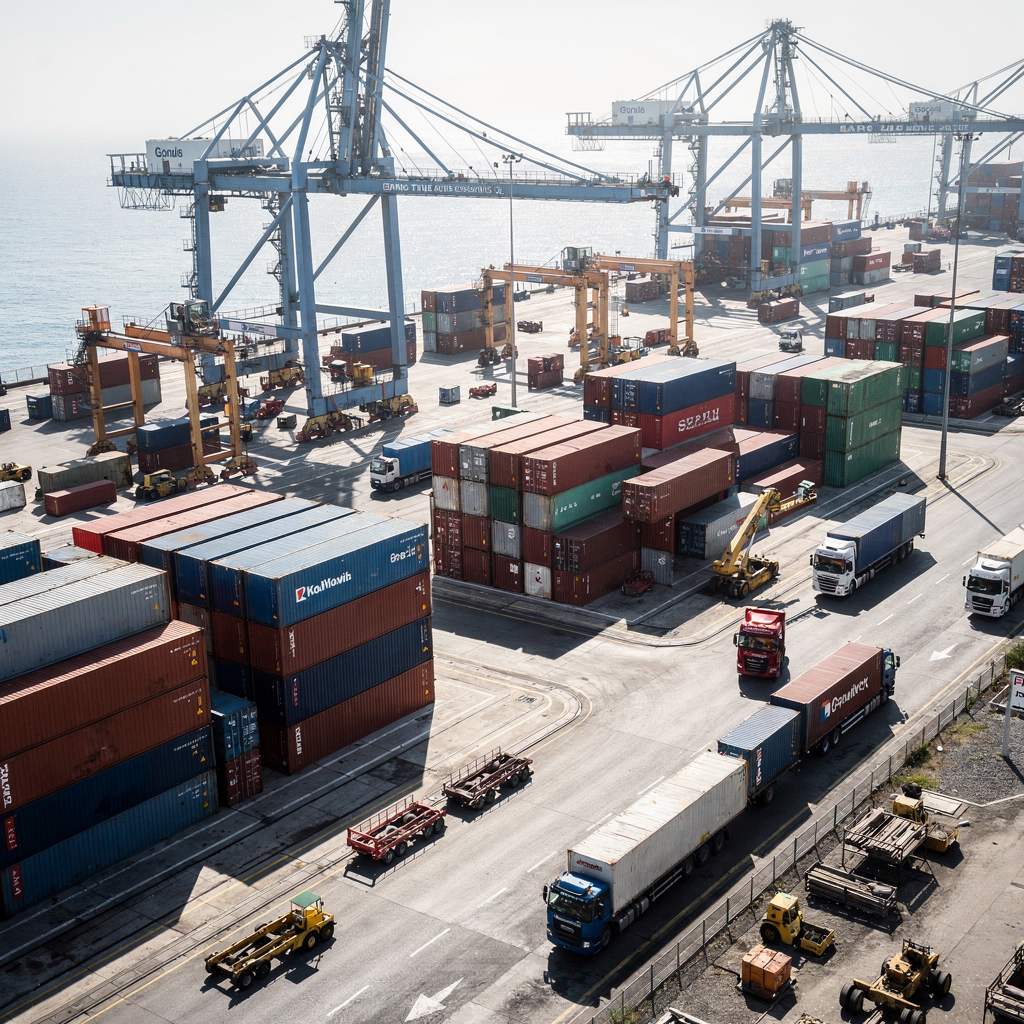
A container terminal is the hub where containers move between ships, trucks, and rail, and where planners must balance speed, safety, and cost. Container terminal facilities shape global trade flows, and they connect liner shipping networks with inland logistics. For example, a busy container terminal handles thousands of TEU moves per day and must coordinate quay operations with yard stacking and gate handling. First, terminals track core metrics such as berth utilization, crane productivity, and container dwell time to measure performance. Second, they adjust layout and sequence to improve throughput and reduce idle equipment.
Automated container terminals now use robotics and software to raise crane productivity and reduce human error. Yet yards still depend on good layout and real-time telemetry. A well-designed yard reduces unnecessary driving distances for straddles and RTGs, and it lowers rehandling operations. In practice, planning for container yards must balance short-term moves at the quay and medium-term balancing of the entire container yard. For terminals that adopt smart systems, the impact shows in higher moves per hour and steadier berth occupancy rates.
Real-time data streams from quay cranes and yard sensors matter. They feed AI and optimization modules that refine schedules and sequences. For deeper reading on TOS-driven vessel turnaround gains see our article on the role of TOS optimization in reducing vessel turnaround time (role of TOS optimization). Also, planners who want to reduce yard congestion can review approaches in our piece on reducing yard congestion with AI (reducing yard congestion).
Operationally, the terminal must measure and react. Therefore, KPIs such as quay crane idle time and average truck turnaround guide daily choices. For a practical guide to AGV and equipment scheduling see our work on optimizing AGV charging schedules (AGV charging schedules). In short, a container terminal that pairs layout, telemetry, and adaptive planning can raise throughput, reduce dwell, and improve predictability.
Algorithm
An algorithm for stowage planning assigns containers to ship slots and yard locations to meet many goals. The purpose of these routines is to optimize loading and unloading, to maintain ship stability, and to minimize rehandle and travel. Planners use heuristic methods when they need fast, practical answers. They prefer heuristic rules because those rules produce executable plans within minutes. At the same time, exact methods such as integer programming can deliver strong guarantees, but they suffer from scale limits when the number of container and stops grows.
Heuristic approaches include greedy heuristics, simulated annealing, and greedy randomized adaptive search procedure. They often pair with compact solution encoding to keep search space manageable. For small multi-stop cases, enumeration yields excellent sequences, but as Oracle explains, “the enumeration algorithm works well for shipments with a small number of stops (3 or 4) … but scalability issues arise” (Oracle – enumeration and multi-stop limits). Therefore, planners mix heuristic algorithm choices with local search to scale.
Key constraints shape every decision. Size and container weight determine stackability and deck placement. Port rotation and discharge priorities limit where a box can sit. Stability constraints decide how heavy loads must distribute across ballast and trim. In addition, dangerous goods rules and reefer power needs insert operational constraints. An effective planning algorithm must encode each constraint and enforce them in real time.
Designers also consider rehandling operations in the yard, the allocation problem of quay to cranes, and the ship stowage planning that affects truck pickup timing. For those who want a technical primer on automation and stowage planning software, see our automated port operations stowage planning software overview (stowage planning software). In practice, the right algorithm blends speed, constraint handling, and robustness so teams can solve the problem on an operational cadence.
Drowning in a full terminal with replans, exceptions and last-minute changes?
Discover what AI-driven planning can do for your terminal
Genetic algorithm
A genetic algorithm models stowage plan search like biological evolution. It creates a population of candidate plans, evaluates each plan’s fitness, then applies crossover and mutation to create new candidates. Fitness measures include crane productivity, minimized rehandling operations, and balanced yard workload. As a result, genetic algorithm based solutions explore diverse options and often escape local minima that trap greedy heuristics. They work well for combinatorial spaces like the container ship stowage problem because they can search large, complex solution spaces in parallel.
Genetic algorithm formulations support multi-objective goals. Designers encode trade-offs so the algorithm optimizes for moves per hour and for reduced driving distance at once. For example, a GA chromosome can represent master bay assignments and sequence orders, while operators swap sequences between parents to create offspring. Then mutation perturbs a few slots to introduce new patterns. The process iterates until it yields near-optimal stowage results that planners can validate.
Evidence shows that optimized stowage planning can reduce handling time and speed vessel turnaround. Studies report handling time reductions in the 15–20% range for well-tuned stowage routines (Efficiency and productivity in container terminal operation). Therefore, a genetic algorithm that focuses on crane sequences and yard balance may deliver measurable productivity gains. In contrast, particle swarm optimization and ant colony optimization offer alternative metaheuristics. For specific terminal problems, combining genetic algorithm with local search or hill-climbing often improves final plan quality.
Practically, operators need an optimization algorithm that integrates with TOS and provides executable sequences. Loadmaster.ai uses simulation-trained agents to augment vessel planning and to reduce shifters while keeping plans executable. Our approach shows how learned policies can complement a genetic algorithm by offering rapid scenario evaluation and operational guardrails. Together, GA and reinforcement techniques provide planners with robust, adaptive tools for ship loading and container loading tasks.
Problem in container
The problem in container stowage and allocation grows from many interacting constraints and from dynamic arrivals. Terminals must handle heterogeneous boxes, balance weight distribution, and respect port rotation. In addition, unpredictable truck and rail arrivals change yard density and force replanning. For that reason, the container ship stowage problem becomes a moving target. The number of container moves and the distribution of discharge ports create exponential complexity for exact methods.
Researchers describe the core planning issue succinctly: “the most common planning issue in freight logistics is probably the container shipment assignment and routing in the intermodal transport network” (MDPI – Container Shipping Supply Chain). That statement explains why container terminals struggle with multi-stop problems and with scalability. For multi-port container stowage, small stop counts allow enumeration and near-optimal sequences, but once stops increase, performance drops and planners must trade optimal stowage for feasible, fast solutions.
Quantitative bottlenecks appear in metrics like dwell time and berth occupancy. Studies show that a small reduction in rehandling operations can cut average truck wait by minutes and improve crane throughput by a measurable percentage. In practice, terminals face frequent rehandles in the yard and container rehandle in yard drives extra moves, which in turn raises operational cost. Also, the allocation problem of assigning quay slots and stacking positions forces planners to juggle conflicting goals every hour.
To solve the problem, teams need fast predictive models, but those models must be reliable. As one whitepaper notes, “models used need to be not only fast, but also reliable, in terms of predictive value” (robotized maritime design). For terminals that lack clean historical data, simulation-first approaches let planners generate realistic experience and test policies. Loadmaster.ai’s closed-loop agents train in a digital twin to produce robust decisions without heavy reliance on past data. In short, the container must be placed with foresight and with tools that adapt to changing demand and vessel mixes.
Drowning in a full terminal with replans, exceptions and last-minute changes?
Discover what AI-driven planning can do for your terminal
Scheduling problem
The scheduling problem in terminals covers berth allocation, crane assignment, and yard stacking. Berth planners decide which ships occupy which berth segments and when. Crane controllers assign quay cranes to bay ranges and to precise move sequences. Yard planners determine where to stack inbound and outbound boxes to reduce future rehandles and to support gate flows. Each decision affects others, and so schedulers must coordinate across domains.
For example, a late arriving ship compresses quay windows and cascades delays into yard work and truck schedules. Therefore, scheduling systems must be resilient. They must plan for contingencies and quickly propose alternative allocations. Scheduling problem solvers often embed heuristic rules and local search to adapt in minutes. They also combine mathematical optimization model elements like integer programming for assignment subproblems, and then apply heuristics to tune sequences for execution speed.
Coordination between arriving ships, trucks and rail services amplifies the challenge. Planners must sequence loading and unloading to match rail departures, and they must align truck appointments with gate windows. Scheduling algorithms help match limited berth space with arriving ships and trucks, says one source, and that matching reduces congestion and wait times (scheduling and berth space). Thus, smoother terminal flow depends on integrated schedules that respect crane productivity and yard capacity.
Performance metrics quantify gains. Better schedules reduce ship waiting hours and increase crane moves per hour. They also cut average container dwell time at the yard. For deeper practical methods, consider traffic management and multi-lane crane coordination; our guides on traffic management in terminal operations and on multi-lane STS scheduling explain the trade-offs and algorithms that support execution (traffic management) and (multi-lane operations). Ultimately, the best schedules tie berth assignments to yard density and to gate load so the whole terminal runs more predictably.
Scheduling problems in container terminals
Scheduling problems in container terminals now attract AI and machine learning solutions. Modern Terminal Operating Systems (TOS) add modules that predict truck arrivals and that recommend moves based on live telemetry. In addition, simulation and digital twins let teams test recovery actions and evaluate resilience during disruptions. A decision support system can use simulation optimization to identify robust plans, as research on resilient ports shows (DSS for resilient port).
AI-driven models provide better input to traditional planners. A whitepaper explains that “important input variables for planning and optimizing port and terminal operations are used to provide traditional planning algorithms with better input data” (Whitepaper – Machine Learning in Maritime Logistics). Therefore, combining learned predictors with optimization yields faster, more accurate schedules. However, models must generalize and remain interpretable so operators can trust recommendations.
Loadmaster.ai builds on those ideas by using reinforcement learning agents that train in a digital twin and then run with operational guardrails. Our StowAI, StackAI, and JobAI agents coordinate quay, yard, and gate to minimize rehandles and to protect future plans. They reduce dependency on historical data by generating experience in simulated operations; this lets terminals cold-start while maintaining safety and governance. For more technical resources on decentralized coordination, see our article on decentralized AI agents coordinating quay, yard, and gate (decentralized AI agents).
Future challenges include real-time decision making, model reliability, and scaling to growing throughput. Decision systems must solve the optimization problem within the seconds available during operations, and they must incorporate constraints like reefer power, master bay grouping, and hazardous cargo segregation. Methods such as ant colony optimization, particle swarm optimization, and genetic algorithm based hybrid schemes remain relevant. In addition, techniques like the grasp algorithm for the container and greedy randomized adaptive search procedure can help solve subproblems like the blocks relocation problem. Going forward, terminals that combine AI with strong operations research and with explainable models will achieve optimal stowage and resilient port operations.
FAQ
What is a container terminal and why does it matter?
A container terminal is a facility where cargo containers transfer between ships, trucks, and rail. It matters because efficient terminals reduce shipping costs, cut transit times, and improve supply chain reliability.
What does a stowage plan do?
A stowage plan assigns each container to a slot on the ship and often to a yard location before loading. The plan balances stability, discharge order, and handling effort to minimize rehandles and speed port calls.
How does a genetic algorithm improve stowage planning?
A genetic algorithm searches many candidate plans in parallel and evolves better solutions through crossover and mutation. It helps when planners face multi-objective trade-offs and complex constraints that stump greedy heuristics.
What are common constraints in stowage planning?
Constraints include container size and container weight, port rotation, dangerous goods segregation, reefers’ power requirements, and ship stability. Planners must encode these constraints so plans remain safe and executable.
Can AI replace human planners?
AI can augment planners by offering fast scenario evaluation and by proposing robust sequences, but humans remain essential for governance and for decisions that require domain judgment. Systems that combine AI and human oversight perform best in real operations.
What is the difference between heuristic and exact methods?
Heuristic methods generate good plans quickly without optimality guarantees, while exact methods like integer programming aim for provably optimal solutions but can fail to scale. Terminals often use heuristics for fast execution and exact methods for small, critical subproblems.
How do scheduling problems affect terminal throughput?
Poor scheduling causes idle cranes, truck queues, and berth congestion, which slow moves per hour and raise costs. Better schedules align berth allocations, quay crane assignments, and yard stacking to smooth flows and reduce wait times.
What is a digital twin and how does it help?
A digital twin is a simulated mirror of a terminal that replicates layout, equipment, and demand patterns. It helps by letting operators train AI agents, test recovery plans, and stress-test schedules without disrupting live operations.
How do terminals measure success from optimization?
Terminals use metrics like berth utilization, crane productivity, and container dwell time to measure success. They also track rehandles, driving distances, and equipment utilization to verify improvements.
Where can I learn more about integrating AI into terminal operations?
Start with technical resources and case studies that cover TOS integration, decentralized agents, and yard optimization. For practical guides, see Loadmaster.ai’s articles on decentralized AI agents and yard optimization for terminal planners (decentralized AI agents), and on terminal operations yard optimization (yard optimization).
our products
 stowAI
 stackAI
 jobAI
jobAI
Innovates vessel planning. Faster rotation time of ships, increased flexibility towards shipping lines and customers.
Build the stack in the most efficient way. Increase moves per hour by reducing shifters and increase crane efficiency.
Get the most out of your equipment. Increase moves per hour by minimising waste and delays.
stowAI
Innovates vessel planning. Faster rotation time of ships, increased flexibility towards shipping lines and customers.
stackAI
Build the stack in the most efficient way. Increase moves per hour by reducing shifters and increase crane efficiency.
jobAI
Get the most out of your equipment. Increase moves per hour by minimising waste and delays.