
Terminal operating system for container terminal operations
A Terminal Operating System (TOS) coordinates the flow of containers across quay, yard, and gate. First, it supports vessel planning, yard management, and gate control. Next, it gives terminal managers a central view of equipment and labour. For example, a vessel planner can sequence calls, an operations manager can set stacking rules, and a gate supervisor can validate paperwork in one platform. In addition, the terminal operating system links with hinterland systems and shipping lines to reduce dwell time and improve throughput.
The TOS consumes container data from multiple sources. These include berth schedules, shipping line manifests, container yard sensors, and truck arrival notices. Consequently, it feeds a digital twin that mirrors live yard operations and equipment states. The digital twin then helps planners run simulation studies and forecasting without interrupting real-world moves. In fact, this pattern supports scenario testing for expansion and equipment changes. For example, one study shows that simulation-based planning can reduce handling times by up to 20% and raise berth productivity by up to 12% (design approach for robotized maritime container terminals).
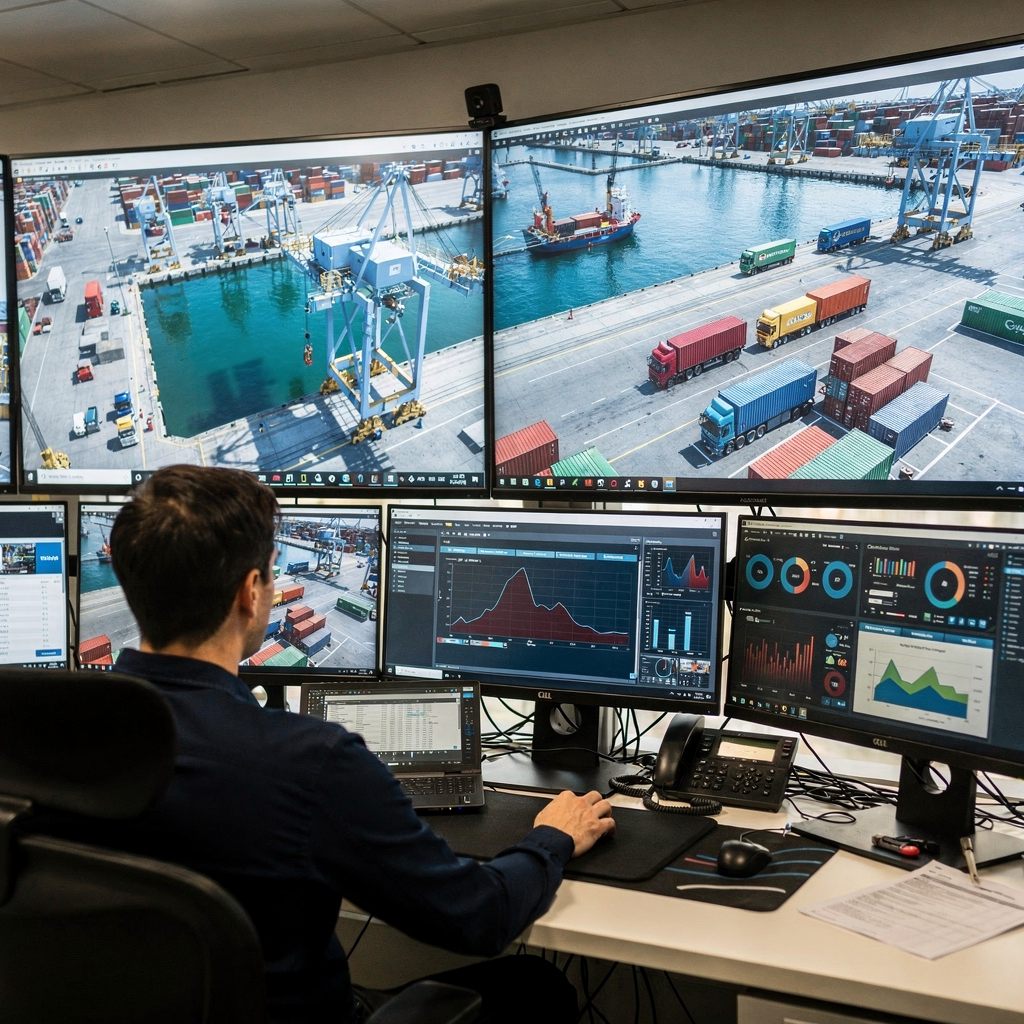
Real-time monitoring in the TOS tracks quay cranes, yard cranes, terminal tractors, and other handling equipment. Therefore, terminal managers see idle time, equipment location, and job queues on a live dashboard. In addition, the TOS can alert dispatchers when a bottleneck forms or when a crane needs maintenance. Consequently, planners make faster choices and improve resource allocation. Large container ports use TOS platforms to coordinate multi-vessel peaks and intermodal handoffs, and many terminals are extending these systems to include energy and emissions metrics (digital twin for resilience and sustainability assessment). Finally, case examples from major cargo ports show that TOS deployment paired with analytical tools helps terminal operators reduce vessel delays and improve service level.
Integrate discrete event simulation model with tos to optimize port
Discrete event methods capture the stochastic nature of container handling. In practice, a discrete event simulation model represents quay cranes and yard operations as a sequence of events. Therefore, it models queueing, resource contention, and random arrival patterns. This makes it ideal for terminals where variability drives bottlenecks. For instance, a simulation model developed for high-frequency services demonstrated measurable berth gains and better equipment allocation (performance analysis for a maritime port).
Technically, the link between TOS data feeds and the simulation engine relies on APIs or EDI. First, the TOS exports vessel schedules, container locations, and telemetry. Then, the simulation engine ingests those feeds and runs scenario batches. Also, some implementations use message queues to push real-time events into the simulator so that planners can run what-if scenarios on live data. This integrated setup enables using simulation to test dispatch rules, crane schedules, and yard placements before changes go live. In addition, integrated simulation supports decision loops: the TOS triggers a rerun when gate or vessel forecasts change, and the simulation returns recommended allocations.
Quantified benefits are compelling. Studies report up to 15–20% reductions in handling times and 10–12% berth productivity gains when simulation guides schedule and dispatch decisions (robotized terminal design). Consequently, vessel turnaround shortens and costs fall. To run a typical workflow, first import TOS snapshots, then define scenarios for arrivals and equipment faults, next run the discrete event model at different seeds, and finally push the selected plan back to the TOS for execution. For concrete guidance on modeling approaches and tools, explore our resource on discrete event simulation for container terminals.
Drowning in a full terminal with replans, exceptions and last-minute changes?
Discover what AI-driven planning can do for your terminal
Simulation model applications in maritime container terminal to automate supply chain
Simulation models serve many use cases across terminal management. First, they inform operational planning by testing crane sequences and gate staffing. Second, they support capacity analysis for yard layouts and rail facility changes. Third, they offer training environments for dispatchers and planners. For example, digital twins allow staff to rehearse peak-day scenarios without risking vessel delays. In addition, simulation tools provide decision support when shipping lines change arrival patterns or when truck flows spike.
Simulation aids resilience testing under disruptions. For instance, terminals can model weather impacts or labour strikes and evaluate contingency plans. Then, they can measure expected vessel delays and yard congestion, and subsequently adjust berth allocation policies. Also, simulation provides energy and emissions forecasts through the digital twin, which helps quantify the benefits of electrifying handling equipment (digital twin resilience and sustainability). As a result, terminals can plan green investments while controlling service level impacts.
Automation trials in ports use simulation to validate systems before deployment. For example, trials for driverless vehicles and remote quay operations often rely on a simulated terminal to test AGV routing and QC sequences. Furthermore, simulation supports fully automated supply chains by modeling handoffs between the quay, the container yard, and intermodal links like rail and road. For readers who want practical tools, our site provides a guide to container terminal simulation software and also highlights how a terminal can progress from pilot to production while keeping operational guardrails in place. Finally, platforms such as Arena and AnyLogic are commonly used; in some projects teams seek AnyLogic support for hybrid modeling and customization.
Model terminal operation with discrete event for automated container terminal efficiency
Terminal operation breaks down into quay, transfer, and stacking processes. Quay cranes perform loading and unloading, straddle carriers or RTGs move boxes, and yard systems stack containers. Each element creates dependencies and queues. A discrete event model captures those interactions by representing moves as events that consume resources. This view reveals where contention builds and where dispatch rules fail. Consequently, terminals use model outputs to tune crane cycles and reduce rehandles.
Discrete event simulation represents crane service times, travel distances, and handling delays. Then, it evaluates routing for AGVs and the sequencing for quay crane operations. For example, a model can test alternate crane assignments to reduce cranes’ idle time or to rebalance jobs across shifts. This leads to quantifiable gains: simulation-backed tuning often yields 8–10% higher equipment utilization and fewer unnecessary shifters. In practice, Loadmaster.ai uses a digital twin and reinforcement learning agents to train policies in simulation so that real operations see fewer rehandles and shorter driving distances. The RL agents learn from millions of simulated decisions and then run with operational guardrails to protect service level.
For an automated terminal, the model guides AGV routing logic and crane scheduling. First, it tests safety buffers and traffic rules, then it measures cycle time and idle time. In addition, the simulation model helps terminal managers decide on resource allocation for peak windows and transshipment events. This analytical approach reduces vessel delays and improves throughput. If you want detailed steps to model quay cranes and yard interactions, read our analysis on terminal digital twin software, which includes examples and system requirements.
Drowning in a full terminal with replans, exceptions and last-minute changes?
Discover what AI-driven planning can do for your terminal
Data-driven optimization of container terminal operations: integrate simulation with terminal operating
Key performance indicators define success. Typical KPIs include throughput, dwell time, and yard density. Also, equipment utilization and vessel delays matter. To improve them, terminals collect telemetry, gate timestamps, and container location data. Then, they feed those inputs into optimization algorithms and simulation tools. As a result, planners test alternative stack policies and crane dispatch rules before implementation. This reduces operational risk and speeds decision cycles.
Feedback loops are central to modern terminal management. For instance, a live dashboard can trigger a simulation rerun when gate queues exceed thresholds. Then, simulation provides alternative allocations and the TOS applies the chosen plan. This integrated simulation approach shortens the time between detection and remediation. In addition, it supports business intelligence by storing scenario outcomes and by surfacing trade-offs between quay productivity and yard congestion.
Decision support is where theory meets operations. For example, a “what-if” analysis for a new berth layout compares throughput and idle time across scenarios. One case study shows how simulation provides a robust plan for peak volumes and preserves service level for transshipment calls (performance analysis). For teams that need practical guidance, our resources include a range of tools from layout optimisation to throughput simulation and terminal equipment simulation. Also, when terminals integrate simulation with their TOS they realize both cost savings and steadier performance. To explore simulation-led planning further, consider our guide on terminal layout optimisation simulation.
Future container port: integrate automated container terminal to optimize maritime supply chain
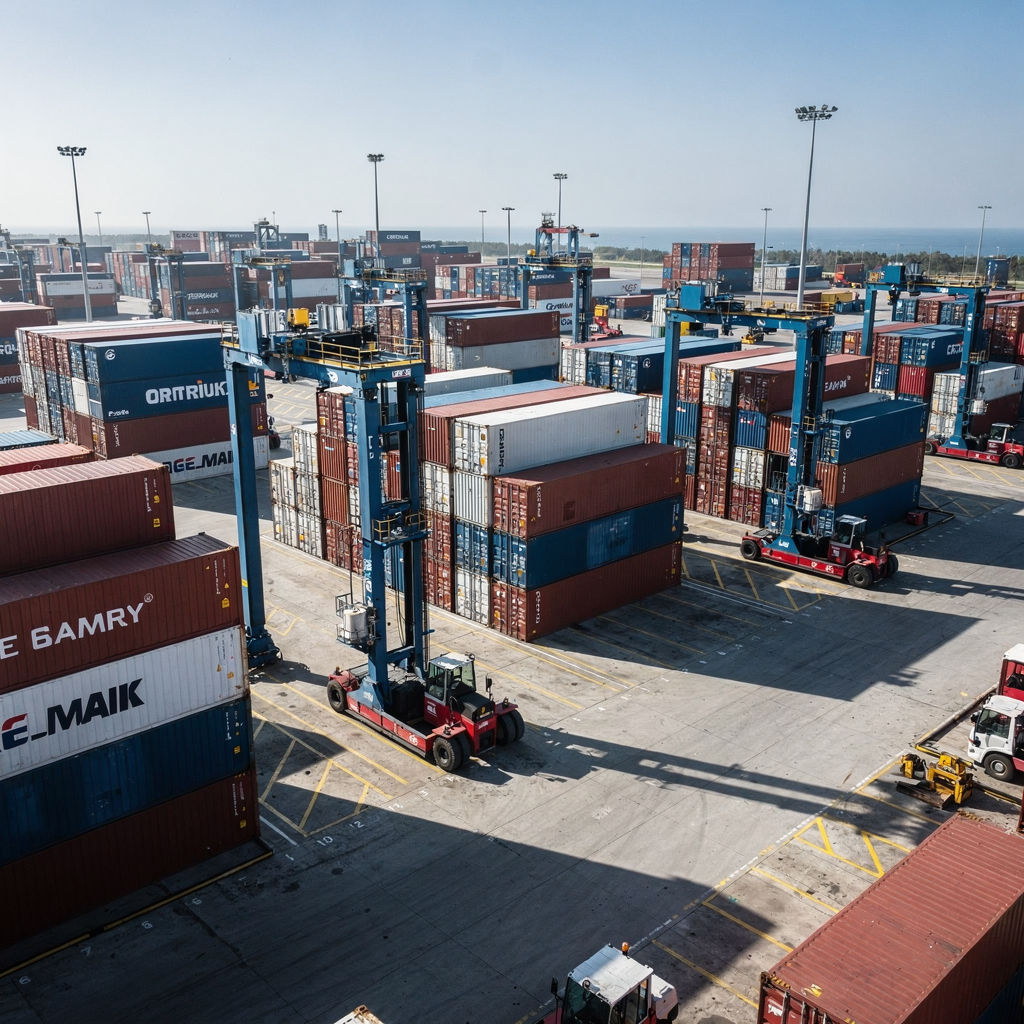
Trends shaping the next generation of ports include electrification, digital twins at scale, and expanded automation. First, electrification reduces emissions and changes energy profiles for handling equipment. Second, digital twins enable continuous experiment and tuning. Third, automation introduces driverless vehicles and remote quay crane operations. As a result, terminal infrastructure evolves to support higher throughput with lower energy use.
The role of automation extends beyond hardware. AI agents help balance competing KPIs between quay productivity and yard congestion. For example, Loadmaster.ai trains RL agents in a sandbox digital twin to produce control policies that adapt in real-time. Then, these agents coordinate stowage, stack placement, and job dispatch to reduce rehandles and driving distance. Consequently, terminals gain consistency across shifts and reduce dependency on individual planners’ tribal knowledge.
Challenges remain. Data standards and cybersecurity need attention, and workforce change management matters. Therefore, terminals must plan for phased rollouts with human oversight. Additionally, interoperability between TOS platforms and equipment telemetry demands clear system requirements. Finally, the forecast impact on the maritime supply chain is significant: faster turnarounds, lower operational cost, and better intermodal handoffs. For terminals that want to pilot an automated yard, consider trialing with a digital twin and simulation-backed policies before full deployment. For reference, see practical examples of an automated container terminal roadmap and related integration steps.
FAQ
What is a Terminal Operating System (TOS) and why is it important?
A Terminal Operating System is software that coordinates vessel planning, yard management, and gate operations. It is important because it centralizes data, improves resource allocation, and enables real-time decision support.
How does discrete event simulation help terminal managers?
Discrete event simulation models events like crane moves and truck arrivals to reveal queueing and contention. It helps managers test schedules, evaluate layouts, and quantify the impact of operational changes without disrupting live operations.
Can simulation reduce vessel turnaround time?
Yes. Studies show that simulation-guided planning can reduce handling times by up to 20% and increase berth productivity by around 10–12% (robotized terminal design). As a result, vessel turnaround time often improves.
What data does a TOS need to run useful simulations?
A TOS should supply vessel schedules, container locations, telemetry from cranes and tractors, gate timestamps, and intermodal arrival forecasts. This data enables accurate digital twin behaviour and credible scenario outputs.
How do simulated policies get deployed in live operations?
First, the simulation tests candidate policies in a sandbox. Next, operators validate the results and set operational guardrails. Finally, the chosen policy is exported to the TOS or to automation controllers for supervised rollout.
Are there standard tools for terminal simulation?
Yes. Popular tools include discrete event engines and commercial platforms such as Arena and AnyLogic. Some projects seek AnyLogic support for hybrid modelling and customization. These tools integrate with TOS feeds for realistic inputs.
What is a digital twin in the terminal context?
A digital twin is a live simulation that mirrors terminal equipment, container flows, and schedules. It enables testing of operational changes, resilience scenarios, and sustainability measures without risking real moves.
How does automation affect terminal staff roles?
Automation shifts staff from repetitive tasks to supervisory and exception handling roles. Therefore, workplaces must invest in change management and training so teams can manage automated systems and focus on higher-value planning.
Can simulation support sustainability goals?
Yes. Simulation estimates energy use and emissions under different equipment mixes and schedules. Consequently, terminals can compare electrification options and forecast environmental benefits before committing to investments (digital twin resilience and sustainability).
How can I learn more about implementing simulation in my terminal?
Start with pilot studies that connect your TOS to a sandboxed digital twin, and run targeted scenarios for high-impact problems. For practical guides, see resources on container terminal simulation and terminal layout optimisation available on our site (container terminal simulation software) and (terminal layout optimisation simulation).
our products
 stowAI
 stackAI
 jobAI
jobAI
Innovates vessel planning. Faster rotation time of ships, increased flexibility towards shipping lines and customers.
Build the stack in the most efficient way. Increase moves per hour by reducing shifters and increase crane efficiency.
Get the most out of your equipment. Increase moves per hour by minimising waste and delays.
stowAI
Innovates vessel planning. Faster rotation time of ships, increased flexibility towards shipping lines and customers.
stackAI
Build the stack in the most efficient way. Increase moves per hour by reducing shifters and increase crane efficiency.
jobAI
Get the most out of your equipment. Increase moves per hour by minimising waste and delays.