
Understanding port operations: synchronising Fleet Management and TOS
Fleet management in a modern port covers scheduling, tracking, and asset optimisation of trucks, cranes and vessels. It focuses on moving cargo efficiently and keeping equipment productive. Planners assign quay tasks, arrange gate flows, and coordinate carriers. They track each crane and truck and they measure moves per hour. The Terminal Operating System is the strategic software that handles berth allocation, yard management, invoicing and throughput planning. The phrase terminal operating system appears here to meet the outline requirement. In practice, planners use the TOS to plan vessel sequences and to set priorities for gate and yard tasks. However, fleet control teams work on the execution layer. They run dispatch, routing, and equipment assignments in short cycles. As a result, silos form between the two layers. These silo issues cause misaligned schedules, under-utilised equipment and higher operational costs. For example, a vessel may receive a berth plan but trucks arrive at the gate without matched crane schedules. This mismatch creates queuing and extra trips. It also increases fuel use and delays the carrier. A connected approach can reduce these inefficiencies and improve throughput and turnaround.
Ports that link strategy and execution benefit from shared data and coordinated commands. When a port integrates real-time telemetry, planners get live status on cranes and trucks. In turn, dispatchers receive priority changes and updated vessel ETAs. This flow reduces rehandles and unnecessary moves. Transition words and short sentences keep communication crisp and actionable. AI plays a role here by translating planning rules into operational heuristics and by suggesting dynamic assignments that adapt to changing conditions. In practice, combining AI with human expertise reduces dependence on unique tribal knowledge. For terminals that want an AI-first approach, a TOS-agnostic plugin can help the port start small and scale. Learn more about TOS-agnostic integrations on our platform documentation for practical examples.
Enabling smart port performance: bridging strategy and execution
A smart port is a data-driven hub that orchestrates assets and workflows across quay, yard and gate. It uses sensors, connectivity and analytics to make faster choices, and to manage peaks. Smart ports combine automation with human oversight. AI augments planners and dispatchers and helps the port decide where to place containers, when to reshuffle stacks and how to sequence cranes. For example, AI can reweight priorities when the gate spikes, and it can protect quay productivity during busy windows. AI optimises for multiple KPIs at once, and it can test many trade-offs in seconds. As a result, ports report notable gains. Research shows synchronized fleet and terminal systems can reduce vessel turnaround by 20–30% (ESCAP) and can raise throughput without adding infrastructure (TOS functions). Furthermore, live-data platforms improve decision-making accuracy by up to 40% (Thetius). These statistics show how AI and connected systems can influence port productivity and cost profiles.
AI appears throughout this chapter because it speeds decision-making and reduces human error. AI also supports predictive scheduling and dynamic berth and equipment assignment. Ports that apply AI can adapt to disruptions, and they can automate repetitive tasks while staff focus on exceptions. Also, AI drives the digital transformation of the port and supply chain. In a smart port, AI models process sensor feeds, traffic data and carrier notices. Then, AI recommends actions or directly automates execution. The result: smoother vessel calls and fewer delays. To explore berth and crane planning techniques that work with AI, read our guide on container terminal berth and crane planning best practices which explains practical steps for integrating AI into berth allocation.
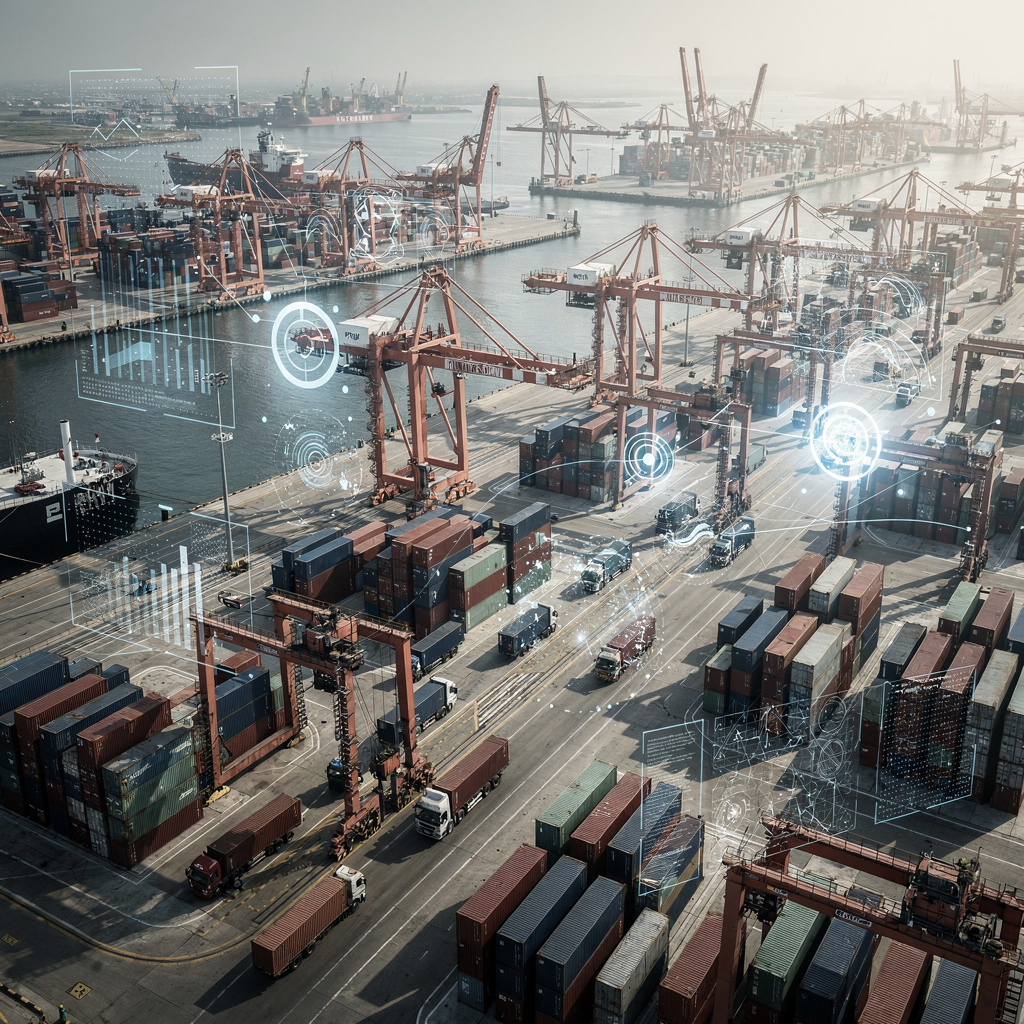
Drowning in a full terminal with replans, exceptions and last-minute changes?
Discover what AI-driven planning can do for your terminal
Leveraging automation for dynamic resource allocation
Automation turns plan signals into machine actions. Middleware such as an Electronic Control System (ECS) translates strategic TOS commands into actionable crane and vehicle tasks and supervises the flow. The ECS sends short work packets to cranes and automated guided vehicles. It also collects status updates and feeds them back to planners. As explained in a smart port architecture note, “ECS works as a bridge between the strategic planning level (TOS) and operational execution,” enabling direct coordination with automated gantry cranes and fleet assets (BetterCrane). That bridge reduces latency and keeps execution aligned with priorities.
Many ports now run automated gantry cranes and automated guided vehicles simultaneously. AGVs and unmanned trucks move containers to stacking areas. Meanwhile, RTGs and straddles run guided jobs with remote dispatch. The port benefits because idle times drop and productivity rises. In fact, synchronized fleet and TOS systems can cut idle times for trucks and cranes by approximately 15–25% (Thetius). AI agents further enhance allocation by learning which moves reduce rehandles and which sequences preserve future options. At Loadmaster.ai we train reinforcement learning agents in a digital twin so the AI policies can handle dynamic vessel mixes, yard states and disruptions. This approach automates execution with guardrails. It also reduces dependency on historical data and ensures the AI can propose novel strategies that improve outcomes.
Automation does not remove human oversight. Instead, it augments staff and shifts focus to exception management. For example, when a crane fails, automated systems can reroute tasks and reschedule trucks. The system also triggers predictive maintenance alerts so teams can act before downtime grows. To read about predictive maintenance applications that work with automation, see our predictive maintenance resource which outlines how sensors and AI keep cranes productive.
Strategies for seamless dataflow: integrating systems and protocols
Seamless dataflow is essential for any port that wants to integrate planning and execution. Key communication links include Port Community Systems, Vessel Traffic Services and ERP interfaces. Port Community Systems act as a shared layer for documents and declarations and they facilitate data exchange across stakeholders. Vessel Traffic Services help with approach coordination and berth timing. ERP interfaces bring commercial and invoicing data into planning. Together, these systems reduce manual handoffs and ensure a common view of operations. For full interoperability, the port needs standard formats, robust APIs and error handling.
Establishing feedback loops matters. Execution layers must stream real-time status back to planning systems. That stream should include crane position, truck locations, job completion confirmations and sensor alarms. Then, planning agents and AI models can recompute sequences and notify dispatchers. Low latency ensures the port reacts to congestion, equipment failure and sudden arrival changes. To minimise latency, ports use edge compute near the quay, resilient networking, and message brokers that prioritise critical signals. In addition, data consistency is enforced with schema validation and reconciliation checks so the port avoids conflicting commands and duplicated moves.
For secure and scalable integration, ports should select middleware that supports interoperability and the degree of automation the operation requires. Open, TOS-agnostic connectors make rollouts less risky. They also facilitate phased deployment and allow an AI to train safely in a sandbox before live use. For practical steps to synchronise ASC gantry travel with job scheduling, review our technical note on synchronizing asc gantry travel with job scheduling in container ports which explains message flows and timing considerations. Finally, include stakeholders early and set governance rules for APIs, data ownership and change control. That approach reduces disruption and speeds adoption.
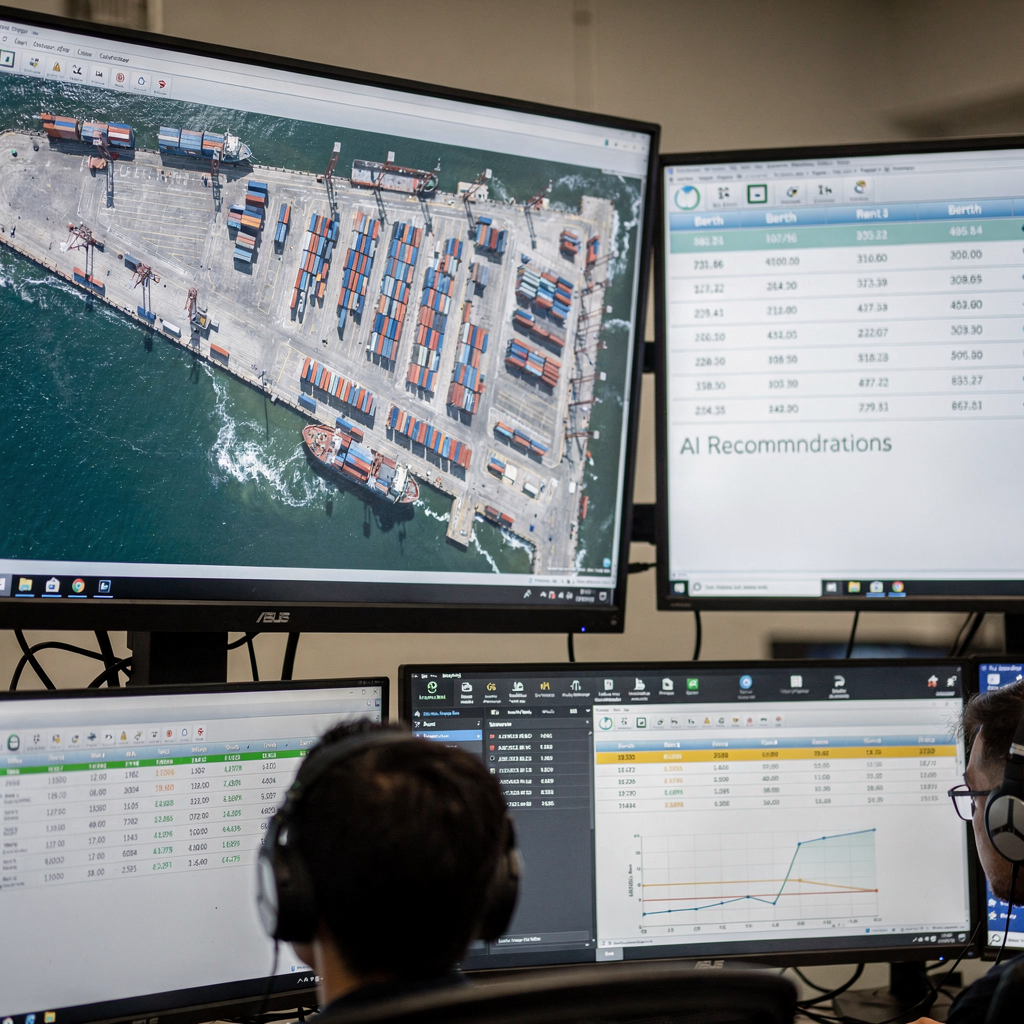
Drowning in a full terminal with replans, exceptions and last-minute changes?
Discover what AI-driven planning can do for your terminal
Deployment of integrated systems: best practices and challenges
Deploying integrated systems in a port requires a phased rollout. First, conduct a requirement analysis to map processes and interfaces. Next, pick middleware and design a proof-of-concept that tests core flows such as berth assignment, crane sequencing and gate dispatch. Run pilots in a contained yard block and measure the impact on moves per hour and turnaround. Then, scale to full implementation. This approach reduces risk and keeps the port operational while the new systems come online. Also, maintain clear KPIs so stakeholders can track progress and justify investment.
Legacy systems pose a common challenge. Older TOS modules, proprietary interfaces and inconsistent data formats make integration harder. Data-format standardisation and API wrappers help to bridge the gap. Cybersecurity is also critical. Ports must protect command channels and telemetry feeds from tampering and they must encrypt sensitive commercial data. Combine network segmentation, identity management and monitoring to secure the environment. Human factors also matter. Change management should include staff training, documented procedures and a remote operations centre that supports new workflows. These measures reduce human error and increase acceptance.
Another deployment tactic is to use simulated training and digital twins so the port can test AI policies without impacting live flows. At Loadmaster.ai we spin up a digital twin and train RL agents that learn robust policies for quay, yard and gate. This method cuts implementation time and decreases the need for historical data. It also produces a safer deployment path because the AI is validated in a sandbox. For more on stacking and yard strategies that pair well with AI, see our analysis of optimizing container stacking for yard operations at container terminals which includes simulation scenarios and KPIs.
Applying analytics to drive efficiency and predictive insights
Analytics and dashboards give operators a single pane of glass for throughput, asset utilisation and key performance indicators. Real-time dashboards show current yard balance, crane productivity and truck wait times. They also surface potential bottlenecks. AI models can run on that data to create predictive alerts and to suggest interventions. For example, predictive maintenance driven by analytics can reduce crane downtime and increase availability. Studies show predictive approaches improve decision-making by using live data and predictive signals to schedule interventions before failures occur (Thetius).
AI and artificial intelligence power many analytics functions. AI detects anomalies, forecasts gate peaks and recommends re-sequencing of moves. The AI can output simple rules or complex policies that a dispatcher follows. When combined with digital twins, AI can test “what-if” scenarios and measure the impact on KPI trade-offs such as quay productivity versus yard congestion. This approach helps the port plan investments and to prioritise upgrades. In addition, real-time data from sensors and IoT feeds improves routing and helps the AI maintain balanced workloads across cranes and straddles. The result is lower fuel use, fewer rehandles, and higher moves per hour.
Finally, data-driven decisions prepare ports for future demands. As cargo volumes and vessel sizes grow, ports need smarter scheduling and robust resource control. Analytics and AI together provide a path to consistent performance and reduced human error. To explore deployment patterns that use AI for berth planning and vessel sequence optimisation, check our guide on ai-assisted vessel planning for shortsea container terminals which shows field-tested approaches and outcomes.
FAQ
What is the difference between Fleet Management and a Terminal Operating System?
Fleet Management handles the scheduling, tracking and asset optimisation of trucks, cranes and vessels at the execution layer. A Terminal Operating System focuses on strategic tasks such as berth allocation, yard management and invoicing. Together they form the planning and execution layers of port operations.
How does AI improve port performance?
AI analyses sensor feeds and operational data to recommend or automate decisions that balance competing KPIs. It speeds decision-making, reduces human error and helps ports adapt to disruptions in real-time.
Can existing TOS platforms be integrated with modern AI agents?
Yes. Many ports use middleware and API wrappers to integrate legacy systems with AI and automation. TOS-agnostic connectors reduce risk and let AI train in a sandbox before live deployment. Our TOS-agnostic software plugins page offers guidance on practical integration options.
What role does predictive maintenance play?
Predictive maintenance uses AI and sensor analytics to forecast equipment failures and to schedule interventions. This reduces downtime and keeps cranes and port equipment productive. See our predictive maintenance resource for implementation steps.
How do AGVs and automated gantry cranes coordinate?
Coordination happens through middleware that converts strategic assignments into executable jobs for AGVs and cranes. The ECS provides tasking, monitors completion and feeds back status to planners. This reduces idle time and unnecessary moves.
What are the main cybersecurity concerns for an automated port?
Ports must secure command channels, telemetry and commercial data. Key measures include network segmentation, identity management, encryption and monitoring to prevent tampering and to protect data integrity.
How quickly can a port see benefits after deployment?
Proof-of-concept pilots can show measurable gains in weeks, especially when they target specific bottlenecks. Full benefits depend on scope and change management, but many ports report reduced turnaround and higher throughput after integration.
Does AI require historical data to work?
Traditional supervised models need historical data, but reinforcement learning and simulation-based AI can train without extensive history. These methods use digital twins to generate experience and to create robust policies before deployment.
How do Port Community Systems fit into integration?
Port Community Systems act as a shared data layer that facilitates communication between carriers, terminals and authorities. They improve document flow and ensure consistent operational inputs for AI and planning systems.
What should port authorities consider before starting a digital transformation?
Port authorities should assess connectivity, governance and stakeholder alignment. They should plan phased deployments, enforce cybersecurity, and prioritise training so the workforce can support new AI-driven workflows.
our products
 stowAI
 stackAI
 jobAI
jobAI
Innovates vessel planning. Faster rotation time of ships, increased flexibility towards shipping lines and customers.
Build the stack in the most efficient way. Increase moves per hour by reducing shifters and increase crane efficiency.
Get the most out of your equipment. Increase moves per hour by minimising waste and delays.
stowAI
Innovates vessel planning. Faster rotation time of ships, increased flexibility towards shipping lines and customers.
stackAI
Build the stack in the most efficient way. Increase moves per hour by reducing shifters and increase crane efficiency.
jobAI
Get the most out of your equipment. Increase moves per hour by minimising waste and delays.