
Transforming PORT OPERATIONS: The Rise of SMART PORT OPERATIONS
First, define the SMART PORT concept. A smart port brings sensors, networks, AI, and automation together to improve throughput, safety, and sustainability. Next, the idea matters because global trade keeps growing and ports must scale to meet that demand. For example, growing container volumes place steady pressure on ports and on hinterland links. Therefore, ports need solutions that automate routine tasks, provide real-time visibility, and proactively manage equipment and flows. In that context, digital transformation is essential.
Smart port solutions help ports optimize flows from vessel berth to hinterland. Also, they enable port authorities and terminal operators to reduce congestion and reduce costs. In many cases, transforming port operations shortens turnaround times, and improves reliability for shipping lines. At the same time, smart technologies link with port infrastructure and terminal automation to support sustainability targets and regulatory goals.
Key drivers push adoption. First, sustainability targets force ports to minimize their environmental impact and to optimize energy use. Second, digitalisation brings new port technology and analytics that provide real-time data and decision support. Third, competitive pressure compels ports to modernize or lose share to more efficient hubs. For instance, one of europe’s busiest ports invests heavily in sensors and network upgrades to stay competitive.
To drive this change, ports must plan investment and governance. Ports must balance initial investment with long-term savings. For some, a port management solution or a terminal operating system is the starting point. For others, modular upgrades such as terminal automation or iot solutions make sense. Loadmaster.ai helps by applying reinforcement learning agents that work with existing systems to automate planning decisions and to boost operational efficiency. Our approach uses a sandbox digital twin, and it trains policies that adapt to changing vessel mixes and yard states. As a result, terminals can automate complex decisions without sacrificing safety or governance.
Finally, the move from a traditional port to a smart port is not only technical. It is organisational. As one expert warns, “The transition to a fully digitalized port environment requires not only technology but also a cultural shift among all stakeholders to embrace new operational paradigms” source. Therefore, ports should combine human training, process automation, and new technologies together.
Port Automation and AI in CONTAINER TERMINAL OPERATIONS
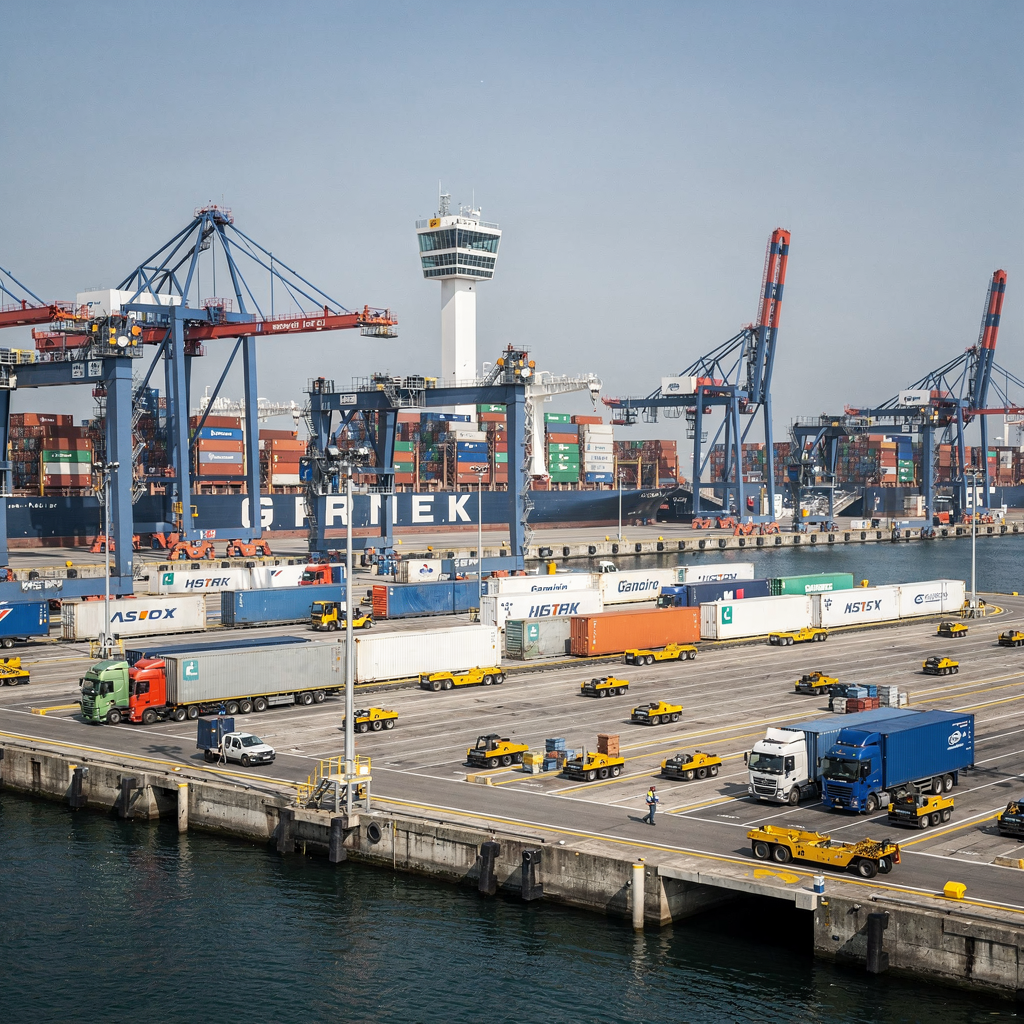
First, automation reshapes the quay and the yard. Automated guided vehicles (AGVs), automated stacking cranes, and robotic handlers take repetitive moves off people. These machines work with a terminal operating system and with control layers to sequence moves. For example, terminals that fully automate their quay have achieved notable throughput improvements. One study reports up to a 30% increase in container handling efficiency after a full automation rollout source. That figure shows why terminal automation remains a priority.
Second, AI complements physical automation by solving planning complexity. AI algorithms handle yard layout planning and slot allocation. They weigh trade-offs between quay productivity, yard congestion, and driving distance. In practice, decentralised AI agents can coordinate quay, yard, and gate moves to cut idle time and to smooth flows. Loadmaster.ai deploys three coordinated agents—StowAI, StackAI, and JobAI—to close the loop between vessel planning, yard strategy, and dispatch execution. These agents train in a simulated twin and learn policies that outperform historical rules.
Third, automation technologies extend to crane control and scheduling. Modern cranes can accept optimized sequences from AI-driven stowage planning. Then, cranes execute moves with consistent productivity and reduced risk. For terminals, that means fewer rehandles and less dependence on individual planners. For terminal operators, this shift delivers more stable performance across shifts, and better predictability for shipping customers.
Fourth, adopt automation carefully. Initial investment is often high. However, the payoff appears in lower labour costs, higher moves per hour, and reduced dwell. Operators should phase deployments and run pilots inside a digital twin. Doing so protects operations while testing AI policies. For further reading on how AI layers integrate with a TOS, see a practical overview of integrating TOS with AI optimization layers terminal integration guide. This approach helps ports automate planning without rewriting their whole stack.
Drowning in a full terminal with replans, exceptions and last-minute changes?
Discover what AI-driven planning can do for your terminal
Real-Time ANALYTICS for CONTAINER TRACKING in YARD OPERATIONS
First, real-time data changes how yards are run. IoT sensors on vehicles, containers, and cranes provide a continuous stream of status reports. These sensors track container position, temperature, shock, and equipment health. Then, analytics platforms aggregate and visualize that feed. Dashboards show hot spots, idle equipment, and drifting schedules in real time. They help planners make fast, confident decisions.
Second, real-time analytics improves container tracking accuracy. By combining sensor telemetry with yard cameras and RFID, terminals can locate containers quickly. Studies show accuracy gains of over 40% where IoT and analytics are fully used source. For yards that struggle with mismatches and manual search, this improvement translates into faster gate transactions and fewer misplaced boxes.
Third, analytics tools support operational efficiency and safety. Real-time alerts can warn an operator about a stuck straddle carrier or a crane overload. Also, anomaly detection flags unusual container movements that could signal theft or mis-declaration. In short, analytics reduce the risk of delays and losses. For an example of how to monitor yard density with live feeds, review an example of real-time container terminal yard density monitoring density monitoring case.
Fourth, smart port management benefits from integrated data. When TOS feeds are enriched by sensor streams, planners can simulate contingencies and allocate resources dynamically. AI-driven analytics then propose slot moves or rehandling sequences to balance workload. This reduces rehandles and shortens travel distances for handling equipment. Also, real-time visibility supports better interactions with port authorities and with hinterland carriers.
Finally, analytics and big data open new service layers for ports. For example, predictive slotting and demand forecasting become possible. Terminals can then pre-stage containers, and they can schedule chassis and labour more accurately. These small shifts add up to measurable reductions in turnaround times and in idle capital inside the port.
Process AUTOMATION to OPTIMIZE CONTAINER HANDLING and TERMINAL OPERATIONS
First, process automation strings together vessel operations, quay moves, yard stacking, and gate flows. Workflow automation can automate the gate check-in, assign a slot, and then schedule a chassis. Rules-based engines drive those steps and keep execution consistent. Also, they enforce safety and compliance rules.
Second, rules engines optimize gate transactions and chassis allocation by following explicit constraints. They pick the nearest available handling equipment and schedule moves to minimize driving distance. In addition, process automation reduces manual data entry and prevents mistakes. As a result, terminals see a 20% reduction in manual labour costs and a 15% cut in turnaround times when end-to-end automation is implemented source.
Third, systems that automate matching between container booking and yard placement improve throughput. These systems allocate slots that protect vessel productivity while preventing yard congestion. For deeper technical detail on matching and stowage logic, see research on terminal operations container matching algorithms and stowage planning stowage matching article. That content explains how slot allocation algorithms balance crane cycles with yard space.
Fourth, process automation supports human operators. Automated workflows reduce firefighting and free planners to focus on exceptions. Also, automation helps standardize operations across shifts so outcomes do not depend on a single planner’s experience. Finally, automation technologies can interface with existing terminal operating systems. That makes phased rollouts possible and lowers the perceived risk of change. When combined with AI policy layers, process automation optimizes throughput, and it helps ports streamline operations with a single authoritative plan.
Drowning in a full terminal with replans, exceptions and last-minute changes?
Discover what AI-driven planning can do for your terminal
PREDICTIVE MAINTENANCE of PORT EQUIPMENT and Sustainable PORT INFRASTRUCTURE
First, predictive maintenance reduces unplanned downtime. Vibration and temperature sensors on cranes, straddle carriers, and AGVs send continuous signals. AI models analyze that telemetry and predict failures before they occur. Terminals that use predictive maintenance have reduced unplanned downtime by about 25% source. That figure shows why ports invest in condition monitoring.
Second, predictive maintenance links directly to sustainability. When handling equipment runs efficiently, fuel and electricity use drop. Smart energy management and efficient shift scheduling can reduce a terminal’s carbon footprint by 10–15% source. For ports looking to minimize their environmental impact, these combined savings matter.
Third, maintenance automation preserves expensive assets and protects safety. For instance, early detection of wear on a crane brake reduces the risk of a catastrophic failure. Sensors and AI models also plan maintenance windows so they coincide with low-traffic periods. As a result, terminals can balance operational uptime with safe practices and cost control.
Fourth, integrating predictive models with a terminal operating system and with remote monitoring helps port management. Port operators can schedule spare parts, and they can dispatch specialist crews proactively. Also, this approach supports scenario-based capacity optimization and lowers reactive repairs. For more on predictive housekeeping and schedule-driven upkeep at container terminals, review a practical implementation of predictive housekeeping predictive housekeeping.
Finally, the combined effect of predictive maintenance and fleet optimization improves equipment lifetime. This reduction in heavy machinery churn reduces material waste and operating expense. Taken together, these improvements strengthen resilience for ports and terminals while helping them meet broader environmental objectives.
Enhancing OPERATOR PRODUCTIVITY to STREAMLINE OPERATIONS in CONTAINER YARDS
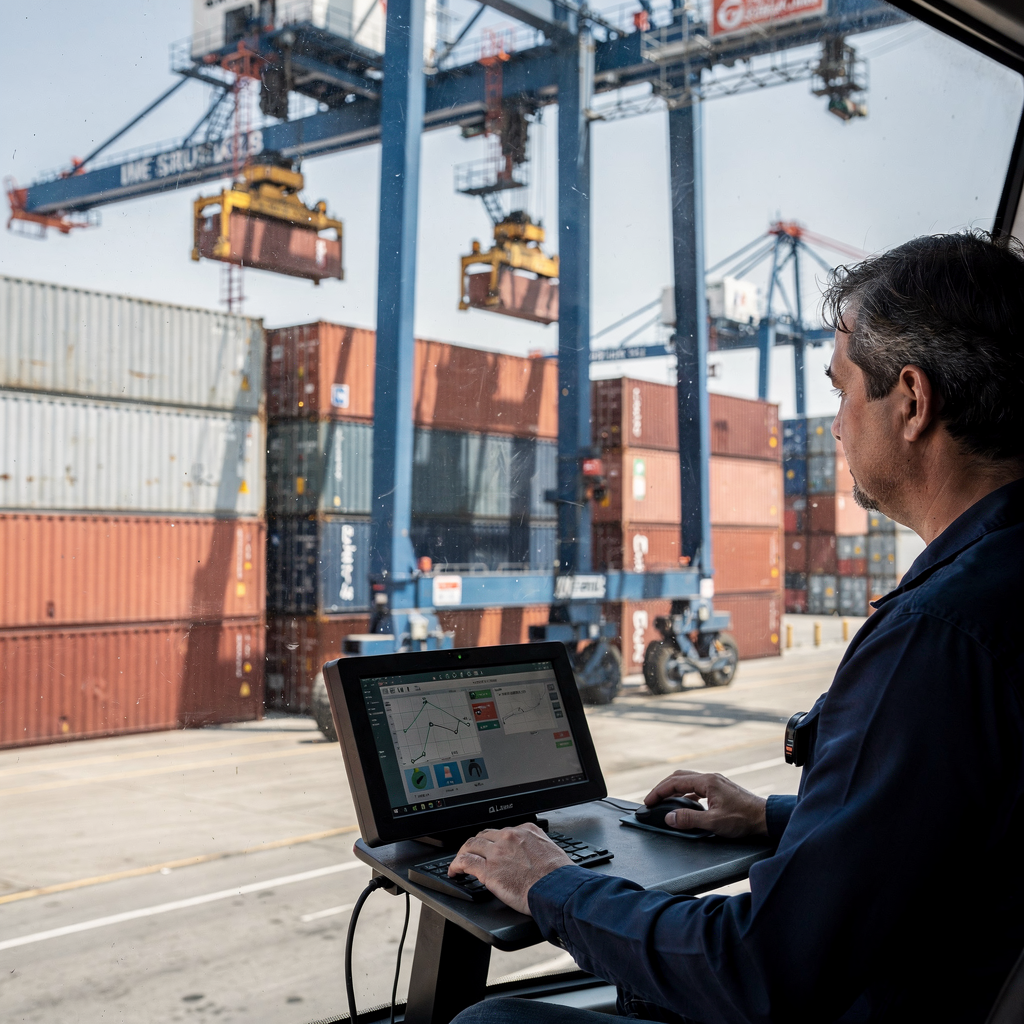
First, improving operator productivity starts with better tools. Human-machine interfaces and AR-guided maintenance speed diagnosis and repair. Remote-control stations let a single operator manage multiple cranes or lifting devices. These tools reduce fatigue and improve safety. They also support training because new operators learn in guided steps.
Second, training simulators and digital twins boost skills. Operators can rehearse complex scenarios in a virtual copy of a yard. Then, when events occur in real operations, the operator reacts with practiced confidence. Loadmaster.ai builds a sandbox twin to train reinforcement learning agents and to test policies. That same twin can help train staff and show expected KPI trade-offs. As a result, crew confidence increases and improved productivity follows.
Third, coordination between human operator and AI improves outcomes. AI suggests efficient moves. The operator approves or adjusts those suggestions. Over time, the system learns preferences and becomes more useful. This human-in-the-loop approach reduces rehandles and balances workloads across cranes and straddle carriers. It also cuts overall driving distance for handling equipment.
Fourth, improving productivity matters for throughput. Combined improvements in process automation, terminal automation, and AI-driven planning can raise container throughput by 15–35% depending on scale and context source. At the same time, ports can reduce labour costs by up to 20% through smarter scheduling and fewer unnecessary moves source. These gains free capital and reduce congestion in container yards and at terminal gates.
Finally, to sustain these gains, ports should pair technology with governance. Port authorities should set clear KPI weights, and terminal operators should adopt continuous improvement practices. When ports coordinate investments in network upgrades such as 5G, and in AI-driven tools, they help ports and terminals operate more predictably. For further reading on decentralized coordination between quay, yard, and gate, see this discussion of decentralized AI agents decentralised coordination.
FAQ
What is a smart port?
A smart port uses sensors, networks, and AI to improve operations, security, and sustainability. It connects equipment, people, and systems to provide real-time insights and to automate routine tasks.
How does automation improve container handling?
Automation reduces manual moves and human error while increasing speed. Automated cranes, AGVs, and robotic systems deliver consistent performance and can increase throughput significantly.
Can AI reduce yard congestion?
Yes. AI optimizes slot allocation and move sequencing to reduce rehandles and to balance yard workload. That leads to lower congestion and shorter turnaround times.
What role do sensors play in terminal operations?
Sensors provide condition and location data for equipment and containers. They enable predictive maintenance and provide real-time visibility that supports better decision making.
How much can predictive maintenance save a terminal?
Predictive maintenance can cut unplanned downtime by roughly 25% in many implementations. It also reduces wasted fuel and materials through timely servicing.
Are digital twins useful for operator training?
Yes. Digital twins let operators rehearse rare and complex events in a safe environment. They also help train AI agents before deployment into live operations.
How do smart ports support sustainability?
Smart energy management and efficient scheduling lower fuel and electricity use. Many terminals achieve a 10–15% reduction in carbon footprint by optimizing flows and maintenance.
What is the initial investment for port automation?
Initial investment varies by scope and technology. Ports must plan phased rollouts and align investments with expected savings and regulatory goals.
Can small ports benefit from smart technologies?
Yes. Even smaller container ports can adopt modular upgrades like IoT sensors and process automation. Those steps improve accuracy and help them compete.
How do AI agents like those from Loadmaster.ai help terminals?
Loadmaster.ai trains reinforcement learning agents in a digital twin to optimize stowage, stacking, and dispatch. These agents improve resilience, lower rehandles, and stabilize performance across shifts.
our products
 stowAI
 stackAI
 jobAI
jobAI
Innovates vessel planning. Faster rotation time of ships, increased flexibility towards shipping lines and customers.
Build the stack in the most efficient way. Increase moves per hour by reducing shifters and increase crane efficiency.
Get the most out of your equipment. Increase moves per hour by minimising waste and delays.
stowAI
Innovates vessel planning. Faster rotation time of ships, increased flexibility towards shipping lines and customers.
stackAI
Build the stack in the most efficient way. Increase moves per hour by reducing shifters and increase crane efficiency.
jobAI
Get the most out of your equipment. Increase moves per hour by minimising waste and delays.