
Simulation Software and digital twin model for airport terminal planning
Simulation software and a digital twin give planners a safe way to test a new terminal before bricks and steel. They recreate layouts, flows, equipment, and interfaces so teams can inspect impacts quickly, and adjust plans fast. A digital twin mirrors the real-world geometry and operational logic of an airport and links to live feeds for scenario testing. For example, a senior planner noted that “Simulation allows us to visualize and quantify the impact of design decisions before construction, saving millions in potential rework and operational inefficiencies” IATA. The core FEATURES of modern software tools include event engines, agent logic, KPI dashboards, and 3D visualization. They also include APIs for TOS and telemetry, and a user-friendly editor for rules and constraints. Many teams choose AnyLogic or bespoke platforms that support hybrid modelling. A digital twin model can replicate passenger handling, check-in counters, baggage systems, and gate layouts while preserving realistic behaviour of staff and passengers. It can simulate peak hours, disruptions, and construction phases. This approach helps identify bottlenecks early and reduce waiting times during peak passenger volumes. Planners can also connect a dashboard to compare alternative layout and capacity choices side by side. Loadmaster.ai uses a digital-twin-first workflow to train RL agents in a sandbox, so teams get actionable policies without requiring perfect historical data. That method reduces time and cost for pilots, and improves robustness when conditions change. In short, a robust digital twin and simulation software reduces risk and supports evidence-based terminal planning, and it speeds up decisions on capacity planning, staffing, and automation while keeping stakeholders aligned.
Discrete Event Simulation Model to analyse passenger flow in terminals
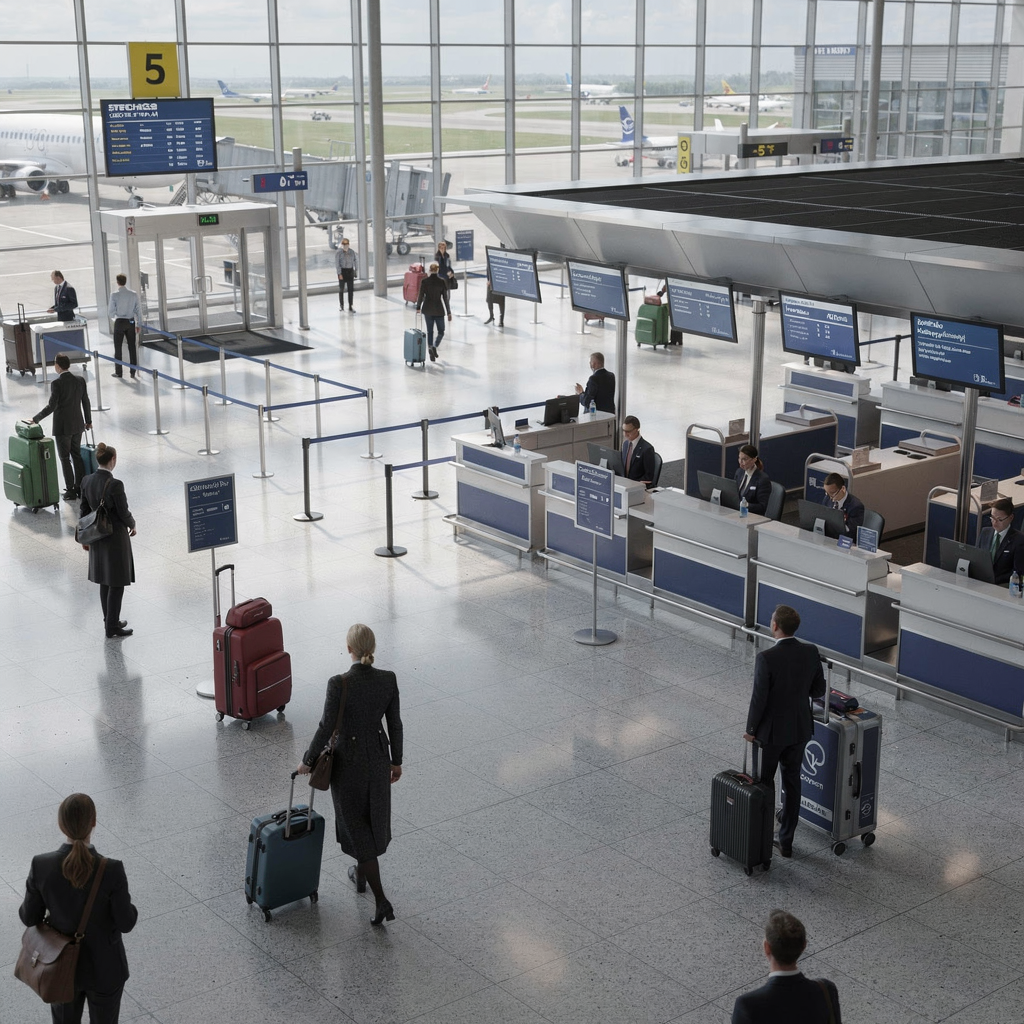
A discrete event simulation model represents terminal activity as a sequence of events. Events include arrivals, service starts, and departures. This model type excels at queueing problems. It captures passenger flow by tracking individual arrivals and service completions, and it triggers resource allocation when events fire. For check-in, security, and boarding, DES maps service points, service time distributions, and routing rules. It can reveal how stochastic arrivals create congestion at specific counters. For instance, calibrated DES studies have shown optimized terminal layouts can cut waiting times by up to 20% and improve throughput by 15% EMA study. A DES approach also supports what-if tests that vary passenger volumes, staffing, and arrival patterns. Planners can then analyze queue lengths, service levels, and dwell time at gates. DES pairs well with agent rules to reflect realistic behaviour such as group travel, or late arrivals. It also integrates with 3d visualization to help airport operators and airlines understand passenger handling and space use. To simulate large terminals, teams often build a modular simulation model developed for check-in modules, security modules, and gate modules. These modules plug into a system that shows how local changes affect the whole airport. Planners use DES to identify where to reallocate staff, or where to add self-service kiosks. They can then compare cost and service trade-offs. For technical readers, more on discrete event libraries is available in dedicated resources on AnyLogic and other platforms AnyLogic terminal simulation library. DES remains a core technique to predict passenger flow, to optimize staffing, and to identify bottlenecks before committing to build.
Drowning in a full terminal with replans, exceptions and last-minute changes?
Discover what AI-driven planning can do for your terminal
Terminal Simulation Software for container terminal operations and port simulation software integration
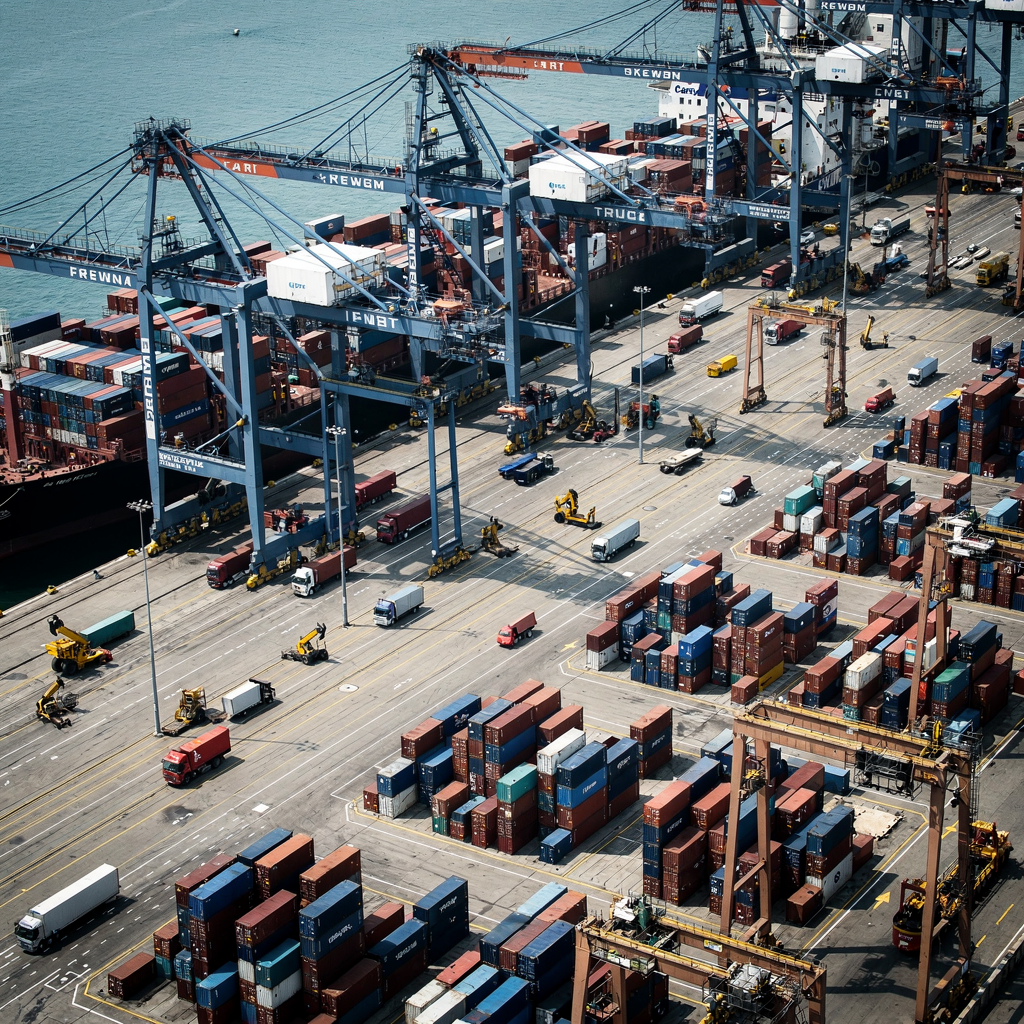
Terminal simulation software for container operations models quay, yard, and gate processes in one connected environment. It links quay crane work, yard handling, and gate flows so planners can evaluate container flows end to end. Port simulation software focuses on berth scheduling, quay crane productivity, and vessel calls while also modelling yard stacking and truck turnaround. The integrated approach helps port and terminal planners test resource strategies that affect the entire hub. Using a single software tool allows teams to measure how quay crane schedules change yard congestion, and how gate peaks affect truck queues. It also supports greenfield design studies that compare different layout and equipment mixes. A linked model can simulate quay crane productivity and idle time, and show effects on container moves per hour. Planners can test RTG, straddle carrier, and automated guided vehicle scenarios. For decision makers, the major advantage is visibility: they can observe how a change at the quay ripples to yard handling and gate operations. Case evidence shows simulation-driven port planning can cut vessel turnaround times by 10–25% and thus improve supply chain reliability MDPI review. Modern port and terminal simulation software supports scenario comparison, and it offers visualization and KPI dashboards so teams can compare throughput, utilization, and idle time at a glance. For operators considering which platform to adopt, our guide on what simulation software container terminals use gives practical comparisons and integration tips what simulation software do container terminals use. Integrating port simulation software with TOS via APIs also enables realistic testing of automated terminals and hybrid manual/automated operations.
Optimisation of terminal operation with container terminal simulation software
Optimisation features in container terminal simulation software let planners test thousands of options fast. Tools embed search and optimisation algorithms to tune equipment schedules, and to balance yard space against quay productivity. Common techniques include genetic algorithms, tabu search, and simulation-based optimisation that couples a solver to stochastic runs. These techniques produce practical allocations for quay cranes, yard blocks, and truck slots. For example, optimisation can adjust stowage plans to minimize rehandles while keeping quay crane productivity high. Loadmaster.ai takes optimisation further with reinforcement learning agents that learn policies in a digital twin, and that adapt to operational changes in real-time. The goal is to optimize terminal KPIs such as moves per hour, driving distance, and rehandles. Simulation helps quantify trade-offs between staffing levels, equipment count, and layout choices. Teams run trade-off analysis to see how adding one quay crane changes yard congestion, or how different allocation rules affect idle time. A container terminal simulation software run can reveal that adjusting allocation rules reduces container moves and shortens average dwell time. Planners can then evaluate time and cost implications and make investment decisions. Tools also allow sensitivity tests and robustness checks across different scenarios. The simulation model developed for optimisation must mirror data quality and rule constraints; otherwise optimisation finds impractical schedules. For a practical primer on optimisation in planning, see our work on terminal optimisation and digital twin integration terminal-optimisation-digital-twin. In short, simulation plus optimisation lets teams choose the best mix of human and automated control to improve performance consistently.
Drowning in a full terminal with replans, exceptions and last-minute changes?
Discover what AI-driven planning can do for your terminal
Case Studies of airport terminal and container port efficiency in the supply chain
Real deployments show measurable gains from simulation-guided planning. An airport case using calibrated models at East Midlands demonstrated waiting times reductions of up to 20% and throughput improvements of about 15% when layouts and staffing were optimised EMA study. In container port contexts, simulation-led changes reduced vessel turnaround by roughly 10–25%, which improved resilience for ship operators and road and rail partners MDPI review. Those results affected the wider supply chain by lowering dwell time and smoothing peak congestion, and they raised port management confidence when committing to capital spend. A university thesis also showed that airport terminal design with flexible elements can raise space utilization by up to 30% under variable passenger volumes QUT thesis. These case studies combined simulation, stakeholder workshops, and staged pilots. They used mixed methods including discrete event, agent-based, and system dynamics to capture micro and macro effects. In practice, airport operators, terminal operator teams, and airline partners ran multiple different scenarios to compare cost, time, and passenger service outcomes. The port studies often required detailed quay modelling to assess quay crane productivity and gate staffing. For readers interested in comparative examples and runnable projects, see our simulation case studies and tool comparisons which detail methods and KPIs simulation case studies. Overall, evidence supports that investing in simulation and simulation software offers payback through reduced waiting times, fewer rehandles, and steadier throughput across the terminal and the broader supply chain.
Validate simulation model accuracy for terminal simulation and future optimisation
Validation keeps models credible and useful. You must validate data inputs and model outputs by comparing model behaviour to observed operations. Start with unit verification, then run calibration using historical traces or targeted observations. Methods include sensitivity analysis, calibration against time-series KPIs, and verification experiments that test edge cases. For example, one should validate that a discrete event process reproduces observed queue length distributions at peak times. You also must record how changes in arrival patterns affect dwell time and gate delays. Where historical data is scarce, reinforcement learning and simulated experience can fill gaps, but the model still needs validation against expert judgement and short-term trials. Loadmaster.ai trains RL agents in a digital twin, and then validates agent policies in sandbox pilots before operational deployment. Best practice also includes performing robustness checks across different scenarios and varying system requirements, so optimisation does not overfit to a single future. Use verification logs and a dashboard to trace decisions and to identify bottlenecks visually. Sensitivity runs help identify which inputs matter most, and they reveal how much uncertainty affects recommended policies. Finally, adopt continuous validation with real-time telemetry so models evolve as the terminal evolves. Future directions include tighter integration of AI, improved real-time decision support, and online calibration that keeps the model aligned with live operations. For more on how to connect a TOS and simulation for validation and decision support see our article on TOS and simulation integration TOS simulation integration. Validated models support safer optimisation, and they enable next-generation planning that adapts under stress and change.
FAQ
What is the difference between a digital twin and simple simulation software?
A digital twin continuously mirrors a real terminal with live or near-real-time feeds, while simulation software typically runs offline scenarios. The twin supports ongoing validation and can power real-time decision support as conditions change.
Can discrete event models capture passenger behaviour realistically?
Yes, discrete event models capture queueing and service dynamics precisely, and they can include probabilistic behaviours to mirror realistic behaviour. For more complex individual actions, agent-based layers can be added to reflect group movement and choice.
How do ports measure the benefits of simulation projects?
Ports measure benefits using KPIs such as vessel turnaround, quay crane productivity, and average dwell time. They also track container moves, truck turnaround, and yard utilization to show system-wide gains.
Do simulation studies require a lot of historical data?
Historical data helps with calibration, but it is not always required. Reinforcement learning and synthetic scenarios can generate experience in a digital twin, which is useful when past data is scarce or unrepresentative.
How long does it take to build a credible simulation model?
Model build times vary by scope and data quality; a focused module can take weeks while a full terminal model can take months. Iterative validation shortens deployment time and improves robustness.
What optimisation methods work best with simulation?
Genetic algorithms, tabu search, and simulation-based optimisation are common, and reinforcement learning is increasingly used for closed-loop optimisation. Choice depends on the decision horizon, constraints, and the need for multi-objective trade-offs.
Can simulation software support greenfield and expansion studies?
Yes, simulation software is ideal for greenfield design and incremental expansion planning. It helps compare layout alternatives, equipment mixes, and capacity planning before committing to capital investments.
How do you validate that a simulation reflects peak passenger volumes?
Validate by running stress tests that replicate peak arrival patterns and then compare model outputs to short pilot observations or historical peak day snapshots. Sensitivity analysis confirms the model’s robustness under high loads.
Is automation compatible with existing terminal operating systems?
Automation can integrate with TOS via APIs and EDI. Simulation helps test automated workflows safely before live integration, and it can validate system requirements and operational changes.
Where can I find examples of container terminal simulation case studies?
There are public case studies and academic reviews that document container port improvements and terminal planning outcomes. For a curated selection, see our collection of simulation case studies which links practical examples and tools.
our products
 stowAI
 stackAI
 jobAI
jobAI
Innovates vessel planning. Faster rotation time of ships, increased flexibility towards shipping lines and customers.
Build the stack in the most efficient way. Increase moves per hour by reducing shifters and increase crane efficiency.
Get the most out of your equipment. Increase moves per hour by minimising waste and delays.
stowAI
Innovates vessel planning. Faster rotation time of ships, increased flexibility towards shipping lines and customers.
stackAI
Build the stack in the most efficient way. Increase moves per hour by reducing shifters and increase crane efficiency.
jobAI
Get the most out of your equipment. Increase moves per hour by minimising waste and delays.