
inland container terminals: metric and throughput
Inland container terminals form a key part of the supply chain and act as intermodal hubs connecting rail, road, and waterways. Inland container terminals move boxes between modes and store them temporarily while onward transport is arranged. The terminal must balance quay schedules, yard operations, and gate flows. Throughput time and dwell time are the two metric areas that most directly measure terminal performance. Throughput measures how quickly inbound and outbound cargo moves through the terminal. Dwell time measures how long a container sits in the yard before pickup or onward movement. Shorter dwell time reduces yard congestion and improves crane productivity. Longer dwell time raises equipment idle time and increases operational costs.
Measuring throughput and dwell time yields insights for optimization decisions and helps terminal teams set realistic service targets and KPI weights. Studies show that using simulation-first AI and related methods can cut container handling times by up to 20% (PDF) AI-Enhanced Smart Maritime Logistics. That 20% figure translates into higher throughput and lower unit cost per move. Other research links improved scheduling from simulation and AI to reduced terminal-related emissions and cost savings of 10–15% Optimal Design of Inland Waterway System.
Terminal managers and terminal operators focus on key performance indicators like crane moves per hour, queue length at the gate, and equipment utilization. Using these metrics helps locate bottlenecks and define optimization objectives. Loadmaster.ai uses simulated environments and reinforcement learning to train agents that reduce rehandles and balance workload across quay and yard. The approach is designed to be cold-start ready so the live system sees benefits without a large historical dataset. For more on dwell metrics and prediction methods see our detailed piece on dwell time prediction dwell time prediction in port operations.
Terminal-level decisions cascade into yard congestion, quay queueing, and equipment allocation. A focused program to measure throughput and dwell time is the first step to meaningful optimization. With clear metrics and simulation-driven tests, terminal teams can apply AI policies and validate the model repeatedly before live deployment. That step reduces operational risk and improves predictability for inbound and outbound container flows.
discrete event simulation model and digital twin for simulation
Discrete event simulation captures the key processes inside a terminal. A discrete event simulation model represents trucks, cranes, stacks, and gates as interacting events. The model triggers actions like container unload, transport, and stacking when conditions change. This lets terminal teams simulate peak days, failures, and schedule shifts without interrupting live operations. The simulation environment is the sandbox where AI agents learn to make robust choices under uncertainty.
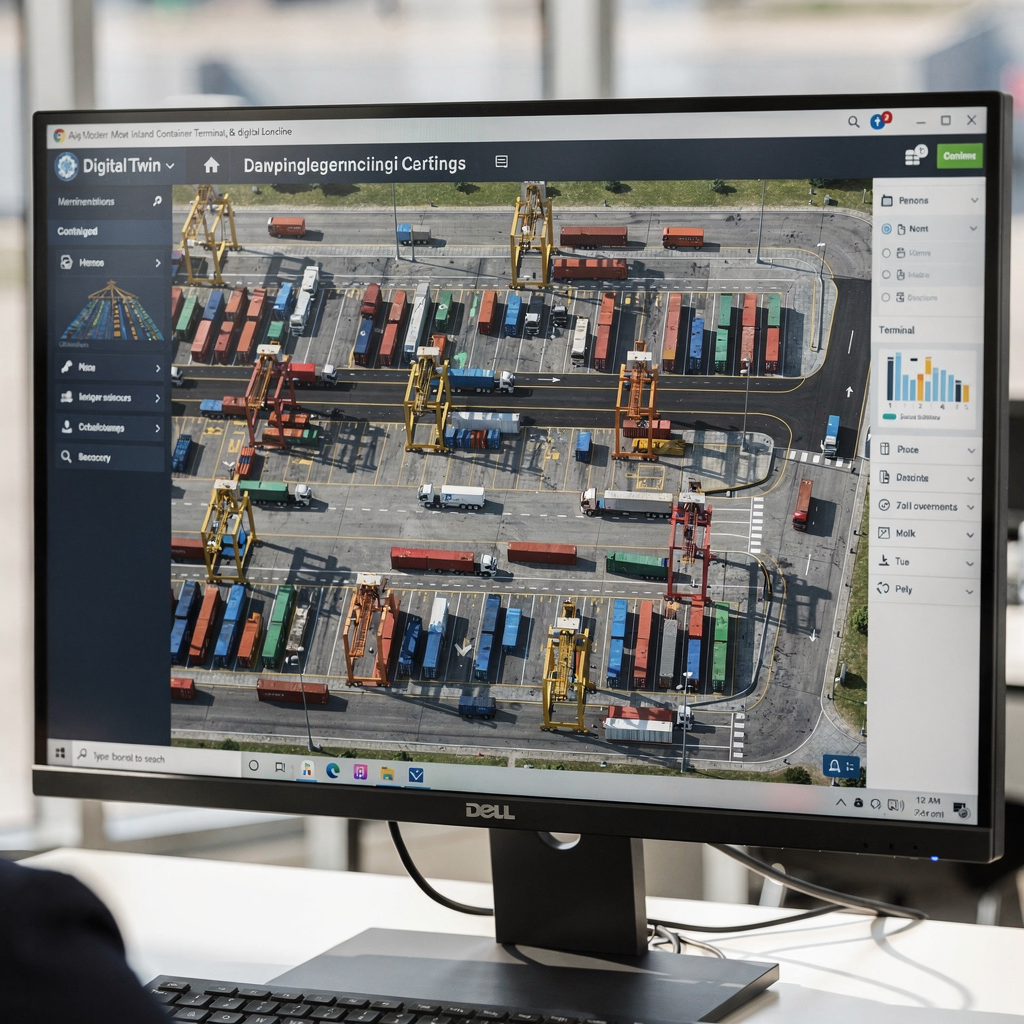
A digital twin extends that simulation by pairing the model with telemetry and rules from the live facility. The digital twin keeps the simulation model aligned with the actual terminal layout, equipment capabilities, and operational constraints. As Krishnan Srinivasan wrote, “digital twins allow port operators to simulate various scenarios,” and that helps with planning and resilience Eye on the future – AI in supply chains and logistics – Maersk. Using a digital twin also supports closed-loop optimization where simulation outputs inform live control and live feedback re-tunes the model.
Scenario testing is an important use-case for both risk management and congestion prediction. Simulation-first AI solutions have shown strong accuracy in predicting congestion and enabling pre-emptive actions. Machine learning trained on simulation data can predict and mitigate port congestion with accuracy exceeding 85% Understanding and Predicting Port Congestion with Machine Learning. That level of predictive power lets terminal operators test “what-if” events like chassis shortages or sudden volume surges.
Validate the model frequently with live terminal KPIs and sensor feeds. The simulation model and the digital twin should be updated as layout changes, as new quay crane or yard crane is added, and as traffic patterns evolve. For teams that want to optimize container storage and retrieval patterns or evaluate adding a quay crane, simulation-first approaches give a low-risk way to measure outcomes. For more on automated stacking and crane planning see our write-up on automated stacking crane optimization automated stacking crane optimization in terminal operations.
Drowning in a full terminal with replans, exceptions and last-minute changes?
Discover what AI-driven planning can do for your terminal
mathematical model for terminal operation optimization
A mathematical model gives a formal objective for terminal scheduling and resource allocation. Typical models include variables for crane allocation, truck sequences, and yard allocation. The models use constraints to enforce safety, equipment reach, and slot occupancy. The objective often balances crane productivity with yard congestion and travel distance. Mathematical optimization is the backbone for generating schedules that maximize throughput while meeting service windows.
Common approaches range from integer programming to heuristics and multi-objective formulations. A mathematical model can schedule quay cranes and yard crane moves, and then feed tasks to a dispatcher. Optimization algorithms like mixed-integer programming or metaheuristics solve the assignment, routing, and stacking problems. Then simulation outputs help validate and stress-test these schedules. Using simulation to produce realistic load patterns and rare events lets optimization algorithms see the full range of scenarios. This improves their generalization and prevents overfitting to historical averages.
Simulation-first pipelines train AI agents and algorithms on synthetic experience. These agents refine scheduling decisions so idle time falls. Studies and practical pilots demonstrate 10–15% reductions in idle time when AI policies replace fixed rules and manual dispatching (PDF) AI-Enhanced Smart Maritime Logistics. Loadmaster.ai follows a similar closed-loop process. We spin up a digital twin, then train RL agents against the defined KPI weights. The agents learn under many demand patterns and then provide executable policies that terminal operators can deploy safely.
Real-time data integration lets the model recalibrate under varying demand. Telemetry from quay crane sensors, gate scanners, and yard crane controllers updates arrival rate estimates. The system then adapts allocation in minutes rather than hours. The combination of simulation model, mathematical optimization, and AI provides both a rigorous objective and the adaptability required for live terminal operation. For further technical context, our article on container terminal vessel planning and decision support covers how mathematical models interact with scheduling tools container terminal vessel planning explained.
automated container and container storage: crane allocation
Automated container handling systems reduce manual steps in yard operations. Automated stacking cranes and automated guided vehicles automate repetitive moves and shorten travel time. Automated terminals can improve safety, and they can increase moves per hour when well integrated. However, automation must be paired with smart container storage policies to avoid excessive reshuffles. AI helps optimize container storage and retrieval patterns so stacks remain accessible and future moves are protected.
Optimizing container storage reduces unnecessary reshuffles and travel distance. AI algorithms evaluate inbound and outbound patterns to place containers where they minimize expected future moves. Stack-level strategies consider the number of container layers, container weight, and expected dwell time. Algorithmic placement combined with optimized yard allocation yields higher equipment utilization and lower yard congestion. In practice, intelligent storage planning can reduce rehandles and save fuel by shortening transport paths within the yard.
Crane allocation is a complementary problem. Assigning quay crane tasks and sequencing yard crane moves determines how smoothly the terminal flows. Strategies include splitting polices between adjacent quay cranes, dynamic allocation when congestion forms, and prioritizing tasks that reduce downstream reshuffles. Using AI-trained policies for crane allocation yields more consistent crane productivity and fewer idle periods. Studies show gains in crane productivity and utilization when optimization methods replace fixed assignment rules.
Loadmaster.ai’s StackAI and StowAI concepts reflect this integration. StowAI augments vessel planner sequences to minimize shifters while maintaining executability. StackAI places and reshuffles to balance the yard and protect future plans. JobAI coordinates execution so cranes and trucks remain busy and wait times fall. These trained agents run against a terminal simulation model so their allocation decisions are validated before deployment. For more on automated crane split planning see our post on automated container terminal crane split planning software automated container terminal crane split planning software.
Drowning in a full terminal with replans, exceptions and last-minute changes?
Discover what AI-driven planning can do for your terminal
bottleneck in container terminal operations and ports and terminals
Bottlenecks appear in many forms across ports and terminals. Common constraints include yard congestion, quay-side queues, and chassis shortages. Yard congestion forms when stacks saturate and trucks queue at gates. Quay queues happen when vessel calls overlap or when berth productivity drops. Chassis shortages create downstream delays even if quay cranes are productive. Identifying bottlenecks uses metric analysis like queue length, equipment wait times, and stack occupancy rates.
Key performance indicators and quantitative analysis make constraints visible. Monitoring crane moves per hour, average truck turnaround, and number of container rehandles helps pinpoint where throughput breaks down. For example, long gate queues often correlate with poor yard allocation or suboptimal gate appointment scheduling. Simulation and AI together let terminal teams run stress tests that reveal hidden interactions between quay schedules and yard capacity.
AI-driven forecasts enable pre-emptive measures that relieve pressure on terminal resources. Predictive models trained on simulation outputs can signal when yard congestion will spike within hours. Operators can then deploy contingency plans, such as temporary stack reassignments or targeted labor shifts. Simulation-first AI also supports scenario testing for “what-if” situations like equipment failure or sudden volume surges; this gives terminal managers a safe method to trial mitigations.
Addressing bottlenecks typically requires combined interventions across berth management, yard operations, and gate procedures. Optimization methods and intelligent automation reduce the frequency and impact of bottlenecks. For terminal teams interested in how yard density relates to gross crane rates, our analysis on yard density and gross crane rate provides practical data and models relationship between yard density and gross crane rate. Finally, planning tools that include human-in-the-loop exception handling keep operations robust when unexpected events occur exception handling workflows with human-in-the-loop vessel planning.
AI to optimize maritime container flows in inland terminal
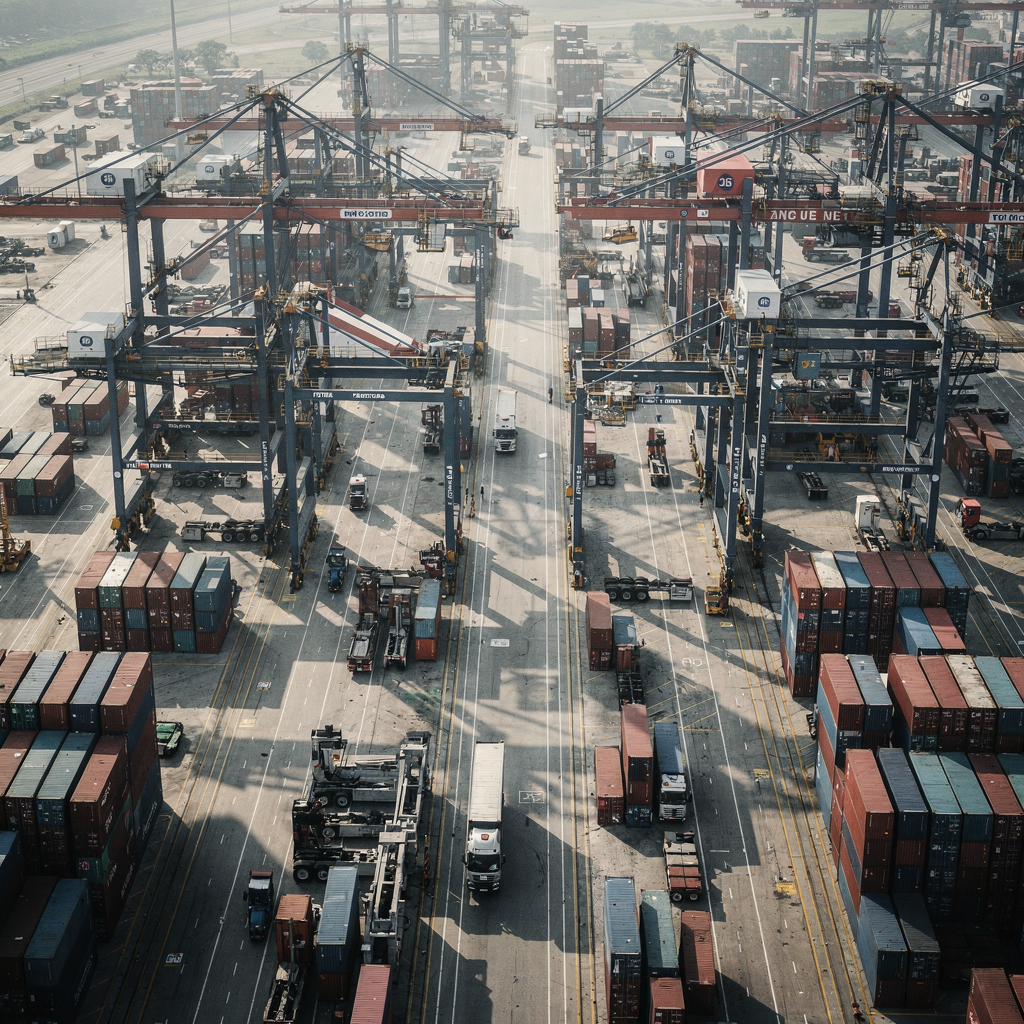
AI coordinates maritime container arrivals with rail, road, and inland waterways. Predictive arrival models and scheduling agents match vessel calls with inland connections. This coordination reduces mismatches between berth windows and inland transport capacity. AI helps optimize container flows by timing moves to gate windows and to rail departure schedules. The result is fewer trucks waiting, faster gate cycles, and better use of rail and barge capacity.
Intermodal optimization can also cut emissions. When AI optimizes stacking, routing, and crane allocation, terminals report measurable CO2 reductions. Digital twin studies show simulation-based AI approaches that reduce terminal-related emissions by up to 15% Digital Twin for resilience and sustainability assessment. That kind of sustainability improvement aligns with green logistics targets and cost reduction at the same time.
AI licenses include reinforcement learning and agent-based control for closed-loop optimization. Reinforcement learning agents learn policies that maximize multi-objective KPIs across quay and yard. They can be trained without historical data by simulating millions of decisions in a model developed for the terminal. Loadmaster.ai uses RL agents trained in a digital twin to deliver policy-based control that adapts in real time and preserves operational guardrails.
Extending AI to last-mile logistics further improves end-to-end flow. Agent-based and multi-agent systems coordinate terminal dispatch with truck appointment systems and last-mile carriers. Research shows benefits when simulation-first methods combine with multi-agent coordination for last-mile optimization An intelligent multi-agent system for last-mile logistics. Future research will likely focus on tighter integration between TOS, fleet telematics, and reinforcement learning controllers. For practitioners seeking practical use-cases, our inland container terminal productivity improvement strategies piece outlines deployment patterns and ROI considerations inland container terminal productivity improvement strategies.
FAQ
What is the difference between throughput and dwell time at a terminal?
Throughput measures the rate at which containers move through the terminal. Dwell time measures how long containers remain in the yard before pickup. Monitoring both lets terminal operators identify flow constraints and optimize operations.
How does a discrete event simulation model help terminal planning?
A discrete event simulation model represents terminal activities as events that change system state. Planners use the model to test schedules, equipment allocations, and contingency plans without disturbing live operations. This reduces risk and improves decision quality.
Can AI reduce crane idle time in container terminal operations?
Yes. AI policies trained in simulation and applied to crane allocation can lower idle time by improving sequencing and task assignment. Field studies and pilot projects report reductions in idle time and more stable crane productivity.
Are digital twins necessary for AI deployment at a terminal?
Digital twins are not strictly necessary, but they provide a controlled simulation environment that mirrors the live terminal. Using a digital twin speeds up safe testing and helps validate the model before deployment. That lowers operational risk.
How do AI agents handle unexpected disruptions like chassis shortages?
AI agents trained on simulated disruption scenarios learn contingency behaviors and adaptive priorities. When faced with shortages, they adjust allocations and sequencing to keep critical flows moving while minimizing rehandles.
What role does reinforcement learning play in terminal optimization?
Reinforcement learning trains agents to make sequential decisions that maximize long-term KPIs. It is especially useful in environments with many interacting parts and changing demand patterns. RL agents can outperform supervised approaches that merely imitate past behavior.
How accurate are congestion predictions based on simulation-trained models?
Simulation-trained models have demonstrated high predictive accuracy, with some studies reporting congestion mitigation accuracy above 85%. These models help terminal teams act proactively rather than reactively.
Can simulation-first AI improve sustainability at ports and terminals?
Yes. By optimizing moves, reducing idle travel, and smoothing peaks, simulation-first AI can lower terminal-related emissions. Case studies report emission reductions of around 15% when simulation and AI guide operations.
What data is required to start with simulation-first optimization?
Basic layout, equipment capabilities, and rule sets are sufficient to build an initial simulation model. More telemetry and gate data improve fidelity, but many AI solutions can start without long historical records by generating experience in simulation.
How do terminal operators adopt AI without disrupting live operations?
Operators use a staged approach: build a digital twin, train agents in simulation, validate the model, and run pilot blocks under supervision. Deployments typically include guardrails and human-in-the-loop controls to ensure safe ramp-up and steady performance.
our products
 stowAI
 stackAI
 jobAI
jobAI
Innovates vessel planning. Faster rotation time of ships, increased flexibility towards shipping lines and customers.
Build the stack in the most efficient way. Increase moves per hour by reducing shifters and increase crane efficiency.
Get the most out of your equipment. Increase moves per hour by minimising waste and delays.
stowAI
Innovates vessel planning. Faster rotation time of ships, increased flexibility towards shipping lines and customers.
stackAI
Build the stack in the most efficient way. Increase moves per hour by reducing shifters and increase crane efficiency.
jobAI
Get the most out of your equipment. Increase moves per hour by minimising waste and delays.