
schedule and planning problem in container terminals
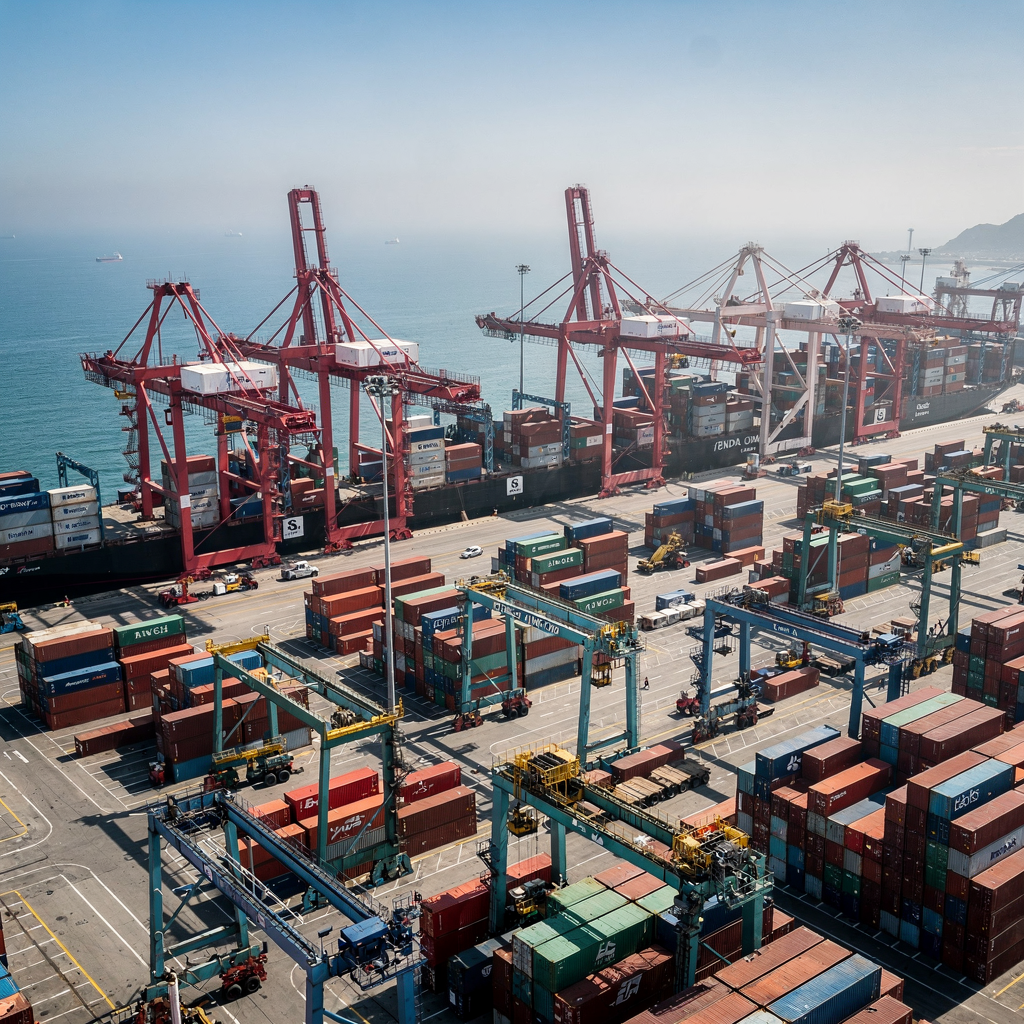
Crane scheduling sits at the heart of the schedule and planning problem in container terminals. The planning problem begins before a vessel arrives. Terminal planners must translate a ship stowage plan into actionable moves. They must decide which quay crane handles which bay, and which yard crane performs pickups and drops. These decisions create a complex allocation problem. They also create a cascade of constraints that affect throughput, handling time and energy consumption. For example, a congested bay can delay several vessel bays. Therefore, planners must balance short-term gains against long-term congestion risks. Also, terminals must adapt when berthing times shift. Furthermore, weather, equipment failures and late arrivals make the scheduling problem stochastic and dynamic.
Traditional heuristic and rule-based scheduling methods still appear in many container terminal operations. Yet they often fail in volatile terminal yards. Heuristics can be fast. However, they do not always adapt to changing demand or unexpected events. Consequently, terminals seek algorithms that learn from experience. Reinforcement learning offers such a path. Reinforcement learning-based methods let a learning agent update its policy while interacting with the terminal environment. A reinforcement learning algorithm defines state, action and reward. The action space can include crane assignments, sequencing and routing decisions. The reward can encode throughput, average handling time and energy use. When designed well, the learning algorithm can outperform static heuristics in live scenarios.
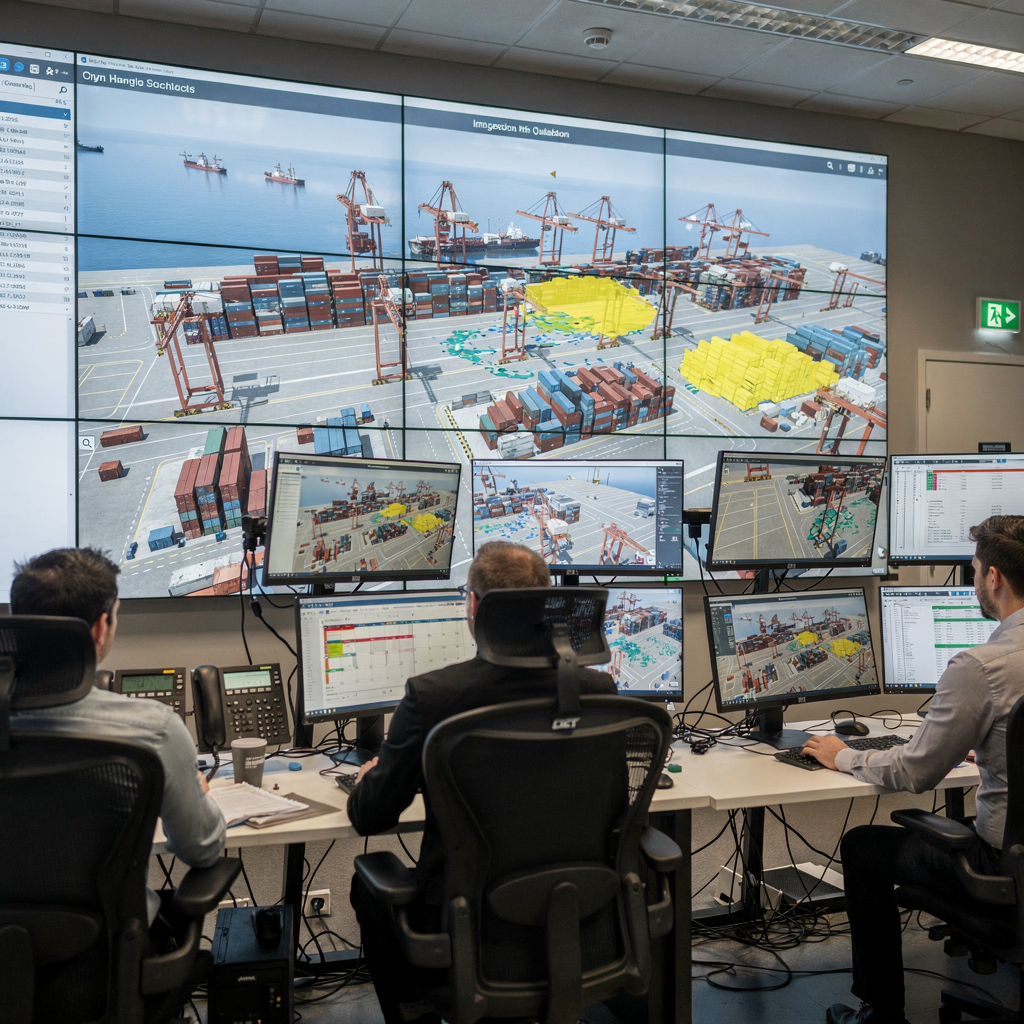
Key performance metrics guide every scheduling effort. Handling time measures the time to move a container between ship and yard. Throughput quantifies the number of moves per hour or per vessel call. Energy consumption tracks fuel or electric draw per move. Studies report reductions in average container handling time by 10–20% when using learning approaches; see the survey on operations and supply chain management for context “The integration of deep reinforcement learning in container terminal crane scheduling is a promising direction”. In addition, research combining ILP with RL reports energy savings up to 15% in coil storage applications Energy-oriented crane scheduling in a steel coil storage. For planners who need simulation-based validation, a digital replica of terminal operations can help test schedules before deployment digital replica of terminal operations for scenario simulation. This allows teams to compare conventional algorithms, genetic algorithm approaches, and novel RL solutions under identical demand traces.
crane operations and yard crane coordination
Quay crane versus yard crane roles are clear. Quay cranes handle ship-side loading and unloading. Yard cranes move containers inside the container yard. Coordinating these cranes resolves the core scheduling problem in container terminals. If coordination fails, queues appear at the ship face. As a result, berth productivity drops. Therefore, a coordination strategy must match quay crane outputs to yard crane pickups. That matching reduces waiting, and increases quay crane utilization. Research indicates that RL methods have improved crane utilisation by 12–18% in studied terminals Efficiency and productivity in container terminal operation.
Constraints multiply the challenge. Crane interference restricts simultaneous movements in adjacent lanes. Yard storage layout influences travel distance for yard crane operations. Different container types, such as refrigerated or hazardous goods, impose handling rules. For instance, stacking restrictions and weight distribution rules can force non-intuitive moves. A single crane cannot serve all needs. Thus, coordinated multi-crane policies are essential. Multiple cranes require multi-agent strategies. Multi-agent reinforcement learning helps here. It lets each crane act locally while coordinating through shared rewards or signaling protocols.
For real terminals, practical factors matter. Crane availability and maintenance windows change daily. Gantry crane spacing and terminal yards layout dictate safe motions. Terminals that adopt automation must also consider scheduling in automated container terminals and u-shaped automated container terminal designs. Operators increasingly use a mix of heuristics, scheduling strategies and learning models. Virtual schedulers and decision-support tools can surface conflicts. For a deeper dive into quay crane scheduling and yard interaction, see our guide on AI-driven quay crane scheduling and yard optimization AI-driven quay crane scheduling and yard optimization. Also, terminal teams often combine an integer programming model for high-level planning with learned policies for real-time adjustments. These hybrid frameworks improve throughput while respecting crane interference and yard constraints. Finally, simple simulation studies and numerical experiments are conducted to validate coordination policies before field trials.
Drowning in a full terminal with replans, exceptions and last-minute changes?
Discover what AI-driven planning can do for your terminal
reinforcement learning based algorithm design
Designing a reinforcement learning based solution for crane tasks begins with modeling. First, define the state. The state can include ship bay occupancy, container locations in the yard, crane positions, current moves and timestamps. Second, define actions. Actions may assign a quay crane to a bay, order the next container to handle, or dispatch a yard crane to a stack. Third, craft the reward. Rewards typically combine penalties for delay, energy use and conflicts, plus bonuses for completed moves. This simple triad—state, action and reward—forms the backbone of any reinforcement learning algorithm.
Popular learning approaches vary. Q-learning works well in discrete action spaces and small-scale problem settings. Q-learning remains popular due to simplicity and interpretability (PDF) Reinforcement Learning for Logistics and Supply Chain. For larger state spaces, deep Q-networks and policy-gradient methods use deep neural networks to approximate value functions or policies. When the action space grows, deep models capture high-dimensional patterns that tabular methods cannot. A deep reinforcement learning method can learn sequences and temporal dependencies that affect crane availability and container matching.
Reported gains are compelling. Studies report 10–20% reductions in average handling time using RL-based algorithms in container terminal experiments Operations & Supply Chain Management survey. Moreover, researchers combine integer programming with learning to secure energy savings up to 15% in related coil crane scheduling studies Energy-oriented crane scheduling. To build production-ready models, teams often adopt a learning framework that blends imitation learning with reinforcement updates. This approach speeds convergence and reduces initial operational risk.
Action space design matters. A coarse action space reduces learning time but limits fine-grained control. Conversely, a large action space allows precise moves but increases sample complexity. Engineers choose between discretized actions for Q-learning and continuous or parameterized actions for policy-gradient methods. When training RL agents, reward shaping helps. Rewards can prioritize urgent moves or penalize energy spikes. As a result, the agent learns productive yet safe behaviors. For more on terminal-level planning and scenario testing, consider a container terminal vessel planning optimization tool container terminal vessel planning optimization tools. Finally, integration with operations data, such as WMS and TMS feeds, improves state fidelity.
proximal policy optimization for crane scheduling
Proximal Policy Optimization is a practical policy-gradient method. It balances stable updates with efficient learning. PPO constrains how much the policy can change in a single update. This constraint reduces catastrophic policy shifts. For continuous control problems and multi-crane coordination, PPO fits well. It supports stochastic policies and scales across parallel environments. As a result, PPO has become a go-to method for learning coordinated behaviors among several cranes and automated vehicles.
Architectures for PPO typically use deep neural networks. A shared backbone can encode global terminal state. Separate heads produce per-crane action distributions. Thus, a single network controls multiple cranes yet keeps specialized outputs. Hidden layers often include fully connected units and attention blocks that focus on critical bays or stacks. These architectures produce a deep reinforcement learning model that learns temporal dependencies between quay crane assignment and yard crane tasking. In some experiments, proximal policy optimization-based solutions achieved energy savings up to 15% compared with heuristic methods, particularly when combined with an integer programming model for high-level allocation Energy-oriented crane scheduling.
PPO also works well when extended to multi-agent setups. Each agent can run the same policy with different observations. Communication channels can be implemented through shared rewards or learned embeddings. These systems offer a path toward joint scheduling and integrated scheduling optimization. For example, a joint scheduling system may use a planning model using ILP to fix bay-level assignments and then let PPO refine sequencing in real time. Hybrid methods like this deliver good trade-offs between compute cost and solution quality. For more on practical scheduling systems, see AI-driven quay crane scheduling and yard optimization and automated quay crane scheduling software automated quay crane scheduling software and AI-driven quay crane scheduling and yard optimization.
Drowning in a full terminal with replans, exceptions and last-minute changes?
Discover what AI-driven planning can do for your terminal
optimization and optimization approach in crane scheduling
Optimization methods for crane scheduling range from integer programming to metaheuristics and RL. Integer programming models deliver high-quality solutions for small-to-medium instances. They capture constraints exactly. However, they often struggle with real-time decision-making. Conversely, RL algorithms make fast online decisions. They adapt when the terminal environment changes. Hence, many terminals adopt hybrid frameworks that combine strengths of both families.
An integer programming model can provide a baseline plan. Then a reinforcement learning-based agent can adjust sequencing when deviations occur. This programming model plus learning approach improves robustness. Particle swarm optimization and genetic algorithm variants provide additional options. A genetic algorithm may explore diverse solutions for master bay planning problems. Yet metaheuristics require careful tuning and often lack guarantees. In contrast, a reinforcement learning algorithm improves by experience and can generalize across scenarios when trained appropriately.
Trade-offs exist. High-quality integer programming solutions need compute time. Real-time requirements limit how long planners can wait. Training deep learning agents costs compute too. However, once trained, a trained policy makes instant decisions. Training time and sample complexity remain the main barriers. Hybrid optimization approaches mitigate this by using optimization algorithm outputs as demonstrations. Then the learning agent fine-tunes via reinforcement updates. Such learning frameworks speed-up convergence and reduce dependency on large-scale labeled datasets.
Scalability is crucial. Large terminals with many quay crane and yard crane resources create massive action spaces. Integrated scheduling approaches and integrated scheduling optimization tackle that. A practical path uses hierarchical decomposition. Top-level integer programming assigns cranes to bays. Lower-level RL handles local sequencing. This produces a system that balances solution quality against real-time responsiveness. For further reading on predictive versus reactive planning and yard congestion, see our piece on predictive versus reactive planning predictive versus reactive planning. Finally, researchers continue to explore optimization of container energy and terminal productivity while respecting crane availability and safety constraints.
ship stowage planning problem and future research directions
The ship stowage planning problem drives much of the crane schedule logic. A stowage plan specifies what container sits in which bay and which deck slot. That plan determines the sequence of crane moves. Poor stowage planning increases container movements and creates unproductive idle time. Therefore, stowage plans must consider how quay crane assignment and yard crane deployment will interplay.
Open challenges remain. Data quality and availability are frequent issues. High-fidelity state information such as stack heights, container types and gate times is essential. Transfer learning could reduce training demands by reusing policies across terminals. Also, multi-agent reinforcement learning needs robust communication primitives to avoid deadlocks. Another challenge is safety and explainability: operators expect policies that provide traceable decisions. Research argues for hybrid designs that combine domain knowledge, programming model constraints and learning-based adaptivity. For instance, a proposed approach may use an integer programming model for stowage decisions. Then a deep reinforcement learning model refines crane sequencing. Such integrated scheduling solutions can produce both safe and efficient operations.
Future studies will test more realistic environments. Digital twins and emulation layers help scale experiments. As examples, container port emulation and digital replica platforms can simulate berth schedules and yard congestion for thousands of runs, enabling reliable comparisons of reinforcement learning-based controllers and conventional algorithms deepsea container port emulation software for planning. Research also explores deep learning for state encoding and transfer learning for cross-terminal generalization.
Finally, practical deployment needs solid toolchains. Data pipelines ingest ERP, TMS and WMS signals. That structured data can seed training sets and help to validate policies in pre-deployment simulations. Going forward, hybrid frameworks, improved simulation environments and better transfer learning will accelerate adoption. The literature already includes a range of RL and deep reinforcement learning-based proposals that demonstrate measurable efficiency gains. Researchers and operators must continue to align modeling fidelity with operational constraints so that results demonstrate that the proposed methods deliver real-world benefits.
FAQ
What is the core challenge in crane scheduling?
The core challenge is matching crane resources to container movements under uncertainty. Terminals must handle changing berthing times, equipment availability and variable container mixes. That makes the scheduling problem both dynamic and stochastic.
How does reinforcement learning improve crane scheduling?
Reinforcement learning learns policies from interaction with the terminal environment. It can adapt to live delays and changing demand. In practice, RL agents reduce handling time and improve utilization compared to static heuristics.
Are there proven benefits of RL in terminals?
Yes. Studies show reductions in average handling time by 10–20% and improved crane utilization of about 12–18% Efficiency and productivity in container terminal operation. Energy-focused studies also report up to 15% savings when combining optimization and RL Energy-oriented crane scheduling.
Which RL algorithms are common for crane scheduling?
Q-learning is popular for discrete problems due to simplicity (PDF) Reinforcement Learning for Logistics and Supply Chain. Deep Q-networks and policy-gradient methods like proximal policy optimization scale to larger state and action spaces.
What role does proximal policy optimization play?
PPO balances stable updates with efficient learning. It suits continuous control and multi-crane coordination. PPO has been used to reduce energy consumption and refine sequencing in simulated terminals.
Can RL work together with integer programming?
Yes. Hybrid systems use integer programming for high-level allocation and RL for rapid, local decisions. This integrated scheduling approach provides both quality and real-time performance.
What data is needed to train RL agents?
High-quality telemetry from TMS, WMS, ERP and crane controllers is essential. Detailed logs of container locations, timestamps and equipment states allow realistic state representations during training.
How do terminals validate RL policies?
Terminals use simulation and digital replicas to run numerical experiments before live deployment. These emulation platforms let teams compare algorithms across identical scenarios deepsea container port emulation software for planning.
What are common barriers to adoption?
Barriers include training cost, data quality and concerns about safety and explainability. Operational teams also need integration with existing scheduling systems and governance around automated decisions.
That structured data feeds RL training and improves simulation fidelity. As a result, teams can reduce manual delays and accelerate the path from research to production deployment.
our products
 stowAI
 stackAI
 jobAI
jobAI
Innovates vessel planning. Faster rotation time of ships, increased flexibility towards shipping lines and customers.
Build the stack in the most efficient way. Increase moves per hour by reducing shifters and increase crane efficiency.
Get the most out of your equipment. Increase moves per hour by minimising waste and delays.
stowAI
Innovates vessel planning. Faster rotation time of ships, increased flexibility towards shipping lines and customers.
stackAI
Build the stack in the most efficient way. Increase moves per hour by reducing shifters and increase crane efficiency.
jobAI
Get the most out of your equipment. Increase moves per hour by minimising waste and delays.