
Literature review: Understanding equipment starvation in port operations
Equipment starvation describes when critical assets are not available at the right time and place. It slows cargo flows and lengthens vessel turnaround times. The result is higher costs, longer delays, and reduced port performance. A systematic review of recent studies shows that fixed allocation strategies do not cope well with variable vessel arrivals, shift changes, or sudden demand surges. In one review, researchers emphasise that flexible sharing of assets across terminals improves resilience and throughput; this point is highlighted in the Marine Corps University analysis of flexible ground equipment use Returning From EBB Tide – Marine Corps University.
This literature review finds patterns across academic and industry reports. For example, studies on artificial intelligence and logistics report 20–30% gains in equipment utilization when dynamic sharing is deployed, and a linked case study shows a 40% cut in starvation incidents with AI-driven pooling Artificial Intelligence in Logistics Optimization with Sustainable Criteria. These statistics reinforce that ports can optimize resource use by using data from sensors and combining historical and live input. Using big data and machine learning enhances forecasts and reduces idle time.
Gaps remain. Traditional port planning often relies on static rosters and siloed equipment ownership. Those approaches ignore demand variability, causing redundant assets to sit idle while other terminals face shortages. Current research calls for more integrated decision support that links quay cranes, yard handling, and truck flows. For readers who want deeper practical guidance on improving terminal throughput and operational efficiency, see this practical guide to operational-efficiency-in-container-ports for applied methods and tools.
To bridge gaps, the literature recommends updating data collection, improving data processing, and creating shared governance for pooled assets. Finally, the review highlights that ports around the world need new business model innovation to enable pooling and shared risk. This sets the stage for the next chapter on how real-time monitoring and sensor networks must be deployed to address equipment starvation.
Real-time monitoring of port equipment with AI
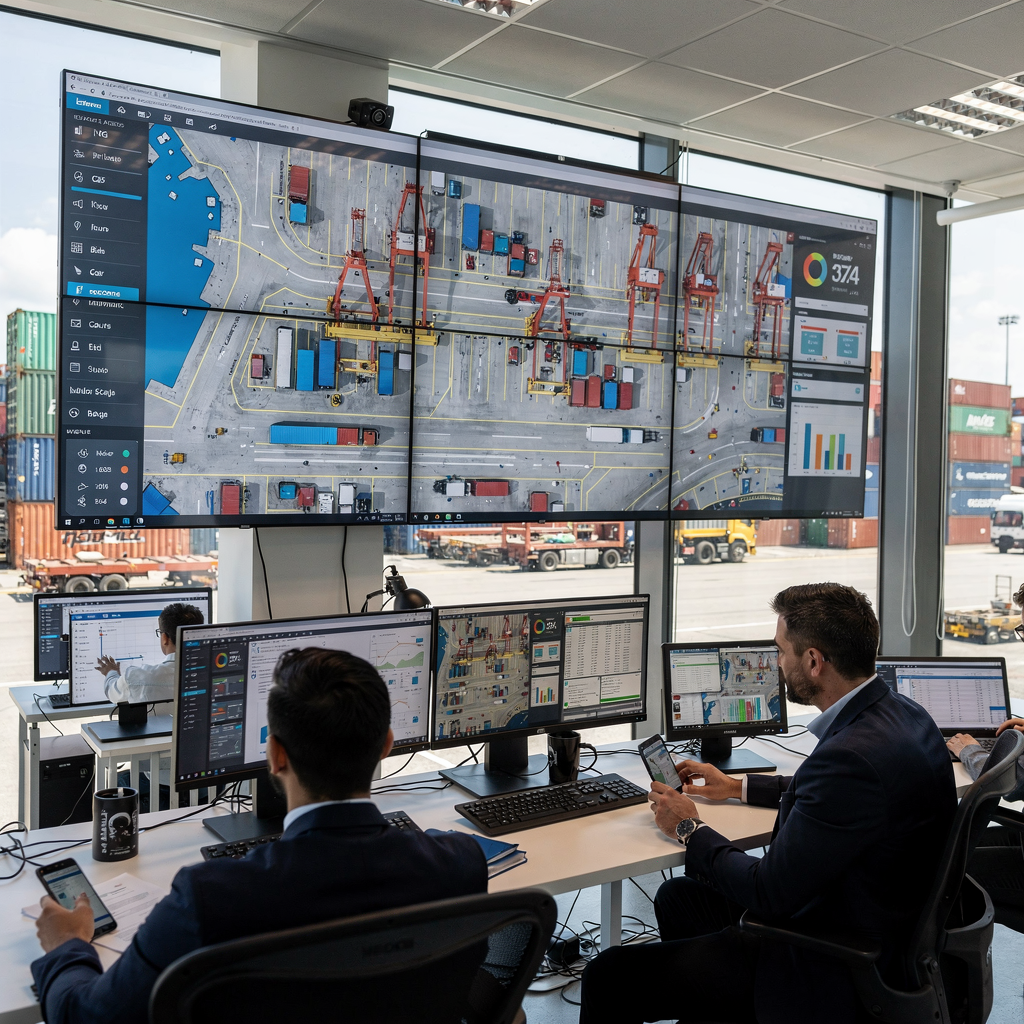
Real-time monitoring turns fragmented status updates into a continuous situational picture. Sensors installed on cranes, trucks, and handling equipment stream location, load, and health metrics. An Internet of Things layer links those sensors to central workflows. The live feed enables operators to see where critical components are, what their health status is, and when to move assets to meet demand. This view reduces idle time and prevents shortages before they cause delays.
Sensor networks feed AI models and dashboards. AI technology ingests sensor data and flags anomalies. These dashboards provide clear decision support and alert the right teams immediately. This reduces noise and ensures that alerts for urgent faults reach technicians fast.
Beyond alerts, real-time visibility supports dynamic allocation decisions. A real-time predictive maintenance function combines live telemetry with past failures to estimate remaining useful life. That predictive model shifts preventive checks to non-peak windows. It also lowers the chance of sudden asset unavailability and unplanned downtime. Ports using a combination of sensors and AI report measurable drops in waiting times and faster vessel servicing Artificial Intelligence in Logistics Optimization with Sustainable Criteria.
Deployment requires careful data integration. Systems must handle data from multiple sources and maintain consistent timestamps for actionability. Thus, teams should prioritize robust data processing and secure links between field devices and control rooms. For a technical take on dynamic pooling and live demand-driven resource allocation, explore the research on dynamic-equipment-pool-allocation-based-on-real-time-demand-in-container-terminals which dives into architecture, APIs, and orchestration patterns.
Drowning in a full terminal with replans, exceptions and last-minute changes?
Discover what AI-driven planning can do for your terminal
Predictive maintenance and dynamic allocation for cargo handling
Predictive approaches reduce both unexpected breakdowns and equipment shortages. Predictive maintenance uses sensor streams, historical records, and machine learning to forecast equipment failures. A predictive maintenance of terminal equipment program prioritises checks on assets that show early warning signs. When implemented, the approach reduces unplanned stops and supports planned reallocation so that cargo continues to move.
Machine learning models, including neural network classifiers and anomaly detection algorithms, can detect subtle patterns that precede faults. These models combine vibration, temperature, cycle counts, and other signals to produce a health index. Operators then route maintenance crews and spare assets accordingly. This intelligent maintenance protects key assets such as quay cranes and yard movers, and it reduces the chance that a single failure will disrupt berth schedules.
Dynamic allocation algorithms work alongside predictive systems. They use demand forecasts for incoming vessels and yard flows to recommend where equipment should move. The algorithms balance priorities, such as minimising vessel waiting times and maximising crane productivity. In practice, a predictive model suggests that moving one extra crane to a busy berth can cut service time and prevent a backlog. Tight integration between maintenance plans and allocation logic prevents competing objectives from creating new bottlenecks.
Maintenance of port equipment requires updated procedures and shared data. Teams must combine maintenance logs, equipment data, and crew availability to create practical schedules. For decision-makers, the combined benefits are clear: lower downtime, fewer starvation events, and improved port operational efficiency. Evidence from applied studies shows crane productivity gains and decreased truck waits when predictive maintenance is paired with dynamic allocation Artificial Intelligence in Logistics Optimization with Sustainable Criteria. For specific methods to reduce idle crane time and improve quay cranes performance, the guide on optimizing-quay-crane-productivity-in-container-terminals offers targeted strategies and benchmarks.
Sustainable port operations: reducing starvation and optimising resources
Intelligent pooling supports achieving sustainability by lowering energy use and emissions. When assets are shared across terminals, fewer machines sit idle consuming standby energy. That reduction in idle power helps cut fuel use and the carbon footprint of operations. Studies show that pooling and smarter scheduling can lower logistics costs while improving service levels; the sustainability paper quantifies these savings and links them to reduced emissions Artificial Intelligence in Logistics Optimization with Sustainable Criteria.
Sharing cranes, trucks, and handling machinery yields capital expenditure advantages. Rather than buying redundant units for each terminal, operators form a common pool. This lowers acquisition costs and reduces the need for spare parts. For ports looking to optimize the long-term balance sheet, pooled assets free capital for other investments, such as electrification or energy storage. In practice, a container port that adopts pooling may reassign a fraction of its crane fleet during off-peak hours and avoid buying an extra unit.
Energy-efficient job allocation and smarter sequencing further trim waste. AI models can schedule moves to reduce empty runs and cluster high-power tasks when renewable energy is abundant. Such strategies help with achieving sustainability goals and support peak efficiency without compromising throughput. For technical teams, this links to broader planning work such as port planning and energy management; see energy-efficient-job-allocation-in-port-operations for frameworks and algorithms that match tasks to energy profiles.
Finally, sustainability and resilience reinforce each other. By reducing the number of idle assets and by improving uptime through predictive maintenance, ports lower total lifecycle emissions. This drives better environmental performance and reduces operational risk. Ports are responsible for delivering efficient service while lowering impacts on local communities and the wider maritime industry. Intelligent pooling is a practical lever to do both.
Drowning in a full terminal with replans, exceptions and last-minute changes?
Discover what AI-driven planning can do for your terminal
Case studies on berth allocation and AI-driven throughput improvements
Real deployments show measurable gains. One major container port implemented intelligent pooling and AI-driven allocation and reduced equipment starvation incidents by 40%, which led to a 15% drop in vessel turnaround time Artificial Intelligence in Logistics Optimization with Sustainable Criteria. That example highlights how algorithmic berth allocation and cargo sequencing interact to improve port throughput. Clear rules for shared ownership and cross-terminal coordination proved essential to success.
AI algorithms for berth allocation use historical and live predictors to sequence vessel arrivals and assign quay cranes. These tools also account for yard stack density, truck schedules, and cargo priorities. Combining berth allocation with dynamic equipment pooling reduces idle crane time and aligns resources with real demand. For technical readers interested in algorithmic details, reinforcement learning techniques for terminal operations have shown promise to adapt to varied traffic patterns; see reinforcement-learning-in-terminal-operations-crane-scheduling for an in-depth exploration.
Stakeholder coordination matters as much as technology. In the case study, operators set clear escalation paths, shared equipment logs, and joint maintenance windows. They also used shared KPIs to allocate costs and benefits fairly. Integrating maintenance schedules, demand forecasts, and crew rosters avoided conflicts that can otherwise disrupt operations. For organizations seeking a blueprint, the dynamic-equipment-pool-allocation-based-on-real-time-demand-in-container-terminals resource outlines governance models and API patterns for orchestration.
Lessons learned include investing in clean data and testing algorithms in narrow pilots before scaling. One port saw rapid returns after improving data consistency between TOS and yard systems. Another important point was that AI models must be explainable to earn trust; teams preferred models that offered decision support with clear rationale rather than opaque recommendations. These principles helped ports move from pilot projects to sustained improvements in port throughput and port performance.
Predictive strategies: future of port and berth optimisation
Predictive strategies will shape the next generation of operations. Demand for shipping fluctuates, and AI can sense those shifts early. Models that combine historical and real-time data will predict demand spikes, enabling proactive allocation and staffing. Deep reinforcement learning and neural network hybrids will improve scheduling under uncertainty. These approaches reduce the probability that a single failure will disrupt an entire berth schedule.
Integration with digital twins will let planners run scenarios and stress-test responses. Digital twins simulate equipment and yard states, and they allow what-if testing for extreme conditions. Combined with real-time predictive maintenance, these tools will keep assets healthier and more available. They will also support intelligent transportation patterns across gateway networks and improve coordination with inland terminals.
To adopt predictive systems, ports should start with a focused pilot that links sensors, data processing, and decision support. Begin by instrumenting a subset of quay cranes and a set of trucks, then implement a predictive model for fault detection and maintenance scheduling. Use clear KPIs such as reduced waiting times and improved quay cranes utilization. Remember to include operational teams early so that algorithms match real workflows and to integrate with systems such as TOS, WMS, and ERP.
Finally, consider organizational change: new roles for data stewards, clearer SLAs for pooled assets, and processes that let AI recommendations be reviewed before action. As ports move toward smart port architectures powered by AI and real-time predictive maintenance, they will reach peak efficiency while driving sustainability and resilience. For more on adoption steps and operational integration, the guide on operational-efficiency-in-container-ports and the piece on improving-container-port-gross-crane-rate-with-ai provide actionable paths forward.
FAQ
What is equipment starvation and why does it matter?
Equipment starvation happens when handling assets are not available where and when they are needed. It matters because it slows cargo handling, increases vessel turnaround times, and raises costs for port operators and shipping lines.
How does real-time monitoring prevent equipment shortages?
Real-time monitoring gives operators up-to-the-minute visibility into asset location and condition. With that information, teams can redeploy resources quickly and reduce idle time, preventing shortages that would otherwise disrupt berth schedules.
Can AI help predict equipment failures?
Yes. AI and machine learning analyze sensor data and maintenance logs to detect patterns that precede equipment failures. This enables predictive maintenance that lowers unplanned downtime and keeps assets available for peak cargo handling.
What are the sustainability benefits of intelligent pooling?
Intelligent pooling reduces the number of idle machines and cuts unnecessary trips, which lowers energy use and emissions. Shared assets also reduce capital needs, freeing funds for electrification and other green investments.
Are there real-world results from AI-driven pooling?
Yes. For example, a major container port reported a 40% reduction in starvation incidents and a 15% decrease in vessel turnaround time after deploying intelligent pooling and AI-driven allocation study. These results show clear operational and financial gains.
What technology does a port need to start?
Begin with sensors on key equipment, robust data collection and data processing pipelines, and a decision support layer that uses predictive models. An initial focus on a few critical cranes or yard areas helps to prove value before scaling.
How do ports coordinate shared assets across terminals?
Successful coordination relies on governance frameworks, shared KPIs, and clear escalation paths. Joint maintenance windows, transparent cost-sharing, and interoperable APIs help terminals pool resources without creating conflicts.
Yes. This reduces triage time and ensures that critical maintenance and allocation tasks get the right context and ownership.
What skills do teams need to run predictive systems?
Teams need data engineers, domain experts, and maintenance planners who can translate model outputs into operational tasks. They also need IT support for integrations and governance to manage access to equipment data.
How should a port begin testing predictive allocation?
Start with a pilot that focuses on a single berth or yard block. Instrument assets with sensors, run a predictive model for a limited period, and measure KPIs like waiting times and crane productivity. Then iterate and scale based on those measured gains.
our products
 stowAI
 stackAI
 jobAI
jobAI
Innovates vessel planning. Faster rotation time of ships, increased flexibility towards shipping lines and customers.
Build the stack in the most efficient way. Increase moves per hour by reducing shifters and increase crane efficiency.
Get the most out of your equipment. Increase moves per hour by minimising waste and delays.
stowAI
Innovates vessel planning. Faster rotation time of ships, increased flexibility towards shipping lines and customers.
stackAI
Build the stack in the most efficient way. Increase moves per hour by reducing shifters and increase crane efficiency.
jobAI
Get the most out of your equipment. Increase moves per hour by minimising waste and delays.