
terminal capacity and yard design for mega-ships
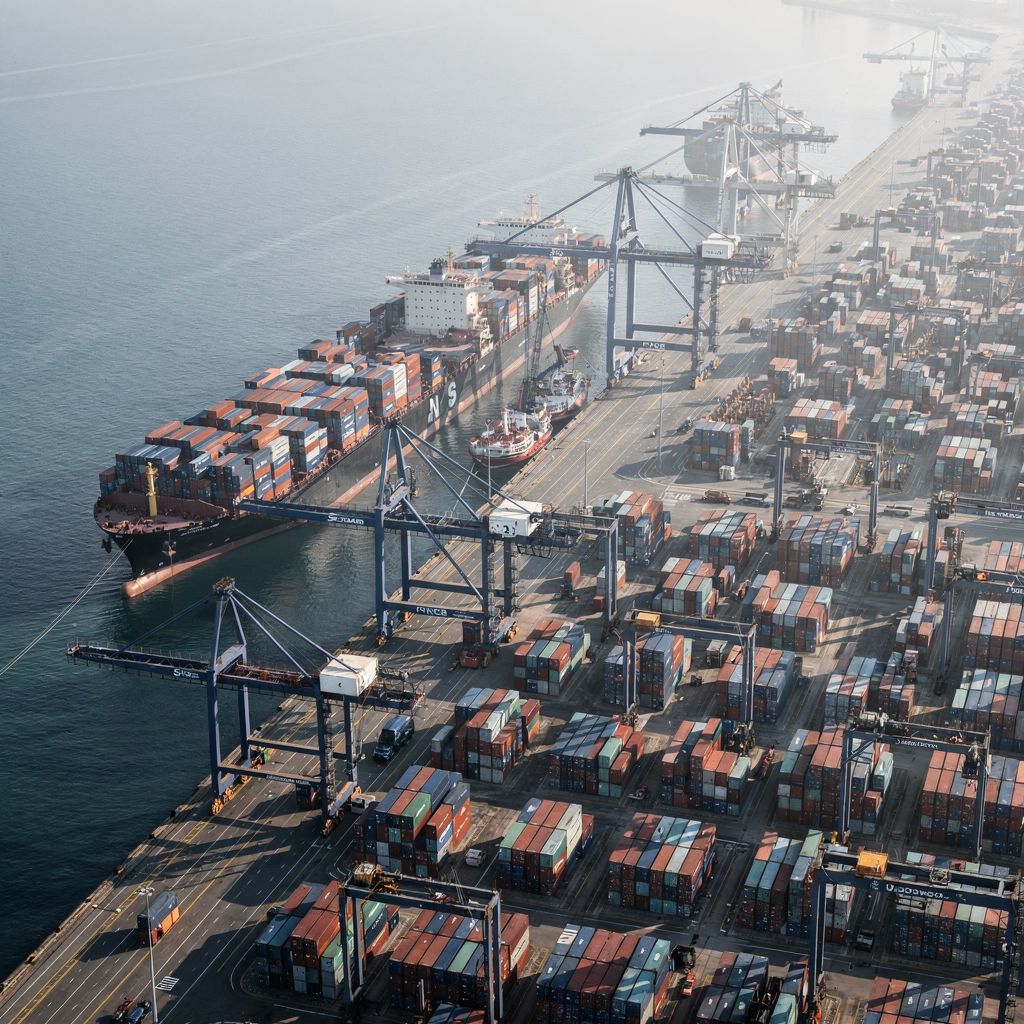
Terminal planners now design for VESSEL SIZES that once seemed improbable. Mega-ships above 20,000 TEU concentrate three times the containers per call compared with mid-generation vessels. For example, modern mega-ships can carry upwards of 24,000 TEUs, which changes berth requirements and yard flows (ITF: The Impact of Mega-Ships). Ports must provide longer quay, deeper drafts, and heavier handling equipment. These factors raise capital needs and alter deployment schedules.
Throughput trends amplify pressure. Many container ports grew at annual rates of roughly 4–6%, and leading hubs now exceed 15 million TEU per year (UNCTAD: Review of maritime transport 2024). In busy seasons vessel calls cluster. As a result, congestion spikes and vessel waiting times may surpass 48 hours, causing real economic losses and schedule uncertainty (ScholarWorks: Port and Terminal Congestion). Planners must anticipate those peaks. Otherwise, terminal productivity collapses and customers suffer.
Yard layout must balance storage, retrieval speed and safety. Design principles include dedicated storage blocks, clear inbound and outbound lanes, and layered access for horizontal transport. Stack height and density increase yard space efficiency, but higher stacks raise reshuffle risk and slow container handling. A mix of dense storage and fast-access lanes works well. Use shuttle loops to reduce empty driving and minimize driving distance for RTG and tractor units. For example, modular storage blocks near the quayside shorten rehandle times and protect service level for expected departure slots.
Allocation of yard space must be dynamic. Planners should reserve flexible blocks for last-minute changes and for priority carrier calls. In practice, a terminal that can dynamically reallocate space will limit bottleneck effects. Loadmaster.ai trains RL agents inside a digital twin to learn such allocation policies. The agents aim to reduce rehandles while keeping quay crane productivity high, so the yard strategy complements berth plan and optimizes overall throughput. For deeper context on stowage strategies see our piece on stowage planning fundamentals.
terminal operating systems: core functions and integration
A terminal relies on coordinated software to run daily work. A terminal operating system ties vessel planning, berth schedules, yard control and gate activities into one workflow. The TOS serves as the backbone for dispatch, for crane assignment and for gate throughput monitoring. A single terminal operating system instance helps reduce manual handoffs and clarifies responsibilities across teams. It also supports SLA adherence and visibility for carrier partners.
Key modules include vessel planning, berth allocation, yard management, and gate operations. Each module must exchange data with others. For instance, berth changes should update quay crane schedules and adjust yard allocation within minutes. To get there terminals must consolidate IoT feeds, AIS signals, and sensor telemetry. These data streams enable a single source of truth and improve decision cadence. While doing so, operators must manage latency and data consistency across systems. For more on API integration and latency challenges see our technical note on managing latency and data consistency.
Standards and APIs solve many integration problems. Without them, data silos block end-to-end visibility and slow analytics. In practice a TOS that exposes clean APIs enables third-party plugins, advanced analytics, and modular upgrades. That approach supports scalable upgrades and allows terminals to integrate new capabilities without full rewrites. For example, a TOS-agnostic plugin can add job allocation optimization or predictive maintenance without altering core systems; learn more about TOS-agnostic integrations in our write-up on TOS-agnostic software plugins.
Interfaces with shipping lines, rail operators, and customs require both technical and process alignment. Customs pre-clearance feeds accelerate yard turns and reduce dwell time at gates. Rail manifests and inland carrier ETAs improve intermodal connections. A strong terminal operating setup reduces manual matching of bookings to containers and so helps to optimize both quay and hinterland flows. Finally, the terminal ecosystem benefits when analytics tools can visualize KPIs across all modules for agile management and continuous improvement.
Drowning in a full terminal with replans, exceptions and last-minute changes?
Discover what AI-driven planning can do for your terminal
automation in quay and yard: robotics, AGVs and AI
Automation improves speed and reduces human exposure to repetitive tasks. Quay cranes are increasingly semi-automatic and sometimes fully automated. Modern quay cranes and quay cranes with advanced control can sustain higher moves per hour and more consistent productivity. Automated cranes lower human error during loading and unloading while protecting safety for dock crews. That said, deployment requires careful layout, safety protocols and fail-safes.
AGVs and autonomous trucks offer different value propositions. AGVs suit predictable quayside loops and automated container terminals where lane control is precise. Autonomous trucks can add flexibility for mixed traffic environments. Each choice affects horizontal transport patterns, yard routing, and gate sequencing. For terminals that want high flexibility, a hybrid fleet of AGVs and trucks can serve seasonal peaks and special assignments.
AI-driven allocation models change how tasks are assigned. Reinforcement learning and prescriptive analytics enable agents to balance quay productivity against yard congestion and travel time. For example, AI can coordinate crane assignment, shuttle routing, and stack allocation to reduce rehandles. Predictive maintenance models also keep cranes and yard cranes online by forecasting failures from sensor streams. That approach reduces unscheduled downtime and protects throughput.
Safety protocols must evolve with automation. Human-machine collaboration zones, clear visual cues, and robust emergency stop logic are non-negotiable. Training programs should pair human operators with automation supervisors. Loadmaster.ai applies RL agents such as StowAI, StackAI and JobAI in a closed-loop digital twin before deployment. This ensures that automated policies are tested and safe prior to live rollout. For deeper reading about deployment trade-offs and idle-time reduction see our article on reducing equipment idle time.
transshipment strategies: optimising intermodal flows
Transshipment hubs need agile strategies. Ship-to-ship transfers and dense feeder networks support regional redistribution. When a terminal acts as a transshipment node it must minimize handling and minimize the time containers spend in the yard. Efficient container flow here is a balance of service level and cost control.
Intermodal connections reduce road pressure and cut emissions. Rail and inland waterway links are key to unlocking hinterland capacity. Coordinated schedules between liners and rail operators reduce dwell time and lower truck trips. Customs pre-clearance and blockchain-based manifests also speed handovers and cut paperwork. A transparent chain of custody shortens clearance cycles and reduces inspection-related delays.
Container shipment assignment algorithms optimize routing across modes. These discrete algorithms assign containers to specific shuttles, railcars or feeder legs to meet forecast demand. Good algorithms consider expected departure slots, service level targets, and quay crane feeds. They also hedge for seasonal peaks and equipment shortages.
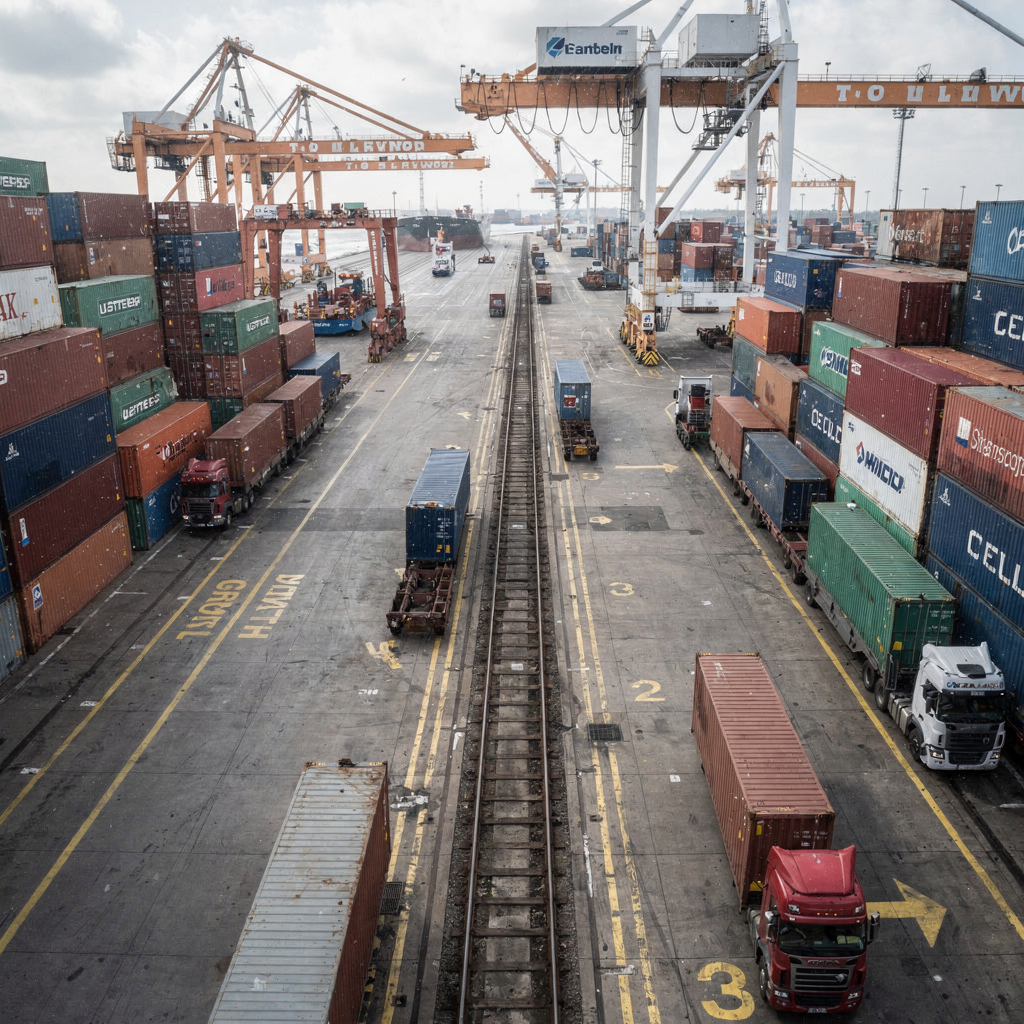
For intermodal terminals the container yard design must support quick outbound moves and smooth staging for liners. Shuttle frequencies should match berth windows to avoid creating bottleneck queues at the quayside. When possible, use designated lanes and staging blocks for transshipment cargo to separate it from long-term storage. Loadmaster.ai’s approach trains agents inside a digital twin to reduce driving distances and prevent uneven workloads across cranes and shifters. For thinking on autonomous terminals and future fleet strategies see our piece on future of autonomous container terminals.
Drowning in a full terminal with replans, exceptions and last-minute changes?
Discover what AI-driven planning can do for your terminal
terminal digital twin architecture: real-time simulation and scenario analysis
Digital twin models recreate terminal behavior in software. They combine data sources like TOS records, crane telemetry, AIS, and sensor feeds to mirror the live site. Building the digital twin requires model calibration and frequent update cycles to remain accurate. The model then serves for forecasting, stress-testing, and operator training.
Data inputs include vessel schedules, yard inventory, truck ETAs, and equipment health signals. Calibration aligns simulation outputs with observed KPIs such as berth occupancy and yard utilisation. Update cycles vary. Some terminals refresh near-continuously, while others update hourly. The trade-off is speed versus computational cost.
Scenario testing helps planners prepare for common disruptions. Run what-if runs for vessel delays, equipment failures, or sudden peaks. A scenario might simulate a multi-day berth shift change and estimate time of vessels impacts across the port. These runs reveal bottleneck risks and suggest mitigation such as temporary shuttle increases or reallocation of RMGS and yard cranes.
KPI visualization is central. Dashboards must present berth occupancy, dwell time, gate throughput and quayside move rates. Clear visuals speed decisions and support continuous optimization. Integrating AI for what-if analysis lets planners evaluate many alternatives fast. For instance, reinforcement learning agents can explore assignment policies in simulation and recommend ones that preserve quay productivity while limiting yard congestion. Our team trains agents in a sandbox digital twin so terminals can validate policies without risking live operations; learn more about digital twin approaches in our overview on inland terminal simulation.
automation and AI-driven decision support: future research directions
Next-generation research blends reinforcement learning with prescriptive analytics. That fusion yields decision support systems that propose actions and explain trade-offs. For example, a policy could trade short-term crane productivity for long-term yard balance. The system quantifies that move and shows expected KPI shifts.
Blockchain-based data sharing can secure manifests and facilitate customs pre-clearance. When stakeholders trust shared records, clearance delays drop and the handover between carrier and inland haulier speeds. Standards for data exchange will be crucial to enable end-to-end visibility across the transport system. Industry collaboration is needed to define those schemas and governance rules.
Research should also explore standards and the next generation container port challenge in practical pilots. Workstreams should cover API standards, cyber resilience and regulatory alignment, including references to the EU AI Act where appropriate. Investment questions remain too. Terminals must assess trade-offs between automation CapEx and operational savings over time. Case studies show gains when automation reduces rehandles and shortens dwell time, but the upfront cost and integration burden require careful planning.
Finally, decision support must be human-centric. Systems should provide actionable, explainable recommendations and maintain planner control. For example, Loadmaster.ai’s closed-loop agents—StowAI, StackAI and JobAI—train in a digital twin and then propose policies under operational guardrails. That method increases scalability, reduces operator firefighting, and sustains productivity across shifts. Future research should continue to combine simulation-based learning, blockchain data sharing, and clear standards for seamless, secure, and fair integration across stakeholders. For more on job allocation and deployment strategies see our analysis on equipment job allocation optimization.
FAQ
What are the main berth impacts of 20,000-plus TEU vessels?
Large vessels require longer berth length and deeper drafts. They also concentrate many TEUs in one call, which raises short-term crane demand and yard allocation pressure.
How can a terminal reduce congestion and vessel waiting times?
Improved berth planning, pre-clearance, and dynamic yard allocation help reduce dwell time. Automation and better scheduling also cut delays and speed turnarounds.
What is a terminal operating system and why is it important?
A terminal operating system connects berth planning, yard control, gate operations and reporting in one place. It reduces manual handoffs and enables consistent execution across the terminal.
How do AGVs compare with autonomous trucks in yard operations?
AGVs offer precise automated loops for controlled environments. Autonomous trucks provide flexibility in mixed traffic but need more complex safety and routing logic.
What role does a digital twin play in planning?
A digital twin simulates terminal behavior so teams can test scenarios safely. It supports training, what-if analysis, and the validation of AI-driven policies before live deployment.
Can blockchain speed customs handovers?
Yes. Shared, tamper-proof manifests accelerate verification and lower the need for repeated checks. That can shorten gate dwell times and improve intermodal handovers.
What KPIs should terminals monitor in real-time?
Key KPIs include berth occupancy, yard utilisation, gate throughput and dwell time. Monitoring these metrics enables prompt corrective actions and better service consistency.
How do reinforcement learning agents help terminal planners?
RL agents test millions of policies in simulation to find strategies that balance multiple KPIs. They can reduce rehandles, shorten driving distances, and stabilize performance across shifts.
Are automated container terminals safe for mixed traffic?
They can be, but safety relies on robust protocols, human-machine zones and redundant shutdown systems. Planning must include training and staged rollouts to manage risk.
How should terminals approach investment in automation?
Terminals should pilot within a digital twin and scale proven gains. Cost-benefit analysis must weigh CapEx against long-term labour savings and improved port efficiency.
our products
 stowAI
 stackAI
 jobAI
jobAI
Innovates vessel planning. Faster rotation time of ships, increased flexibility towards shipping lines and customers.
Build the stack in the most efficient way. Increase moves per hour by reducing shifters and increase crane efficiency.
Get the most out of your equipment. Increase moves per hour by minimising waste and delays.
stowAI
Innovates vessel planning. Faster rotation time of ships, increased flexibility towards shipping lines and customers.
stackAI
Build the stack in the most efficient way. Increase moves per hour by reducing shifters and increase crane efficiency.
jobAI
Get the most out of your equipment. Increase moves per hour by minimising waste and delays.