
ai agent and port: the rise of artificial intelligence in maritime operations
An AI agent is an autonomous or semi-autonomous software component that senses, reasons, and acts in an environment to achieve goals. In a port context, an AI agent can plan a stow, sequence crane moves, or manage truck appointments while observing constraints and KPIs. AI agents are designed to handle complexity that humans and static rules find hard to manage. They respond to changing vessel mixes, yard states, and interruptions, and they learn policies that generalize beyond historical patterns. This ability matters because ports must move more cargo with fewer surprises.
Ports face growing cargo volumes and more variable trade patterns. As a result, terminal operators need artificial intelligence that can streamline scheduling, reduce rehandles, and improve consistency across shifts. For example, studies show AI-enhanced smart maritime logistics can raise throughput by up to 20% and cut turnaround times by about 15% when multi-component AI coordinates planning and execution (PDF) AI-Enhanced Smart Maritime Logistics: Spotlighting Port …. That kind of uplift reduces congestion, and it changes how stakeholders measure value.
Key drivers for AI adoption include digital transformation, the need for resilience, and the pressure to optimize scarce quay and yard capacity. Terminal operators that adopt AI shift from firefighting to planning. They automate repetitive tasks, protect stowage quality, and streamline loading and unloading. In practice, AI can also act as a decision-maker that balances crane productivity against yard congestion and driving distance. For teams that want a fast path to production, building digital twins helps validate choices before live rollout; see our digital twin testing resource for more detail digital twin container port yard strategy testing.
To be clear, artificial intelligence in ports does not replace human expertise. Instead, it augments domain experts and preserves tribal knowledge. Designed for specific domains, AI agents capture policy trade-offs and then execute them reliably. That approach helps terminals streamline operations and improve resilience against disruptions.
multi-agent orchestration for real-time workflow automation in terminal operations
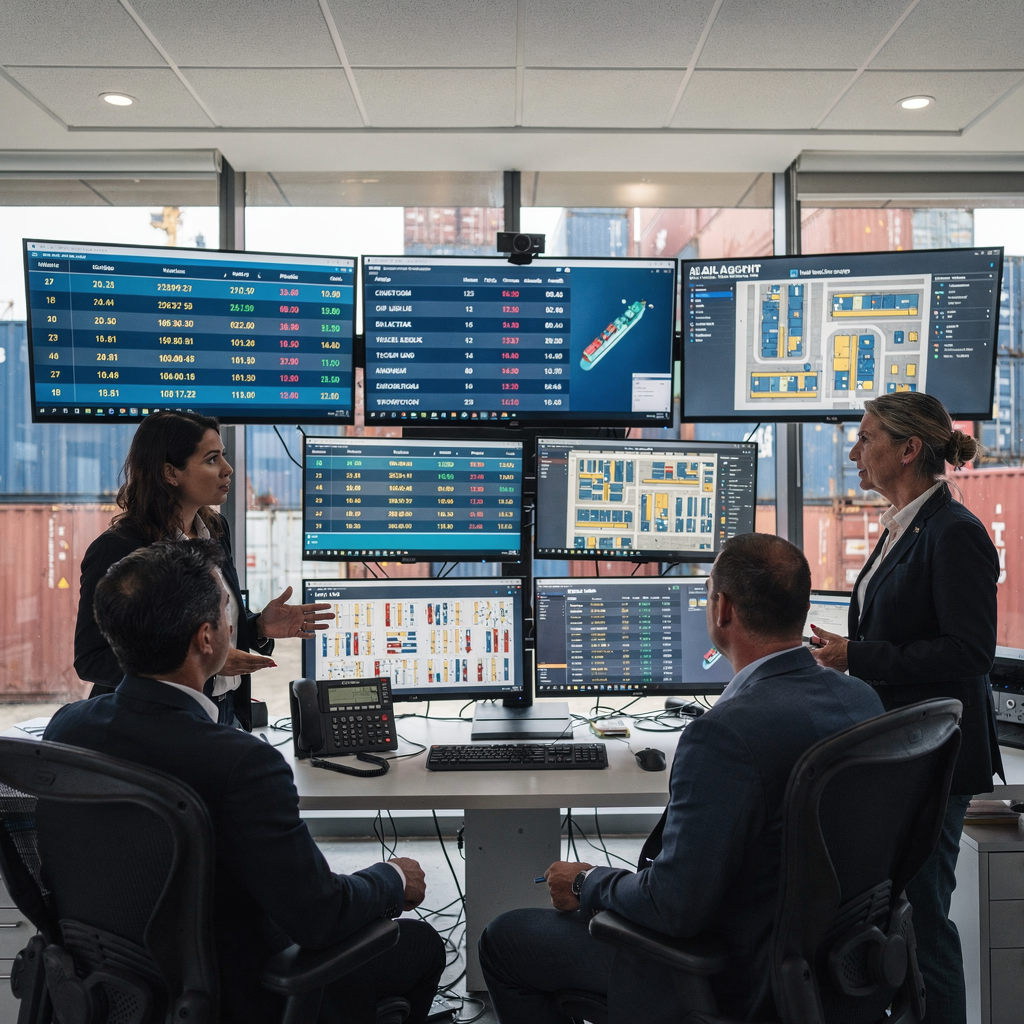
Multi-agent orchestration brings many cooperating AI agents together to run end-to-end terminal workflows to optimize throughput and reduce delays. In this setup, multi-agent systems coordinate specialized agents that handle berth allocation, crane sequencing, yard moves, gate flow, and hinterland handoffs. Each agent focuses on a subtask while the orchestration layer ensures the system meets shared KPIs.
Agents operate with context-aware heuristics and learned policies. For example, a berth manager agent negotiates arrival windows while a crane agent sequences discrete moves, and a yard strategist places containers to reduce future reshuffles. The system can support multi-agent negotiation so that conflicts get resolved automatically and ways to optimize emerge without manual rework. Because the orchestration layer runs in real-time, the system can adapt as conditions change.
Orchestration protocols matter. Standardized messaging and control systems let agents exchange intent, reservation, and status messages. They also provide automated workflows that keep equipment busy and cut idle time. Control systems must handle both continuous and discrete signals, and they must connect to PLCs and telemetry without slowing down. To see architectural patterns and event-driven approaches, visit our piece on simulation models and event-driven AI simulation models for automated terminal operations.
Real-time orchestration unlocks clear benefits. Terminals can optimize berth allocation and yard flow, reduce waiting, and shorten queues at gates. The approach also enables autonomous agents to act autonomously with guardrails, so execution stays safe. Finally, specialized agents such as QC planners and yard strategists improve specific outcomes while the orchestration prevents local optimization from harming global KPIs. In short, multi-agent orchestration provides workflows to optimize the full terminal loop.
Drowning in a full terminal with replans, exceptions and last-minute changes?
Discover what AI-driven planning can do for your terminal
agent use cases and ai agent use cases for berth planning and ETAs
AI agent use cases in ports focus on high-impact problems such as predictive ETAs, berth planning, crane sequencing, and yard stacking. A common use case is predictive ETAs for inbound vessels. By combining AIS, weather, and port congestion data, agents produce ETAs that let planners allocate berths earlier. Better ETAs reduce idle time at berth and help avoid late arrivals that cascade into yard congestion. Research shows predictive coordination can reduce turnaround time by roughly 15% in pilot trials (PDF) AI-Enhanced Smart Maritime Logistics: Spotlighting Port ….
Other agent use cases include yard stacking optimization, truck appointment scheduling, and crane assignment. Specialized agents handle yard placements to minimize travel and protect future plans. For example, a yard strategist can place imports to reduce rehandles while a job dispatcher sequences moves across quay, yard, and gate. These agents work with IoT sensors on equipment and containers to track state and to feed a data-driven planning loop. When an anomaly appears, agents can propose corrective moves and flag the plan for human review.
Quantitative benefits appear quickly. The South Korean smart maritime port study reports measurable throughput gains when AI coordinates across tasks, up to a 20% improvement in some blocks (PDF) AI-Enhanced Smart Maritime Logistics: Spotlighting Port …. Those gains translate to reduced operational costs and fewer delays. Terminal operators also see fewer rehandles and shorter driving distances, which cuts fuel and time. If you want to learn how yard strategy patterns matter, see our analysis of yard strategy optimization using stowage masks AI-driven yard strategy optimization using stowage mask patterns.
ai agents vs traditional automation: disruption and agentic ai in port operations
AI agents vs traditional automation is a common debate. Traditional automation uses fixed rules and scripts. Those systems work well for predictable, repetitive tasks. However, when exceptions arrive, rule engines break down. AI agents, by contrast, learn patterns and can adapt. They handle exceptions more gracefully. That reduces the need for constant manual fixes.
Agentic AI and agentic systems move orchestration from fixed rules to self-improving policies. For instance, a learning planner can adjust priorities when cranes slow or when a truck surge hits the gate. This adaptive behavior increases resilience, and it can improve safety. As one study puts it, “AI agents, with their ability to process vast amounts of data in real time and make informed decisions, are at the heart of this transformation” Enhancing Safety in Autonomous Maritime Transportation Systems …. Yet the shift brings new responsibilities. Oversight and governance must ensure agent behavior remains predictable, explainable, and auditable.
Agentic AI adds disruption potential in several dimensions. It reduces operator cognitive load, it lowers accident risk, and it automates coordination across the quay and yard. Still, safety remains top of mind. Human intervention remains necessary for novel emergencies. That means terminals need clear audit trails and monitoring so operators can validate and, if needed, override decisions. For example, embedding safety rules into decision models helps keep outcomes within acceptable limits; see our work on embedding operational safety rules embedding operational safety rules into AI decision models for port operations.
Drowning in a full terminal with replans, exceptions and last-minute changes?
Discover what AI-driven planning can do for your terminal
deploy and integrate AI agents for port optimisation: agents integrate and use ai in supply chain
To deploy AI agents successfully, teams must follow a practical sequence. First, define KPIs and the management system that will accept agent output. Second, create a digital twin to train policies safely. Third, connect agents to telemetry and legacy control systems via APIs and EDI. Finally, run pilots that validate performance and safety. Our approach trains in simulation so systems start useful on day one and then refine online with live feedback.
Technical challenges include integrating with legacy systems, ensuring data flows from IOT SENSORS, and maintaining audit trails for governance. Many terminals rely on a TOS and older control systems; agents must interface without disrupting operations. To integrate agents, engineering teams design a monitoring system and define guardrails. They also plan for monitoring and debugging so staff can inspect decisions and validate outcomes.
AI also brings new tools. Generative AI can produce explanations and reports, and predictive models can flag an anomaly before it cascades. When combined with reinforcement learning, specialized agents can learn robust policies without heavy historical training data. That approach helps overcome data scarcity and enables cold-start readiness. Terminals must also address downtime sensitivity. Agents should offer fallbacks so operations continue during maintenance. Finally, to help terminal operators use AI responsibly, systems should provide human intervention paths and clear audit trails that support security and governance and EU AI Act readiness. For architectures that show how agents integrate across systems, see our piece on cloud versus edge AI cloud versus edge AI for container ports.
real-world examples of AI agents work in maritime: multi-agent success stories
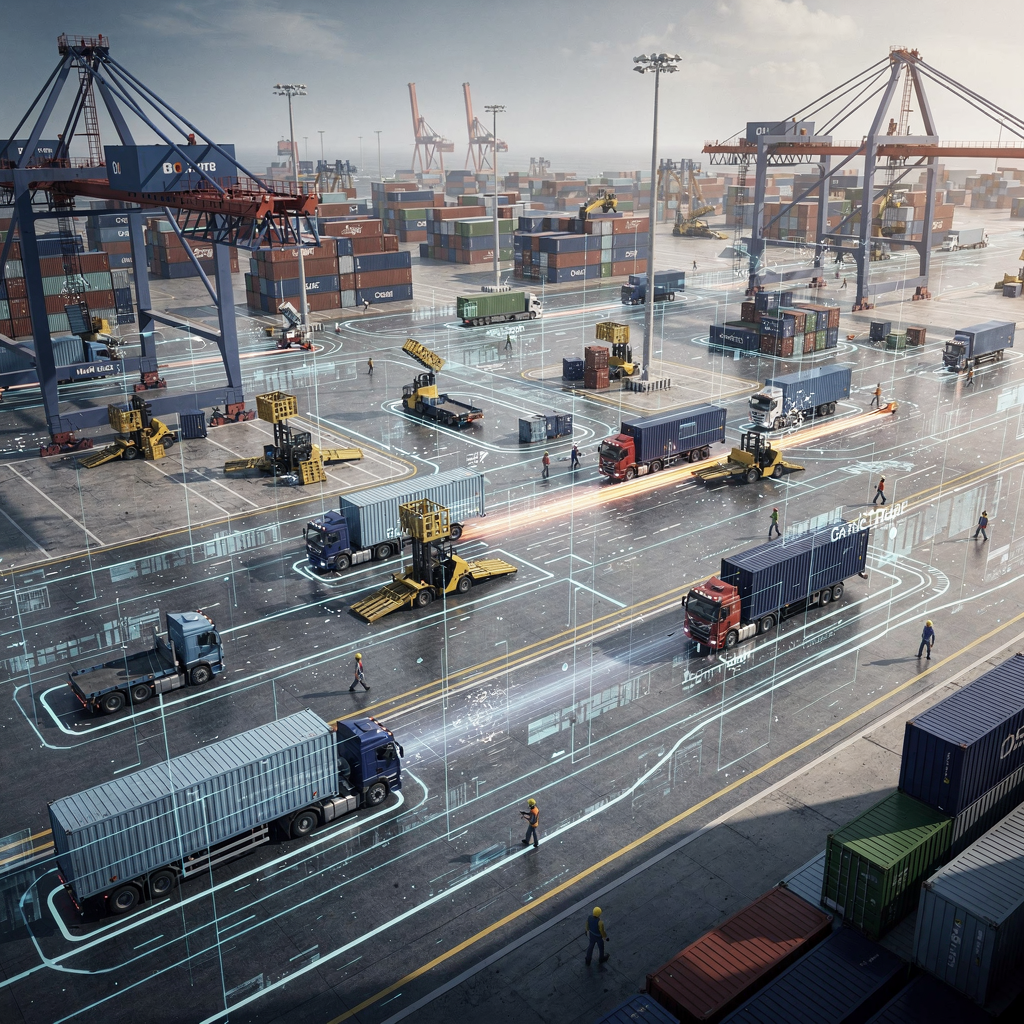
Real-world pilots give the clearest evidence. A South Korean smart maritime port pilot reported measurable gains in throughput and turnaround time after deploying coordinated AI agents (PDF) AI-Enhanced Smart Maritime Logistics: Spotlighting Port …. Specifically, the study cites up to a 20% throughput improvement and roughly 15% shorter vessel stays. Safety pilots using real-time AI agents showed safety incident drops of around 10–12% in experimental deployments Enhancing Safety in Autonomous Maritime Transportation Systems ….
These statistics point to business outcomes. Terminals that adopt AI report reduced operational costs and more stable performance across shifts. In one review, ports that applied AI methods saw operational cost reductions in the range of 10–18% thanks to predictive maintenance and better allocation of equipment The Role of Applying Artificial Intelligence in Improving Supply …. That value appears without adding headcount, because automation replaces repetitive tasks and streamlines coordination.
Looking ahead, smart ports will scale agentic AI platforms that combine digital twins, multi-agent orchestration, and robust governance. Multiple terminals can share lessons, and systems can leverage transfer learning to speed up deployments. To explore how container terminal capacity planning and digital twins interact in real projects, read our article on container terminal capacity planning using digital twins container terminal capacity planning using digital twins.
At Loadmaster.ai we build reinforcement learning agents that train in sandboxes and then deploy with operational guardrails. Our trio of agents—StowAI, StackAI, and JobAI—shows how specialized AI agents can work together to cut rehandles, shorten routes, and stabilize performance. As more terminals adopt these approaches, the opportunity to scale improvements across global chains grows. The future will blend measurable gains in throughput, smarter risk control, and consistent execution across many terminals.
FAQ
What is an AI agent in the context of a port?
An AI agent is software that senses environment data, makes decisions, and acts to meet goals such as reducing waiting time or balancing yard quality. It works alongside humans and systems to automate repetitive tasks and to support planners with policy-driven suggestions.
How do multi-agent systems improve berth planning?
Multi-agent systems split the problem into smaller, coordinated responsibilities: an arrival agent predicts ETAs, a berth agent allocates slots, and crane agents plan moves. This distributed approach reduces conflicts and allows dynamic reallocation when delays appear.
Can AI predict ETAs more accurately than traditional methods?
Yes. By combining AIS, weather, and port state, predictive models give earlier and more accurate ETAs that help with berth planning and reduce cascading delays. Studies have documented turnaround-time reductions when predictive coordination is used (PDF) AI-Enhanced Smart Maritime Logistics: Spotlighting Port ….
Are specialised agents safe to use around cranes and trucks?
When designed with hard constraints and tested in digital twins, specialized AI agents respect safety rules and limit risky actions. Safety studies report fewer incidents in pilot deployments when agents operate with human oversight Enhancing Safety in Autonomous Maritime Transportation Systems ….
How do you integrate agents with legacy systems?
Integration typically uses APIs, EDI, and telemetry adapters so agents exchange state with the TOS and equipment control systems. Teams should plan for monitoring and debugging, and for fallbacks that keep operations running during upgrades.
Do AI agents require lots of historical data?
Not always. Reinforcement learning agents can train in digital twins to generate experience, so they start useful without lengthy historical records. That approach avoids copying past mistakes and helps when historical data is poor.
What governance is needed for agentic systems?
Agents require audit trails, explainability, and human-in-the-loop controls to allow intervention when necessary. These elements support security and governance and make it easier to validate decisions during audits.
How do AI agents handle anomalies?
Agents detect anomalies via predictive models and signal a response, which can include corrective actions or escalation to humans. Combining anomaly detection with generative explanations helps teams understand root causes quickly.
What business value can terminals expect from AI agents?
Terminals can expect measurable reductions in operational costs, fewer rehandles, and higher crane productivity that lead to improved throughput and faster vessel turnaround. Real-world pilots report double-digit percentage gains in throughput and cost savings.
How do I start a pilot with AI agents at my terminal?
Begin by defining KPIs, creating a sandbox digital twin, and selecting a focused use case such as stack optimization or berth planning. Then run simulation-based training, validate results, and deploy with guardrails and clear human intervention paths.
our products
 stowAI
 stackAI
 jobAI
jobAI
Innovates vessel planning. Faster rotation time of ships, increased flexibility towards shipping lines and customers.
Build the stack in the most efficient way. Increase moves per hour by reducing shifters and increase crane efficiency.
Get the most out of your equipment. Increase moves per hour by minimising waste and delays.
stowAI
Innovates vessel planning. Faster rotation time of ships, increased flexibility towards shipping lines and customers.
stackAI
Build the stack in the most efficient way. Increase moves per hour by reducing shifters and increase crane efficiency.
jobAI
Get the most out of your equipment. Increase moves per hour by minimising waste and delays.