
Literature Review of container terminal operations
Container stacking and rehandling in deepsea terminals shape berth productivity and vessel turnaround. Research shows rehandling can account for up to 30% of total moves, a figure that directly raises labor, equipment use, and emissions (Assessing performance of container slot allocation heuristics). Also, studies summarised in an operations research review demonstrate that algorithmic approaches can reduce rehandles by about 15–25% depending on layout and flow patterns (Operations research at container terminals). Therefore, improving stacking policies provides measurable gains in throughput and cost control.
Transitioning from quay operations to yard stacking reveals strong interactions. Effective quay crane scheduling impacts how quickly exported and import boxes reach the yard, and it shapes how planners assign storage locations. For example, poorly synced quay crane and yard processes increase the need to reshuffle to access export containers. Furthermore, the literature links quay crane sequencing with yard travel time, and it highlights that slot allocation heuristics must consider both arrival time and departure estimates to limit extra moves (heuristic study).
Also, collaborative logistics across terminals can lower rehandling during peaks by coordinating inbound and outbound flows; a recent study reports reductions close to 18% under coordinated scenarios (collaborative container logistics). In addition, ports that invest in automation and data analytics show a trend to fewer unnecessary moves. For example, automation lessons from Antwerp and Rotterdam link higher automation with lower rehandling rates (automation determinants). Finally, literature emphasises a balanced approach that couples scheduling, storage planning, and real-time decision support to protect berth productivity and to reduce emissions associated with container handling.
Heuristic Approaches for optimising the stack
Heuristics remain practical, fast, and effective for real terminals where data streams change quickly. A common technique prioritises placement by estimated departure, and another ranks by container size to reduce blocking. Also, neighbourhood rules place export containers near the quay to shorten travel times. These methods form the basis of many slot assignment systems because they trade optimality for speed.
A key comparative study evaluated four stacking policies on realistic terminal data and reported up to a 20% reduction in rehandle moves when heuristics used departure estimates and stacking height constraints (policy comparison). Therefore, combining time-to-departure with size-aware placement pays off. However, implementation complexity varies. Simple rules need only arrival and planned lift data. More advanced heuristics require continuous input: updated vessel stow plans, truck ETAs, and the status of handling equipment. As a result, terminals must invest in data integration before full benefits appear.
Additionally, successful heuristic deployment demands real-time adjustments. For instance, when a quay crane sequence changes, the heuristic must reassign slots to avoid future reshuffle. Also, labour and equipment constraints like limited yard crane availability affect which heuristic performs best. Practical considerations include IT integration, staff training, and fallback rules for when data is incomplete.
Finally, many terminals enrich heuristics with short-term optimisation loops. These loops test a few assignment swaps and accept changes that lower expected rehandles. For deeper automation, hybrid approaches combine heuristics and search-based methods to balance speed and quality. For readers interested in algorithmic yard solutions, see our material on smart algorithms for container location assignment and on container terminal yard optimization software solutions.

Drowning in a full terminal with replans, exceptions and last-minute changes?
Discover what AI-driven planning can do for your terminal
Mathematical Model for container stack allocation
Define a mathematical model to formalise decisions and to compare heuristics. Variables typically include container size, estimated departure, and assigned stack level. Also, include constraints for maximum stack height per bay and limits imposed by the number of cranes and their reach. The proposed model uses integer variables to represent whether a container occupies a specific storage location at a given time.
The objective function minimises total rehandles across the horizon while respecting yard layout constraints and crane capacity. In addition, the model may include penalties for long travel distances from quay to yard, and for moves that interfere with scheduled quay crane lifts. Thus the programming model becomes a mixed integer formulation that balances rehandling and operational throughput.
Solution methods vary. Exact integer programming can solve small to medium instances to optimality. Metaheuristics such as tabu search, genetic algorithms, and simulated annealing scale better for realistic container volumes. Also, decomposition methods split the problem into quay scheduling and yard allocation subproblems, which reduces computational burden. Each approach has trade-offs: exact methods give certificates of optimality but demand time. Metaheuristics provide good solutions fast but without optimality guarantees.
Moreover, hybrid pipelines pair short MIP runs with local search refinements to gain reliability. For cases where arrival patterns change, rolling-horizon solves update decisions frequently. The proposed model benefits from accurate inputs like estimated departure and arrival time, yet it remains robust when planners include buffer capacity. For readers who want model-level detail, our discussion on berth allocation and dynamic stowage adjustments may be useful.
Container Flow and yard layout integration
Deepsea ports face high peaks in container volumes and complex patterns of inbound and outbound containers. Flow of containers from quay to yard and back to trucks or feeder vessels defines how often planners must reshuffle. Also, peak demand often coincides with weather or schedule perturbations, and capacity buffers shrink. Therefore, synchronising flows across terminals helps maintain service levels.
Yard layout matters. Bay widths, block lengths, and the number of slots per bay affect crane access and travel time. For example, longer bay blocks can increase crane walk time and delay retrieval. Also, narrow bays reduce stacking density but speed up access. Planners trade storage space for reduced handling time when designing yard layout. Yard layout choices influence the effectiveness of space allocation heuristics and the total number of containers that can be handled without excessive reshuffle.
Collaborative logistics strategies coordinate moves across adjacent terminals and across the hinterland. Shared schedules and cooperative transfer windows reduce duplicate moves. A collaborative approach can lower rehandling during peaks by arranging that export containers move directly to a terminal that has immediate vessel calls. Additionally, ports can use predictive models to reroute flows and to free yard space before surges. See our piece on optimizing inter-terminal transport flows for examples of routing that lowers rehandle risk.
Finally, yard planning tools that combine layout-aware heuristics with flow predictions reduce unnecessary moves. For terminals that run twin automated stacking cranes or an automated container terminal, these integrations are essential. Practical yard management includes buffer sizing, staggered truck windows, and coordinated berth plans so that quay crane scheduling and yard processes work together to reduce overall moves.
Drowning in a full terminal with replans, exceptions and last-minute changes?
Discover what AI-driven planning can do for your terminal
Terminal Operation strategies with AI and automation
AI-driven analytics and automation reshape how terminals assign slots. AI models forecast container departures and truck arrivals. Then optimisation modules assign storage locations to reduce future rehandles. Also, automated stacking and twin automated stacking cranes tighten access and execute plans consistently. These systems combine predictive inputs with constraint-aware assignment to make choices in seconds.
Case studies from major hubs show clear benefits. Ports that adopted higher automation levels report lower rehandling and better throughput. For instance, Antwerp and Rotterdam have demonstrated productivity improvements tied to automation and better data use (automation determinants). Also, the synergistic effect of operational research and big data analytics enables dynamic slot allocation and predictive retrieval, offering significant reductions in unnecessary moves (synergy of OR and big data).
Terminal operating systems with integrated AI make these benefits available in real time. They ingest ERP, TMS, and TOS events and then recommend assignments. Likewise, a terminal using automated stacking cranes benefits when AI agents feed updated departure probabilities into the slot allocation engine.
Integration challenges remain. Handling equipment diversity, legacy IT, and crew acceptance slow adoption. However, automated container terminal pilots show that coupling AI forecasts with automated stacking cranes and coordinated quay crane scheduling can reduce rehandles and speed loading and unloading operations. For more on AI-driven yard management, explore our analysis of AI-driven container port yard management systems and AI modules for automated port planning.
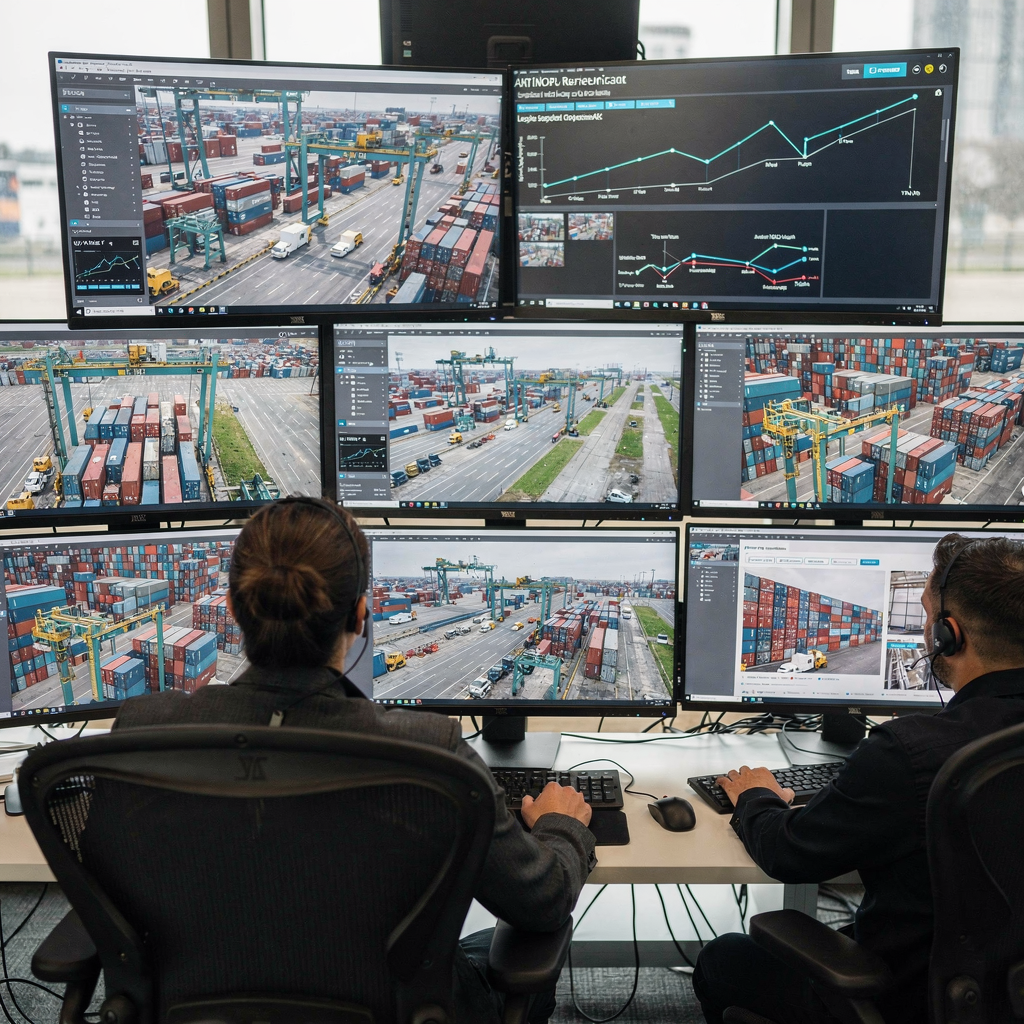
Numerical Experiments evaluating optimisation outcomes
Design experiments to mirror real terminal conditions. A typical setup includes several traffic scenarios, container flow distributions, and yard layout alternatives. Simulations compare heuristic policies and a proposed model across metrics: rehandles, vessel turnaround, and equipment utilisation. Also, test sensitivity to traffic variation to see how robust each method proves when peaks arrive.
In many experiments, heuristic policies reduce rehandles by 15–25% compared to naive placement, matching literature ranges (policy results) and (OR review). Also, when the mathematical model runs as a rolling-horizon optimiser, it often outperforms static heuristics at the cost of more computation. Consequently, planners choose hybrid deployments: run a fast heuristic online and a deeper optimise offline or during low-load windows.
Experiment outputs show benefits beyond rehandle counts. Vessel turnaround improves as fewer moves free quay crane time and reduce berth occupancy. Equipment utilisation evens out when assignments prevent hot spots in the yard. Also, sensitivity tests reveal that accurate arrival time and departure estimates strongly influence performance. Therefore, investing in better prediction systems can reduce the need for aggressive reshuffle and improve overall terminal KPIs.
Finally, numerical experiments help set practical parameters: acceptable planning horizons, buffer sizes, and trade-offs between compute time and solution quality. For more applied research and tools that decrease driving distances and improve lashing and crane productivity, see related work on driving distance reduction and lashing and crane productivity. These links show how focused experiments translate into operational gains.
FAQ
What is the main cause of rehandles in a container terminal?
Rehandles typically arise from mismatches between initial storage assignment and the actual departure sequence. Also, changes in quay crane scheduling or late-arriving export containers force reshuffles that increase moves.
How much can heuristics reduce rehandling moves?
Studies report heuristics can reduce rehandles by roughly 15–25% depending on layout and flow patterns. In one comparative analysis, certain stacking policies cut rehandling by up to 20% (policy comparison).
Do mathematical models always beat heuristics?
Not always. Exact optimisation can yield better solutions but often needs more compute time. Therefore, hybrid approaches that combine fast heuristics with periodic optimisation runs are common in practice.
How does quay crane scheduling influence yard stacking?
Quay crane sequencing determines when groups of containers reach the yard, which affects stacking choices and future accessibility. Poor synchronisation increases reshuffle and slows vessel turnaround.
Can AI reliably predict departure times?
AI models improve departure and arrival estimates by learning from historical data and live events. However, prediction accuracy depends on data quality and how well the model handles disruptions.
Are automated stacking cranes necessary to reduce rehandles?
Automated stacking cranes help execute precise plans and reduce human error. Yet, automation alone is not sufficient; it must pair with good assignment logic and forecasts to truly lower rehandles.
What role do collaborative logistics strategies play?
Collaboration across terminals and with hinterland partners smooths peaks and routes export containers to the best locations. This coordination can cut rehandling during high demand periods.
How should terminals prioritise investments to minimize rehandles?
Terminals should prioritise data integration and prediction systems first, then invest in optimisation software and selective automation. Also, staff training and change management are crucial for adoption.
By reducing manual triage and surfacing relevant data, teams can act faster on scheduling and assignment changes.
Where can I read more about yard optimisation tools?
Explore resources on AI-driven yard management and inter-terminal transport optimisation for practical guidance. For example, see our work on AI-driven container port yard management systems and on optimizing inter-terminal transport flows.
our products
 stowAI
 stackAI
 jobAI
jobAI
Innovates vessel planning. Faster rotation time of ships, increased flexibility towards shipping lines and customers.
Build the stack in the most efficient way. Increase moves per hour by reducing shifters and increase crane efficiency.
Get the most out of your equipment. Increase moves per hour by minimising waste and delays.
stowAI
Innovates vessel planning. Faster rotation time of ships, increased flexibility towards shipping lines and customers.
stackAI
Build the stack in the most efficient way. Increase moves per hour by reducing shifters and increase crane efficiency.
jobAI
Get the most out of your equipment. Increase moves per hour by minimising waste and delays.