
Introduction to Dual Cycling in Container Terminals
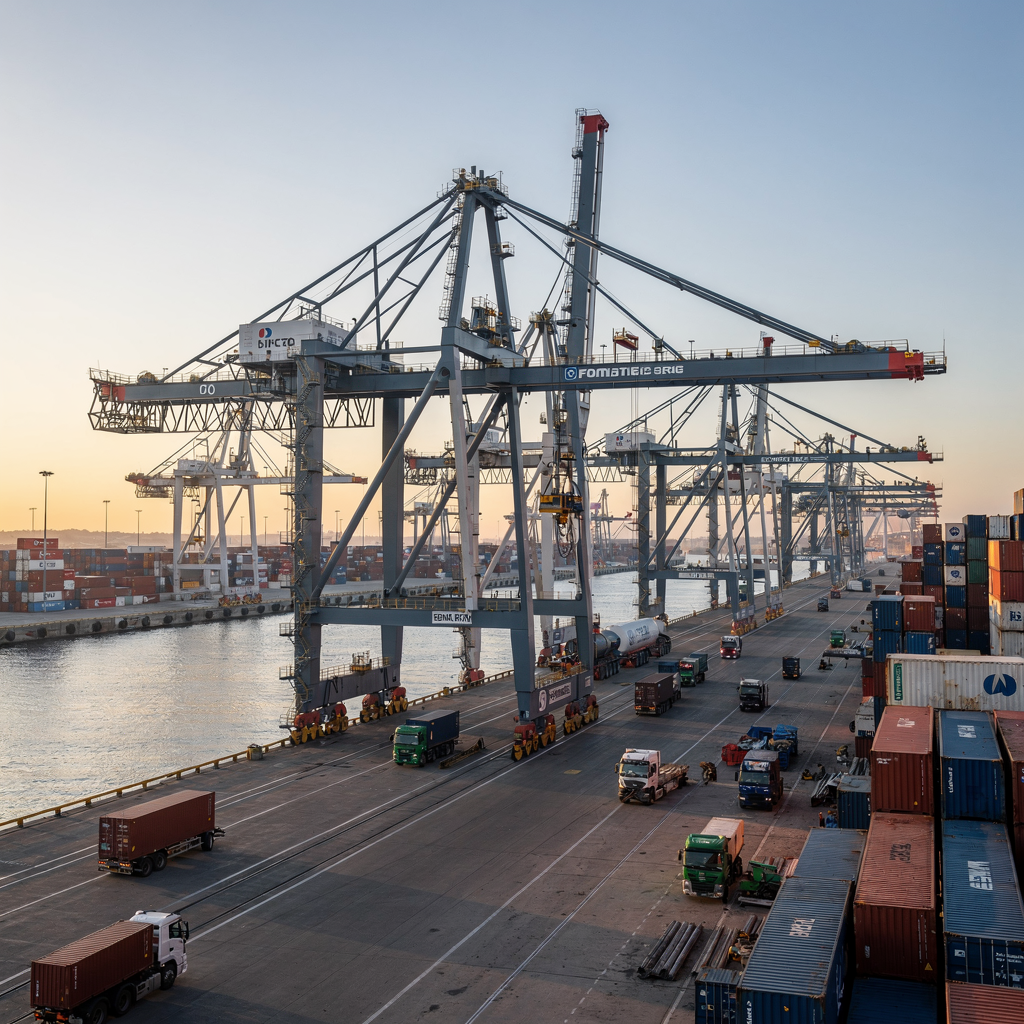
Ports today face rising trade volume and tighter berth windows. As a result, planners must improve equipment use and reduce idle operating time. Dual cycling, sometimes called double cycling or dual-cycle in practice, aims to do that by overlapping UNLOAD and loading tasks at the quayside. First, a quay crane lifts a container from a vessel. Next, while that crane stages the next move, yard resources and an internal truck shuttle the container to the storage yard. Then, loading and unloading tasks proceed in parallel so the QC stays productive.
Therefore, terminals that adopt dual cycling can lift their throughput substantially. For example, research shows equipment allocation improvements can raise throughput by up to 20% and reduce vessel turnaround by about 12–15% (efficiency and productivity study). Also, wider sustainability frameworks stress the same point: “Optimizing equipment allocation through dual cycling not only boosts productivity but also aligns with global efforts to reduce transport chain emissions” (GLEC Framework). Furthermore, ESCAP warns that “effective berth allocation and logistics monitoring are essential to support complex equipment cycles and ensure seamless operations” (Smart Port Development).
Loadmaster.ai builds on this idea. Our agents coordinate quay cranes, internal truck fleets, and yard strategies so the QC moves do not wait for the next resource. For planners who currently do firefighting rather than planning, dual cycling gives a controlled way to improve crane productivity while respecting yard constraints. In addition, dual cycling can address container ships and their effect on terminal peaks by smoothing resource demand across time.
literature review
This literature review maps key work on equipment allocation and the core scheduling problem in container terminal research. First, classic studies quantify how QUAY CRANE allocation, yard layout, and truck dispatching shape crane productivity. For example, the University of Antwerpen report documents shifts in crane utilisation and shows how better allocation can shorten completion time for vessels (efficiency study). Second, broader surveys synthesize findings on throughput and scheduling; one review highlights throughput gains in the 10–18% range when coordinated schedules are used (MDPI literature review). Third, congestion studies frame the problem as both an optimization and an operational constraint; they stress that limits on yard slot supply and berth windows create unavoidable constraints that any algorithm must respect (port congestion thesis).
Also, foundational modeling approaches include mixed-integer programming and integer programming that represent the handling sequence and the objective function directly. Researchers have proposed mixed-integer programming models that target total completion time and crane productivity. In practice, planners balance upper and lower bounds on resource use. For example, DAGANZO-style processing models and Goodchild-inspired yard studies influence modern solution design; the literature review finds that heuristic and genetic algorithm methods still compete well on large-scale problems. Finally, experimental work often compares scheduling policies against a lower bound for all strategies and a tight upper bound from optimal solvers. For readers who want applied examples of how to identify unused capacity, see our article on identifying hidden capacity with AI which shows a digital-twin approach to test alternative schedules in a safe environment identifying hidden capacity with AI.
Drowning in a full terminal with replans, exceptions and last-minute changes?
Discover what AI-driven planning can do for your terminal
algorithm
We define a practical algorithm for dual cycling that synchronizes QUAY, yard cranes, and internal truck movements. First, the proposed model and algorithm set out a multi-equipment plan. Second, the model encodes vessel arrival times, yard slot availability, travel times, and operation time windows. Third, the objective function aims to minimize the total completion time and to improve the efficiency of the QUAY CRANE so the crane operating time is high and idle time is low.
The algorithm is proposed as a hybrid approach. It uses a mixed-integer programming model to provide bounds and to solve small-scale instances exactly. Then, it applies a heuristic to scale to large-scale problems. For example, a decomposition step splits berth-level problems from yard-level moves. Next, a genetic algorithm refines sequences for the quayside while local search adjusts internal truck dispatch. Also, one branch integrates a QC-level plan (stow and split) while another branch optimizes yard placements using rules derived from Goodchild and Daganzo literature.
Practically, the algorithm based design feeds a real-time schedule to a Terminal Operating System. Loadmaster.ai trains RL agents in a sandbox so the plan adapts when conditions change. Thus, the system transitions from static schedules to policies that consider the time of the ship, inbound container mixes, and export containers. Finally, developers can use CPLEX to validate small instances, while the deployed controller runs fast heuristics for online decisions.
numerical experiments
We set up numerical experiments to evaluate dual cycle performance. First, we use a mix of real-world terminal data and synthetic test cases to simulate typical daily peaks. Second, the simulation environment tracks crane idle time, container moves per hour, vessel turnaround, and emissions. Third, we monitor solution quality and computational cost across runs.
In tests mirroring realistic traffic, dual cycling delivered around a 15% uplift in throughput and 25% less crane idle time compared to a single-cycle baseline. Those numbers echo published ranges where throughput rose by 10–18% under coordinated schedules (literature survey). Also, the experiments checked total completion time and confirmed reductions in vessel time at berth by about 12% in some scenarios (congestion study). The study measured operating time per move and used the GLEC method to estimate emissions. As a result, fewer operating hours translated to fuel savings and lower greenhouse-gas output (GLEC Framework).
We ran numerical experiments to capture sensitivity to berth sequence, number of cycles, and truck fleet size. Then, we compared results with a greedy-dispatch baseline. Overall, dual-cycle schemes performed best when internal truck headways were short and storage yard slot density allowed rapid drops and pickups. For terminals with constrained yard access, dual cycling still improved crane productivity but the solution quality depended on internal truck availability. For more on optimizing yard and fuel, review our guide to reducing fuel consumption in container port yard operations reducing fuel consumption in yard operations.
Drowning in a full terminal with replans, exceptions and last-minute changes?
Discover what AI-driven planning can do for your terminal
solution algorithms
We compare dual cycling against other approaches such as single-cycle scheduling and greedy-dispatch methods. First, single-cycle systems treat unloading and loading as separate sequential processes. Second, greedy dispatch sends the next job to the closest resource without global foresight. In tests, greedy methods were fast but produced suboptimal operating time totals and more rehandles.
Consequently, optimization approaches such as mixed-integer programming and integer programming serve as benchmarks. A mixed-integer programming model gives exact benchmarks and lower bounds for performance. Then, algorithms that combine MILP with decomposition help scale performance. For instance, a tight upper bound can come from a solved MILP on a reduced instance. Also, heuristic and genetic algorithm methods provide near-optimal solutions quickly for large datasets. The genetic algorithm showed useful encoding strategies and improved solution quality when paired with local search.
Also, dual cycling needs a real-time TOS integration. Loadmaster.ai’s JobAI automates execution and produces schedules that adapt to delays. Integration requires APIs that share berth status, QC telemetry, and internal truck positions. For terminals moving to automated guided vehicles or automated stacking crane workflows, the system must respect automated constraints and predefined handling sequence rules. Practical deployment uses CPLEX for offline validation and RL-derived policies for live control. In small-scale pilots in Shanghai and elsewhere, this combined approach reduced idle time and helped improve the overall operational efficiency of the quay and yard.
related research
Related research explores AI-driven predictive scheduling, digital twin pilots, and sustainability analyses. First, AI teams develop models that simulate terminal dynamics so agents can learn to trade off crane productivity against yard congestion. Second, digital twins let teams simulate millions of decisions to avoid dependence on limited historical data. For example, our StowAI and StackAI prototypes were developed to solve multi-objective allocation problems and were designed to solve cases where historical patterns no longer predict future peaks.
Also, extensions include using predictive berth availability and dwell-time models to smooth demand spikes. Research connects container transportation modeling to berth-level schedule choices and shipping line patterns. In addition, there is work on encoding constraints and decomposition methods so large-scale problems can be solved efficiently. For readers interested in applied pilots, see our piece on automated stacking crane optimization which links stacking policies with quay-side sequence choices automated stacking crane optimization. Furthermore, those who want to optimize equipment moves to save fuel can consult our practical guide on that topic optimizing equipment moves to save fuel.
Finally, future directions point to standard data-sharing frameworks and smarter berth planning. Researchers will continue to test lower bounds and tight upper bound solutions, to decompose problems, and to simulate mixed manual and automated fleets. As trade volume grows and ship sizes change, terminals must adopt strategies for container ships, ship loading and unloading operations, and new internal truck patterns. In short, related research aims to minimize the total delay, to improve the efficiency in automated container terminals, and to ensure better solution quality for real port operations.
FAQ
What is dual cycling in a container terminal?
Dual cycling is a scheduling approach where quay activities overlap with yard and truck moves so equipment works in two synchronized cycles. This method keeps cranes and trucks busy and reduces idle time while aiming to improve throughput.
How does dual cycling affect quay crane utilization?
Dual cycling raises quay crane utilization by coordinating unloading and loading moves so the QC rarely waits for the next container. Studies report average increases from about 65% to over 85% when schedules and allocation are improved (efficiency study).
Can dual cycling reduce vessel turnaround time?
Yes. Coordinated schedules and faster handling sequences shorten the time of the ship at berth. Research evidence suggests vessel turnaround can fall by roughly 12–15% with efficient dual-cycle implementations (congestion study).
What data inputs are needed to run a dual-cycle schedule?
A practical schedule needs vessel arrival times, yard slot availability, equipment travel times, and expected operation time per move. Also, the system benefits from berth windows, truck headways, and gate throughput predictions.
Which algorithms solve the dual-cycle scheduling problem?
Researchers use mixed-integer programming, integer programming, heuristics, and genetic algorithms depending on problem size and required speed. A mixed-integer programming model provides exact benchmarks while heuristics and genetic algorithm variants scale to large terminals.
How do internal trucks fit into dual cycling?
Internal trucks provide the link between quay and storage yard under dual cycling. They must run at short headways to enable the quayside to hand off containers quickly. When truck fleets are congested, the gains from dual cycling shrink.
Is dual cycling compatible with automated equipment?
Yes. Dual cycling works with automated guided vehicles and automated stacking crane setups as long as schedules respect the machines’ constraints. Integration requires tight data exchange and robust real-time control.
What environmental benefits does dual cycling offer?
By reducing equipment operating time and idling, dual cycling cuts fuel use and greenhouse-gas emissions. The GLEC Framework underscores that optimized allocation supports emissions reduction goals (GLEC).
How do I test dual cycling before deployment?
Run numerical experiments in a digital twin and compare dual-cycle policies with single-cycle and greedy baselines. Loadmaster.ai uses simulation-trained RL agents so terminals can validate policies without relying on historical data.
What common constraints limit dual cycling gains?
Key constraints include limited storage yard slots, insufficient internal truck capacity, and restrictive berth windows. When these constraints bind, optimization must trade off quay productivity against yard congestion and gate throughput.
our products
 stowAI
 stackAI
 jobAI
jobAI
Innovates vessel planning. Faster rotation time of ships, increased flexibility towards shipping lines and customers.
Build the stack in the most efficient way. Increase moves per hour by reducing shifters and increase crane efficiency.
Get the most out of your equipment. Increase moves per hour by minimising waste and delays.
stowAI
Innovates vessel planning. Faster rotation time of ships, increased flexibility towards shipping lines and customers.
stackAI
Build the stack in the most efficient way. Increase moves per hour by reducing shifters and increase crane efficiency.
jobAI
Get the most out of your equipment. Increase moves per hour by minimising waste and delays.