
AI in Port Operations: Evolution from Rule-Based Planning to AI-Powered Systems
Ports once relied on rule-based systems to plan vessel arrivals, allocate berths, and sequence cargo moves. Those rule-based systems used static heuristics and fixed schedules. They worked for predictable days. However, they often failed when weather, equipment faults, or sudden surges in cargo occurred. As a result, planners spent hours firefighting. Planners had to balance quay productivity against yard congestion and driving distance. That trade-off led to inconsistent performance across shifts and to lost productivity.
Today, AI changes how a port runs. AI uses machine learning, reinforcement learning, and learning algorithms to learn from scenarios. It adapts to new arrival mixes and evolving yard states. For example, some AI deployments report up to a 30% reduction in vessel turnaround times by improving berth allocation and sequencing (AutomationFactory.AI) and by optimizing execution (Sphere Partners). These figures show a clear shift from static rule engines to adaptive models.
AI offers continuous learning and predictive resilience. It forecasts congestion, predicts equipment faults, and suggests better resource allocation. Therefore, ports can reduce idle time and automate decisions that used to require human intervention. Loadmaster.ai uses reinforcement learning agents to simulate millions of decisions in a digital twin environment, so you get policies that do more than copy the past. Our agents train without relying on clean historical data and then deploy with operational guardrails. The approach helps port operators achieve consistent results, and it reduces rehandles and unnecessary travel.
Transitioning from rule-based systems to AI systems requires changes. You need clean integration with a container terminal operating system, telemetry, and governance. You also need to manage workforce change and to build trust in ai-powered recommendations. Yet the benefits of AI and of artificial intelligence in port contexts are measurable. They include lower costs and higher predictability. They also help ports better serve global trade while maintaining safety and sustainability.
Real-Time Data and Automation in Container Terminal Operations
Real-time data changes the speed and precision of container terminal operations. IoT sensors, AIS feeds, and equipment telemetry stream position, load, and status. Operators can act on this data and make quicker choices. Real-time tracking of cranes, trucks, and vessels lets the dock team see where bottlenecks form. Then dispatchers can reroute moves to reduce queues and idle time. Real-time data also allows predictive models to forecast short-term congestion and to suggest allocation of resources.
Automation augments the human team. Automated guided vehicles and autonomous straddles move containers with less variation. AI helps automate crane scheduling and optimize gate throughput. Digital twin models simulate sequences and outcomes without interrupting live operations. A well-calibrated digital twin enables planners to test strategies and then apply validated plans to the yard. This simulation-first approach cuts risk and shortens the deployment cycle. Research shows ports using simulation and AI can increase throughput by around 20% without adding physical infrastructure (MDPI) and (Maersk).
Real-time systems also enable smoother berth allocation. Dynamic berth scheduling matches berths to vessel needs, and it adjusts when a vessel arrival shifts. Edge AI nodes process telemetry close to the equipment, so networks carry less load and response times stay low. Consequently, automation combined with real-time data leads to steadier crane cycles, fewer rehandles, and improved operational efficiency.
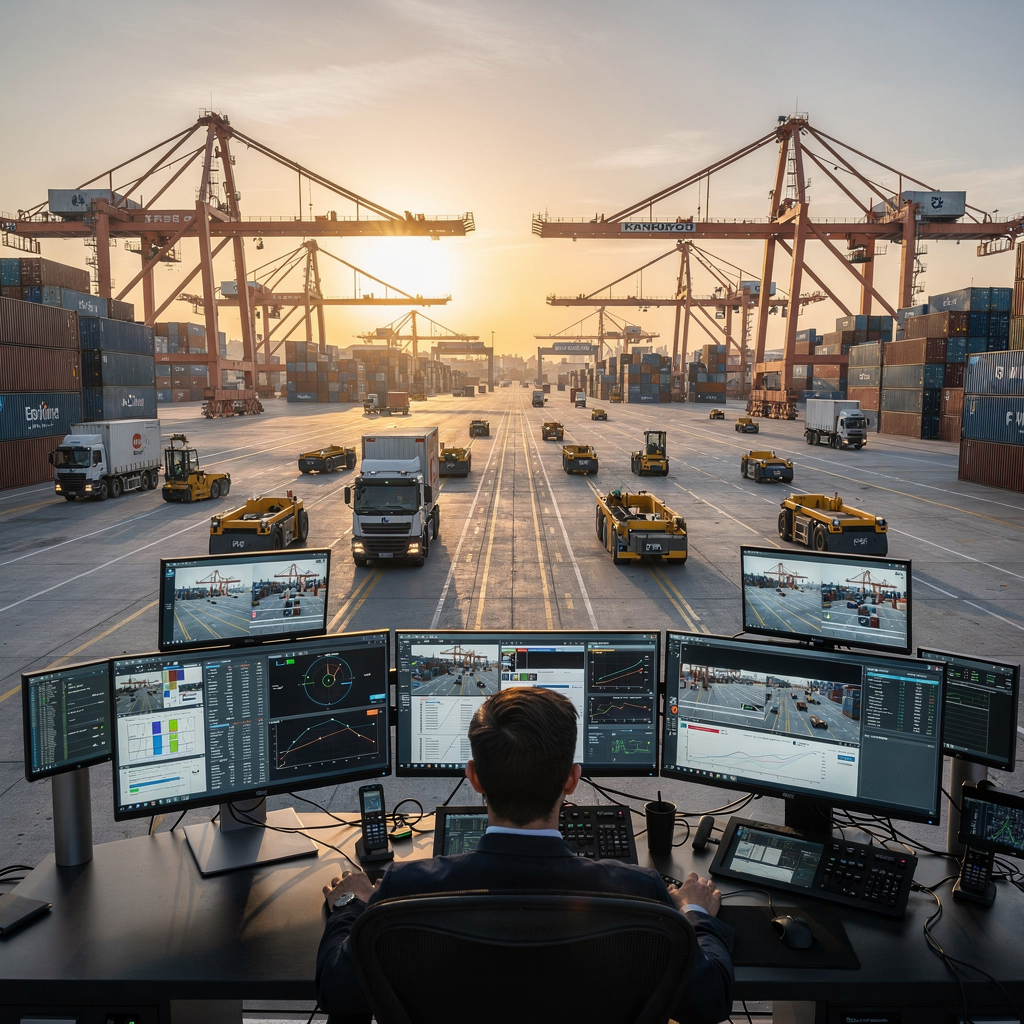
Drowning in a full terminal with replans, exceptions and last-minute changes?
Discover what AI-driven planning can do for your terminal
Gate Operations and Container Stacking: AI Solutions to Optimise Operations
Gate operations often define the cadence of a terminal day. Long queues at the gate slow truckers and disrupt terminal rhythm. AI-driven gate operations speed processing by validating documents, pre-checking loads, and sequencing trucks. Machine learning models predict peak truck arrival windows. So terminals can staff gates dynamically and avoid long wait times. Reports indicate AI can cut gate waiting times by as much as 25% when combined with better yard planning and dispatching.
Container stacking and yard slotting drive internal efficiency. Smart algorithms plan stack locations so cranes travel less and rehandles drop. Loadmaster.ai’s StackAI uses reinforcement learning to place containers and to reshuffle based on future vessel plans, which helps balance yard density and reduce driving distance. These AI agents learn policies that protect future plans while optimizing current moves. In practice, that yields fewer rehandles, steadier crane workloads, and energy savings.
AI can predict where congestion will appear in the yard and then propose allocation changes before issues escalate. Predictive models use container flows, expected vessel arrivals, and gate schedules to assign slots that minimize movement. This approach supports safety and improves throughput of container movements. The system can automate some decisions and surface others for human review. That hybrid workflow ensures human oversight while enabling the terminal to automate repetitive tasks.
To make these gains sustainable, terminals must address data quality, integration with a container terminal operating system, and staff training. With proper governance and an incremental rollout, operators can capture both operational efficiency and safer yard dynamics. For more on stacking-specific improvements, see our research on automated stacking crane optimization and on reducing empty gantry time in ASC systems (automated stacking crane optimization, reducing empty gantry time).
Maritime Logistics and Smart Port: Strategies to Streamline Operations
A smart port links ships, landside systems, and hinterland transport. It relies on connectivity and on data sharing across stakeholders. Predictive berth scheduling improves berth utilization and reduces waiting at anchor. AI can forecast arrival windows and then suggest berth assignments that shorten time-to-berth. Maersk describes AI as a force that enables faster, smarter, and more sustainable logistics, and that view frames how ports plan for the future (Maersk).
Smart port strategies include emission reductions and better energy use. AI models optimize vessel speed and arrival timing to reduce unnecessary idling and emission. Those optimizations affect the entire maritime corridor and support sustainability goals. Ports can also use AI to monitor fuel use and to plan gate slots to smooth peak demand. These measures help reduce emission and to lower operational cost.
Interoperability matters. Port authorities must adopt standards for data exchange and for secure sharing. That allows predictive models to access AIS feeds, terminal status, and hinterland constraints. The result is smoother cargo hand-offs, fewer delays, and improved supply chain visibility. For ports exploring predictive berth availability, see our modeling work on berth prediction that ties into vessel planning systems (predictive berth availability modeling).
Smart port technologies such as digital twins and edge AI let ports test scenarios. They can simulate changes before applying them live. That reduces deployment risk and accelerates benefits realization. In short, a smart port connects maritime operations, terminal systems, and hinterland networks to streamline operations and to support the global supply chain.
Drowning in a full terminal with replans, exceptions and last-minute changes?
Discover what AI-driven planning can do for your terminal
Machine Learning for Terminal: Optimise Yard and Container Terminal Operations
Machine learning helps terminals predict demand and allocate equipment. Supervised models forecast arrival patterns, and they estimate yard resource needs. Yet supervised models often copy the average of past choices. By contrast, reinforcement learning can search policy space to find better strategies. Loadmaster.ai uses reinforcement learning agents that train in a simulated terminal. That approach generates policies without needing decades of clean historical data.
Dynamic scheduling algorithms adjust cargo handling in real-time. These algorithms balance crane work, yard moves, and gate throughput. They respond to delays, vessel arrival shifts, or equipment outages. Terminals that employ dynamic scheduling often see reduced idle time and better equipment utilization. In many cases, resource optimization driven by AI leads to cost reductions in the 15–25% range through lower idle time and better equipment allocation (SupplyChainToday, The Intellify).
Predictive maintenance keeps cranes and vehicles working. Predictive solutions analyze vibration, temperature, and operational cycles. They flag a failing motor before it halts operations. That reduces downtime and saves maintenance costs. Digital twin models can test repair schedules without disrupting the terminal. Using such tools yields steady crane productivity and more predictable shifts.
Effective deployment requires robust data analysis, integration, and operational governance. Terminals must connect their machine learning outputs to management systems and to the container terminal operating system. For practical deployment advice, review our guidance on measuring the ROI of AI and on simulation-first approaches to inland terminal optimization (measuring ROI of AI, simulation-first AI).
Operations with AI: AI-Powered Port Solutions for Smart Terminals
Emerging AI solutions include autonomous vehicles, robotics, and advanced analytics. Autonomous trucks and automated guided vehicles reduce human-driven variation. Advanced analytics surface actionable insights that help planners and operators. For example, AI can predict container flows and then adjust allocation of cranes and straddle carriers. That reduces unnecessary moves and shortens the cycle time for cargo operations.
Yet adoption of AI carries challenges. First, data integration from disparate systems is hard. Second, cybersecurity and governance must be robust. Third, terminals need staff with new skills to manage ai systems and to trust their recommendations. To address these, ports should design phased deployment with pilots, sandbox testing, and clear guardrails. Loadmaster.ai follows a sandbox-first strategy: train agents in a digital twin and then refine online with live feedback. This method reduces risk and supports safe roll-out.
Standards help. Port authorities and port operators should agree on common interfaces and data models so that systems interoperate. That reduces friction for vendors and speeds deployment. Operators can then implement congestion management, predictive berth allocation, and smart gate workflows more easily. AI can provide short-term operational recommendations and long-term policy updates. Consequently, terminals gain consistency and resilience.
Finally, governance and explainability are crucial. AI policies must be auditable and must align with safety and compliance rules. Reinforcement learning agents should operate with hard constraints, and their decisions should be traceable. Doing this enables terminals to transform port operations while protecting people, equipment, and the environment. For more on implementing AI across brownfield and greenfield projects, see our trends and practical articles on port automation and job scheduling (trends in port automation, internal terminal transport job scheduling).
FAQ
What is AI optimization for port and terminal operations?
AI optimization uses artificial intelligence to improve planning, scheduling, and execution at a port or terminal. It replaces rigid rule-based systems with adaptive models that learn from scenarios and that can automate routine decisions.
How does real-time data improve terminal performance?
Real-time data from IoT sensors, AIS feeds, and equipment telemetry enables fast detection of congestion and equipment issues. This data allows AI to adjust schedules dynamically and to reduce queues and idle time.
Can AI reduce vessel turnaround times?
Yes. AI-driven berth allocation and sequencing have delivered reductions in vessel turnaround times. Reports show reductions of up to 30% when AI optimizes berth and crane planning (source).
What role do digital twins play in terminal AI?
A digital twin simulates terminal layouts and workflows so planners can test strategies safely. It enables simulation-first training for reinforcement learning agents and reduces deployment risk.
How does AI help gate operations and container stacking?
AI speeds gate processing and predicts truck peaks, which cuts queue times. It also optimizes container stacking to reduce rehandles and to shorten driving distances inside the yard.
Are there measurable cost savings from AI in ports?
Yes. Ports that deploy AI report operational cost savings in the range of 15–25% through better resource allocation and lower idle time (source).
What challenges should terminals expect with AI adoption?
Terminals must handle data integration, cybersecurity, and workforce change. They also need governance and explainability to ensure AI decisions align with safety and compliance requirements.
How do reinforcement learning agents differ from traditional ML models?
Reinforcement learning agents learn policies by trial and error in simulation and can discover strategies that outperform historical averages. Traditional supervised ML models often mimic past behavior and require clean historical data.
Can AI help with sustainability goals at a port?
Yes. AI can optimize vessel arrival timing, reduce idling, and optimize equipment moves to save fuel and lower emission. These changes support broader sustainability targets for the maritime industry.
How can my terminal start with AI safely?
Begin with sandbox pilots using a digital twin and clearly defined KPIs. Use phased deployment, integrate with your container terminal operating system, and include human-in-the-loop checks to validate decisions.
our products
 stowAI
 stackAI
 jobAI
jobAI
Innovates vessel planning. Faster rotation time of ships, increased flexibility towards shipping lines and customers.
Build the stack in the most efficient way. Increase moves per hour by reducing shifters and increase crane efficiency.
Get the most out of your equipment. Increase moves per hour by minimising waste and delays.
stowAI
Innovates vessel planning. Faster rotation time of ships, increased flexibility towards shipping lines and customers.
stackAI
Build the stack in the most efficient way. Increase moves per hour by reducing shifters and increase crane efficiency.
jobAI
Get the most out of your equipment. Increase moves per hour by minimising waste and delays.