
Simulation in Port Logistics: Foundations and Benefits
Enterprise simulation has grown into a core planning approach for modern port operations. It creates a virtual replica of real processes so planners can test ideas without risk. In port logistics this means teams can model vessel arrival patterns, cargo movements, yard stacking and multimodal handoffs. A clear example is AnyLogic, which describes how “Port and terminal simulation can be used for detailed internal logistics analysis, decision support, risk mitigation, and disruption response” Port and Terminal Simulation Software – AnyLogic. That direct quote highlights why many groups adopt port and terminal simulation software to back decisions.
Simulation models mirror quay cranes, trucks, gates and storage blocks. They mimic scheduling, loading and unload events and they capture operator behavior. As a result, planners can identify bottlenecks and test layout changes. The models also allow teams to compare alternative staffing mixes, crane allocations and peak versus off-peak schedules. This low-risk environment enables continuous improvement and helps to minimize demurrage and delay.
Key benefits include lower cost, higher throughput and more robust decision making. For example, ports that use simulation-driven planning report up to a 20% cut in vessel turnaround time Port and Terminal Simulation Software – AnyLogic. In addition, simulation supports analytical work to balance quay productivity with yard congestion. The tools integrate with Terminal Operating Systems and ERP systems to reflect live records. If you want more context on TOS options, see our guide to the best terminal operating systems for 2025 best terminal operating systems 2025. That link explains how a model ties to real transactional data and how integration can enable faster reaction to disruptions.
Finally, simulation helps identify trade-offs and to set realistic KPIs. You can test new rules and then measure impact on utilization, throughput and demurrage. For ports and terminals the return on investment often comes quickly. With targeted investment in modeling and visualization, teams gain operational clarity and better planning capability. This foundation sets the stage for advanced AI and digital twin work covered later.
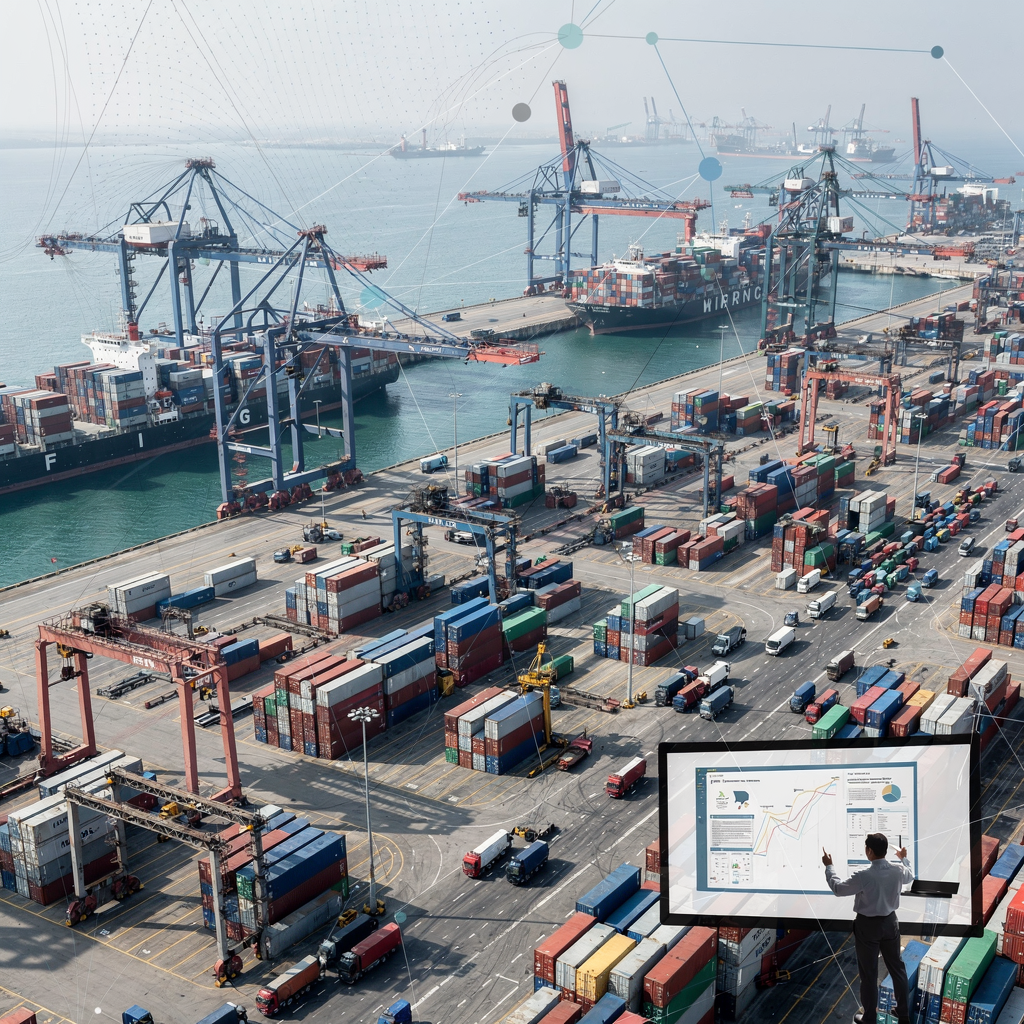
Simulation Tools and Simulation Model: Strategies to Optimize Operation
Choosing the right simulation tools starts with clear objectives. First, decide whether you need a discrete-event simulator, a continuous model or a hybrid approach. Leading platforms include AnyLogic, FlexSim and Arena, each with distinct strengths. AnyLogic supports multi-paradigm modeling and shines where process dynamics and agent behavior must interact. FlexSim has strong 3D layout visualization for yard flows and energy studies. Arena is widely used for discrete event work and for scenario analysis. These vendors help teams to visualize workflows and to test alternative scheduling and resource allocation strategies Port & Terminal | Arena Simulation Software | US – Rockwell Automation.
Effective simulation model creation follows a structured plan. Start with a scoping session and then map business processes and data sources. Next, translate those maps into a working model and validate using historical runs. Finally, run scenario batches to identify robust strategies. A key step is to sync live records from the TOS and telemetry so the virtual state matches the real-world state. That integration makes what-if testing risk-free and supports rapid decision making when disruptions occur. You can also connect models to a digital twin to train policies before go-live.
Tailored models support workforce planning and equipment use. For example, a model can simulate several shift schedules and compare crane utilization and drive distances. Because Loadmaster.ai builds digital twins that train reinforcement learning agents, terminals can run millions of simulated decisions until the policy meets goals. Our closed-loop approach tests StowAI, StackAI and JobAI in a sandbox twin. This produces policies that balance moves per hour against yard congestion and rehandles. The result is a measurable uplift in operational KPIs and steadier performance across shifts.
Integration with TOS is essential. If you want to learn how models feed TOS data, review our Navis N4 overview Navis N4 Terminal Operating System. That page explains common API patterns and how simulation can ingest gate, vessel and yard records. In practice, simulation tools enable planners to test layout changes, to reassign equipment, and to pick the best strategy before committing capital or altering the schedule.
Drowning in a full terminal with replans, exceptions and last-minute changes?
Discover what AI-driven planning can do for your terminal
Digital Twin and AI for Real-World Efficiency
Digital twin concepts extend simulation by linking a live model to streaming data. A digital twin enables continuous learning and it can predict near-term congestion and equipment failures. Combining IoT sensors with AI and simulation creates a powerful tool for optimization, as industry leaders note: “Combining IoT with AI simulations creates a powerful tool for logistics optimization” AI in Logistics: Cut Costs with Fleets & Digital Twins – The Intellify. That idea underpins many pilots in maritime hubs.
IoT sensors on cranes, trucks and gates feed the twin. Then AI analyzes patterns and predicts likely delays. For example, AI models can predict vessel berthing windows and so reduce queueing. During recent disruptions, simulation-based forecasts helped to reduce congestion by up to 30% Port congestion under the COVID-19 pandemic – ResearchGate. That statistic shows how forecast capability translates to better service across supply chains.
Sustainability analysis is another strong use case. Using a model, terminals can measure energy draw for automated cranes, and then re-sequence jobs to reduce idle time. Studies using FlexSim highlight automation and sustainable practices to lower terminal energy use by roughly 15% A simulation tool for container operations management at seaport. These assessments help operations teams to set emissions targets and to track progress.
Digital twin simulation also supports predictive maintenance and automated dispatch. A twin flags variable wear patterns and then AI suggests maintenance before a failure. That reduces downtime and keeps utilization high. In practice, operators who integrate a twin into their operational stack see faster recovery from incidents and more stable throughput. For terminals that plan investment in automation, a twin lets them safely trial autonomous vehicles and robotics in a virtual zone before live trials.
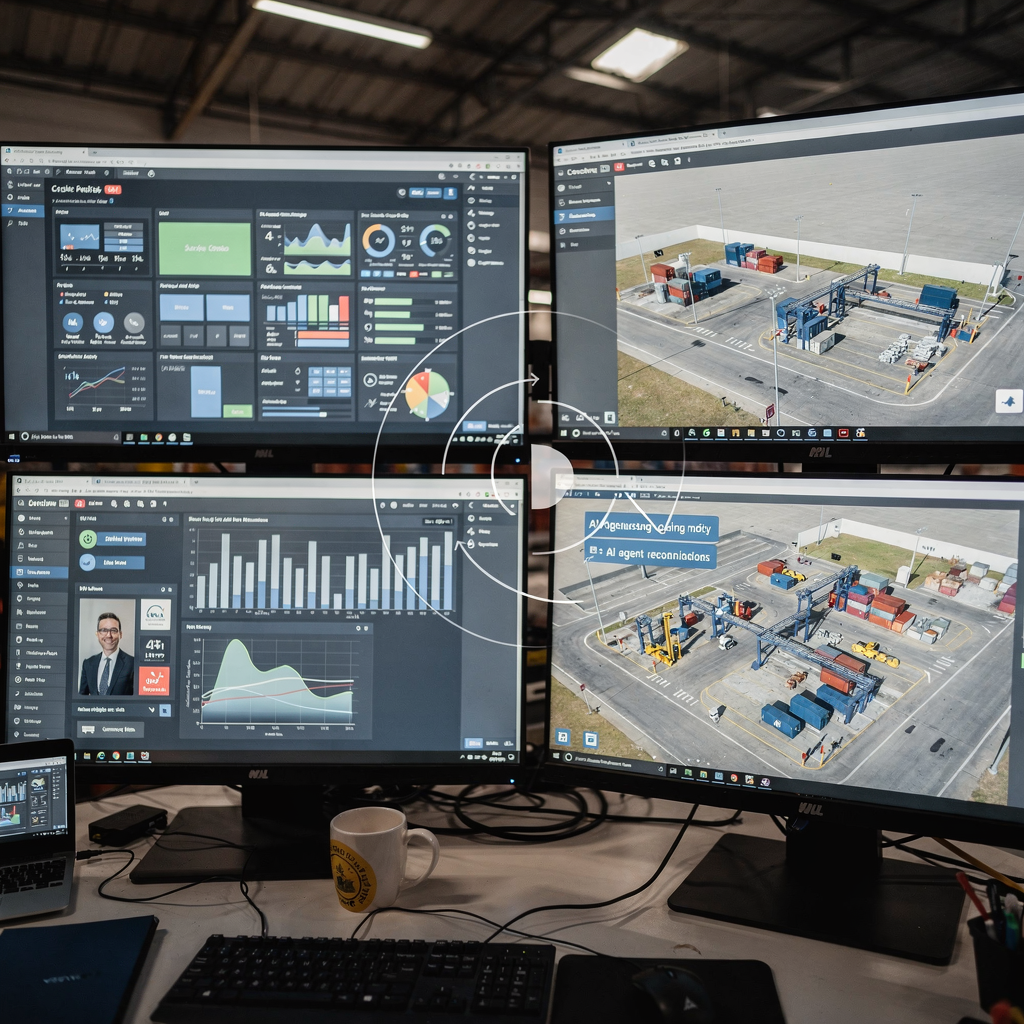
Throughput: Optimization Strategies
Throughput improvement is the central metric for many port leaders. The most relevant KPIs include vessel turnaround time, moves per hour, yard throughput and gate throughput. A well-built simulation highlights bottlenecks and helps to pick the best strategy for peak loads. For instance, simulation-driven planning can reduce vessel turnaround by up to 20% when the model is used to re-sequence cranes and trucks Port and Terminal Simulation Software – AnyLogic. That kind of gain directly increases available berth capacity and reduces demurrage.
To optimize throughput, start with data and a clear hypothesis. Test alternative quay schedules, gate shifts and stack layouts. Use discrete event models for crane cycles and continuous models for yard diffusion. Combine those with agent logic to represent human dispatchers. Loadmaster.ai applies reinforcement learning inside a digital twin to discover policies that minimize travel and rehandles. This method finds non-intuitive trade-offs between crane productivity and yard balance.
Energy optimization sits beside throughput work. Simulation results show automated equipment sequencing and reduced idling can lower terminal energy use by around 15% A simulation tool for container operations management at seaport. You can therefore improve throughput and reduce cost simultaneously. Continuous improvement cycles should run weekly or monthly and they must include scenario runs for peak disruption events and equipment failures.
When disruption hits, a tested scenario library speeds response. Good libraries include container mix shifts, late vessel arrivals and sudden gate surges. A prepared manager can then pick the most resilient plan and deploy it quickly. This approach minimizes delay and protects customer service. Finally, investment in modeling pays off through fewer emergency moves, lower demurrage and more predictable vessel schedules.
Drowning in a full terminal with replans, exceptions and last-minute changes?
Discover what AI-driven planning can do for your terminal
Port Simulation Case Studies from the Industry
Real-world case studies show what the technology can deliver. Maersk ran pilots that combined a digital twin with AI to improve container flow reliability across a busy hub. The pilots used simulated policies to reduce variability and to protect critical vessel windows. These efforts illustrate how a digital twin and a simulator can be used together to test policies before a live roll-out. You can find several industry case studies that demonstrate similar benefits for ports and terminals International case studies and good practices.
Port community systems that integrate with simulation software also deliver measurable savings. These integrations improve data acquisition and give planners a single truth across the chain. For example, combined PCS and simulation deployments reduced turnaround variability and improved visibility for truck operators. Case studies further show that layout redesigns tested in simulation can raise capacity without large capital projects. In several instances, modest layout tweaks produced a double-digit throughput boost.
Another example is the use of a simulator for harbor design and construction. Teams use a simulator to test berth spacing, channel dynamics and fender placement. These tests validate engineering choices before construction begins. They also reduce the risk of costly rework. For terminals focused on reducing demurrage and improving stack utilization, simulation tests identify the best crane mix and block layout to balance utilization and travel time.
Finally, lessons from international terminals emphasize governance and training. A successful rollout pairs technical teams with experienced operators to validate assumptions. It also includes phased pilots and careful change management. When operators contribute to scenario design, the final policies are more likely to stick and to deliver sustained gains across the maritime supply chains.
Digital Twin Simulation in Logistics: Enhancing Capability
Next-gen digital twin simulation is reshaping how terminals prepare for automation and scale. These twins run continuous experiments and they train AI agents to automate repetitive decisions. For example, reinforcement learning agents can learn stacking and dispatch policies inside a safe virtual environment. Loadmaster.ai uses this pattern to deliver StowAI, StackAI and JobAI. The agents learn to balance crane speed, yard balance and future demand without needing historical training data. This cold-start ready feature enables pilots in terminals that lack clean history.
Looking ahead, AI-driven autonomous vehicles and robotic handlers will become more common. Digital twins let teams trial these systems at scale in virtual yards. They can test safety cases and operational rules and then export validated policies to live pilots. Predictive maintenance also benefits. Twins detect wear patterns and then predict failures so teams can schedule repairs during low-demand windows. This reduces unscheduled downtime and raises equipment utilization.
Future skill sets will blend operations know-how with data literacy. Managers must understand KPIs and AI outputs. They must also be able to audit policies and to set guardrails. Good governance ensures explainable decisions and supports compliance with the EU AI Act. Investment in capability and training is therefore as important as software purchases. For terminals that plan to automate, start with small pilots and expand once the twin and AI policies prove robust.
Finally, vendors are improving ease of use and visualization. Modern libraries include 2D and 3D views, drag and drop building blocks and user-friendly dashboards. These features make it easier for operators to visualize dynamics and to identify variables that influence outcomes. Ultimately, a practical digital twin capability will enable smarter, faster and more resilient port or terminal operations across the global maritime industry.
FAQ
What is a simulation for ports and terminals?
A simulation is a virtual representation of port processes that lets teams test changes without risk. It reproduces activities such as vessel berthing, crane cycles and yard moves so you can evaluate scenarios and measure impact on key metrics.
How does a digital twin differ from a simulator?
A digital twin is a live model that links streaming data to a virtual copy of the terminal. A simulator often runs standalone scenario tests. A twin enables continuous learning and real-time decision support.
Can simulation reduce vessel turnaround times?
Yes. Simulation-driven planning has been reported to cut vessel turnaround times by up to 20% in industry studies Port and Terminal Simulation Software – AnyLogic. This reduction improves berth capacity and lowers demurrage.
What role does AI play in port simulation?
AI analyzes large datasets and finds patterns that help predict congestion and failures. When combined with a digital twin, AI can train agents to automate planning and to improve consistency across shifts.
Are there sustainability benefits from using simulation?
Yes. Simulation studies have shown roughly 15% energy reductions by optimizing automated equipment sequences FlexSim study. This lowers cost and emissions.
How do simulation tools integrate with Terminal Operating Systems?
Integration is done via APIs and data feeds. Models ingest gate, vessel and yard records to mirror real conditions. For examples of TOS connections, see our Navis N4 overview Navis N4 Terminal Operating System.
What is the value of running scenario libraries?
Scenario libraries speed response during disruptions by providing pre-tested plans. They help managers choose the best strategy fast and thereby minimize delays and service impact.
Can I pilot AI without historical data?
Yes. Reinforcement learning in a digital twin can train agents without historical data by simulating millions of decisions. This cold-start approach is useful when clean history is scarce.
Which vendors are common for port simulation?
Popular platforms include AnyLogic, FlexSim and Arena. Each has unique strengths for visualization, discrete event modeling and hybrid experiments Arena reference.
How should a terminal begin a simulation project?
Begin with clear objectives, a scoped model and stakeholder alignment. Start small, validate against live data and then scale. For TOS alternatives and options, review our guide to terminal operating systems container terminal TOS alternatives.
our products
 stowAI
 stackAI
 jobAI
jobAI
Innovates vessel planning. Faster rotation time of ships, increased flexibility towards shipping lines and customers.
Build the stack in the most efficient way. Increase moves per hour by reducing shifters and increase crane efficiency.
Get the most out of your equipment. Increase moves per hour by minimising waste and delays.
stowAI
Innovates vessel planning. Faster rotation time of ships, increased flexibility towards shipping lines and customers.
stackAI
Build the stack in the most efficient way. Increase moves per hour by reducing shifters and increase crane efficiency.
jobAI
Get the most out of your equipment. Increase moves per hour by minimising waste and delays.