
simulation and its role in container terminals
Discrete event simulation is a cornerstone analytical approach for modern terminals. It models key events in time so planners can investigate how arrivals, handling, and transfers interact. In practice, that means representing vessel berthing, quay crane cycles, truck arrivals, and yard moves as discrete events that change the system state. The method captures stochastic elements such as random arrival times, variable handling durations, and intermittent equipment availability. As a result, planners can test alternate schedules without disrupting live operations and can measure outcomes quantitatively.
Stochastic variability drives many inefficiencies at a terminal. For instance, unpredictable arrival patterns cause peaks and troughs at the quay. Similarly, equipment breakdowns create local congestion that cascades across the yard. A well-built simulation model lets teams run a scenario and observe how those dynamics evolve. They then alter parameters to reduce wait, rehandles, and unnecessary travel. You can find a broad review of this approach in operational research literature, where the role of a digital twin is examined for resilience and sustainability (digital twin for resilience and sustainability).
Using a simulation model in planning offers concrete benefits. It provides a risk-free environment for capacity planning and resource allocation. For example, operators can test alternative crane allocations and gate staffing to see which minimizes vessel waiting time. Studies report measurable performance gains, including cost reductions and throughput improvements when scheduling and yard management are optimized; see one synthesis that reports up to a 15% cut in operational costs and roughly a 10% throughput uplift (quantified improvement). Loadmaster.ai uses these principles to train reinforcement learning in a sandbox twin, creating policies that improve stability across shifts while reducing rehandles. For more on software choices and how to integrate twin environments you can review recommended tools at our resource on container terminal simulation software (simulation software guide).
Practically, implementing simulation starts with clear objectives and data feeds. You must capture arrival schedules, handling rates, and equipment specs. Then you design event logic and validation tests. Finally, you run many replications to quantify variability and confidence intervals. In this way, discrete event simulation provides decision support that helps terminals adapt to increasing maritime complexity while protecting KPIs.
container model: constructing a realistic representation
To build a realistic model you must identify the system’s primary entities. Core entities include vessels, quay cranes, yard cranes such as RTGs or straddles, trucks, and storage blocks. Each entity has attributes: capacity, speed, handling time distributions, and fault rates. For a terminal twin, equipment specifications and block geometry feed directly into the layout and movement rules. The model should also capture the roles of gates and rail interfaces for multimodal transportation and rail and road interchange. When those pieces are accurate, the simulation model mirrors operational constraints closely.
Event sequencing defines the stepwise flow. Typical events include vessel arrival, berth assignment, quay crane start, container unloading, truck transfer, stacking by yard crane, and later retrieval for loading. That sequence repeats across vessels, with interleaving tasks and potential conflicts. The model must represent state changes clearly: equipment moves from idle to busy, storage slots move from free to occupied, and trucks queue at gates. Capturing these transitions lets analysts calculate utilization and idle metrics precisely.
Data needs are substantial. You will require arrival schedules and historic delay distributions. Handling rates, mean and variance, define service times. Equipment availability patterns, including maintenance windows and mean time to failure, are essential. Accurate container types, weights, and stacking rules affect stacking and yard capacity. For terminals that export heavy cargo or special loads, additional constraints matter. If you seek an example of how to align model parameters with operational priorities, see our guide to capacity planning using digital twins (capacity planning resource).
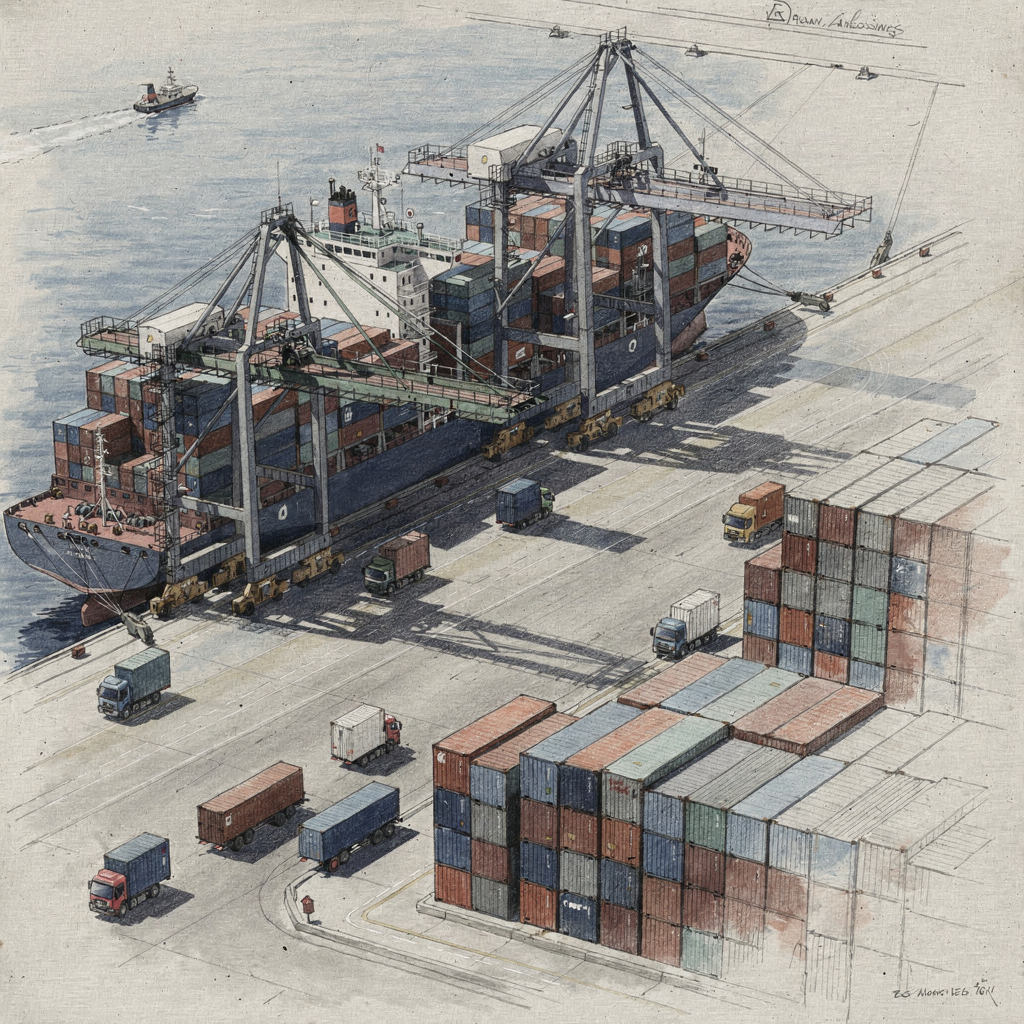
Model validation is vital. You must compare simulated KPIs with observed data, then tune distributions and rules. Where history is sparse, reinforcement learning and synthetic experience can expand coverage; Loadmaster.ai demonstrates this by training policies without relying solely on historical records. When the model is credible, it becomes a flexible laboratory to test layout tweaks, schedule changes, and tactical rules without operational risk.
Drowning in a full terminal with replans, exceptions and last-minute changes?
Discover what AI-driven planning can do for your terminal
simulation model of port operations
A simulation model of port operations represents the full process flow from vessel berthing to departure. It starts when a vessel reports arrival and requests a berth. The terminal assigns quay cranes and plans a sequence of moves. Containers are unloaded, transferred by trucks or automated carriers, and stacked in blocks. Later the reverse occurs for loading. Each action implies changes in state: a crane that was idle becomes busy; a yard slot that was free becomes occupied. Capturing these changes enables precise measurement of throughput and turnaround.
In an operational model, attention to process detail matters. You model the quay, the transfer paths, and the container yard. You must capture interference between cranes, truck routing, and the impact of gate policies. The model should also include external connections, such as railway interfaces, which affect yard dwell time. For a robust example of port-scale modeling tied to resilience, consult research that links digital twin methods to sustainability and disruption recovery (digital twin resilience study).
Performance metrics are central to evaluation. Throughput measures container moves per hour over a period. Turnaround time measures vessel stay from arrival to departure. Utilization indicates the fraction of time equipment performs work versus being idle. Collectively, these KPIs reveal bottlenecks and the most promising levers for improvement. Simulation outputs feed into technical and strategic decisions, including investments in equipment, changes in schedule rules, and automation rollouts. If you want to explore tools that specialize in terminal modeling and scenario testing, see our comparison of maritime terminal simulation software (simulation tools).
Model evaluation must include sensitivity tests and confidence intervals. You should run many replications to understand variability and to ensure results are statistically significant. The IEEE and other standards suggest rigorous reporting so results can be replicated; relevant methodologies are discussed in classic discrete-event texts and contemporary reviews (foundational DES text). This step transforms a model from a toy into decision support that operations teams can trust.
optimization using the simulation model for efficiency gains
Optimization starts with a clear objective. Typical objectives include minimizing vessel waiting time, maximizing crane productivity, or reducing yard rehandles. Using the simulation model, analysts test crane scheduling strategies. For example, assigning cranes in overlapping sequences can reduce vessel wait while balancing quay utilization. In trials, targeted scheduling tweaks produced measurable gains reported in literature, with operational costs sometimes falling by as much as 15% and throughput rising by roughly 10% when combined with better yard rules (quantified benefits).
Yard layout and rules also deliver benefits. Small changes in storage zoning, aisle placement, or stacking limits reduce truck turnaround by shortening driving distances and lowering rehandles. The simulation model lets planners measure these effects before physical changes. For terminals seeking tighter yard control, our article on container yard simulation system details storage strategies and how they affect moves and delays (yard simulation).
Optimization can be manual or algorithmic. Heuristic scheduling rules work well for known patterns, but reinforcement learning can discover non-intuitive policies that perform across a variety of conditions. For a modern approach, Loadmaster.ai trains RL agents in a digital twin to optimize across multiple KPIs. The agents learn by simulating millions of decisions and then propose executable plans that respect operational constraints. This closed-loop approach can improve flexibility and resilience while reducing dependency on historical data.
Quantified impacts from optimized policies are persuasive to leadership. Simulation-backed proposals typically include ranges and probabilistic outcomes. That makes it easier to justify investments in equipment, staffing, or layout changes. When optimization focuses on whole-system objectives rather than single metrics, terminals achieve balanced gains: higher crane utilization, fewer shifters, and lower driving times. Such balanced strategies support long-term competitiveness in a global maritime network.
Drowning in a full terminal with replans, exceptions and last-minute changes?
Discover what AI-driven planning can do for your terminal
support for decision-making: port case study
Consider a mid-sized port that used a simulation-driven approach to guide capacity expansion. The terminal faced fluctuating volumes and frequent yard congestion. Management commissioned a simulation model to evaluate options. The model represented vessels, quay cranes, yard equipment, trucks, and storage blocks. It ran scenarios that compared adding a crane, expanding a block, and changing gate shift patterns. Simulation outputs clearly showed trade-offs for each choice and helped decision makers prioritize.
Simulation findings informed both budget and staffing choices. The analysis revealed that adding a single quay crane would reduce average vessel waiting time by more than the incremental cost of hiring additional crane drivers. However, the model also showed that without yard changes, the extra crane would create congestion inland. The team therefore recommended a combined investment: a modest layout expansion plus revised staffing schedules. The final plan balanced capital and operational expenditure and was more resilient to demand spikes.
The case study also quantified resilience gains. When the terminal simulated a sudden equipment failure or a surge in inbound vessels, the revised setup recovered faster. The simulation indicated a roughly 20% improvement in recovery time when operators implemented both scheduling changes and modest yard reconfiguration (resilience improvement). These results helped secure funding and shaped a phased rollout plan that reduced disruption risk during implementation.
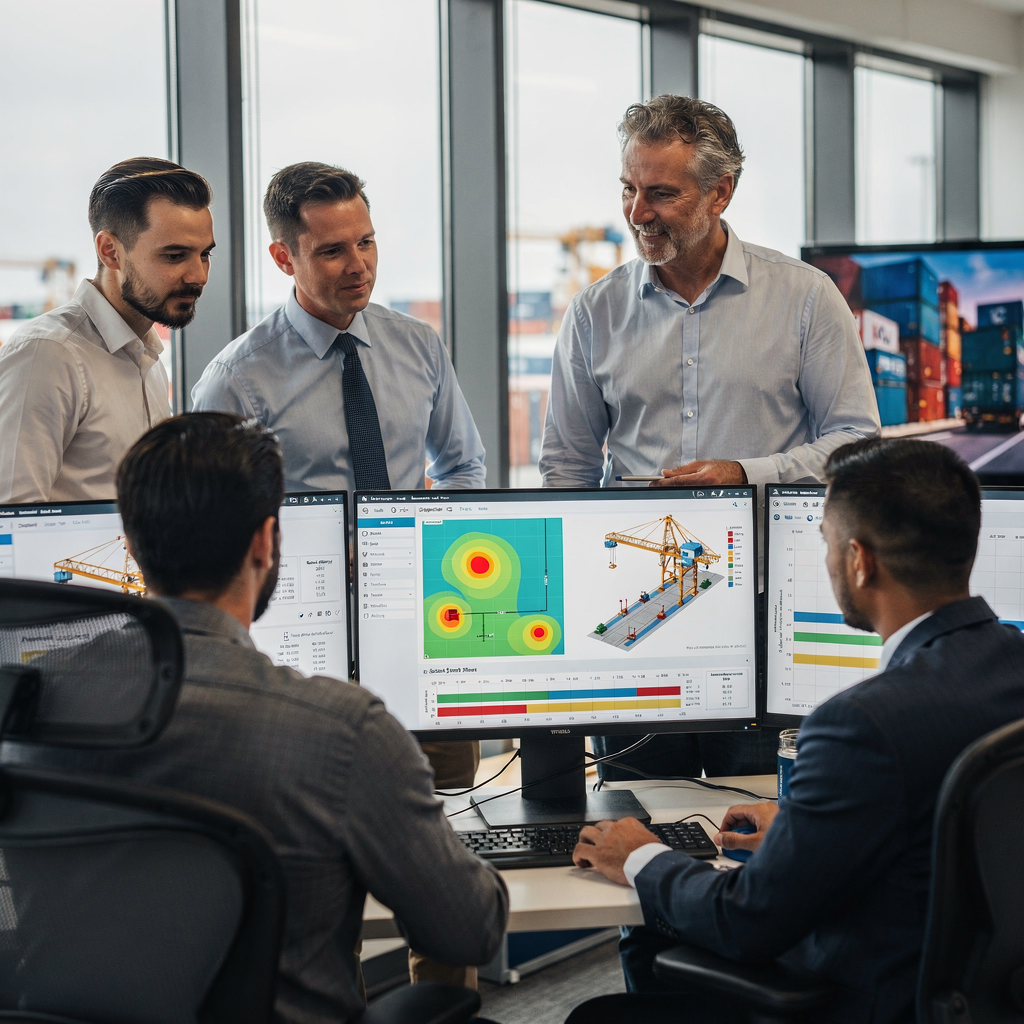
Finally, simulation outputs supported decision support needs by supplying clear KPIs and confidence bands. Leadership could see projected throughput, required staffing per shift, and the chance of queue spillover under each scenario. For terminals exploring AI-native workflows, our resource on multi-agent planning architectures explains how simulation ties to policy training and deployment (multi-agent planning). The transparency of the simulations made stakeholders comfortable with the chosen course of action and ensured smoother implementation.
future optimization and support through digital integration
The future of terminal optimization hinges on integration with live data and intelligent control loops. Coupling a simulation model with a digital twin allows near real-time adaptation. When the twin receives IoT feeds from cranes, trucks, and gate systems, it updates state and can re-evaluate short-term plans. A key insight from recent work is that combining discrete event simulation with live streams helps terminals adapt during disruptions while monitoring sustainability metrics (digital twin and real-time adaptation).
IoT and AI expand model fidelity. Sensors supply equipment statuses and position data that reduce uncertainty in transfer times. AI can analyze telemetry to predict failures and suggest pre-emptive actions. For terminals that want a full transformation, integrating simulation with Terminal Operating Systems and telemetry ensures that recommendations are actionable. For practical guidance on integrating software and standards, see our discussion of data exchange standards in container ports (data exchange best practices).
Sustainability modules are increasingly important. Simulation can capture energy use and emissions per move. Then planners can test greener strategies, such as staged charging of electrified tractors or shift timing that flattens peak power draw. Those assessments help terminals meet environmental targets while keeping throughput high. Also, intelligent automation and optimized schedules enable lower fuel usage and fewer empty runs, reducing total emissions.
In the long-term, combining AI-trained policies with a live twin creates resilient, flexible control. The system can adapt schedules when a vessel is delayed, shift yard allocation when gate volumes spike, and reassign moves when equipment sets fail. Such capability ensures terminals remain competitive in a fast-changing maritime and logistics environment. As new tools like AnyLogic and other platforms evolve, they will further streamline the path from model to live decision-making, enabling terminals to operate more efficiently and sustainably.
FAQ
What is discrete event simulation and why use it for container terminals?
Discrete event simulation models system changes as events occurring at specific instants. It helps terminal planners reproduce variability in arrivals, handling, and equipment availability and to test strategies without disrupting live operations.
Which entities must a realistic container model include?
A realistic model includes vessels, quay cranes, yard cranes, trucks, and storage blocks. It also needs equipment specs and operational rules to capture interactions accurately.
How does a simulation model measure performance?
Models output KPIs such as throughput, turnaround time, and equipment utilization. Analysts run multiple replications to estimate variability and to provide confidence in results.
Can simulation improve vessel waiting times?
Yes, targeted crane scheduling strategies tested in simulation often reduce waiting times. Research shows combined scheduling and yard changes can increase throughput and lower costs (example study).
How do digital twins enhance simulation capability?
Digital twins couple models with live data, enabling near-real-time adaptation. They allow terminals to respond dynamically to disruptions while tracking sustainability and resilience metrics (digital twin study).
Do terminals need historical data to use AI with simulation?
Not necessarily. Reinforcement learning approaches can train policies through simulated experience without relying only on history. That helps avoid repeating past inefficiencies.
Which software tools are common for terminal simulation?
Several platforms support port modeling, including general-purpose DES tools and maritime-focused packages. For guidance, check our survey of maritime terminal simulation software (software survey).
How does simulation help with sustainability goals?
Simulation captures energy usage and emissions per move and lets planners test green strategies. It can reveal trade-offs between throughput and energy consumption.
What role do sensors and IoT play in model fidelity?
IoT provides real-time equipment and position data that improves transfer time estimates and fault detection. This data reduces uncertainty and enhances the model’s predictive power.
How can simulation support investment and staffing decisions?
Simulation quantifies the impact of changes on KPIs and recovery from disruptions, helping to justify capital and operational spending. Case studies show clearer funding decisions when results include probabilistic outcomes and recovery metrics (case evidence).
our products
 stowAI
 stackAI
 jobAI
jobAI
Innovates vessel planning. Faster rotation time of ships, increased flexibility towards shipping lines and customers.
Build the stack in the most efficient way. Increase moves per hour by reducing shifters and increase crane efficiency.
Get the most out of your equipment. Increase moves per hour by minimising waste and delays.
stowAI
Innovates vessel planning. Faster rotation time of ships, increased flexibility towards shipping lines and customers.
stackAI
Build the stack in the most efficient way. Increase moves per hour by reducing shifters and increase crane efficiency.
jobAI
Get the most out of your equipment. Increase moves per hour by minimising waste and delays.