
digital twin technology: Foundations and Key Concepts
A digital twin is a live digital model of a physical system. In a container terminal, it acts as a virtual replica of quay cranes, yard stacks, trucks, gates, and the human workflows that connect them. The digital twin technology combines telemetry, business rules, and models. It monitors daily operations, it can simulate scenarios, and it can run analytics to improve decision-making. Operators use the twin platform to test changes before they touch physical systems. This reduces risk, and it speeds up safe roll-outs.
The core functions of a digital twin include monitoring, simulate, prediction, and feedback. The twin ingests sensor streams and equipment state. Then it mirrors the real-world terminal and it offers what-if runs. It can support predictive analytics and predictive maintenance. For example, the twin can flag a motor that will likely fail within days, so the operator plans a repair window. The twin also supports planning for cargo flow, lane allocation, and resource allocation.
Key components include a virtual replica, IoT connectivity, and simulation engines. The virtual replica models geometry and timing. IoT links feed live telemetry from iot devices and control systems. The simulation and analytics layer runs optimization algorithms and reinforcement policies. This layer generates policies for quay scheduling and yard placement. When used with a terminal operating system and a port management information system, the twin becomes a closed-loop control layer.
Digital twins provide transparency across stakeholders. They surface bottlenecks and waiting times. They let port operators compare alternatives in a virtual environment. For proof, researchers call the twin a bridge between cyber and physical elements, noting how it helps “intellectualized upgrades of terminals’ operation mode” [IEEE case study]. For teams that want a TOS-agnostic deployment, Loadmaster.ai spins up a sandbox digital twin and trains AI agents there before live deployment, reducing risk and ensuring safe operations. To read about TOS integrations and plugins, see our guidance on TOS-agnostic software plugins for terminal operations.
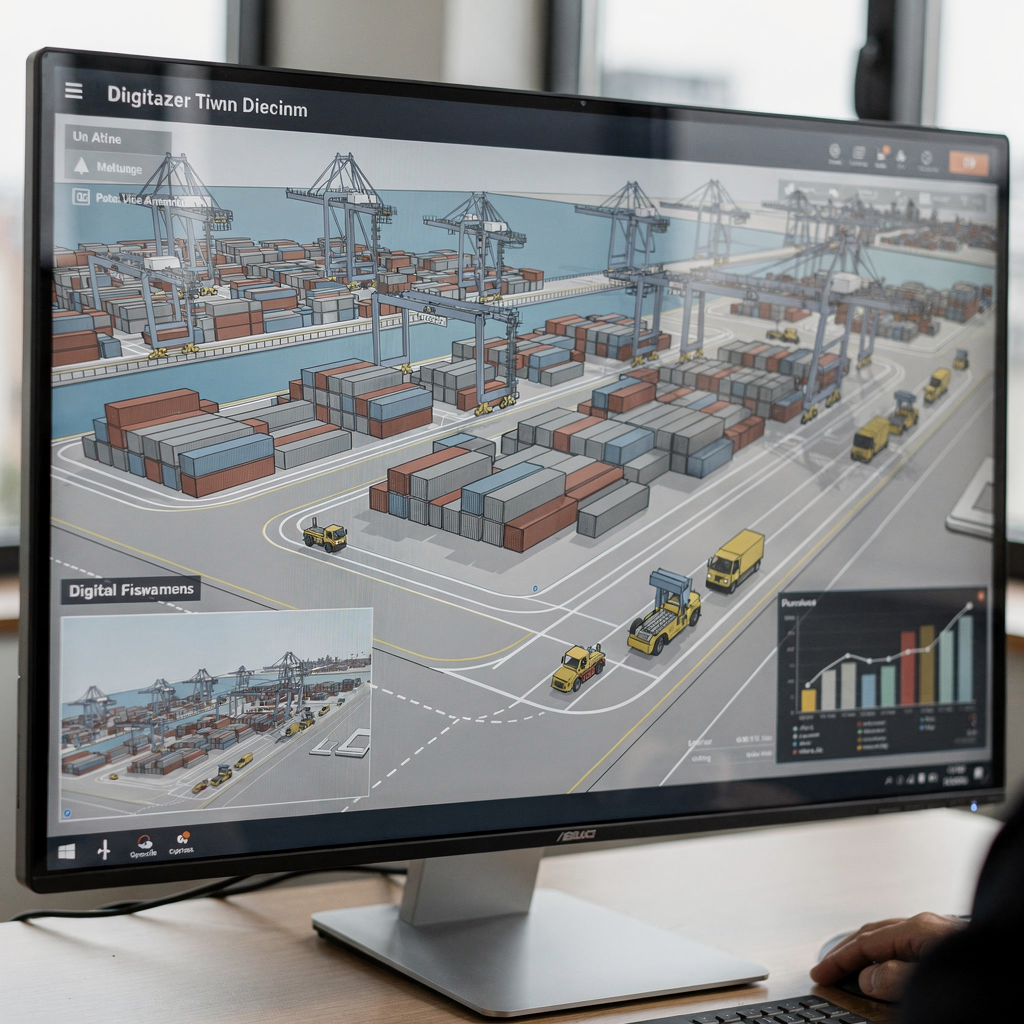
container terminal: Port Infrastructure and Logistics Optimisation
Container terminal designs vary. Yet the twin must map all major assets to function. That means linking stacking cranes, automated guided vehicles (AGVs), and berth scheduling into one digital model. The twin can test berth allocation algorithms and then recommend a plan. It can also run optimization runs to reduce vessel dwell time, gate queues, and rehandles.
In practice, integrating stacking cranes and AGVs requires accurate timing and control interfaces. The twin ingests equipment telemetry and it simulates moves at the second level. This lets planners evaluate crane cycles and yard flows. A notable study reports non-productive crane movements fell by up to 15% when terminal yards used DT-based methods [arXiv study]. This statistic links directly to lower fuel use, and to fewer rehandles.
Infrastructure needs include reliable networks, robust edge compute, and interoperable APIs. Ports need resilient LANs and wireless coverage across stacking areas, gate complexes, and quays. They also need middleware to harmonize legacy PLCs and modern control systems. For terminals that aim to transform port scheduling, dynamic berth and crane allocation is a frequent first use case. See our detailed approach to dynamic berth and crane allocation in deepsea container terminals for an implementation pattern.
Physical layout matters. The twin models container placement, crane reach, and aisle widths. It simulates crane interference and truck queues. That allows planners to evaluate layout changes with limited disruption. The terminal digital twin enhances terminal efficiency and it helps ports and terminals pursue a smart port transformation. At scale, a twin can align with port strategy and with broader infrastructure investments, linking yard planning to berth strategy and to hinterland connections.
Drowning in a full terminal with replans, exceptions and last-minute changes?
Discover what AI-driven planning can do for your terminal
sensor and management systems: Real-time Data Integration
Data feeds power the twin. A well-designed flow starts at sensor sources. The sensor and telemetry stack might include RTG position feeds, gate scanner logs, and crane PLC outputs. These streams enter a message bus, they then go to the terminal operating system (TOS) and to the twin. The twin receives real-time data and it updates the virtual replica accordingly. This makes operations in real time possible and reliable.
Harmonising heterogeneous sources presents a major challenge. Legacy systems may output EDI or proprietary frames. Modern systems prefer JSON or OPC-UA. Teams must map fields and timestamps. They must also handle latency and occasional data gaps. Loadmaster.ai addresses these problems with an API-first integration layer that works across TOS vendors and telemetry sources. For more on API and latency strategies, read our guide on managing latency and data consistency in deepsea container port API integrations.
Real-time data quality matters. The twin uses filters and state estimators to clean noisy feeds. Then a simulation engine ingests cleaned events to keep the twin synchronized. This lets the twin simulate future crane cycles and identify congestion. The system also supports discrete-event simulation and Monte Carlo runs to stress-test plans under shocks.
To address missing IoT coverage, research demonstrates methods that use synthetic data and heuristic search to assess resilience and sustainability when sensors are sparse [T&F framework]. The approach shows how digital platforms can estimate emissions and energy consumption even when some device telemetry is unavailable. This supports early-stage digital transformation in ports that lack full instrumentation.
digital twins in port: Pilot Projects and Case Studies
Pilot projects show measurable gains. One study found overall terminal productivity rose by about 10–20% after applying visualization and twin-driven planning tools [ScienceDirect]. Another report notes 12% better equipment utilization in automated terminals when digital twins coordinate resources [Springer]. These numbers give operators an expectation for return on investment during pilot project runs.
Digital twins in port often begin at a pilot block. Teams copy a yard layout into a sandbox and they run the twin system with historic or synthetic flows. Loadmaster.ai follows this playbook. We spin up a twin, train RL agents in simulation, and then deploy policies with strict guardrails. The agents learn policies that reduce rehandles and that improve crane throughput. This approach avoids teaching AI past mistakes because the agents create their own experience in simulation.
Lessons from leading terminals stress simulation-based optimization and safe deployment. The twin must link to optimization and algorithmic planners that balance quay productivity against yard congestion and driving distance. A Delphi study highlights that “the true potential of Digital Twins to enhance terminal operations still needs to be further investigated” [MDPI Delphi]. The takeaway is clear. Pilots must show reproducible gains under varied vessel mixes and disruptions.
Case studies also reveal specific metrics to track during pilots: waiting times, idle time, moves per hour, and container placement accuracy. Pilots that focus on these KPIs uncover tuning opportunities. For more on reducing equipment idle time and how scheduling changes impact metrics, see our work on reducing deepsea container port equipment idle time. When organizations run rigorous pilots, they capture both immediate operational uplift and lessons that scale.
Drowning in a full terminal with replans, exceptions and last-minute changes?
Discover what AI-driven planning can do for your terminal
benefits of digital: improve efficiency in port operations
Using digital twins yields clear benefits of digital adoption. They reduce non-productive crane movements and they cut idle time. For instance, DT-based yard strategies reduced unnecessary stacking crane moves by up to 15% in study scenarios [arXiv]. In automated environments, twin-driven coordination lifted equipment utilization by about 12% [Springer]. These improvements directly lower operational cost and energy use.
The twin also tightens assignment and resource allocation. Algorithms within the twin platform can optimize quay crane sequences and yard placements to protect future plans. Loadmaster.ai trains RL agents to do precisely that. Our StowAI, StackAI, and JobAI agents search for multi-objective policies that balance quay productivity versus yard congestion. This delivers more consistent and predictable performance across shifts.
Sustainability gains appear when twins model energy consumption and emissions. The twin can run what-if scenarios that show how equipment idling impacts fuel use. It can also test alternative gate timings to reduce truck queuing. Research demonstrates frameworks that enable resilience and sustainability assessments across cargo types, even with limited sensors [T&F framework]. Thus, operators can project emissions reductions before making capital changes.
Additionally, predictive maintenance and predictive analytics help reduce unplanned downtime. The twin feeds condition indicators into a maintenance planner and it prioritizes work based on operational impact. The result is fewer breakdowns during peak vessel calls and lower total cost of ownership. These gains matter to port operators who want to improve efficiency and to enhance overall terminal resilience.
shaping the future of port: role of digital twins
The role of digital twins in shaping the future of port is expanding. Twins support advanced AI-driven agents, and they enable more resilient supply chains. Industry commentary notes that terminals are shifting toward intelligent twins, fueled by AI agents, machine learning, and IoT devices [PortTechnology]. That convergence promises faster reaction to disruptions and to changing vessel mixes.
Challenges remain. Digital readiness varies widely between sea port sites. Some terminals lack consistent wireless coverage or they rely on legacy control systems. Data governance and interoperability are also pain points. Terminals must define what data to share, and how to secure it across vendors. For cyber-resilience patterns, see our article on cybersecurity in automated port operations. Standards and governance will shape adoption speed.
Next-generation trends include AI agents that coordinate decisions across quay, yard, and gate. These agents will work with twin platforms to trade off KPIs dynamically. The twin will also expand to model environmental conditions, hinterland links, and multimodal flows. As a result, digital ports will become more adaptive and more energy efficient.
Finally, discover how digital twin technology can help ports move from firefighting to proactive planning. Companies like Loadmaster.ai show how simulation-trained agents can start cold and then refine online. This approach reduces dependency on historical data and it preserves tribal knowledge. In short, the twin will not replace human operators. Instead, it will amplify their reach, speed, and consistency. This shapes the future of port strategy and of global trade.
FAQ
What is a digital twin in a container terminal?
A digital twin is a live digital model that mirrors a terminal’s physical assets and workflows. It ingests telemetry and it runs simulations so planners can test and validate operational choices before they affect daily operations.
How do sensors feed a terminal digital twin?
Sensors such as RTG position feeds, crane PLC outputs, and gate scanners stream data into a message bus. The twin ingests the streams, cleans them, and updates the virtual replica to reflect current conditions in real time.
Can digital twins improve crane and yard productivity?
Yes. Studies show reductions in non-productive crane movements and improved equipment utilization when terminals apply twin-driven strategies [arXiv]. Pilots commonly track moves per hour and idle time to measure gains.
Do twins require full IoT coverage to be useful?
No. Methods exist to use synthetic data and heuristic search to perform resilience and sustainability assessments even when coverage is incomplete [T&F framework]. However, richer telemetry improves fidelity and decision quality.
How do digital twins integrate with TOS and other systems?
Twins connect via APIs, EDI, or middleware adapters to a terminal operating system and to control systems. For TOS-agnostic patterns and plugin models, teams can rely on well-tested integration layers to avoid vendor lock-in [TOS plugins].
What metrics should a pilot project track?
Track waiting times, idle time, crane utilization, rehandles, and gate throughput. These KPIs reveal both immediate operational efficiency gains and longer-term effects on yard balance and vessel dwell.
How do AI agents interact with the twin?
AI agents train in the twin using simulation and optimization algorithms. After they learn policies, the agents deploy with operational guardrails to assist vessel planning, yard strategy, and job dispatching.
Are digital twins secure for production use?
Yes, if you implement strong access controls and secure data links. Terminals should adopt cyber resilience best practices and align with guidance for automated port operations [cybersecurity guide].
How long does a pilot typically take to show results?
Pilots often run for weeks to a few months, depending on scope. They usually produce measurable improvements in throughput and utilization, and they surface integration work required to scale.
Where can I learn more about optimizing berth and crane allocation?
For practical patterns and algorithms, see our article on dynamic berth and crane allocation. It covers scheduling approaches and real-world constraints for deepsea terminals [dynamic berth allocation].
our products
 stowAI
 stackAI
 jobAI
jobAI
Innovates vessel planning. Faster rotation time of ships, increased flexibility towards shipping lines and customers.
Build the stack in the most efficient way. Increase moves per hour by reducing shifters and increase crane efficiency.
Get the most out of your equipment. Increase moves per hour by minimising waste and delays.
stowAI
Innovates vessel planning. Faster rotation time of ships, increased flexibility towards shipping lines and customers.
stackAI
Build the stack in the most efficient way. Increase moves per hour by reducing shifters and increase crane efficiency.
jobAI
Get the most out of your equipment. Increase moves per hour by minimising waste and delays.