
Container terminal simulation vs TOS: terminal efficiency
Port and terminal operations: Foundations of container handling
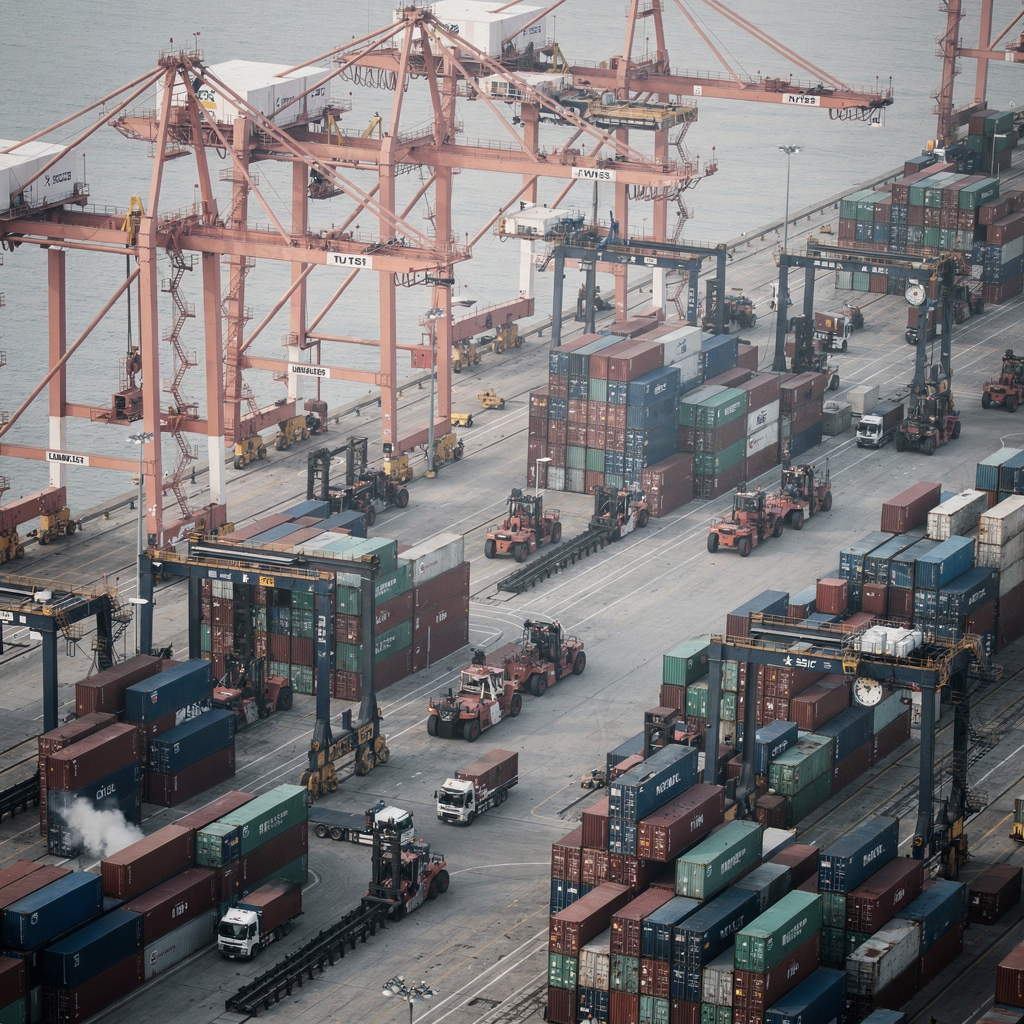
The port sits at the centre of global trade, and it links ships, trucks, rail, and storage. For that reason, operators and planners must manage cargo flow, equipment, and people. A busy terminal handles vessel berthing, quay moves, container stacking, and gate processing each day. First, quay cranes load and unload. Next, yard vehicles move containers to stacks. Then, gate staff process truck turn paperwork. And finally, the terminal records the movements in its systems. As a result, digital control is critical. It reduces delays, and it helps to optimise allocation of assets and labour. For more detail on equipment roles see this guide to container-terminal-equipment-planning-explained (container terminal equipment planning).
Terminals range from local feeders to mega hubs that process huge volumes of containers. For example, some mega terminals manage over 10 million TEUs per year, and they must coordinate thousands of moves per hour to keep throughput stable [source]. Gate handling and yard moves create peaks and valleys in demand, and planning must absorb them. Therefore, terminal managers use scheduling, allocation and visualisation tools to track vessel windows, resource availability, and truck turn times. Also, they monitor handling equipment like RTGs and straddle carriers to keep utilisation high and to reduce idle time.
The daily workflow has many constraints. For instance, service times at the gate and quay crane cycles must align to avoid yard congestion. Meanwhile, truck turn targets guide staffing and dispatch. And, teams to evaluate new layouts or staffing rosters need a safe way to test changes without disrupting. Hence, simulation and emulation are common in modern yards. In short, a robust terminal management framework combines digital systems, planner expertise, and automation to maintain smooth container flow and to improve efficiency.
Container terminal simulation model: Analysing performance virtually
A simulation model recreates yard, quay and gate as a virtual environment so planners can test choices. The model will simulate quay crane cycles, travel distances for vehicles, and container stacking rules. It can range from simple flow diagrams up to a full-fidelity digital twin. For example, multi-fidelity approaches let teams start with coarse flows and then refine to include handling equipment behaviour and equipment dispatching. In practice, using simulation helps to identify a bottleneck before it affects live operations. Research shows that simulation studies can drive significant gains, with reported improvements of 15–20% in throughput when yard and quay crane plans are optimised prior to deployment (15–20% throughput gains).
Simulation software provides metrics and visualisation so planners can validate scenarios. The software includes stochastic elements for service times and arrival patterns. Also, it supports sensitivity tests across various scenarios. For many teams, simulation tools are the go-to method to test new layouts, gate staffing, and quay assignments without risk. Indeed, “Simulation provides a risk-free environment to test operational strategies,” and you can quote that authority when arguing for pilot work (source).
Terminal simulation has been successfully used to reduce rehandles and to lower travel distances. In addition, simulation allows operators to validate allocation rules and to assess equipment control systems before roll-out. As a result, plans move from theory to practice more smoothly. For a practical toolkit, see our overview of container-terminal-simulation-software (container terminal simulation software).
Drowning in a full terminal with replans, exceptions and last-minute changes?
Discover what AI-driven planning can do for your terminal
Virtual terminal and emulation: Safe experimentation for efficiency
A virtual terminal provides an emulated copy of the live site. In that virtual environment staff can test new crane layouts, different container stacking rules, and altered gate schedules. For example, teams can change stack heights and verify container stacking impacts on retrieval times. Also, they can run training sessions so operators to test procedures without risk. Indeed, emulation allows hardware-in-the-loop tests of control systems and handling equipment before full automation.
Emulation to PSA’s Pasir Panjang has been used as an example where a virtual test bed informed real deployment. In other cases teams built an emulation to PSA’s Pasir Panjang setup to test gate algorithms and yard allocation strategies before hardware changes. The PSA’s Pasir Panjang terminal and the panjang terminal at the port both served as testbeds in regional projects. For instance, pilots ran emulation to psa’s pasir panjang tests so engineers could validate new sequences and to improve productivity prior to physical changes. These trials reduced risks and helped validate the actual configuration of cranes, RTGs, and AGVs.
Digital twin frameworks combine live telemetry with emulation. A digital twin injects real-time sensor feeds into the virtual terminal so planners can run what-if scenarios using current states. Therefore, teams can simulate a sudden berth delay or a truck surge and observe effects in near real-time. This approach helps to test operators and to quantify travel distances, service times, and equipment utilisation under stress. In effect, the virtual terminal becomes a tool during the development of new operational rules, and it empowers terminal managers to validate plans before they go live.
Finally, emulation allows safe commissioning of automation, and it supports staff familiarisation. For ports preparing automation rollouts, emulation provides a repeatable test bed where operators can test and refine control scripts, and where teams can evaluate AGV interactions, straddle carrier routing, and crane coordination without disrupting actual operations.
Turning to simulation and emulation: Integrating with TOS for resilience
Turning to simulation and emulation requires integration with the terminal operating backbone. The TOS, or terminal operating system, orchestrates daily moves and keeps inventory accurate. Hence, feeding simulation insights into the TOS creates a loop from planning to execution. For example, predictive allocations from a simulation can be transformed into dispatch rules, and the TOS can then enforce those rules during a shift. However, integration has hurdles. Legacy systems, data synchronisation, and differing control protocols often slow projects. As one study notes, “the slow integration of different systems affects operational efficiency and decision-making” (source).
To bridge the gap, many ports use an emulation layer that speaks both to simulation tools and to the TOS software. That approach maps simulation outputs to tos parameters and it translates TOS feedback into model updates. For example, a new tos release or a new tos parameter set can be tested in the virtual environment before it reaches the live site. This reduces deployment risk and it helps to validate equipment control sequences. Also, the emulation layer can mirror tos and equipment messages so integration tests work end-to-end.
Digital twin technology is a practical bridge. It pulls telemetry from control systems and it pushes optimised allocations back to the TOS for execution. In practice, the TOS and equipment stack must exchange container locations, assigned moves, and execution confirmations. For terminals considering a new tos or a major upgrade, testing with emulation avoids costly rollbacks. Many planners now adopt a staged approach: simulate strategic changes, emulate execution with live data samples, and then deploy smaller increments to the real terminal. This path helps to validate outcomes and to reduce disruptions when changes go live.
Finally, a cautionary note. Integration success depends on clear data contracts, and on robust APIs between the TOS and external optimisation modules. Without those, systems often fail to align, and opportunities to leverage simulation-derived policies are lost. For guidance on digital twin integration see this decision support study on resilient ports (digital twin decision support).
Drowning in a full terminal with replans, exceptions and last-minute changes?
Discover what AI-driven planning can do for your terminal
Optimisation and optimize: Boosting throughput and cutting congestion
Optimisation here covers both strategic planning and on-the-fly control. Strategic optimisation tackles yard layout, quay allocation, and staffing levels over weeks and months. In contrast, real-time optimise tools adjust dispatching and slotting during a shift. For example, yard planning algorithms compute container yard slot assignments to minimise reshuffles and to balance travel distances. AI can also generate assignment sequences that reduce crane idle time and that improve utilisation.
StackAI-style agents and learning-based controllers create new options. They search for policies that reduce unnecessary moves. In many pilots, combining AI with a TOS reduced container dwell-time by about 10–12% when predictive scheduling fed the execution layer [source]. In addition, optimising container sequences at the quay can increase moves per hour for the quay crane while keeping yard congestion manageable. The balance between quay productivity and yard congestion remains a key KPI trade-off, and optimisation must weigh both.
Algorithms for allocation and quay-crane scheduling depend on accurate inputs. Therefore, simulation shows where contention might form and it informs priority rules. Also, slotting techniques that use dynamic scores reduce rehandles and protect future plans. In practice, tools that optimise rely on performance indicators like truck turn, crane cycle, and empty moves. For more on predictive planning, see our predictive-terminal-planning-for-port-operations guide (predictive terminal planning).
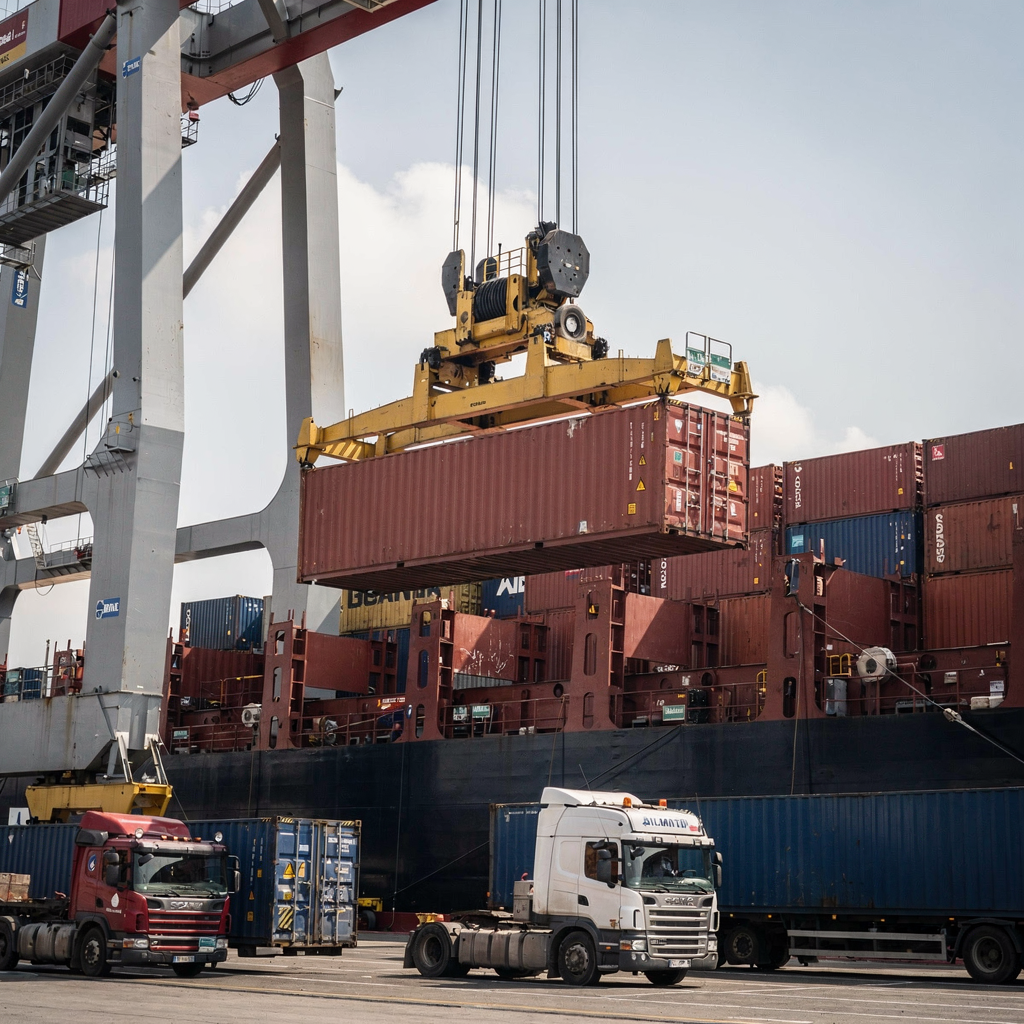
Finally, optimisation delivers measurable benefits. By improving allocation and minimising travel distances, terminals can reduce energy use and lower operating cost. Also, improved scheduling steadies performance across shifts and across years of operations. The result is fewer rehandles, better utilisation of cranes and vehicles, and an overall rise in terminal productivity.
Simulation in terminal operations: From strategic planning to real-time control
Using simulation at every stage creates continuity from strategy to execution. At the planning stage, teams use simulation model runs to compare layouts and to set long-term policy. At the testing stage, emulation allows operators to test control scripts and to validate equipment control interactions. And at the execution stage, trained agents and digital twins can feed optimised instructions to the TOS for live dispatching.
Many terminals worldwide have adopted such layered approaches. For example, pilots at large ports have used simulation software to test vessel stowage and to evaluate yard policies before committing to hardware changes. In some cases terminal simulation has been successfully paired with reinforcement agents to train policies offline, and then these policies were deployed in the live system with guardrails. At Loadmaster.ai we spin up a digital twin of your site and train RL agents so the terminal can benefit from closed-loop control while preserving planner oversight. This approach avoids dependence on historical data and reduces the risk of copying suboptimal past choices.
Simulation has been successfully applied to optimise allocation, to reduce travel distances, and to validate new automation sequences. Many ports found that by testing changes in a virtual environment they could improve throughput and to cut truck turn times without disrupting actual activities. For teams moving from pilots to scale, navis and other TOS integrations must be handled carefully. Integration between the TOS software and external optimisation layers ensures that optimised plans become executable instructions and that execution feedback updates the simulation state. When this feedback loop works, terminals can manage peaks, avoid yard congestion, and maintain steady container flow.
In short, simulation and TOS together provide a path to resilient terminal performance. They let terminal managers validate choices, to protect quay productivity, and to improve efficiency across shifts and across ports including large ports like the port of singapore and hubs such as tianjin. When applied correctly, these tools help to reduce rehandles, to stabilise performance, and to unlock sustainable long-term gains.
FAQ
What is the main difference between container terminal simulation and a TOS?
Container terminal simulation models processes in a virtual environment to test scenarios and to find bottleneck causes. In contrast, a TOS manages daily execution, tracks inventory, and dispatches equipment in real-time.
Can simulation improve throughput in a busy terminal?
Yes. Studies report up to 15–20% gains in throughput when simulation-driven plans optimise yard and quay crane operations before deployment (source). Also, simulation allows validation of those plans so changes deploy smoothly.
How does emulation differ from simulation?
Emulation replicates control messages and equipment interfaces so software and hardware can be tested end-to-end. By contrast, simulation focuses on process outcomes and statistics. Therefore, emulation allows operators to test control systems and tos interactions safely.
Will a digital twin replace the TOS?
No. A digital twin complements the TOS by providing predictive analytics and scenario testing. The TOS remains the execution layer that enforces moves, while the twin provides insights and recommendations.
How do I validate a new configuration before going live?
Use a virtual terminal and emulation to run operational scenarios and to validate the actual configuration. Emulation allows teams to test equipment control sequences and to ensure changes work without disrupting actual operations.
What role does AI play in optimisation?
AI, especially reinforcement learning, can optimise complex trade-offs such as quay productivity versus yard congestion. It can produce policies that reduce rehandles and shorten travel distances while respecting operational constraints.
Can simulation be used with legacy TOS platforms?
Yes, though integration requires careful mapping of data and control messages. Many projects use an emulation layer to translate between simulation outputs and tos parameters so new policies can be tested before deployment.
How much can dwell time be reduced by combining AI and TOS scheduling?
Combining AI with TOS scheduling has shown dwell-time reductions in the order of 10–12% in pilots that link optimisation outputs to execution layers (source). Results depend on local constraints and data quality.
What practical steps should terminal managers take first?
Start with a focused pilot: build a simulation model for a single block or berth, run various scenarios, and then emulate integration with the TOS software. This staged approach reduces risk and helps to validate benefits.
How do I choose between different simulation tools?
Choose tools that match your fidelity needs: start with higher-level terminal throughput simulation for strategic planning, then move to simulation software that models equipment and control messages for emulation and commissioning. For comparisons, see our port-terminal-simulation-tools overview (port terminal simulation tools).
our products
 stowAI
 stackAI
 jobAI
jobAI
Innovates vessel planning. Faster rotation time of ships, increased flexibility towards shipping lines and customers.
Build the stack in the most efficient way. Increase moves per hour by reducing shifters and increase crane efficiency.
Get the most out of your equipment. Increase moves per hour by minimising waste and delays.
stowAI
Innovates vessel planning. Faster rotation time of ships, increased flexibility towards shipping lines and customers.
stackAI
Build the stack in the most efficient way. Increase moves per hour by reducing shifters and increase crane efficiency.
jobAI
Get the most out of your equipment. Increase moves per hour by minimising waste and delays.