
Introduction to container terminal simulation software and discrete event simulation
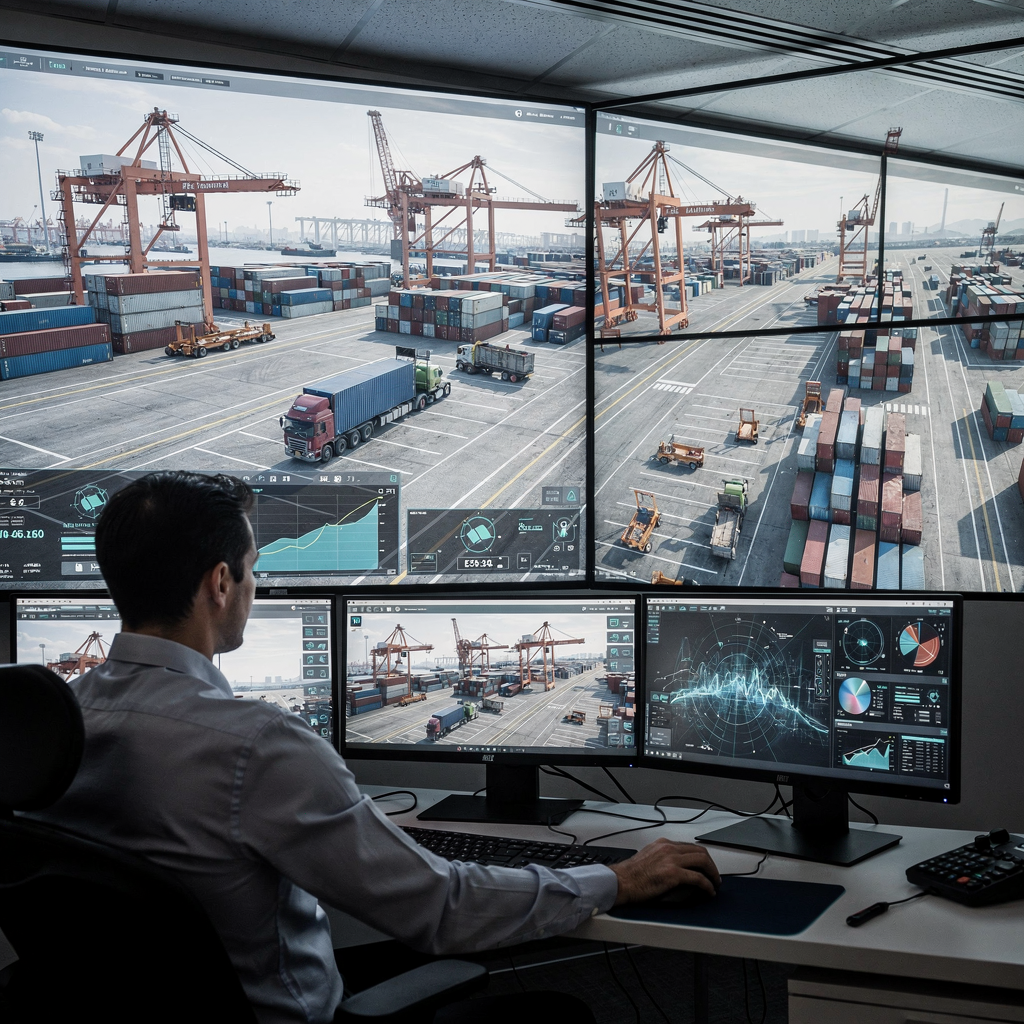
Simulation has become central to modern maritime planning, and discrete event techniques drive most detailed analyses at scale. First, define the terms. A discrete event approach models system changes at event times, for example a quay crane unload or a truck arrival. Next, the software maps the flow of containers from berth to gate, using rules and randomness to reflect real operations. In this context, container terminal simulation software models equipment, yard layout, and human workflows. It helps terminal operators and planners to identify bottlenecks and test alternatives without risking live operations. For example, Portwise explains that “the visualisation of the simulation is essential for conveying the key message of the model, for demonstrating the viability of solutions, and for marketing purposes” Portwise visualization quote. This is critical when large investment decisions are on the table.
Second, list common system requirements and data inputs. A realistic model needs berth schedules, quay crane characteristics, truck arrival patterns, gate processing times, and detailed container yard geometry. It also needs equipment specs such as crane cycle times, lift limits, and transporter driving speeds. In addition, the model benefits from arrival variability, downtime profiles, and service rules. Therefore, accurate data improves fidelity, and yet simulation can also run on minimal inputs when using synthetic scenarios. For terminals with limited history, a simulation model developed with synthetic traffic can still test layout or automation upgrades.
Third, highlight the role of people and processes. Terminal operators and planners use the model for decision support and to validate control logic. Also, simulation supports training for staff who will use new TOS features or automation tools. For readers who want a technical deep dive, our guide on building a digital twin links real operational telemetry and is practical for pilots digital twin integration with TOS. Finally, note that container terminal simulation sits alongside larger supply chain modeling, and it feeds port-level strategy with quantified operational scenarios.
Modeling and system requirements for terminal simulation and digital twin integration
Modeling choices shape outcomes, and three approaches dominate. Discrete event models capture queueing and equipment sequences. Agent-based models represent decision makers, such as trucks and planners, and can show emergent behavior. Hybrid simulators combine both approaches, giving the best of each method. When selecting a simulator, ask whether control logic, human decision rules, and equipment interactions are supported. For example, discrete event is strong when the sequence of moves and resource constraints matter. Agent-based is powerful when individual behavior and adaptation matter. Hybrid modeling therefore supports complex systems where both flow and individual actions matter.
Digital twin integration means linking the model to live Terminal Operating Systems and telemetry. This allows rapid validation and safe testing. Also, a digital twin enables closed-loop optimisation, where simulated policies can train AI agents before live deployment. Loadmaster.ai uses this exact pattern: we spin up a digital twin and train RL agents until the policies meet explainable KPIs, then deploy with guardrails. Learn more in our technical guide on building a digital twin for inland or deepsea terminals building a digital twin of an inland container terminal.
Hardware and software requirements also matter. You need a reliable database for schedules, a messaging layer to ingest telemetry, and a compute cluster for model runs when testing many scenarios. User-friendly dashboards present performance indicators such as moves per hour, idle time, and equipment utilization. For larger pilots, consider cloud or on-premise options that meet your security and latency needs. In addition, integration with your TOS via API or EDI ensures the simulation mirrors real business processes. Finally, ensure the model supports multiple scenarios and fast turnarounds so planners can explore expansion and automation choices quickly and efficiently.
Drowning in a full terminal with replans, exceptions and last-minute changes?
Discover what AI-driven planning can do for your terminal
Throughput optimization and resource management in terminal operation
Identify bottlenecks by tracing flow from quay to yard to gate. Common bottlenecks occur at the quay, in the yard, and at the gate. At the quay, crane scheduling and missed windows reduce moves per vessel call. In the yard, poor placement or excessive reshuffles increase travel and downtime. At the gate, slow processing creates truck backups and shift peaks that ripple back to the quay. Simulation helps to identify bottlenecks and compare remedies. For example, research shows simulation can improve crane productivity by up to 15% and shorten vessel turnaround times simulation study on crane productivity.
Next, outline optimization levers. First, refine crane dispatch rules and sequence planning to reduce idle time and balance workload. Second, adjust stack placement and container stacking strategies to reduce travelling and rehandles. Third, smooth gate arrivals by offering time windows and dynamic dispatch rules. Fourth, use resource management to reassign equipment during peaks, for example moving RTGs or reach stackers to busy blocks. Our article on reach stacker prioritization explains practical tactics to cut rehandles and save moves reach stacker job prioritization.
Quantify the gains to justify investment. Simulation studies and industry reports show meaningful returns. For instance, Arena reports up to a 25% increase in cargo throughput efficiency for ports using their tools Arena simulation efficiency claim. Likewise, capacity models indicate some terminals can accommodate 20–30% throughput growth without extra berths by reconfiguring operations capacity analysis via simulation. Therefore, simulation becomes a powerful tool for deciding which investments yield the best return.
Integrate port simulation software into container terminal operations and supply chain
Integration starts with clear objectives and stakeholder alignment. First, define the questions the model must answer, for example whether an extra berth delivers net benefits. Second, map interfaces to the TOS, ERP, and equipment telemetry. A practical step is to export sample event logs and to validate the simulation against historical KPIs. Then, run controlled experiments and compare outcomes against real-world performance. Loadmaster.ai’s approach is to train agents within a digital twin, then apply those policies to live dispatch with operational guardrails. This reduces risk and speeds adoption.
Next, align simulation outputs with broader supply chain planning. For instance, port container flows connect to rail and road schedules, terminal yard allocation, and hinterland distribution. Simulation results inform modal choices, intermodal timings, and export windows. Use the model to test multimodal scenarios and peaks during export seasons. Also, present outputs as decision-ready dashboards so planners and stakeholders can compare alternatives quickly. When needed, integrate with external planning systems for synchronized updates and alerts.
Finally, manage change carefully. Engage terminal operators, staff, and stevedores from the start. Pilot projects should include training and iterative tuning of control logic. Our work on integrating AI-based restow minimization offers a playbook for rolling out new policies without disrupting live operations AI-based restow minimization. Always provide clear performance indicators and maintain transparency so stakeholders trust simulation-driven decisions. In the end, integration succeeds when the simulation becomes part of routine planning, not an isolated experiment.
Drowning in a full terminal with replans, exceptions and last-minute changes?
Discover what AI-driven planning can do for your terminal
Case studies: terminal simulation, cargo handling and container port improvements
Case study one shows expansion without major civil works. A simulator was used to evaluate berth layouts and redistribution of quay cranes. The team modelled arrival patterns, crane cycles, and yard constraints. The simulation model developed allowed planners to test multiple berth assignments and to quantify throughput and idle time. As a result, the terminal avoided an expensive berth expansion and achieved higher throughput through improved crane sequencing. This case study shows how simulation validates expansion choices and reduces risky investment.
Case study two focuses on yard congestion. A mid-size container port had persistent reshuffles and long truck turn times. The simulation-based study identified a single stacking policy that reduced rehandles by shifting placement rules and reallocating reach stackers during peaks. After applying the new policy, the terminal saw better equipment utilization and fewer delays. The study also highlighted benefits for the wider supply chain because trucks spent less time waiting, which improved road and rail coordination. For readers interested in equipment planning, see our container terminal equipment planning resource for practical steps container terminal equipment planning.
Case study three targeted gate throughput. A global hub used port and terminal simulation software to model peak waves during export season. The model recommended staggered truck windows, added temporary staff at peak gates, and introduced automated gate checks to cut processing time. After implementation, gate congestion fell significantly and vessel schedules became more reliable. In every example, simulation tools gave the terminal operators a low-risk way to test ideas before committing capital. These case studies show how simulation tools support operational changes that deliver measurable results.
Future maritime expansion with container terminal simulation software and optimization
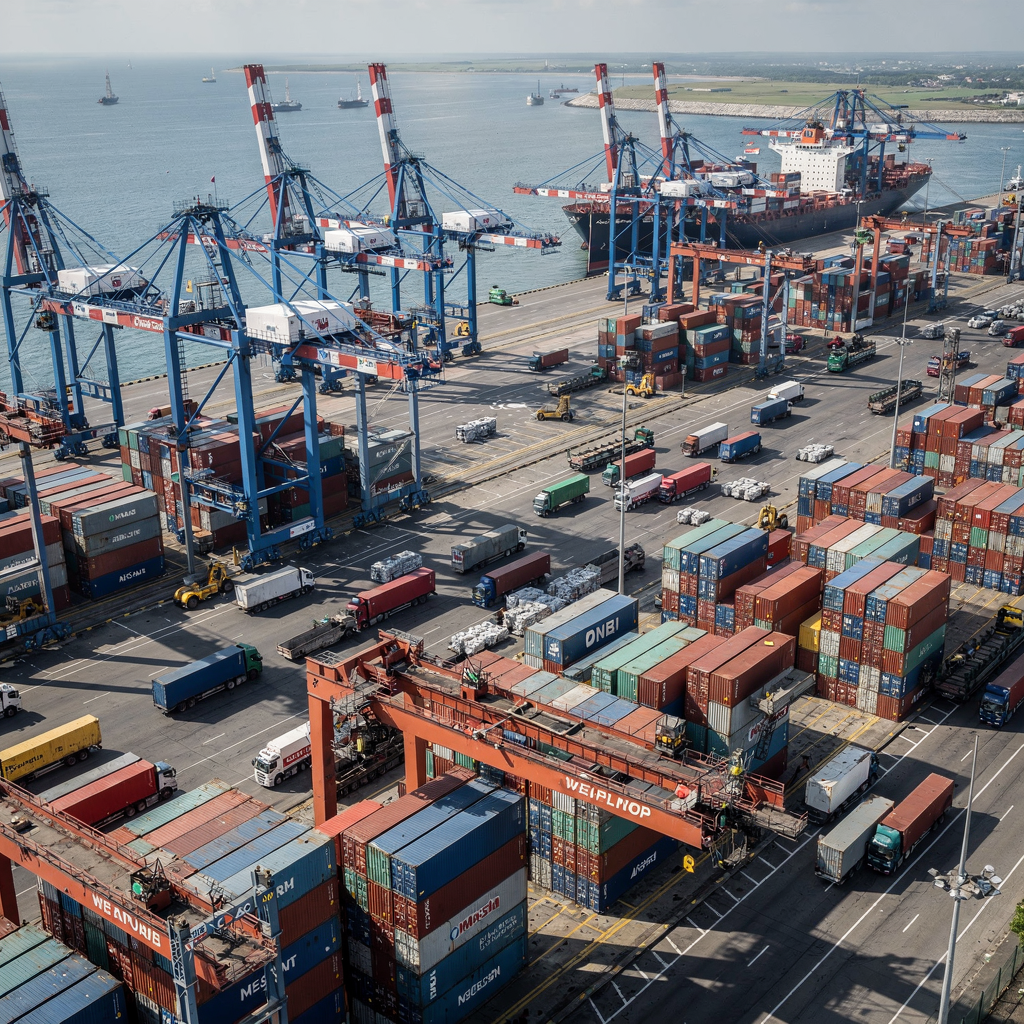
Trends point to more automation, electrification, and sustainability. Automation will alter dispatch rules, and simulation will help refine control logic before hardware changes. Also, digital twin and AI-driven policies will enable terminals to adapt to changing mixes of vessel calls. For example, AnyLogic documents port projects that range from single-dock pilots to large terminals, showing the scalability of simulation modeling AnyLogic port examples. Therefore, planners should include simulation early in expansion programs.
AI-driven simulation will play a greater role. Reinforcement Learning agents can train inside a digital twin and learn policies that outperform historical rules. Loadmaster.ai already applies this by training StowAI, StackAI, and JobAI to balance competing KPIs and to reduce rehandles while preserving executability. This method requires fewer historical data, and it supports cold-start terminals. In addition, AI policies adapt to disruptions and operational changes.
Sustainability gains are also achievable. Simulation-based experiments can test electrified equipment schedules and yard layouts that lower energy consumption and emissions. In parallel, simulation helps to plan for multimodal growth, including barge and rail services. Ultimately, terminals that adopt predictive modelling will be better prepared for throughput growth and expansion. The ability to simulate multiple scenarios, to refine resource allocation, and to present decision support dashboards will remain central to competitive strategy in maritime logistics.
FAQ
What is container terminal simulation software and why use it?
Container terminal simulation software models the flow of containers, equipment, and staff to test operational changes safely. It is used to optimize resource allocation, reduce downtime, and support investment decisions before committing capital.
How does discrete event modeling differ from agent-based modeling?
Discrete event modeling focuses on event sequences and queues, such as crane cycles and truck arrivals. Agent-based modeling represents individual actors, like trucks or staff, and captures emergent behavior when many agents interact.
Can simulation integrate with my Terminal Operating System?
Yes, many projects link simulation to the TOS via APIs or EDI so that models reflect real schedules and telemetry. See our guide on digital twin integration with container terminal operating systems for implementation details digital twin integration with TOS.
How much throughput improvement can I expect from using simulation?
Results vary by terminal, but published studies report crane productivity gains up to 15% and cargo throughput efficiency improvements up to 25% in some cases crane productivity study Arena efficiency case.
Does simulation require lots of historical data?
No. While historical data improves calibration, modern approaches can use synthetic scenarios and AI agents trained within a digital twin. Loadmaster.ai’s RL approach is cold-start ready and does not depend on large historical datasets.
How do I validate a simulation model?
Validation compares simulated KPIs with historical performance and spot-checks event sequences. You should also run sensitivity tests and involve terminal operators during validation to ensure realism.
Can simulation help with sustainability goals?
Yes. Simulation can test electrification of equipment, optimized routing, and reduced idle time to lower energy use. Scenario analysis quantifies trade-offs between emissions and throughput.
Is agent-based simulation useful for training staff?
Agent-based scenarios can simulate realistic human interactions and rare events, making them valuable for training and preparing staff for automation or new procedures.
How quickly can a pilot deliver actionable results?
Pilots often produce useful insights within weeks if objectives and system requirements are clear. Rapid scenario runs and focused KPIs accelerate learning and deployment.
Where can I learn more about capacity planning with digital twins?
For practical methods and case examples, consult resources on capacity planning using digital twins in terminal operations. These show how to use a model for expansion analysis and investment planning capacity planning with digital twins.
our products
 stowAI
 stackAI
 jobAI
jobAI
Innovates vessel planning. Faster rotation time of ships, increased flexibility towards shipping lines and customers.
Build the stack in the most efficient way. Increase moves per hour by reducing shifters and increase crane efficiency.
Get the most out of your equipment. Increase moves per hour by minimising waste and delays.
stowAI
Innovates vessel planning. Faster rotation time of ships, increased flexibility towards shipping lines and customers.
stackAI
Build the stack in the most efficient way. Increase moves per hour by reducing shifters and increase crane efficiency.
jobAI
Get the most out of your equipment. Increase moves per hour by minimising waste and delays.