
container terminal operations under the EU AI Act
Container terminal operations include four key steps: loading, unloading, storage and transfer of containers. Each step demands tight coordination between quay cranes, yard equipment, gate systems and the terminal operating system that manages workflows. Efficient loading and unloading reduce vessel dwell. Smart storage and fast transfer lower yard congestion. Together, these actions shape turnaround time and service for shipping lines and customers.
The EU AI Act introduces a risk-based framework for AI in critical infrastructure, including ports and terminal functions. High-risk classifications apply when AI makes or assists decisions that affect safety, continuity or economic impact in a port. As a result, many AI deployments in a container terminal will need documented risk management, human oversight and reporting. For example, the legislation stresses transparency, accountability and human-in-the-loop requirements so that operators can review decisions and intervene when needed. The Act therefore pushes terminal managers to ensure that any deployed ai system provides auditable logs and explainability.
Transparency matters in day-to-day operations. Terminal operators must retain clear audit trails for container movements, crane operations and dispatch decisions. When an automated scheduling agent recommends a stowage plan, human review and override must remain possible. That aligns with the Act’s emphasis on human oversight and operational governance. As Dr. Maria Jensen puts it, “The future of container terminal operations lies in smart ports where AI not only optimizes efficiency but also adheres to stringent regulatory frameworks like the EU AI Act” https://www.mdpi.com/2077-1312/13/7/1276. This quote highlights how compliance and optimization must coexist.
Data protection is also central. GDPR complements the AI Act by limiting which operational datasets can be used to train models and by requiring safeguards for personal and commercial data. Terminal managers should therefore coordinate cyber and data teams to create data governance that meets both laws. In practice, that means encrypted telemetry, role-based access controls and documented model training pipelines. Together, these practices help ensure safe, explainable and auditable container terminal operations while enabling innovation in the port sector.
AI solutions for modern container terminals: benefits of AI
Modern container terminals adopt AI to solve complex scheduling, stacking and resource-allocation problems. Machine learning, big data analytics and digital twins power these improvements. Machine learning predicts equipment failures and demand spikes. Big data analytics reveal patterns in container throughput and peak gate times. Digital twins simulate yard states and test strategies before changes hit the live terminal. These ai solutions let teams test policy choices and measure trade-offs without risking operations.
AI can deliver measurable gains. Studies show Automated Container Terminal technology can raise productivity by up to 30% while cutting operational costs by about 20% https://www.researchgate.net/publication/346590084_The_global_trends_of_automated_container_terminal_a_systematic_literature_review. Additional research finds efficiency gains in ports that integrate AI and automation ranging from 15% to 40% depending on automation level and system integration https://www.mdpi.com/2673-7590/5/4/155. Those numbers translate to faster vessel service and reduced congestion at major hubs such as Rotterdam, Antwerp and Hamburg. For context, the Port of Rotterdam handled more than 14 million TEUs in 2019, so even small percentage gains can shift large volumes economically https://digitalcommons.pepperdine.edu/cgi/viewcontent.cgi?article=2264&context=etd.
Compliance and explainability shape deployment choices. Explainable AI is essential so terminal operators can justify recommendations for stowage, allocation or equipment dispatch. GDPR and the EU AI Act require clear documentation about data sources and model behavior. Therefore, teams often combine transparent rule-based logic with machine learning to produce hybrid models that are auditable and more acceptable to regulators. For terminals that want to implement AI without large historical datasets, simulation-trained reinforcement learning offers an alternative. Loadmaster.ai, for example, trains RL agents in a digital twin, which reduces reliance on imperfect historical data while keeping operational guardrails in place.
Finally, AI also supports sustainability goals. Optimized moves reduce equipment travel, lower fuel or energy use and cut emissions. Consequently, AI can improve operational efficiency and support a sustainable port strategy simultaneously. For terminals that prioritize both productivity and environmental performance, AI presents a pragmatic route to measurable gains.
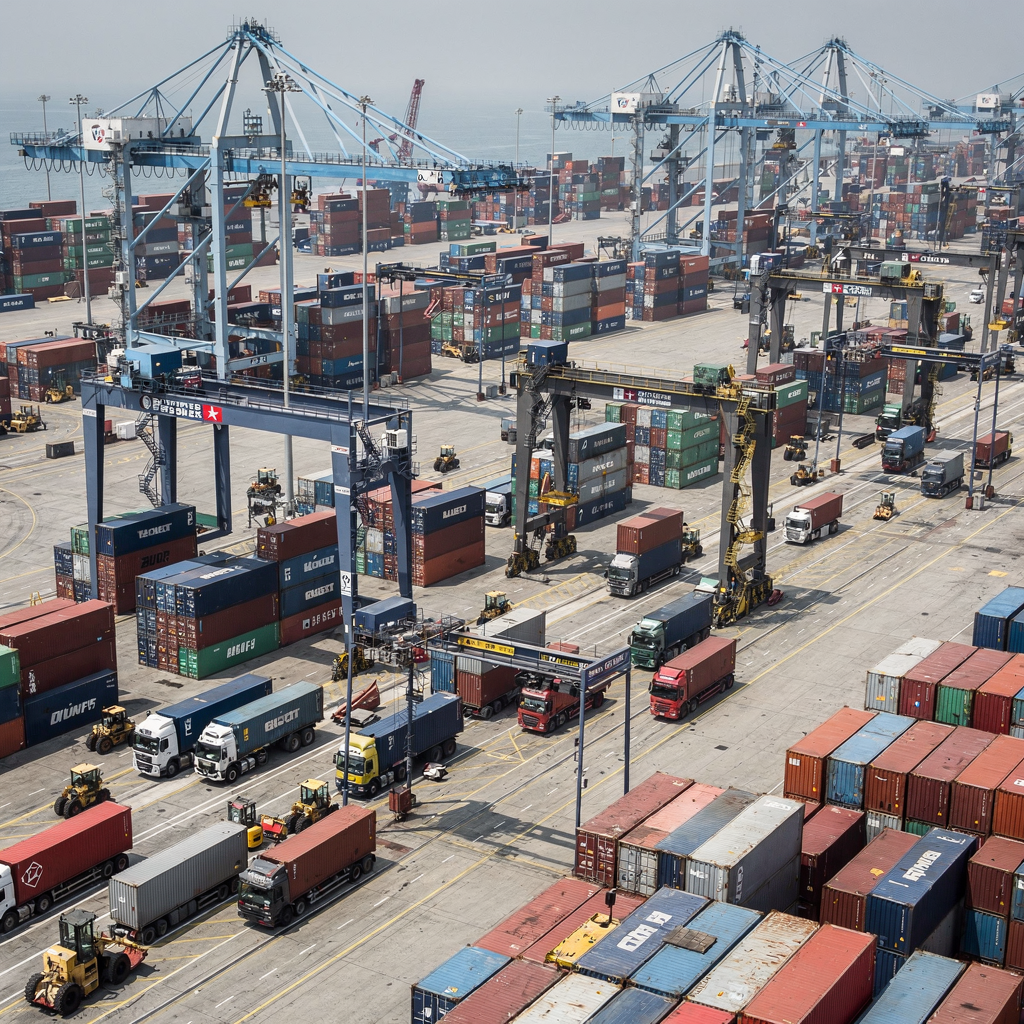
Drowning in a full terminal with replans, exceptions and last-minute changes?
Discover what AI-driven planning can do for your terminal
terminal operating system and container terminal operating system: integrating AI system
A terminal operating system must coordinate vessel planning, yard management, gate flows and equipment dispatch. Core functions include berth and crane planning, yard slot allocation, gate appointment handling and job dispatch. The terminal operating system or terminal operating system modules exchange messages with equipment telemetry, TOS databases and third-party systems such as customs. This integration keeps containers within the terminal moving and ensures that terminal managers can measure KPIs like moves per hour and container dwell time.
Integrating an ai system with legacy IT and OT networks requires careful architecture. First, teams build secure APIs between the terminal operating system and the AI components so data flows are controlled. Next, they deploy model governance that logs predictions, data inputs and decision timestamps. An audit trail must capture why a plan changed and who approved it. That auditability supports both operational troubleshooting and compliance with the EU AI Act. For more on berth and crane planning best practice see this guide on berth and crane planning container terminal berth and crane planning best practices.
AI components typically include prediction engines, optimization layers and execution controllers. Prediction engines forecast arrivals, yard occupancy and equipment failures. Optimization layers solve multi-objective trade-offs such as quay productivity versus yard congestion. Execution controllers translate optimized plans into machine jobs and human instructions. In practice, a CTOS for container will call optimized sequences from an AI agent, then present them to human dispatchers for review. Machine recommendations must include confidence metrics and constraint checks so people can quickly validate them.
Human-override mechanisms are essential. The system should allow terminal operators to pause, modify or replace AI-driven plans. Additionally, IT teams should maintain rollback capability and model versioning to ensure safe deployments. Loadmaster.ai’s approach uses sandboxed digital twins to test policies and create explainable KPIs before go-live, which reduces risk and supports compliance with the EU AI Act. Finally, cybersecurity across the operating system and connected devices is a continuous requirement. Secure authentication, encrypted telemetry and intrusion detection protect both safety and business continuity in an increasingly automated container port.
application of AI in container and container stack: optimising yard operation
AI excels at optimizing yard operation because it can evaluate many constraints simultaneously. Use cases include AI-driven stacking algorithms, yard layout simulation and dynamic relocation policies. Stacking algorithms learn to place containers so that future retrieval is cheaper and less disruptive. Yard layout simulation evaluates gate patterns, equipment lanes and storage density. That helps terminal managers reduce unnecessary container relocation and balance workloads among RTGs and straddle carriers.
A practical case combined AdaBoost with a digital twin to improve real-time control in an Automated Container Terminal https://onlinelibrary.wiley.com/doi/10.1155/2021/1936764. The hybrid framework enabled rapid re-evaluation of stacking and dispatch decisions and reduced contention at peak periods. In many terminals, an AI-driven yard strategist will recommend placements that minimize shifters, shorten routes and protect future plans. For example, Loadmaster.ai’s StackAI places containers to minimize travel while preserving crane productivity and operational constraints.
Key metrics quantify success. Turnaround time and container dwell time drop when stacking and retrieval improve. Safety incidents decrease when AI reduces unnecessary equipment movements. Resource utilization rises as RTGs and trucks operate with fewer idle minutes. Terminals monitoring these metrics often see immediate gains in terminal productivity and in overall terminal efficiency. Moreover, efficiently stacked containers reduce the container relocation problem and cut energy consumption, which supports sustainable port objectives.
Solving the container stacking problem requires both predictive and prescriptive models. Predictive models forecast likely retrieval patterns based on vessel calls and gate appointments. Prescriptive models then assign slots to minimize expected reshuffles and travel distance. When terminals combine those techniques with a digital twin, they gain the ability to test strategies before deployment. Beyond algorithms, the human element remains critical. Yard supervisors and terminal managers must review AI recommendations and adapt them to local constraints and business rules. In that way, AI in container yard operations augments expertise, reduces firefighting and helps achieve smoother schedules and more consistent outcomes.
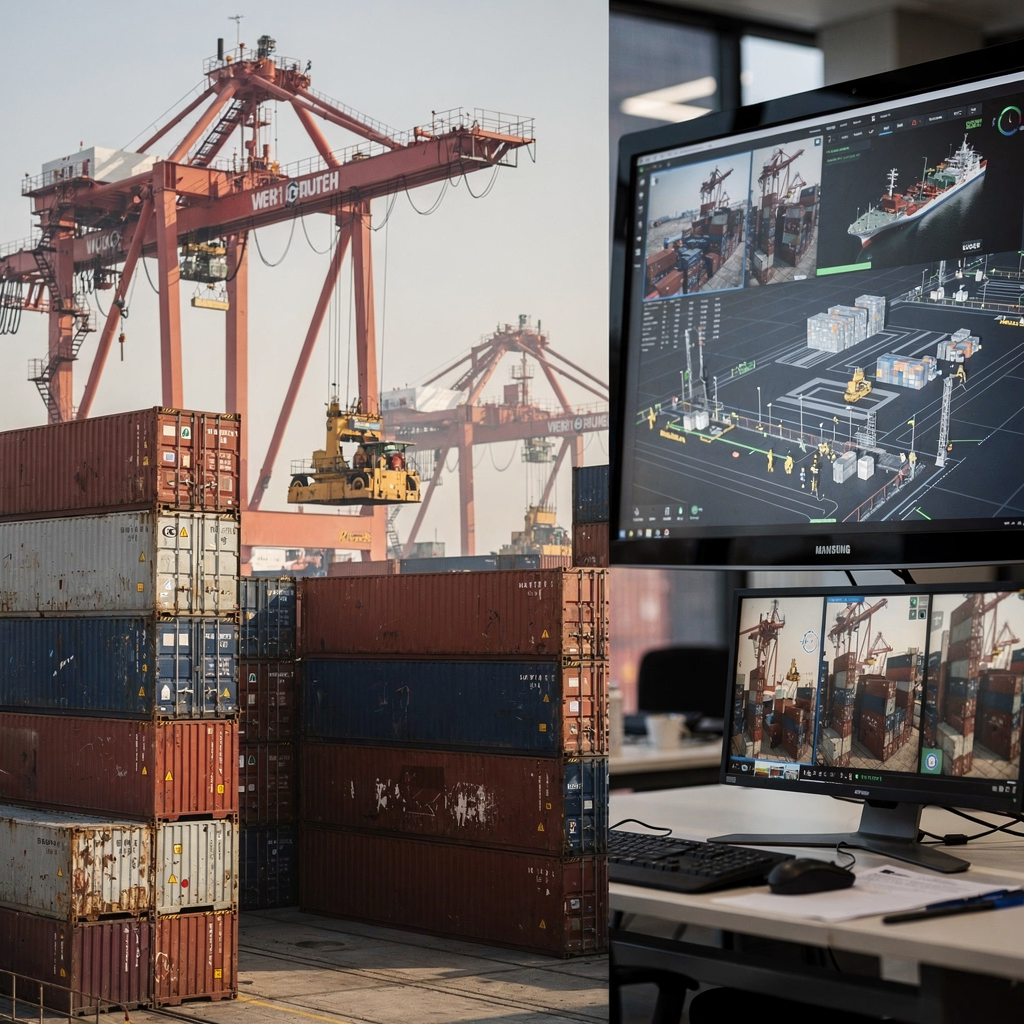
Drowning in a full terminal with replans, exceptions and last-minute changes?
Discover what AI-driven planning can do for your terminal
automated container and automated container terminal: streamline operations in container port
Automation levels range from semi-automated gates and guided vehicles to fully robotic cranes and driverless trucks. Semi-automated gates speed truck processing and reduce gate queues. Automated guided vehicles and straddle carriers move containers with minimal human steering. Fully automated container terminals combine remote crane control, automatic stacking cranes and AI orchestration to enable high throughput with lower labor intensity. Each automation tier delivers different benefits and risks for safety, cyber security and operational continuity.
Major European hubs provide examples. Rotterdam, Antwerp and Hamburg have piloted and scaled automation in various forms. These ports invest in digitalization and in integrating AI into terminal workflows to raise throughput and improve predictability. The benefits include higher terminal productivity and reduced berth waiting. For terminals that want to streamline operations, a staged approach often works best: pilot a small block, measure gains, then scale while preserving human oversight.
The EU AI Act impacts safety-critical automation strongly. When AI directly controls cranes or dispatches heavy equipment, regulators treat the systems as high-risk. That triggers requirements for testing, fail-safe mechanisms and human-in-the-loop controls. Cybersecurity also becomes a top priority. Automated container operations require hardened networks, continuous monitoring and secure device provisioning so that cyber events do not translate into physical hazards. For more on cybersecurity in automated operations see this resource on cybersecurity in automated port operations cybersecurity in automated port operations.
From a practical standpoint, terminals should combine technology with governance. That means clear SOPs for escalation, periodic safety drills and transparent reporting to regulators. Loadmaster.ai’s approach of sandbox training and explainable KPIs helps terminals validate AI policies before live deployment. In addition, the partnership between human operators and AI agents—where people set rules and AI tests millions of simulated actions—creates robust and adaptable operations that can meet both performance and compliance objectives in a sustainable port strategy.
top 10 container terminal AI implementation: future of artificial intelligence in port
Here are ten leading AI use cases that will shape the future of container terminals and maritime container logistics:
1. Predictive maintenance for cranes and equipment to reduce downtime and save cost; see predictive maintenance examples predictive maintenance to reduce crane downtime. 2. Berth and crane scheduling to maximize quay productivity while minimizing idle time; see berth planning best practices container terminal berth and crane planning best practices. 3. Yard optimization and stacking algorithms to cut container relocation and speed retrieval. 4. Gate flow automation and truck appointment systems to reduce queues. 5. Energy management to lower fuel use and support a sustainable port. 6. Job sequencing and dispatch automation to streamline operations and reduce empty driving equipment dispatching to reduce empty driving. 7. Demand forecasting to smooth labor and equipment planning. 8. Smart safety monitoring using video analytics. 9. Digital twins that let teams test policies before they run on the live terminal. 10. Multi-agent reinforcement learning that adapts to changing vessel mixes and yard states.
Experts stress human-AI collaboration. As one report states, “Automation and AI have the potential to revolutionize port operations, but their deployment must be carefully managed to align with emerging legal and ethical standards, particularly in the European context” https://thesis.eur.nl/pub/64841/Harbi-Akram.pdf. Therefore, explainable models and clear governance are non-negotiable. Terminal managers should pilot ai implementation in controlled environments, measure results and scale progressively. Loadmaster.ai recommends a pilot-to-scale roadmap: start with a sandbox digital twin, validate KPIs, then integrate with the CTOS for phased rollout. This approach reduces risk and accelerates value capture while supporting compliance under the EU AI Act.
Finally, the potential of AI depends on implementation choices. Terminals that pair AI with human expertise, strong cybersecurity and transparent governance will unlock consistent performance improvements. The future of container terminals will be shaped by cooperation between people and machines, balanced by regulation and a focus on sustainable, efficient port operations.
FAQ
What does the EU AI Act mean for container terminal deployments?
The EU AI Act sets a risk-based approach that treats safety-critical automation in ports as high-risk. That means terminals must provide documentation, human oversight, and auditable systems before deploying certain AI capabilities.
How can AI improve terminal productivity?
AI optimizes scheduling, yard placement and equipment dispatch to reduce rehandles and idle time. Studies show gains of up to 30% in productivity and roughly 20% cost reductions in automated setups https://www.researchgate.net/publication/346590084_The_global_trends_of_automated_container_terminal_a_systematic_literature_review.
Are digital twins necessary to implement AI safely?
Digital twins are not strictly necessary, but they greatly lower risk by letting teams test policies in simulation. They are particularly useful for reinforcement learning and for proving compliance before go-live.
How does a terminal operating system work with AI components?
The terminal operating system exchanges data via secure APIs with prediction engines and optimization modules. It presents AI recommendations to human dispatchers and logs decisions for governance and auditing.
What are common AI use cases in ports?
Top use cases include predictive maintenance, berth scheduling, yard optimization, gate automation and energy management. These use cases drive efficiency and support sustainable port initiatives.
How do terminals preserve human control when using AI?
Terminals implement human-in-the-loop controls, confidence scores, and manual override options. They also keep detailed audit trails so that human operators can review and change AI-driven plans.
Can terminals implement AI without historic data?
Yes. Reinforcement learning in a simulated digital twin can train agents without relying on large historical datasets. This approach avoids teaching past mistakes and supports cold-start deployments.
What cybersecurity measures are recommended for automated terminals?
Recommended measures include encrypted telemetry, role-based access, continuous monitoring and secure device provisioning. These controls reduce the chance that cyber incidents will cause physical disruptions.
How do AI models handle GDPR requirements?
AI models must use compliant data handling, anonymization where needed and documented data provenance. Terminals must limit personal data usage and conduct impact assessments when necessary.
Where can I learn more about practical AI deployments in terminals?
Explore resources on berth and crane planning, predictive maintenance and equipment dispatch on our site, including guides for pilot projects and CTOS integration container terminal berth and crane planning best practices, predictive maintenance examples, and equipment dispatch strategies equipment dispatching to reduce empty driving.
our products
 stowAI
 stackAI
 jobAI
jobAI
Innovates vessel planning. Faster rotation time of ships, increased flexibility towards shipping lines and customers.
Build the stack in the most efficient way. Increase moves per hour by reducing shifters and increase crane efficiency.
Get the most out of your equipment. Increase moves per hour by minimising waste and delays.
stowAI
Innovates vessel planning. Faster rotation time of ships, increased flexibility towards shipping lines and customers.
stackAI
Build the stack in the most efficient way. Increase moves per hour by reducing shifters and increase crane efficiency.
jobAI
Get the most out of your equipment. Increase moves per hour by minimising waste and delays.