
Core Tasks in container Handling
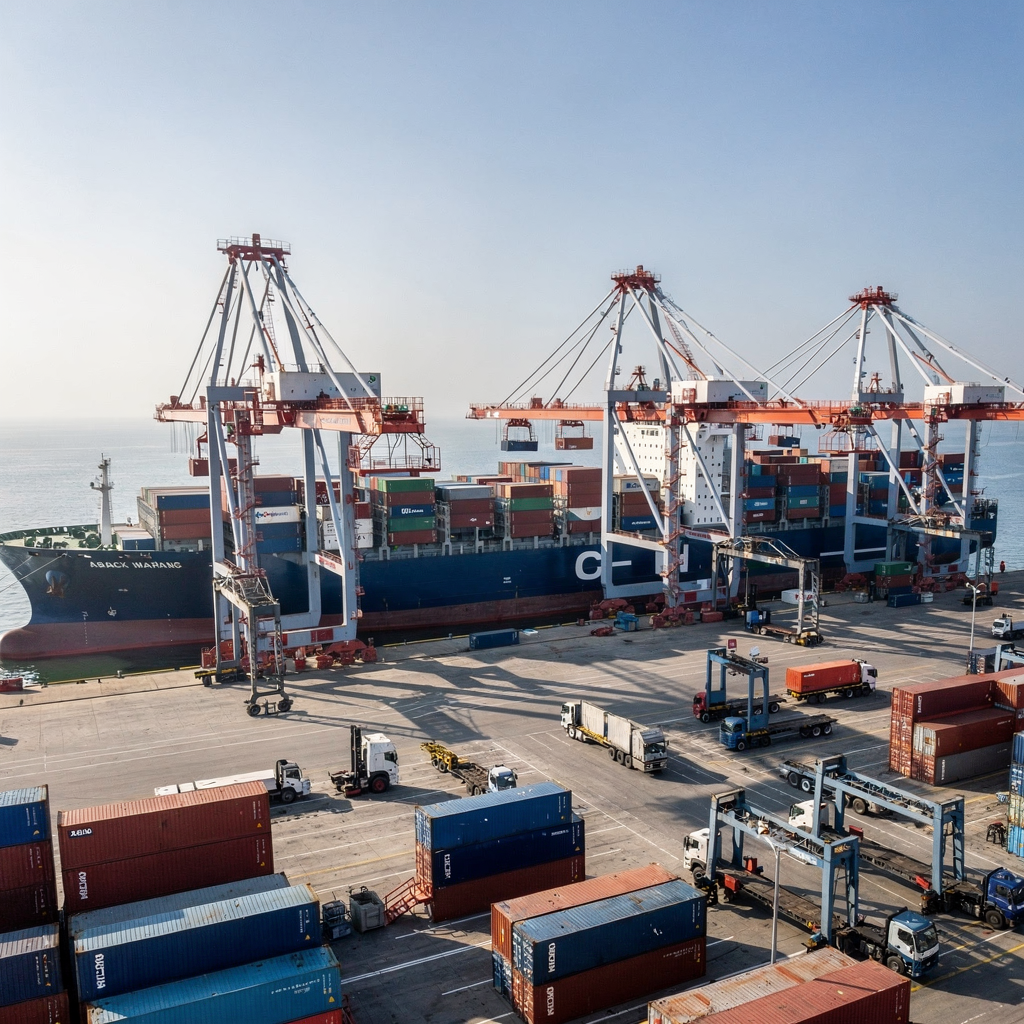
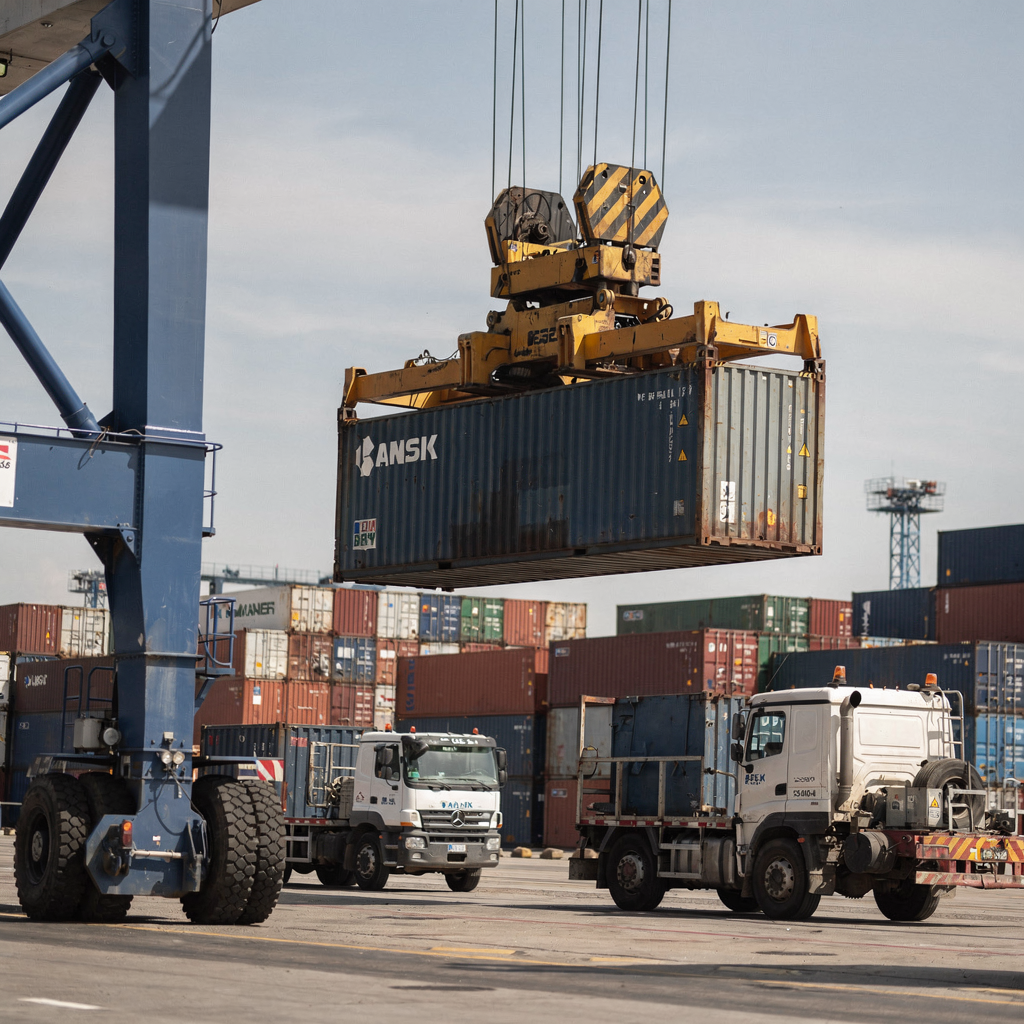
Container handling at the quay begins with QUAY CRANE moves that lift, rotate, and place boxes on the quay or on trucks. Then, a container is handed over to terminal trucks or straddle carriers for horizontal transport. Also, careful sequencing of QUAY CRANE tasks matters. Additionally, the handover window is a critical step. Therefore, planners and operators must coordinate loading and unloading to keep ships on schedule.
Container types and sizes shape the work. For example, 20ft and 40ft TEU boxes, refrigerated units, and oversized loads all have distinct handling requirements. Also, dangerous goods require special stowage and labeling. Thus, the handling sequence must consider weight, bay plan, and equipment reach. Next, yard placement decisions influence future moves. Consequently, a single misplaced box can create rehandles and increase travel distance for yard cranes.
Key performance measures guide decision-making. Throughput measures moves per hour or per vessel call. Crane utilisation tracks active time for each QUAY CRANE. Turnaround time measures how long a vessel stays at berth. Studies show that optimized job assignment can boost equipment utilisation by up to 20–30%. Also, data-driven models can cut handling times by about 12%, which shortens berth time and yard congestion.
Operators track additional KPIs too. For example, the number of container moves without rehandles, the number of equipment trips per container, and energy per move. In addition, human factors matter. A study noted that “driver satisfaction and fatigue are critical parameters that must be integrated into optimization decisions” [source]. Therefore, scheduling must balance throughput with the well-being of equipment operators.
To manage these tasks, terminals deploy a mix of rule-based logic and optimization. However, the scheduling problem grows complex when arrivals vary and equipment breaks down. Also, the design of an optimization model matters because it must capture constraints like reach, weight, and stacking rules. For practical guidance on berth and crane planning, readers can consult our best practices on berth and crane planning.
Overview of container terminal Equipment and Workflow
Container terminal workflow links three main zones: quay, yard, and gate. At the quay, QUAY CRANE equipment lifts and transfers boxes between ship and landside. Then, horizontal transport moves boxes to the yard blocks. Finally, gate operations handle truck-in and truck-out flows for export and import container processing. Also, storage and retrieval at the yard complete the chain.
Main equipment types include QUAY CRANES, yard cranes such as RTGs or RMGs, straddle carriers, and yard trucks. Each equipment type has different reach, speed, and constraints. For example, yard cranes stack and retrieve containers in the yard, while straddle carriers serve short-distance moves. Also, yard truck dispatch connects quay operations to storage. Therefore, the choreography of these assets drives terminal performance.
Horizontal transport is the lifeline. Yard trucks and straddle carriers move one container at a time in many terminals. In addition, automated container terminal designs use AGVs and fixed transfer points to reduce manual handoffs. Because the number of container moves and the pattern of moves vary by vessel mix, the workflow must adapt quickly. Next, optimization of yard flows reduces travel time and protects future plans.
Operators rely on TOS and newer AI tools to manage coordination. For example, TOS-agnostic software plugins help integrate scheduling decisions with telemetry and dispatch systems; see our guide on TOS integration. Also, dispatch systems that reduce empty driving can cut fuel use and travel time; our analysis of equipment dispatching outlines key strategies for reducing empty driving.
Finally, the flow between quay and yard defines the scheduling problem. The handover timing, truck queues, and yard occupancy influence how many cranes can work simultaneously. Thus, synchronized resource allocation and clear operational rules improve moves per hour. Also, terminals using digital twins and AI show more consistent outcomes across shifts, because policies adapt rather than imitate past errors.
Drowning in a full terminal with replans, exceptions and last-minute changes?
Discover what AI-driven planning can do for your terminal
Advanced optimization Models for Quay Crane Scheduling
Quay crane scheduling tackles a core optimization problem: assign QUAY CRANE tasks to minimize idle time, reduce interference, and maximize throughput. The scheduling problem is hard because vessel arrivals, berth windows, and container flows are stochastic. Also, cranes can block each other, and safety spreads limit simultaneous moves. Therefore, advanced optimization combines methods to handle variability.
Hybrid stochastic–robust approaches are now common. In practice, models blend STOCHASTIC OPTIMIZATION to account for uncertain arrival times with ROBUST OPTIMIZATION to protect against worst-case scenarios. For example, researchers reported that a blended approach improved adaptation to real-time variability and decision accuracy [source]. Also, multi-stage models re-evaluate plans as new information arrives. Consequently, policies become resilient to delays and breakdowns.
Objective functions vary with terminal priorities. Typical goals include minimising QUAY CRANE idle time, maximising throughput, and balancing workloads across cranes. Also, secondary objectives include minimising energy use and reducing rehandles. Optimization models often use mixed-integer programming for exact solutions, and metaheuristics such as genetic algorithms or particle swarm for larger instances. In some studies, improved particle swarm optimization algorithms have been tested for related allocation problems.
Case studies show tangible gains. For instance, synchronized container allocation and yard crane collaboration lifted crane utilisation by about 20–30% in certain terminal layouts [source]. Also, stack-based strategies in automated container terminal settings produced a 10–15% increase in throughput by processing multi-batch moves in the same bay [source]. Thus, the right optimization model can unlock lost productivity.
In practice, deployment matters. Loadmaster.ai trains RL agents in a digital twin so policies learn against tailored KPIs. Also, our approach does not require historical data, which removes a common barrier for terminals with limited clean history. Finally, closed-loop training helps avoid the average-of-past outcomes that supervised models return. Therefore, terminals can get active policies that improve crane sequencing and overall berth performance.
Efficient allocation of Cranes and Trucks
Allocation of cranes and trucks defines the efficiency of the waterfront. Sequential allocation assigns QUAY CRANE tasks first, then sends trucks. Integrated allocation coordinates cranes and trucks at once. Also, integrated strategies reduce waiting times because they consider horizontal transport capacity while scheduling quay moves. Therefore, many terminals shift to integrated methods when possible.
Sequential strategies are simpler to implement. For example, planners assign crane tasks according to bay plan and then dispatch yard trucks. However, this can produce mismatches. Trucks may arrive when the QUAY CRANE is occupied or when yard space is not available. Consequently, waiting times and idle trips increase. Also, the problem of container trucks often stems from this lack of coordination.
Stack-based multi-batch processing improves efficiency. By grouping moves in the same stack and handling multiple containers in a single bay visit, terminals can cut container handling times. In automated container terminal contexts, clustering stacks has shown a 10–15% throughput gain, while data-driven models reduced handling times by about 12% [source]. Also, stack-aware sequencing prevents unnecessary travel and reshuffles.
Coordination between QUAY CRANE and yard cranes is crucial. For example, pairing quay moves with yard crane availability reduces truck idle time and keeps QUAY CRANEs productive. Also, systems that map expected yard crane tasks to quay schedules eliminate blind spots. For more on reducing idle time across your terminal, consider our analysis on reducing deepsea container port equipment idle time. Ultimately, optimizing resource allocation for both quay and land fleets increases moves per hour and lowers costs.
Drowning in a full terminal with replans, exceptions and last-minute changes?
Discover what AI-driven planning can do for your terminal
Addressing the scheduling problem under Uncertainty
The scheduling problem in a container terminal is NP-hard in general. Dynamic arrivals and stochastic events like delays, breakdowns, and changing vessel mixes make the problem even harder. Also, the scheduling problem of container handling frequently forces planners into rolling reassignments. Therefore, algorithms must be fast, reliable, and robust to new information.
Rolling-horizon approaches divide the planning horizon into manageable windows. Then, planners or algorithms produce plans for the near term and re-optimize as time advances. Also, real-time rescheduling frameworks let systems react to truck queues, berth shifts, or equipment faults. Consequently, terminals can keep operations stable while adapting to changes.
Human factors affect algorithmic choices. Research showed that operator fatigue and mental workload drop by 15–25% when schedules are balanced and predictable [source]. Also, removing unnecessary reshuffles improves safety and morale. Therefore, incorporating operator constraints into the mathematical model benefits both throughput and working conditions.
Mathematical model choices matter. Mixed-integer programs provide exactness but struggle with scale. Thus, many terminals use hybrid solutions: fast heuristics for daily execution and deeper optimization for strategic planning. Also, reinforcement learning agents can learn policies that generalize to new conditions. For instance, our JobAI and StowAI agents train in a digital twin and then execute with operational guardrails to handle uncertainties without relying on clean historical data.
Finally, simulation and synthetic scenario generation validate solutions. Running stress tests on worst-case container mixes or truck surges finds brittle plans before they hit the quay. In addition, combining stochastic sampling with robust safeguards produces plans that perform well across a range of outcomes. Hence, the optimization problem becomes manageable and actionable for planners and terminal operators.
resource allocation in truck scheduling and yard truck Coordination
Efficient truck scheduling complements quay work. Resource allocation for yard trucks and straddle carriers ensures that horizontal transport matches quay throughput. Also, data-driven dispatching assigns the next best task to each truck based on location, load, and priority. Therefore, smart dispatch reduces empty travel and cuts dwell time for export container handover.
Data-driven dispatching relies on telemetry and prediction. For example, predicting truck arrival patterns lets dispatchers pre-position yard trucks. Then, moves occur with minimal waiting. Also, integrating truck schedules with the quay plan reduces conflicts and speeds up container loading and unloading. Consequently, terminals see fewer rehandles and shorter driving distances.
Integrated resource allocation treats quay cranes, yard cranes, and trucks as one system. In practice, joint optimization removes local bottlenecks and optimizes end-to-end flow. Also, simulation-based optimization tools help test allocation strategies before roll-out. For terminals seeking practical methods, our piece on synchronized fleet management offers guidance on aligning execution layers and fleet management synchronizing fleet management.
Tooling includes simulation, mixed-integer solvers, and reinforcement learning platforms. For example, a simulation can show how many yard trucks are needed to support a given berth schedule. Then, an optimization model can determine the best assignment to minimise total travel. Also, software that integrates with the TOS speeds deployment. See how AI-assisted vessel planning can complement truck coordination in shortsea settings at AI-assisted vessel planning.
To summarise, optimizing truck scheduling and yard truck coordination prevents horizontal delays that limit quay productivity. Also, it reduces fuel costs and evens equipment workloads. Consequently, terminals enjoy improved throughput, lower operational risk, and more stable performance across shifts.
FAQ
What is quay crane allocation and why does it matter?
Quay crane allocation is the assignment of quay crane tasks to minimize idle time and complete ship moves efficiently. It matters because effective allocation increases throughput, reduces berth time, and lowers operational costs.
How does uncertainty affect the scheduling problem?
Uncertainty from vessel arrival times, truck queues, and equipment failures makes scheduling more complex. Therefore, models must be robust and adaptive to maintain performance under changing conditions.
Can optimization improve operator workload and safety?
Yes. Studies demonstrate that balanced scheduling can reduce mental workload and fatigue by about 15–25% [source]. Also, fewer reshuffles and clearer plans improve safety and consistency.
What is the benefit of integrated crane and truck allocation?
Integrating crane and truck allocation cuts waiting times and reduces empty trips. Consequently, terminals increase effective moves per hour and lower fuel consumption and emissions.
Do automated container terminal strategies differ from manual ones?
Yes. Automated container terminal strategies often use stack-based clustering and multi-batch processing to increase throughput by 10–15% [source]. Also, they emphasize coordination between fixed equipment and AGVs.
How can data-driven models reduce handling times?
Data-driven models can predict arrivals and optimize sequence selection, reducing handling times by roughly 12% in trials [source]. In addition, they help test what-if scenarios before execution.
What tools are used for quay crane scheduling optimization?
Tools include mixed-integer programming, heuristics, particle swarm methods, and reinforcement learning agents. Also, digital twins and simulation platforms validate plans under stress.
How does Loadmaster.ai help terminals with allocation?
Loadmaster.ai trains RL agents in digital twins to produce policies that optimize QUAY CRANE sequencing, yard placement, and dispatch without relying on historical data. The result is measurable gains in crane utilisation and fewer rehandles.
What is a scheduling optimization model in this context?
A scheduling optimization model encodes objectives, constraints, and decision variables for crane and truck tasks. Then, it finds assignment schedules that balance throughput, travel, and operator constraints.
Where can I learn more about berth and crane planning best practices?
For practical guidance, read our best practices on berth and crane planning at container terminal berth and crane planning. Also, our resources cover equipment dispatching and fleet synchronization to support implementation.
our products
 stowAI
 stackAI
 jobAI
jobAI
Innovates vessel planning. Faster rotation time of ships, increased flexibility towards shipping lines and customers.
Build the stack in the most efficient way. Increase moves per hour by reducing shifters and increase crane efficiency.
Get the most out of your equipment. Increase moves per hour by minimising waste and delays.
stowAI
Innovates vessel planning. Faster rotation time of ships, increased flexibility towards shipping lines and customers.
stackAI
Build the stack in the most efficient way. Increase moves per hour by reducing shifters and increase crane efficiency.
jobAI
Get the most out of your equipment. Increase moves per hour by minimising waste and delays.