
Terminal safety: collision prevention fundamentals
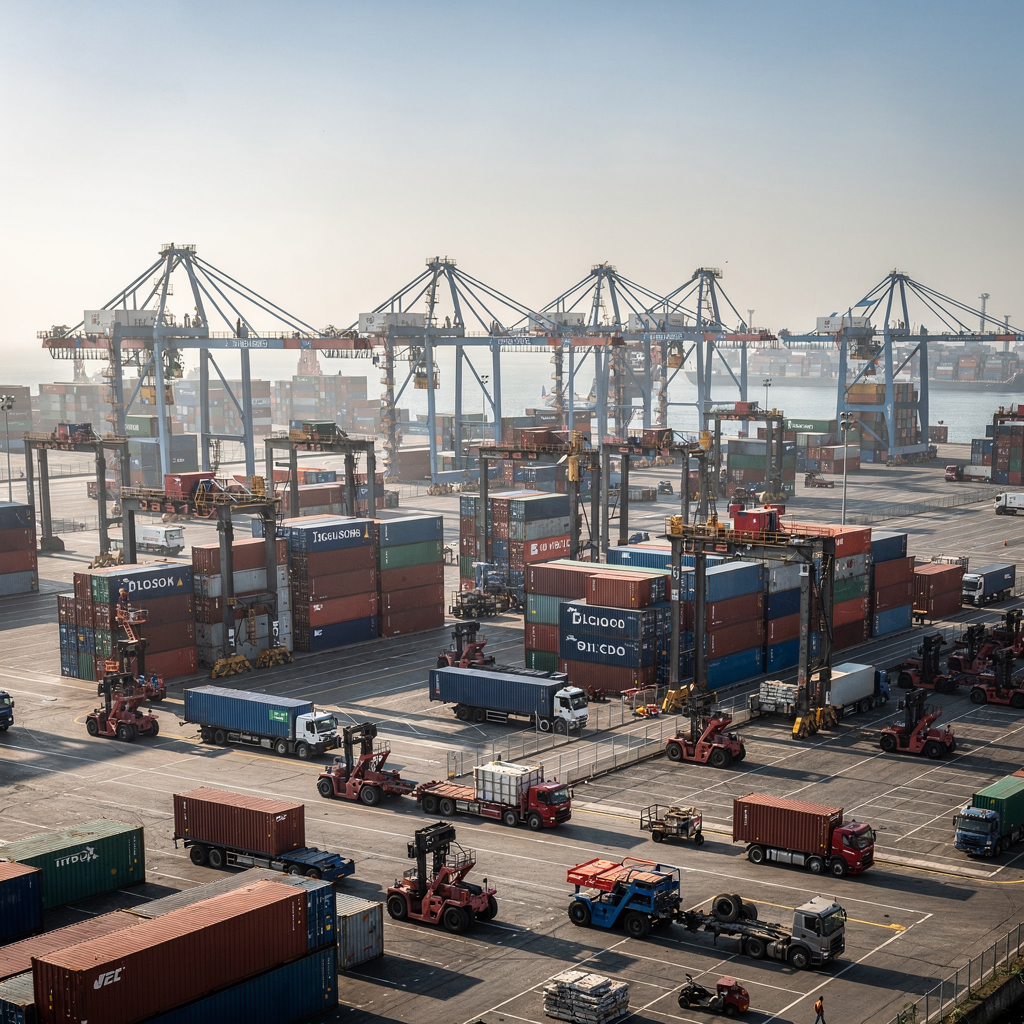
Container terminals are the hubs where ships, trucks, cranes, and yards meet to move global trade. First, they receive a container on a quay. Then, cranes transfer that box to a stack. Next, trucks and straddle carriers take it to a container yard or gate. For terminal operators, keeping this flow safe and efficient is a top priority. Therefore, collision prevention must sit at the centre of operational planning, equipment design, and staff training.
Collision risk rises when traffic density grows and when mixed fleets operate together. For example, heavy quay crane moves or tight stacking patterns increase the chance of a collision between lifting equipment and a stack of containers. To reduce that risk, modern safety systems combine sensors, software, and operator interfaces. Sensors monitor positions, speeds, and blind spots. Then, advanced software fuses the inputs and provides an actionable indicator in the operator console. This system uses object detection, predictive models, and clear alerts so the operator can react fast.
Many terminals now pair safety systems with digital twins and simulation to test rules and workflows before live deployment. If you want practical examples of how to embed rules into AI decision models, see our guidance on operational safety rules for port operations here. Also, closed-loop RL agents can reduce rehandles and balance workloads while the safety layer protects critical constraints. Loadmaster.ai trains its agents in simulated yards so policies support safe and predictable outcomes.
Key system components include a combination of sensors such as LIDAR, 2D laser scanners, radar, and cameras; a controller that fuses input and runs collision detection algorithms; and the human interface where an operator receives an alarm or collision warning. In practice, a modular design keeps systems reliable and allows retrofits on older RTG or quay crane fleets. Finally, training and clear procedures ensure that technology and people work together to improve the safety of equipment, cargo, and staff.
Port congestion and collision risks
Port congestion amplifies collision risks. First, more vessels together raise vessel traffic density and queuing near the quay. Second, delays cause tighter schedules and rushed crane moves. Third, mixed fleets and temporary workarounds increase human error. Statistics underline the scale: collisions accounted for 251 maritime accidents last year, with notable clusters in the British Isles and East Mediterranean and Black Sea Safety and Shipping Review 2025. Therefore port operators must combine traffic planning with targeted prevention measures.
Lost containers add another hidden hazard. When a container goes overboard it becomes a floating hazard in shipping lanes and can cause vessel damage or secondary collisions. Research is building a global surveillance network to track lost containers and warn ships and ports in real time Towards a Global Surveillance System for Lost Containers at Sea. This work aims to reduce environmental harm and costly incidents by detecting drifting boxes early.
The financial and environmental impacts are clear. Collisions and related incidents drive repair bills, downtime, and higher insurance premiums. For terminals, congestion-related delays can increase collision risk by an estimated 15% in busy areas port congestion and delays. Additionally, terminals that adopt advanced collision prevention technologies see a 10–20% decline in collision-related incidents Container Port Performance Index 2021. Thus, prevention saves money and lowers environmental risk.
To manage risks and costs, terminals rely on traffic sequencing, berth call coordination, and integrated yard planning. For a deeper look at how berth call optimization ties into crane planning, see our piece on integrating berth-call optimization with quay-crane planning here. Overall, better planning plus targeted technology reduces collisions, avoids delays, and protects people and cargo.
Drowning in a full terminal with replans, exceptions and last-minute changes?
Discover what AI-driven planning can do for your terminal
Crane and straddle carrier collision avoidance technologies
Crane and straddle carrier operations are high-risk activities where precision matters. STS cranes and straddle carriers work under tight time pressure while lifting heavy loads. Therefore, collision avoidance systems play a critical role. Technologies used include radar, lidar, 2D laser scanners, stereo cameras, and proximity sensors. Each sensor type offers strengths. Radar performs well in poor visibility and long range. Lidar and 2D laser scanners provide high-resolution mapping for short ranges. Cameras deliver contextual views that help with object classification and operator decision-making.
A typical system uses a combination of sensors to cover blind spots and to improve detection reliability. The system uses fusion algorithms so the controller can detect an approaching obstacle and then issue a collision warning or engage an automatic brake. In retrofit scenarios, modular sensor packs are mounted on the trolley, spreader, or gantry legs. These kits include object detection software and a PLC that can interrupt a crane move when a potential collision is predicted. That mix improves safety and reduces repair costs from contact incidents.
Straddle carrier installations often pair proximity sensors with GPS and real-time communications so a straddle carrier fleet can avoid occupied zones or active lift paths. For STS cranes, spreader-mounted sensors plus a robust warning system reduce the risk of striking a stack of containers or a dock worker. Anti-collision systems have shown measurable gains. For example, fully automated terminals report fewer collisions and less downtime after deploying integrated safety systems Container Port Automation: Impacts and Implications.
Case studies include deployments where 2D laser scanners and cameras on quay crane trolleys detect a person or stray box under the boom. Another example uses radar to warn straddle carriers approaching an occupied lane. The system uses predictive algorithms to calculate time to react and then triggers an alarm or corrective action. Operators retain final authority, yet they receive clearer, earlier alerts. This combination of active detection and human oversight reliably reduces collisions while keeping productivity high.
RTG retrofits for downtime prevention
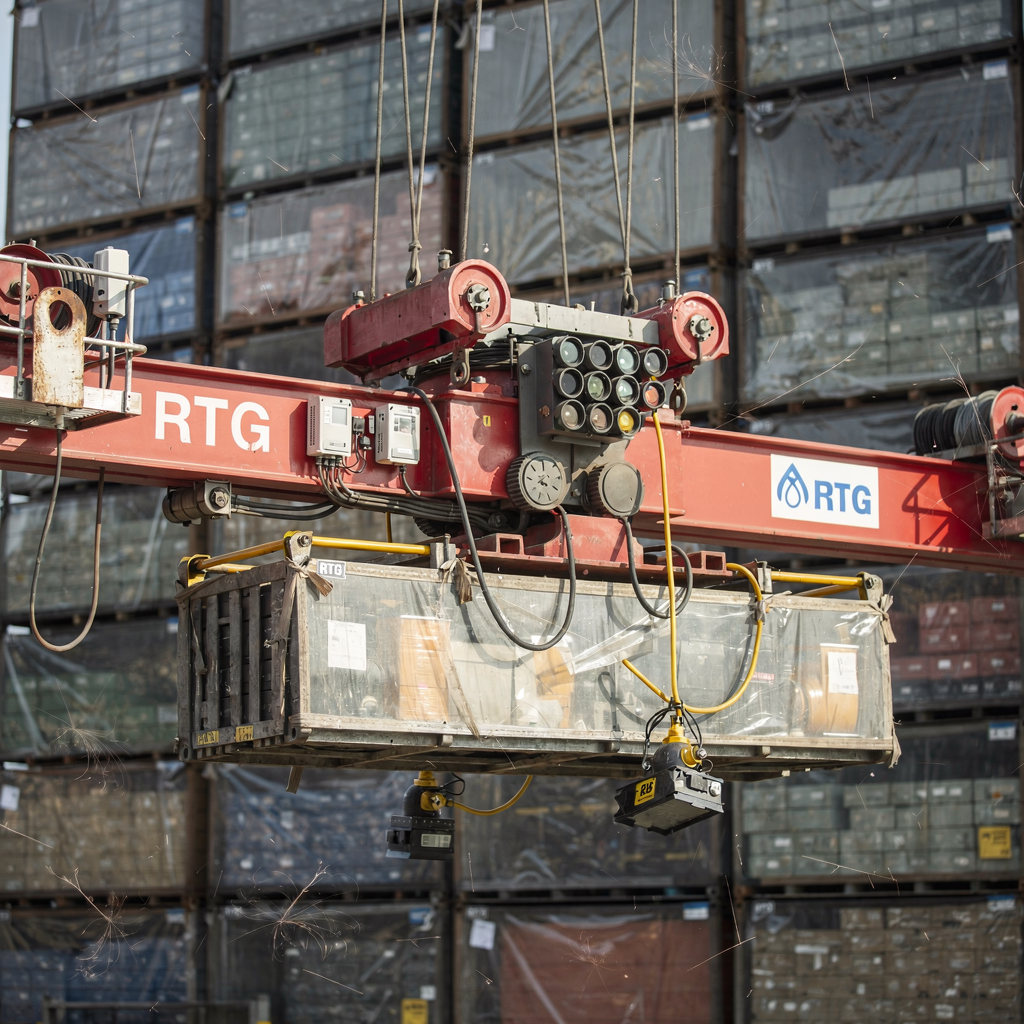
Rubber-tired gantry cranes (RTG) face common collision causes such as misaligned lifts, wheel mis-tracking, and operator error during blind lifts. These events can cause significant downtime when an RTG requires repair or recalibration. To prevent that downtime, terminals install retrofit solutions like proximity sensors, automatic brake engagement, and condition monitoring. A retrofit typically adds a sensor array around the trolley, spreader, and leg interfaces to detect an approaching obstacle or a mis-pick.
Proximity sensors monitor distances to nearby stacks and detect when a spreader moves towards the obstacle. When the system detects a risky trajectory, it can warn the operator and, if necessary, intervene with an automatic stop. Many retrofits also include PLC updates and an operator-facing alarm that shows the detected object on a small display. These retrofits are modular and can be fitted without lengthy equipment downtime. As a result, terminals see fewer unplanned repairs and shorter repair cycles.
Quantifying the benefits helps to justify the investment. Terminals retrofitting RTG cranes with proximity detection and automatic brake engagement report a marked drop in repair costs and downtime. For instance, upgraded RTGs often show fewer collisions and a lower incidence of costly structural fixes. That reduction translates into higher productivity and lower insurance premiums. In practice, reducing a single week of RTG downtime can recoup much of the retrofit cost in saved berth delays and avoided demurrage.
Beyond sensors, retrofits often add predictive maintenance modules that track motor loads, vibration, and component wear. Those inputs feed into predictive analytics that can warn maintenance teams before a failure causes downtime. In short, retrofits combine detection, warning, and predictive control to protect valuable RTG assets, preserve workflow, and improve the safety of the yard and lifting equipment.
Drowning in a full terminal with replans, exceptions and last-minute changes?
Discover what AI-driven planning can do for your terminal
Container handling automation and operator support systems
Automation in container handling ranges from semi-automated assist systems to fully automated straddle carriers and quay cranes. First, semi-automated systems provide collision warning and assistive controls. Second, higher automation levels automate repetitive moves and sequences. Third, fully automated terminals coordinate fleets without continuous human steering. Each step blends AI planning with operator oversight to keep operations stable, safe, and resilient.
Intelligent decision support systems use AI and machine learning to analyze critical data and then present actionable options to the operator. These systems help vessel planners, yard strategists, and dispatchers balance crane productivity, avoid yard congestion, and reduce unnecessary travel. For example, Loadmaster.ai trains StowAI, StackAI, and JobAI agents in a digital twin so the agents propose plans that cut rehandles while protecting safety rules. This multi-agent approach integrates with TOS systems and live telemetry to keep the human operator in the loop. You can read about multi-agent AI for port operations here.
Safety gains are measurable. Intelligent decision support and automation reduce collision and grounding events by up to 25% where they are correctly implemented Systems driven intelligent decision support methods for ship collision prevention. At the same time, throughput improves because crane moves are sequenced to avoid conflicting paths and to minimize travel. Operators receive clear alerts and simplified inputs, which improves reaction times and reduces cognitive load.
Human oversight remains essential. As Dr. Maria Jensen notes, “While automation and AI provide powerful tools for collision prevention, human operators remain essential for interpreting complex scenarios and making final decisions” source. Therefore, successful automation programs train operators, set guardrails, and use simulation for rollouts. For a practical guide to capacity planning and testing, consider our work on digital-twin container port yard strategy testing here. Together, AI and trained operators improve the safety of handling equipment and preserve productivity.
Future collision avoidance in container terminals
Emerging trends point to a safer future. First, autonomous navigation across port approaches and in-harbour channels will reduce human error and improve situational awareness. Research shows autonomous systems aim to “enhance the safety and efficiency” of port approaches and to reduce vessel collision accidents Autonomous navigation and collision prediction of port channel navigation. Second, global surveillance networks for lost containers will warn ships and ports when floating hazards appear at sea lost container surveillance. Third, machine-learning prediction models will improve time-to-react estimates and will predict likely conflicts before they occur.
Predictive controllers will combine sensor inputs with weather conditions and vessel ETA to calculate safe lanes and to generate an early collision warning. AI can suggest optimal crane sequences that reduce mixed fleet conflicts and balance workload across a fleet. In the yard, predictive models will warn when a stack of containers risks destabilization or when a spreader faces a mis-mate. These systems will link to terminal operators through clear alerts and recommended actions so humans remain decision-makers.
The balance between innovation and training remains crucial. New tools must be tested in a sandbox digital twin, and staff must be trained on safe procedures and on how to respond to alarms. Loadmaster.ai’s approach trains agents in simulation so policies are safe by design and then deploys them with operational guardrails. That method helps terminals automate routine choices while keeping control of critical safety decisions. As automation increases, terminals can expect fewer collisions, better productivity, and lower risks and costs, provided that technology and operator expertise evolve together.
FAQ
What is a collision prevention system for container terminals?
A collision prevention system combines sensors, software, and operator interfaces to reduce accidents between vessels, cranes, trucks, and stacks. It detects potential hazards early, issues alerts, and can trigger automatic interventions to protect people and equipment.
How do sensors help avoid collisions at the quay and in the yard?
Sensors such as radar, LIDAR, 2D laser scanners, and cameras monitor positions and blind spots. They provide real-time detection and feed controllers that calculate trajectories and trigger collision warning messages to the operator or automation layer.
Can older RTG cranes be retrofitted to reduce downtime?
Yes. Retrofitting RTG cranes with proximity sensors, automatic brake engagement, and PLC upgrades is common. These retrofits can be modular, fit without long shutdowns, and reduce repair costs and equipment idle time.
Do anti-collision systems replace the operator?
No. Anti-collision systems assist but do not replace human judgment. Operators retain final authority while systems provide alerts, predictive guidance, and automatic stops when necessary to improve the safety of crane moves.
What role does automation play in container handling?
Automation ranges from semi-automated assists to fully automated straddle carriers and cranes. It improves consistency, reduces rehandles, and helps balance quay productivity with yard congestion. Human oversight and guardrails remain essential for safe implementation.
How do lost containers at sea affect terminal safety?
Lost containers create floating hazards that can damage vessels and complicate port approaches. Global surveillance projects aim to detect drifting containers early and to warn ships and ports so they can avoid collisions and environmental harm.
Are there measurable benefits to intelligent decision support?
Yes. Research indicates decision support systems can reduce collision and grounding events by roughly 25% in contexts where they are applied. They also improve productivity by optimizing crane moves and reducing unnecessary travel.
Which sensors work best for straddle carriers?
Straddle carriers benefit from a combination of GPS, proximity sensors, and short-range LIDAR or 2D laser scanners. This mix helps detect obstacles in lanes and avoids blind spots while keeping carrier cycles efficient.
How should terminals test new collision avoidance systems?
Terminals should test systems within a digital twin or simulation before live rollout. This allows teams to evaluate rules, train operators, and confirm that safety systems improve performance without disrupting operations.
What are quick wins for reducing collision risk today?
Quick wins include installing modular proximity sensors on cranes, implementing standardised alarm procedures, and improving berth-call and quay-crane sequencing. Also, targeted operator training combined with decision support reduces errors and improves response times.
our products
 stowAI
 stackAI
 jobAI
jobAI
Innovates vessel planning. Faster rotation time of ships, increased flexibility towards shipping lines and customers.
Build the stack in the most efficient way. Increase moves per hour by reducing shifters and increase crane efficiency.
Get the most out of your equipment. Increase moves per hour by minimising waste and delays.
stowAI
Innovates vessel planning. Faster rotation time of ships, increased flexibility towards shipping lines and customers.
stackAI
Build the stack in the most efficient way. Increase moves per hour by reducing shifters and increase crane efficiency.
jobAI
Get the most out of your equipment. Increase moves per hour by minimising waste and delays.