
Stowage Plan Fundamentals
A stowage plan defines the arrangement of containers on a vessel or within a yard to support safe, timely, and cost-effective loading and unloading. At inland terminals, a stowage plan drives the sequence of moves, the distribution of containers across bays, and the placement that affects crane cycles and truck pickups. The plan must respect container weight, lashing needs, and stability rules. Planners also watch for improper stowage that can create rehandles or unsafe conditions. Terminals operate under tight space constraints and must manage container stacks to avoid bottlenecks. For example, some inland hubs linked to major seaports handle volumes that can exceed 2 million TEUs per year, which magnifies planning complexity.
Common challenges include yard space limits, conflicting arrival windows, and sequencing that forces extra shifters. A yard planner balances gate flows, quay availability, and subsequent port calls. The plan must also support intermodal transfers and match the needs of shipping companies and local logistics providers. When a stow goes wrong, terminals face delays, increased moves, and higher operating costs. A clear loading plan that captures container weight and intended discharge containers reduces those risks. The literature notes “the main planning problems and research opportunities in each logistics segment are reviewed and discussed to promote further research” in this area, which underlines the need for better tools and coordination [MDPI].
Planners use bays, yard maps, and pick-up timelines to efficiently plan moves. The stowman role remains important in many operations to confirm details and handle exceptions. Modern approaches also model container stacks to predict rehandles. Transition words below help connect ideas and guide readers: first, next, then, also, furthermore, however, therefore, consequently, in addition, meanwhile, subsequently, similarly, conversely, likewise, specifically, notably, namely, additionally, hence, thus, besides, alternatively, nonetheless, still, yet, accordingly, ultimately, finally, for example, in particular, as a result, ultimately, simultaneously, thereafter, previously, meanwhile, subsequently, thereafter, progressively, importantly, importantly.
For more on matching yard strategy and stowage, see our piece on terminal operations container matching algorithms for stowage planning, which explains how placement and sequencing work together.
Collaborative Platforms for Inland Terminals
Collaborative platforms change how carriers, terminal operators, and road hauliers exchange information. A collaboration platform lets participants share arrival windows, container statuses, and loading constraints. By design, these systems reduce information lag between ocean carriers and terminal staff. When shipping lines and road hauliers feed data into a shared view, the yard planner can sequence trucks to match quay work. XVELA and similar tools have promoted shared views between carrier planning teams and terminals. At the same time, terminal operators retain control of local operational rules.
Shared data leads to measurable gains. Studies show joint planning across stakeholders can lift efficiency by roughly 15–20% through better yard utilization and fewer rehandles. Yet challenges persist. Data sharing raises security and privacy concerns. Also, the absence of standardized protocols complicates integration between different systems. Some terminals connect their terminal operating system (TOS) with carrier platforms to automate handoffs. For practical examples, see our article on integrating TOS with AI optimization layers, which covers APIs and EDI patterns.
Loadmaster.ai’s approach complements collaboration by training RL agents inside a digital twin that mirrors your terminal. Our agents learn to balance quay throughput and yard flow while respecting the operator’s constraints. This lets planners move from firefighting to stable policies that reduce rehandles and even out workloads. The platform can integrate with Navis or other TOS to preserve existing workflows. In this context, a cloud-based collaborative architecture helps connect carriers and terminals without forcing full system rip-and-replace. Transition connectors include standardized messages such as BAPLIE for vessel stow data and structured yard updates that support synchronous decision-making.
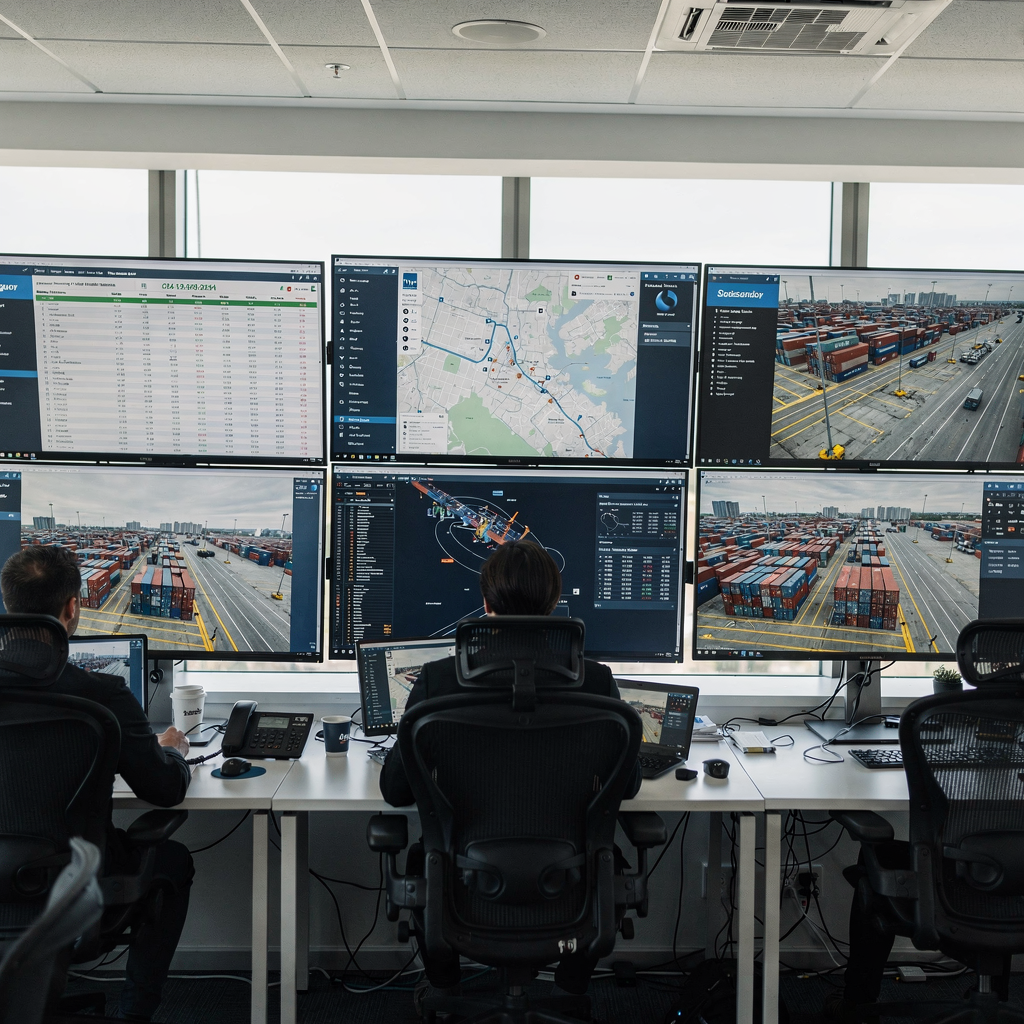
Drowning in a full terminal with replans, exceptions and last-minute changes?
Discover what AI-driven planning can do for your terminal
Port Connectivity and Synchronisation
Real-time links between inland hubs and seaports matter. When inland terminals publish truck slots and expected container readiness, seaports can better plan berth windows and quay allocations. This synchronization reduces delays at the quay and shortens dwell time across both ends of the logistics chain. Research on port congestion emphasizes that “managing and controlling cargo traffic to ports to better match both sides’ supply and demand on port resources” helps reduce queuing and spikes in equipment demand [Cardiff thesis]. In practice, improved sync can cut delay minutes and the number of missed windows for vessels.
Vessel stowage planning and execution depend on accurate ETAs and gate forecasts. When a terminal updates its yard status in real-time, vessel planners can refine the loading plan and minimize shifts between bays. This is especially important for container vessels that call multiple times along a route. A tighter interface between inland and maritime systems helps reduce unnecessary shunting at the quay. Evidence shows that coordinated port-terminal links have driven single-digit percentage drops in delay metrics at some major hubs, and better scheduling reduces the cascade of problems across subsequent ports.
Tools that support port connectivity also improve contingency handling. A DSS that uses digital twinning and simulation optimization can “enable proactive responses to disruptions and enhance overall supply chain resilience” by testing re-sequence scenarios before a ship arrives [ScienceDirect]. For practical monitoring of yard density and live status, our article on real-time container terminal yard density monitoring outlines the telemetry and analytics needed to keep gate and berth schedules aligned.
Transition words to guide implementation: first, next, then, also, therefore, consequently, in addition, meanwhile, subsequently, likewise, specifically, namely, notably, hence, thus, accordingly, finally, for example, in particular, previously, thereafter, subsequently, concurrently, alternatively, nonetheless.
Cargo Flow Optimisation
Cargo flow optimisation starts with accurate allocation of containers to yard slots and ends with minimized crane moves and gate waits. The optimization engine ranks containers by discharge port, priority, and planned pickup. These rankings feed yard planning and container placement. When you correctly place containers that share port calls or require lashing, you reduce rehandles and optimize space utilization. Case studies show that smarter slot assignment reduces yard crane moves and shortens gate turnaround in measurable ways. For more on dynamic approaches to slotted yards, see our analysis of dynamic slotting in container port yards.
Algorithms consider container weight, destination, and handling constraints to recommend the best bay and stack. They also respect intermodal transfers, so trains and trucks receive containers in the right sequence. Better container placement leads to fewer internal moves and improved throughput. For example, using simulation to evaluate distributions of containers can demonstrate throughput improvements and lower energy use for RTGs and straddles. Some research ties yard rehandle reduction directly to throughput gains measured in TEUs, which helps terminals justify investment in advanced planning tools [Efficiency study].
Implementation tips include integrating yard sensors, gate systems, and vessel call information to create a single source of truth for yard decisions. Our work on dynamic slotting and on reducing yard congestion with AI highlights how simulated scenarios support real choices. Transition words to link concepts: first, next, then, also, therefore, consequently, for example, in addition, subsequently, meanwhile, likewise, specifically, notably, thus, hence, accordingly, finally, moreover, nonetheless.
Drowning in a full terminal with replans, exceptions and last-minute changes?
Discover what AI-driven planning can do for your terminal
Stowage Planning Solution Technologies
Modern stowage planning solution stacks combine digital twins, simulation, and decision support systems to test plans before they hit the quay. A DSS can simulate crane cycles and yard moves to find trade-offs between quay productivity and yard congestion. The use of AI allows systems to predict delays and propose recovery actions. A recent study describes a DSS that “uses digital twinning and simulation optimization for resilience assessment and recovery action optimization” to support terminals under stress [DSS study]. Simulation makes it possible to simulate alternative loading sequences and to see which arrangement of containers minimizes rehandles.
These solutions often accept standard messages such as BAPLIE for vessel stow details and support integration with onboard loading computer outputs. Some vendors market a world’s first cloud-based planner or the macs3 onboard systems as part of an end-to-end stack. Software-as-a-service (SaaS) offerings now include optimization engines that compute trade-offs quickly. You can also automate repetitive decisions with AI agents that learn safe policies. Our company uses reinforcement learning agents to create a digital twin and then train StowAI, StackAI, and JobAI to make coordinated choices without retraining on historical mistakes.
Analytics and scenario testing let teams compare options across metrics such as moves per hour, average truck wait, and space utilization. Teams can then choose policies that increase efficiency under current constraints. When new software arrives, validate it in a sandbox that can simulate peak calls and different ports to ensure it protects both quay throughput and yard balance. Transition words for clarity: first, then, next, also, therefore, consequently, in addition, meanwhile, subsequently, likewise, specifically, notably, hence, thus, accordingly, finally, ultimately, for example, as a result, subsequently, concurrently.
Crane Operations and Yard Handling
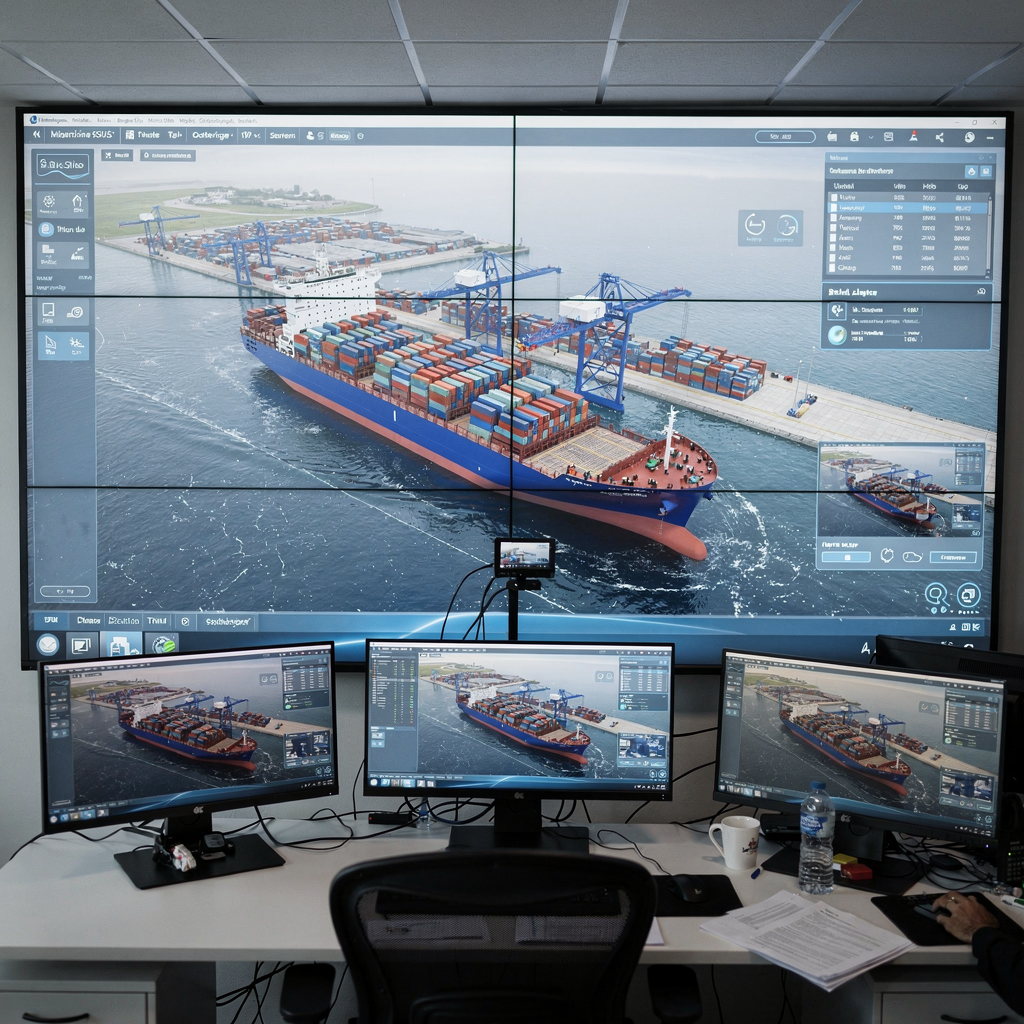
Crane scheduling links directly to yard handling performance. When the crane schedule aligns with yard moves, the terminal achieves smoother loading and unloading cycles. Operators must plan berth time, crane sequences, and gantry coverage to reduce idle time. Integrating the terminal operating system with crane telemetry and a TOS-agnostic optimization layer improves responsiveness. Many sites still use Navis as their TOS, and connectors let optimization layers propose executable moves without changing the core operating system. This layered approach preserves existing processes while adding optimization and analytics.
Automation trials, remote-control gantries, and semi-automated quay lifting increase throughput at some terminals. Yet manual checks such as lashing and weight verification remain essential for safety and stability. Vessel planners and vessel planners’ tools rely on clear signals from terminals about which containers are ready to discharge. Maersk and other large shipping companies often require strict sequencing to support liner shipping networks that call at multiple different ports. The goal is to discharge containers in the right order so trucks and trains can pick them up without extra moves.
Practical improvements focus on reducing driving distances inside the yard and balancing RTG and straddle workloads. Loadmaster.ai’s agents can automate dispatcher decisions and coordinate quay-to-yard handovers to efficiently plan moves and to reduce rehandles. When planners, automation, and analytics work together, the result is stable operational efficiency and safer handling. For further reading on coordinating quay, yard and gate operations see our piece on decentralized AI agents coordinating quay, yard, and gate operations. Transition words that help tie these ideas: first, next, then, also, therefore, consequently, in addition, meanwhile, similarly, specifically, namely, notably, hence, thus, accordingly, finally.
FAQ
What is a stowage plan and why does my terminal need one?
A stowage plan is a guide that defines where containers sit and in what order they load or unload. It helps reduce rehandles, supports safe lashing, and improves crane productivity.
How do collaborative platforms improve inland terminal performance?
They let carriers, terminal operators, and logistics providers share timelines and container status. As a result, terminals can sequence moves better and reduce dwell time at the gate.
Can real-time synchronization really reduce port congestion?
Yes. When terminals publish real-time readiness and ETAs, ports can adjust berth schedules to reduce queuing. Studies show coordination cuts delays and smooths port calls.
What technologies power modern stowage planning solutions?
Digital twins, simulation, and decision support systems underpin current solutions. AI and analytics add predictive capability and let planners simulate recovery scenarios.
How do yard planning and dynamic slotting affect throughput?
Dynamic slotting assigns containers to slots based on sequence and downstream demand to minimize moves. Better slotting improves space utilization and lowers crane and truck wait times.
What role do vessel planners play in integrated workflows?
Vessel planners produce loading plans and coordinate sequencing with shore teams. Clear information from terminals helps vessel planners reduce rehandles and optimize bay allocation.
How does automation change crane and yard handling?
Automation can increase moves per hour and reduce human risk for repetitive tasks. However, automation works best when paired with robust planning, verification, and analytics.
What data standards should terminals support?
Terminals should support common messages such as BAPLIE for stow details and EDI or API links for gate and yard data. Standardization simplifies integration with carriers and analytics tools.
How can a terminal measure operational efficiency gains?
Use KPIs like moves per hour, average truck wait time, and rehandle counts. Simulated scenarios and sandbox pilots help quantify expected improvements before full deployment.
How does Loadmaster.ai fit into stowage planning and execution?
Loadmaster.ai uses reinforcement learning agents trained in a digital twin to coordinate quay, yard, and gate decisions. The approach focuses on consistent performance, fewer rehandles, and measurable gains without depending on historical data.
our products
 stowAI
 stackAI
 jobAI
jobAI
Innovates vessel planning. Faster rotation time of ships, increased flexibility towards shipping lines and customers.
Build the stack in the most efficient way. Increase moves per hour by reducing shifters and increase crane efficiency.
Get the most out of your equipment. Increase moves per hour by minimising waste and delays.
stowAI
Innovates vessel planning. Faster rotation time of ships, increased flexibility towards shipping lines and customers.
stackAI
Build the stack in the most efficient way. Increase moves per hour by reducing shifters and increase crane efficiency.
jobAI
Get the most out of your equipment. Increase moves per hour by minimising waste and delays.