
Solution Approach: Defining the Berth Allocation Problem in Terminal Operations
The berth allocation problem describes how ports assign arriving vessels to named quay positions. First, it defines which vessel occupies which quay space. Next, it sets the start and end of service time. The problem is NP-complete and so finding optimal schedules at scale proves hard for real-time seaside operations; for a summary see this overview. The key performance metrics include vessel waiting time, quay utilisation and terminal throughput. These three metrics shape decisions every day at a container terminal and at bulk terminals.
Container terminals differ from bulk terminals in how they measure throughput and in their service priorities. For example, container terminals must coordinate quay cranes, yard moves and truck flows in very tight cycles. In contrast, bulk terminals often face larger variability in vessel service time and heterogeneous cargo handling constraints. Studies report that optimised berth schedules can reduce vessel waiting time by up to 30% which directly increases throughput and cuts congestion costs (30% waiting time reduction). Thus, ports focus on both tactical and operational levels.
Also, terminals must respect service priorities for certain calls, for example feeder services or vessels carrying critical cargo. In mixed-user terminals, the allocation and quay crane assignment must account for ownership rules and slot leasing. For integrated berth planning, an assigned berth often triggers yard and truck planning. As a result, the berth decision links to many downstream processes in container port ecosystems.
In operations research, model complexity grows quickly with problem size. Therefore, ports use heuristics and hybrid models to balance solution quality and run time. For bulk terminals, recent literature emphasises uncertainty and robust approaches (uncertainty in bulk terminals). For container ports, integrated berth solutions that include quay crane constraints show marked gains in throughput (integrated terminal allocation research). In short, defining the problem clearly helps to choose the right model and the right operational tools.
Solution Approach: Modelling Constraints and Objectives
Every model must capture primary constraints. These include quay length, vessel sizes, quay crane availability and cargo types. Also, models add discrete space limits when berths act as segments, or continuous space when ships can berth anywhere along a long quay. Discrete berth models simplify collision checks. In contrast, continuous approaches model sliding positions and speed optimisations for berth moves. A model of berth must also include handling time and service time windows so planners can respect arrival slots and contractual obligations.
Arrival uncertainty complicates model fidelity. Ships arrive early, late, or on schedule. Weather and pilot delays shift plans. Therefore, models include buffers and time windows that reflect variable service time. For example, a planning horizon may cover a day to a week. Within it, planners optimise to minimise the total waiting time and to maximise berth utilization. At the same time, they must respect priority levels for particular customers or cargo types. In practice, terminals weigh multiple objectives simultaneously. They trade off total waiting time against berth occupancy and crane utilisation.
Also, the model must capture quay crane constraints and crane assignment limits. The quay crane allocation and scheduling interactions shape feasible assignments. Planners often limit the number of cranes that can work on adjacent vessels. In multi-user container terminal environments, terminals must reserve space for operator-specific operations. Thus, the planning of berth allocation becomes multi-dimensional and requires careful constraint modelling.
For tactical objectives, common goals include minimising total waiting time, maximising berth utilisation and respecting contractual service priorities. A strong formulation solved in a solver can give guarantees for small instances. Yet, for larger problem instances, planners prefer heuristics and metaheuristics. They also apply rolling-horizon approaches and stochastic programming to capture arrival uncertainty. For further reading on capacity and yard integration, see a practical guide on container terminal capacity optimisation.
Drowning in a full terminal with replans, exceptions and last-minute changes?
Discover what AI-driven planning can do for your terminal
Solution Approach: Integrating Quay Crane Scheduling with Berth Allocation
Coupled decision-making is essential. Berth position and crane assignment must work in harmony. If planners assign a vessel to a long berth without considering crane assignment, they create idle time and crane clashes. Conversely, optimised crane assignment can unlock better berth sequencing. Integrated berth allocation and quay models give both perspectives. They help ensure that handling time, truck gates and yard operations sync with the vessel plan.
Integrated models benefit multi-user container terminal operations. They reduce transfer delays and improve container flow coordination. For example, a joint terminal allocation and berth scheduling approach assigns berths and terminal blocks to vessels so that containers travel shorter distances from quay to yard. This approach improves throughput and reduces internal truck traffic. If you need to drill into crane workload balancing, the article on crane workload distribution strategies explains practical allocation techniques that pair well with berth scheduling.
Also, integrated berth allocation and quay scheduling delivers operational resilience. When a vessel is delayed, a coupled model updates crane assignment and yard moves. That reduces idle crane minutes and lowers overall handling cost. Case examples show that combining berth planning with quay crane assignment problem formulations cuts handling delays and smooths resource use. In practice, terminals deploy hybrid berth allocation that mixes deterministic schedules with dynamic reallocation rules.
For multi-terminal ports, the integrated berth approach coordinates across terminals to prevent local bottlenecks. Terminals share real-time status and adapt assignments. This method needs strong IT integration and clear governance between terminal operators. For more on dynamic internal transport responses and deepsea port disruption planning, see dynamic internal transport replanning.
Solution Approach: Algorithmic Methods – Heuristics and Metaheuristics
Practitioners often choose heuristics and metaheuristics to solve the berth allocation problem at scale. Common heuristics include greedy insertion and local search. Greedy insertion places vessels incrementally. Local search then refines the sequence and position. These methods run fast and deliver good solutions for large instances. Also, planners combine them with pruning rules to avoid infeasible placements.
Metaheuristics rise when heuristic quality needs improvement. Genetic algorithms, tabu search and simulated annealing explore broader solution spaces. They tune for multiple objectives such as minimising total waiting time while maximising berth utilisation. Reported outcomes show up to 30% reduction in waiting times when advanced methods and integrated models converge (30% waiting time reduction). Therefore, metaheuristics remain popular in research and in commercial tools because they balance quality and computational tractability.
Also, hybrid algorithms mix exact methods with metaheuristics. For small subproblems, a solver can compute optimal positions with a strong formulation. For larger scheduling windows, a genetic algorithm or tabu search improves the global plan. Such hybrid berth allocation models handle discrete and continuous berth constraints and can address discrete berth scheduling and discrete dynamic berth allocation problems by focusing search on promising regions. For discussion of algorithmic choices and practical implementation, review approaches that combine simulation and optimisation in container terminal operation and operations literature.
In addition to algorithm choice, planners tune objective weights and use rolling horizons. They also embed warm-start strategies to accelerate re-optimisation when new information arrives. For ports seeking practical software features, read about real-time equipment dispatch optimisation for container terminals here. That topic overlaps with quay crane allocation and scheduling concerns when equipment conflicts emerge during peak hours.
Drowning in a full terminal with replans, exceptions and last-minute changes?
Discover what AI-driven planning can do for your terminal
Solution Approach: AI and Real-Time Data in Dynamic Berth Allocation
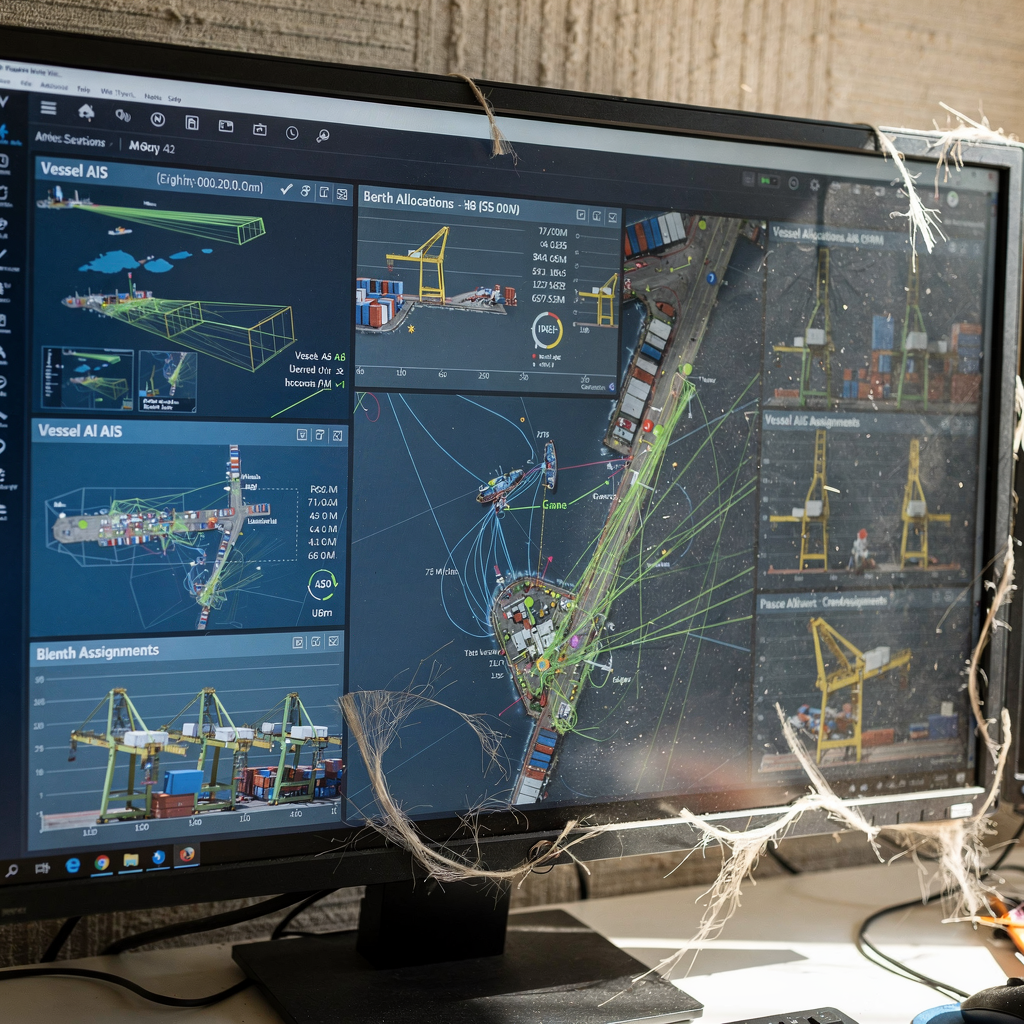
AI-driven systems add a dynamic layer to berth decision-making. They ingest AIS vessel positions, weather forecasts and terminal status feeds. Then they propose updated berth assignments and crane plans in real time. AI can also predict service time and handling time more accurately. As a result, terminals gain resilience and faster responses to disruptions. In practice, AI uplift in berth utilisation ranges from 15% to 20% in field reports (15–20% uplift).
Also, dynamic berth allocation problem formulations integrate live feeds. They treat decisions as rolling-horizon control problems. For example, a dynamic berth allocation model uses short-term predictions to schedule the next 24 hours, then reoptimises hourly. This discrete dynamic berth allocation approach reduces cascade delays and improves berth utilisation.
In berth planning, many emails and coordination tasks trigger manual triage. By automating responses and surfacing the right data from TOS, ERP and terminal sensors, AI agents let planners focus on higher-value decisions. This reduction in handling time mirrors reported gains where email triage falls from ~4.5 minutes to ~1.5 minutes per message when AI assists operations teams. Consequently, planners spend less time on routine confirmations and more time managing exceptions.
AI models also power digital twins for ports. They simulate joint berth and quay interactions to test schedules before execution. This integrated berth allocation and quay simulation helps to validate what-if scenarios. For ports interested in yard impacts and predictive modelling, explore predictive modelling for yard capacity and related simulation tools at predictive modelling for port operations. AI also enhances decisions about quay crane load balancing and whether to split a call across multiple berths or consolidate it to reduce moves.
Solution Approach: Implementation Challenges and Future Directions
Handling uncertainty remains a top challenge. Variable arrivals, operational disruptions and weather delays force frequent replanning. Planners must design robust and adaptive scheduling methods. These include stochastic programming, robust optimisation and fast re-optimisation rules. Robust models acknowledge that the best plan today may not hold tomorrow. They then prepare contingency options and prioritised swaps to reduce recovery time.
Integration issues also slow deployments. Data quality, IT architecture and stakeholder coordination create real barriers. Systems must connect TOS, AIS feeds, weather APIs and enterprise systems. For terminals that lack integrated data, the first gains come from cleansing feeds and automating routine communications. They surface the right data and route queries automatically, which speeds decision cycles and keeps timetables current.
Future research trends point to digital twins, advanced machine learning and hybrid optimisation. Digital twins enable planners to test continuous dynamic berth allocation problem scenarios before committing resources. Advanced ML models predict service time and crane productivity with higher fidelity. Hybrid berth allocation algorithms pair learning-based predictions with optimisation to plan and then correct in real time. Also, researchers investigate allocation and quay crane scheduling under speed and sequencing constraints to minimise total cost and waiting time.
Finally, ports must consider governance and business rules. An integrated planning of berth allocation requires agreements among terminal operators, shipping lines and port authorities. Transparent rules for priority handling and dispute resolution smooth execution and improve trust. For practical guidance on simulation-driven planning and TOS options, ports should review container terminal simulation software and cloud versus on-premise TOS comparisons at container terminal simulation and TOS deployment options. These resources help teams choose the right combination of optimisation, AI and operations planning to improve berth productivity and resilience.
FAQ
What is the berth allocation problem?
The berth allocation problem assigns arriving vessels to specific quay positions and times. It aims to reduce waiting time, increase berth utilization and coordinate quay cranes and yard resources.
Why is the berth allocation problem considered NP-complete?
The problem grows combinatorially as vessel counts and quay segments rise. Exact optimisation then becomes computationally infeasible for large ports, so heuristics and metaheuristics offer practical solutions.
How do container terminals differ from bulk terminals in berth planning?
Container terminals typically require tight coordination between quay cranes, yard moves and truck gates. Bulk terminals face greater variability in service time and differing cargo handling equipment, which demands different stochastic models and buffers.
What data inputs improve dynamic berth allocation?
Key inputs include AIS vessel positions, ETA updates, weather forecasts, quay crane status and terminal yard metrics. Real-time feeds let systems reoptimise quickly when conditions change.
Can AI really improve berth utilisation?
Yes. Field reports show AI-driven systems can lift berth utilisation by about 15–20% by dynamically matching berth and crane resources to incoming load (AI uplift). AI also improves prediction of service time and resource conflicts.
What algorithms work well for berth allocation?
Heuristics like greedy insertion and local search work well for large instances. Metaheuristics such as genetic algorithms, tabu search and simulated annealing yield higher-quality solutions when optimised for multi-objective trade-offs.
How important is integrating quay crane scheduling with berth allocation?
Very important. Integrating quay crane planning with berth allocation reduces handling delays and improves container flow coordination. Joint models often deliver better throughput than separate plans.
What role do digital twins play in berth planning?
Digital twins simulate berth and crane interactions under different scenarios. They help planners test strategies before execution, improving confidence in plans and reducing operational risk.
How can ports handle arrival uncertainty effectively?
Ports use rolling-horizon optimisation, stochastic models and contingency rules to handle uncertainty. Fast reoptimisation and automated communication reduce recovery time when disruptions occur.
By extracting intent and grounding replies in ERP, TOS and AIS feeds, it reduces handling time and frees planners to manage exceptions and optimise schedules.
our products
 stowAI
 stackAI
 jobAI
jobAI
Innovates vessel planning. Faster rotation time of ships, increased flexibility towards shipping lines and customers.
Build the stack in the most efficient way. Increase moves per hour by reducing shifters and increase crane efficiency.
Get the most out of your equipment. Increase moves per hour by minimising waste and delays.
stowAI
Innovates vessel planning. Faster rotation time of ships, increased flexibility towards shipping lines and customers.
stackAI
Build the stack in the most efficient way. Increase moves per hour by reducing shifters and increase crane efficiency.
jobAI
Get the most out of your equipment. Increase moves per hour by minimising waste and delays.