
container
A container is the fundamental unit of freight in modern port logistics. It is a standardized steel box that comes in common sizes such as twenty-foot equivalent units and forty-foot units, and the exact container size matters in yard planning because it dictates stacking, weight limits, and spatial allocation. Planners track type of container, size, and whether a unit is full or empty. They also record sealed versus open units. These details determine how teams group loads, how they sequence moves, and how they minimize handling. For container yard planning, knowing the single container footprint and the stacking height limits lets operators optimize yard blocks and storage yard layouts.
Container movements follow rules set by safety, equipment limits, and operational priorities. A container move may come from a container vessel, from an inland truck, or from rail. Then, staff or automated systems place the container to minimize future relocations. Stacking constraints include weight distribution, hazardous cargo separation, and access for scheduled retrieval. Because the container relocation problem increases handling time and costs, terminals use forecasting and rules to reduce reshuffles. For example, planners apply machine learning to forecast short-term demand and to adjust placement so that fewer containers require reshuffle later.
Operators measure container dwell and container dwell time as critical metrics. A lower container dwell time improves throughput and frees yard space. Terminal operators also monitor container volume and container moves to detect trends. For detailed methods to predict yard congestion and to guide strategy, see predictive analytics in container port logistics and impact of inland container terminal yard density on terminal throughput predictive analytics in container port logistics and impact of inland container terminal yard density. Together, these metrics guide strategic planning for more efficient container handling and safer operations.
port
A deepsea port has distinct characteristics that influence yard planning. It typically handles large container vessels, has limited berth space, and faces peak surges when multiple container vessels arrive. Berth schedules and tidal windows constrain operations. Therefore, yard capacity must absorb flows, and planners must account for quay operations that unload and load containers quickly. Port efficiency depends on synchronized quay crane cycles, truck and rail slots, and available yard space.
Space limits in a port force tight coordination among teams. Ports and terminals often operate under financial pressure to move cargo fast. They also face environmental targets, and a green port strategy can reduce emissions by minimizing idle equipment and by shortening truck queues. For terminals seeking improved quay and yard linkages, research on AI-driven quay crane scheduling and yard optimization provides actionable approaches AI-driven quay crane scheduling and yard optimization. Constraints such as access roads, rail spurs, and customs areas affect where containers can stack.
Common operational bottlenecks include container storage shortages, peak truck arrivals, and mismatched crane and yard capacities. Poor visibility into inbound truck lists makes scheduling hard. Likewise, unbalanced container volumes between import and export flows cause imbalances. Terminal operators need tools to forecast peaks and to plan resources. When planners use simulation and short-term forecasting, they can reduce delays, and they can avoid cascading impacts on hinterland carriers.
Drowning in a full terminal with replans, exceptions and last-minute changes?
Discover what AI-driven planning can do for your terminal
container port
In a container port, key performance indicators focus on throughput, relocation counts, and yard utilization. Yard density is a prime KPI for storage efficiency and for minimizing unnecessary moves. Measuring the average stack height, the percentage of occupied slots, and the frequency of reshuffles helps operators tune day-to-day tactics. A robust model for yard density gives planners the confidence to assign equipment and crew properly.
Data collection matters. Container terminals generate vast datasets from gate logs, crane sensors, terminal operating systems, and truck manifests. High-quality data fuels forecasting models. As an example, many terminals integrate terminal operating systems and real-time telemetry to feed machine learning models that predict peak yard density and relocation needs. Thetius reports that over 80% of the world’s container terminals use integrated solutions that support these capabilities Most Innovative Companies in Maritime 2025 – Thetius. Good data allows terminals to compare scenarios, and it improves the accuracy of simulation runs that support strategic and tactical choices.
Operators who invest in data collection, governance, and sensor networks build the foundation for predictive planning. For more on planning and emulation tools, see deepsea container port emulation software for planning deepsea container port emulation. Together, KPIs and data collection enable a continuous improvement loop that raises port efficiency and reduces the operational risk of over- or under-staffing during peaks.
model
Machine learning and ensemble approaches now power many yard forecasting systems. A learning model ingests past container moves, stacking patterns, equipment availability, and arrival schedules. Then it predicts near-term yard density and relocation counts. Ensemble models combine multiple sub-models to improve robustness. For example, a multi-layer stacked ensemble approach reported relocation count prediction accuracy of 90.76% and an R² of 0.9139, showing strong fit to real yard behavior Research on artificial intelligence-driven container relocation.
Models for yard prediction vary by complexity. Some use regression trees, some use neural networks, and others blend time-series techniques with spatial reasoning. Machine learning in container contexts helps to separate routine patterns from anomalies. A model can flag unexpected surges so teams can react fast. Ensemble approaches reduce overfitting, and they improve generalization across different port terminals. When operators test models across multiple terminals, they find which features transfer well and which require local calibration.
Evaluation metrics include accuracy, R², precision for relocation counts, and mean absolute error for density forecasts. Operators also monitor how models affect operational KPIs like relocation reduction and average handling time. For more on model testing and scenario analysis, terminal planners often use predictive analytics for port operations and yard congestion studies predictive analytics for yard congestion. Overall, the careful design of a model and its integration with operational workflows determine its practical value. Companies should adopt systematic validation and retraining schedules so models remain relevant as traffic patterns change.
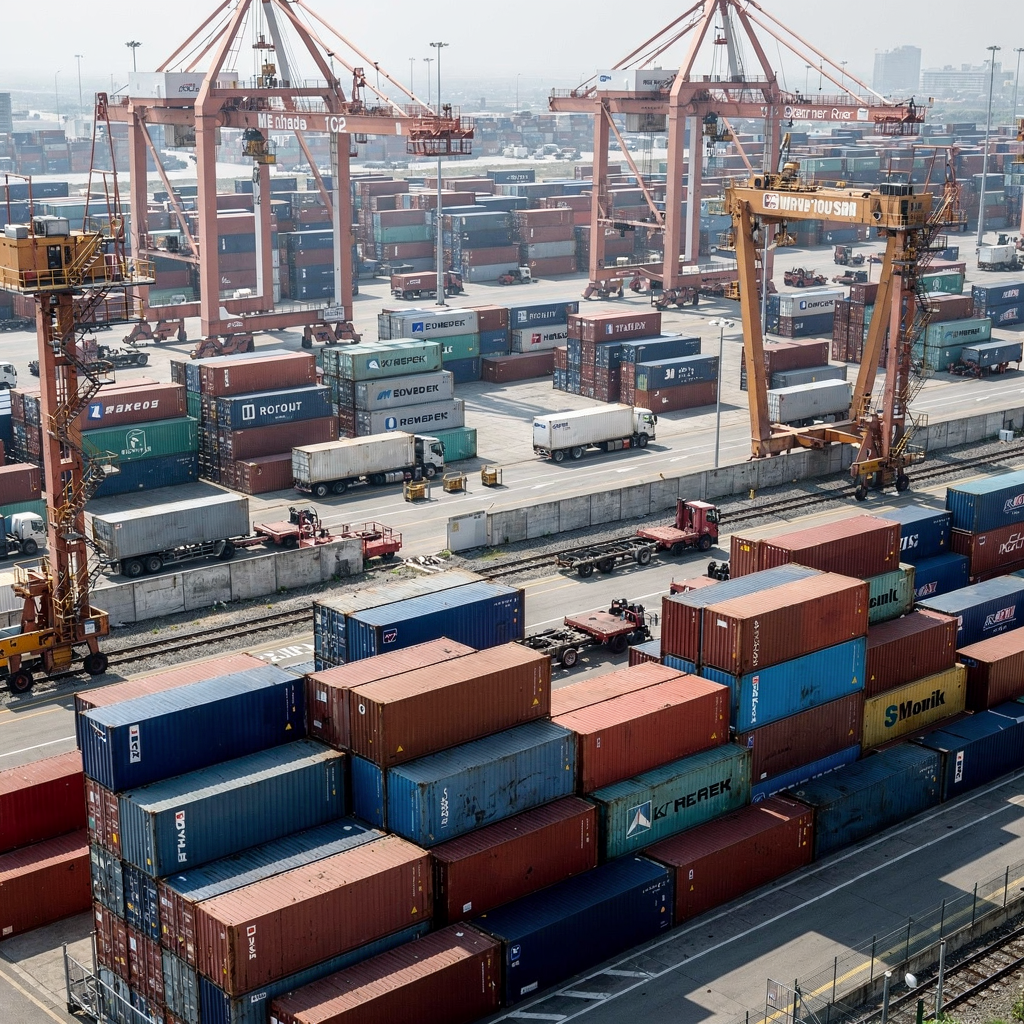
Drowning in a full terminal with replans, exceptions and last-minute changes?
Discover what AI-driven planning can do for your terminal
ai technologies
Several ai technologies address different aspects of yard density prediction. Dynamic shape adjustment and placement algorithms treat the yard as a 3D puzzle. They add time as a dimension so the system places containers not only by space but by expected retrieval time. Research shows that incorporating time in placement algorithms can improve space utilisation by up to 15% dynamic shape adjustment and placement algorithm. Predictive analytics then uses historical and live data to forecast peaks and to suggest proactive moves.
Digital twins emulate yard behavior so planners can test scenarios without disrupting day-to-day operations. They let teams run “what-if” experiments and adjust rules or constraints. Studies also stress the need for bias correction and active monitoring so that artificial intelligence and machine learning systems do not drift. A report on AI advancements notes how digital twins and bias correction strengthen forecasts and operations Recent Advancements and Challenges in Artificial Intelligence. In addition, ai algorithms like scheduling heuristics and optimization solvers complement ML predictions. For terminal operators, combining these methods yields more reliable outcomes than any single approach.
Operators balance algorithmic complexity with transparency. Simple rules remain useful for tactical overrides, while ai algorithm outputs guide longer-term planning. When planners adopt these tools, they often see lower container reshuffle counts and improved resource allocation. For a practical guide to emulation and planning software that supports model testing, see deepsea container port emulation software for planning emulation tools.
application of ai
AI informs relocation count predictions by learning from past moves and from stacking patterns. It estimates which containers will require reshuffle and when. Using this forecast, terminals can sequence moves to reduce total relocations. The benefits for resource allocation include fewer wasted crane cycles, better assignment of yard cranes, and reduced fuel usage due to lowered idling. In effect, AI helps terminals match equipment to demand more intelligently and with greater speed.
Some terminals combine machine learning with optimization solvers. The ML part predicts demand and the solver produces specific allocation plans. This hybrid approach works well in real operations because it respects both forecast uncertainty and operational constraints. For deeper insights on how AI connects to quay and yard scheduling, review automated quay crane scheduling software for terminal operations automated quay crane scheduling. As operators adopt these capabilities, they typically report faster decisions, fewer manual interventions, and lower operating costs.
Finally, successful adoption requires governance and clear escalation paths. Systems should surface confidence metrics so crews know when to trust automated recommendations. With proper validation and integration, application of ai in container environments can materially reduce unnecessary moves and improve throughput.
terminal operating systems
Terminal operating systems integrate gate logs, crane controllers, and yard sensors. These platforms collect the data needed by AI models. Thetius and similar solutions power many container terminal workflows. In fact, industry reports indicate that the majority of container terminals use integrated platforms to manage operations Most Innovative Companies in Maritime 2025 – Thetius. Terminal operating systems feed real-time interfaces and historical archives to models, and they publish commands to equipment when plans require automated execution.
Data streams include crane telemetry, truck arrival times, rail manifests, and gate transactions. Terminals often connect TOS to ERP and TMS systems to capture end-to-end context. When teams want improved visibility into relocation costs and yard occupancy, they pair TOS data with predictive modules and dashboards. For case studies on cloud-based yard optimization and dynamic equipment allocation, explore cloud-based yard optimization solutions and dynamic equipment pool allocation resources cloud-based yard optimization and dynamic equipment pool allocation.
We automate the email lifecycle for ops teams so that gate exceptions, carrier queries, and chassis requests route and resolve faster. By removing email friction, terminal operators gain timely decisions that complement TOS-driven automation. That way, human teams focus on exceptions and strategy while structured data flows back into the terminal operating systems and models.
container terminal operating system
AI modules plug into a container terminal operating system as services or APIs. They consume telemetry and return recommendations or commands. Integration patterns vary. Some systems run AI in the cloud and call TOS endpoints. Others host models on-premises for latency-sensitive tasks. Either way, the interface must handle data normalization, security, and governance. Well-integrated modules also track feedback so models learn from outcomes.
Interoperability challenges include inconsistent data formats, missing timestamps, and noisy sensor feeds. Data quality problems undermine model performance. Terminals invest in cleansing pipelines and in audit trails to show why a model made a suggestion. This transparency helps terminal operators trust outcomes and it streamlines troubleshooting. When teams embed AI modules carefully, they see improvements in operational metrics and in operator confidence.
Adoption also needs careful change management. Operators should pilot models on a single yard block before scaling. By starting small, teams can tune constraint-weighting mechanisms and ensure stable operations. For guidance on rollout strategies and decision support, see container terminal decision support systems decision support systems. These resources explain how to stage integration and how to measure success.
container terminal
An end-to-end workflow in a container terminal spans from berth to yard to hinterland transport. The cascade begins when a container vessel arrives and quay cranes discharge containers to trucks or to yard stacks. Yard cranes then move units to storage yard slots. Finally, trucks or trains collect containers for inland transport. AI enhances each step by forecasting demand, scheduling equipment, and reducing unnecessary moves.
When planners link quay crane schedules to yard crane assignments, they reduce bottlenecks. For example, predicted yard density can change quay unloading sequences so that containers destined for quick pickup face fewer relocations. AI also improves the handoff to inland carriers by forecasting container availability for trucking and rail booking. That coordination shortens wait times and supports smoother supply chain flows. The integration of TOS, AI modules, and operational communication creates a continuous, adaptive workflow that raises overall terminal performance.
simulation
Digital-twin simulation reproduces terminal behavior so planners can test rules and schedules without disrupting operations. A simulation can model container vessels, truck flows, yard blocks, and yard cranes. Planners run “what-if” scenarios for peak arrivals, labor shortages, and equipment failures. This helps them prepare contingency plans and to evaluate the impact of different allocation strategies.
Simulations support calibration of machine learning models by providing synthetic but realistic data where historical records lack rare events. They also reveal emergent interactions between quay cycles and yard congestion. For tools and approaches to emulate deepsea port dynamics, terminals consult deepsea container port emulation software and emulation case studies deepsea port emulation. By validating models within a simulated environment, planners increase confidence before applying recommendations on live operations.
Simulations also enable training for operators. Crew can rehearse peak scenarios and learn to act on AI recommendations. This reduces reaction time when real disruptions occur. Moreover, connecting simulation outputs to terminal operating systems lets teams convert simulated plans into executable tasks. When executed carefully, simulation-backed changes cut handling times and improve yard throughput.
dynamic container
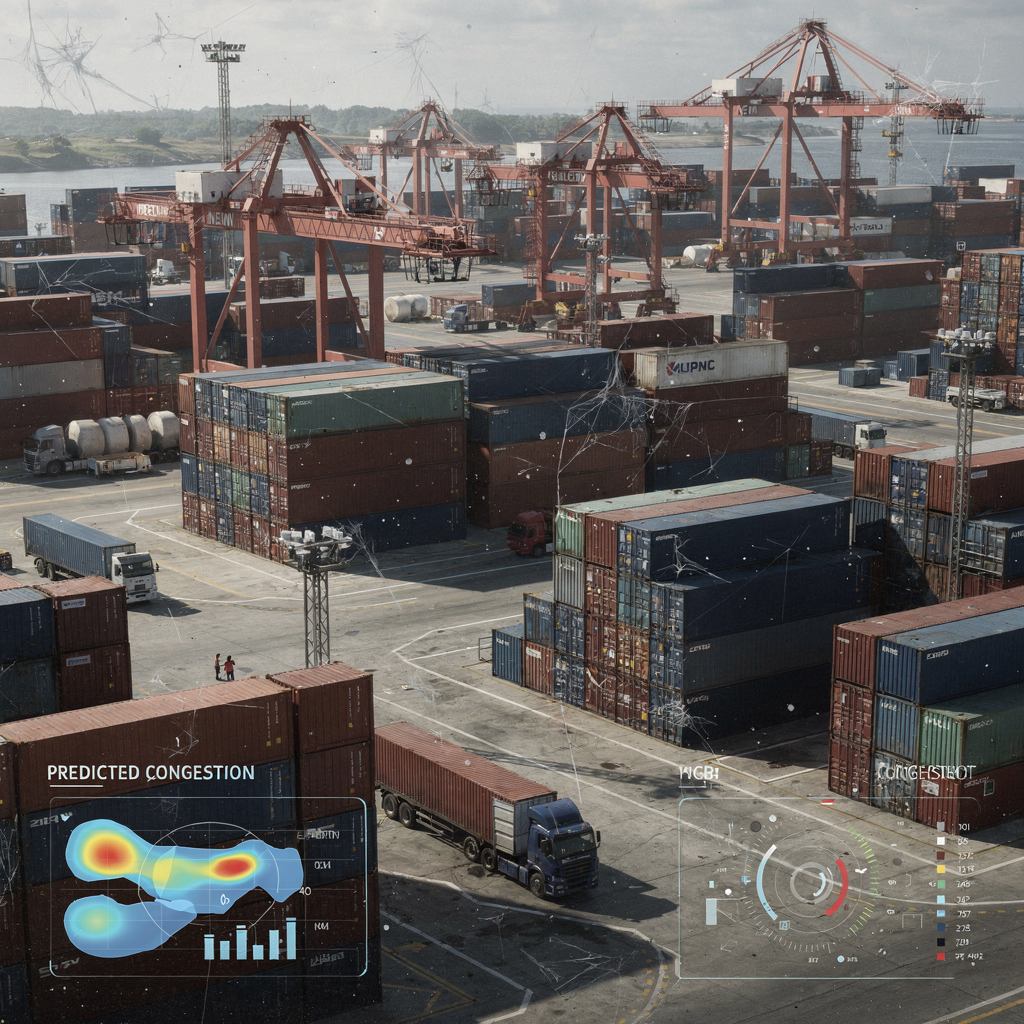
Dynamic container planning treats time as a fundamental coordinate in placement algorithms. Algorithms for the container relocation consider when each container will be retrieved and then place it accordingly. This dynamic approach reduces reshuffles and improves storage yard efficiency. Research indicates that adding time as a dimension can yield up to 15% improvement in space utilisation dynamic shape adjustment study. Terminals that adopt dynamic container placement see fewer unnecessary moves and better alignment with quay schedules.
Algorithms for the container relocation combine predictive steps with optimization. A forecast tells the system which containers will move soon, and an optimizer selects slots that minimize conflict. These algorithms often reference the container pre-marshalling problem for best practices. Operators can then reduce the number of relocations per container and lower fuel use and crane wear.
Dynamic container strategies require accurate inputs. Better gate forecasts, improved truck ETAs, and refined arrival patterns increase the value of these algorithms. As operators add IoT sensors and edge analytics, they get more granular visibility and can make replanning decisions in near real time. The result is smoother terminal operations and measurable savings on handling costs.
yard cranes
AI-driven scheduling of yard cranes optimizes gantry and rubber-tyred crane usage. A scheduler ingests predicted container moves, current crane positions, and equipment constraints, then assigns tasks to reduce travel and idle time. This efficient container placement and retrieval lowers fuel consumption and reduces greenhouse gas emissions. Terminals that optimize yard crane assignments see measurable drops in crane idling and improved container throughput.
Scheduling can also incorporate maintenance windows and operator shifts. By blending short-term predictions with long-term capacity planning, AI systems keep yard cranes productive. For research on RTG job prioritization and crane scheduling in high-density environments, terminals review RTG job prioritization resources and reinforcement learning studies RTG job prioritization and reinforcement learning in crane scheduling. These works show how automated schedules reduce handling times and increase uptime.
Overall, scheduling improvements translate to lower operating costs and higher throughput. When operators combine these schedules with yard layout changes, they unlock additional efficiencies and speed up the flow from berth to hinterland transport.
yard crane scheduling
Constraint-weighting mechanisms help planners balance competing objectives in real time. For example, a system might weigh retrieval speed against minimal relocations and then adjust priorities based on current congestion. These ai algorithm-driven weights update with new data so that schedules adapt to evolving conditions. In practice, terminals use these mechanisms to cut average handling times and to keep major container flows moving.
Real examples show reduced handling times when dynamic constraints guide decisions. Terminals that deploy adaptive constraint weighting observe better alignment between quay and yard activities. This reduces queuing, improves crane utilization, and produces smoother shifts for crews. The combination of predictive forecasting and responsive scheduling yields operational gains that compound over time.
container stacking
AI builds three-dimensional stacking plans that consider weight limits, access requirements, and retrieval windows. By optimizing container stacking, operators reduce reshuffle counts and save labor hours. AI also suggests stack heights that respect safety and equipment constraints. When planners apply these stacking plans, they lower the number of container moves per container and improve throughput.
Algorithms for the container relocation and for stacking interact closely. A good stacking plan reduces the need for future relocation and simplifies container retrieval. Terminals that focus on stacking efficiency see lower costs and faster turnaround for trucks and trains. In the end, smart stacking improves both the bottom line and the environmental footprint of container terminal operations.
yard management
AI dashboards help yard management by consolidating forecasts, equipment status, and KPIs into actionable views. Daily decisions become data-driven. Teams can see predicted congestion, which yard blocks will fill, and which cranes need reassignment. These tools reduce manual triage and improve response times. They also support environmental goals by identifying where idle time can be cut to reduce emissions, supporting a green port agenda.
AI logging and traceability also support audits and continuous improvement. With clear records, managers can analyze root causes of delays and tune models. This feedback loop helps learning model components adapt, and it enables ongoing optimization of container handling and storage yard allocation.
supply chain
Yard density forecasts also affect the wider supply chain. Reliable predictions let terminals coordinate with rail and truck operators so that inland carriers plan slots and reduce waiting times. Better coordination smooths the flow of goods and helps reduce detention and demurrage costs. Collaborative planning between terminal operators and hinterland carriers improves overall supply chain reliability.
When terminals share forecasts with partners, they enhance visibility and enable more synchronized bookings. For resources on multi-vessel scheduling and inland terminal linkages, see multi-vessel crane scheduling optimization and inland container terminal efficiency techniques multi-vessel crane scheduling and inland terminal efficiency techniques. Overall, better forecasting helps the entire chain move faster and with fewer surprises.
application of ai in container
Future uses may combine AI with IoT sensors and edge computing to give granular, near-real-time density predictions. Continuous learning and model adaptation will help systems stay accurate as traffic patterns shift. AI applications may also support automated container loading and live rerouting of trucks to available gates. Terminals should plan for a phased rollout that includes pilots, measurement, and operator training.
Finally, integrating AI with human expertise yields the best results. Operators retain final control while AI accelerates and refines decisions. With steady monitoring and governance, AI becomes a dependable partner for improving container terminal throughput and for supporting sustainable operations.
container operation
End-to-end benefits from AI include reduced relocations, faster container retrieval, and improved allocation of yard cranes. Terminals that adopt these methods typically report measurable improvements in port efficiency and in the efficiency of container flows. Embracing AI requires investment in data quality and in change management, but the operational gains justify the effort.
To maximize value, terminals should follow best practices: start with a focused pilot, validate models with simulation, and then scale while monitoring performance. For further reading on solving the container matching problem and on predictive versus reactive planning, see solving the container matching problem in container terminals and predictive versus reactive planning in deepsea container ports solving the container matching problem and predictive versus reactive planning. By combining technology, process, and people, ports and terminals can unlock better throughput, lower costs, and a smaller environmental footprint.
FAQ
What is the role of AI in container yard planning?
AI forecasts yard density, predicts relocation counts, and recommends stacking and equipment assignments. It helps terminal operators reduce reshuffles and allocate yard cranes more efficiently, which improves throughput and lowers operating costs.
How accurate are AI models for predicting container relocations?
Some multi-layer stacked ensemble models have reported high accuracy, such as 90.76% with an R² of 0.9139 in a recent study research on container relocation. Accuracy varies by data quality and by local operational differences, so validation is essential.
Can AI reduce crane idle time?
Yes. AI-driven scheduling assigns tasks to yard cranes to minimize travel and wait times, which reduces idling and fuel use. Integrated schedules also align quay and yard activities so cranes remain productive.
What data sources do models need?
Models use gate logs, crane telemetry, truck ETAs, vessel schedules, and historical stacking patterns. Terminal operating systems provide many of these streams, and better sensor coverage improves forecast reliability.
Are simulations useful before deploying AI?
Absolutely. Digital-twin simulation lets teams test scenarios and calibrate models without risking live operations. Simulation helps teams run what-if analyses for peak periods and for equipment outages.
How does AI affect the supply chain?
Yard density forecasts inform rail and truck scheduling, which reduces waiting times and improves coordination. Sharing forecasts with hinterland partners smooths flows and reduces detention costs.
What challenges limit AI adoption?
Key challenges include data quality, model generalization across different ports, and integration with existing terminal operating systems. Terminals need strong governance and iterative validation to manage these risks.
Will AI replace human decision-makers?
No. AI augments human teams by automating routine decisions and by surfacing recommendations. Human operators remain essential for exceptions, oversight, and strategic planning.
What is the impact on environmental goals?
AI can lower equipment idling and reduce unnecessary moves, which cuts fuel use and emissions. These gains support green port objectives and improve operational sustainability.
How should terminals start with AI?
Start with a focused pilot on a single yard block, validate models using simulation, and scale gradually. Ensure data pipelines, governance, and operator training are in place for successful adoption.
our products
 stowAI
 stackAI
 jobAI
jobAI
Innovates vessel planning. Faster rotation time of ships, increased flexibility towards shipping lines and customers.
Build the stack in the most efficient way. Increase moves per hour by reducing shifters and increase crane efficiency.
Get the most out of your equipment. Increase moves per hour by minimising waste and delays.
stowAI
Innovates vessel planning. Faster rotation time of ships, increased flexibility towards shipping lines and customers.
stackAI
Build the stack in the most efficient way. Increase moves per hour by reducing shifters and increase crane efficiency.
jobAI
Get the most out of your equipment. Increase moves per hour by minimising waste and delays.