
Quay Crane Scheduling Challenges in Container Terminal
Quay crane scheduling sits at the heart of efficient container terminal operations. In simple terms, quay crane scheduling assigns cranes to handle container tasks on arriving container ships. The goal is to minimize vessel turnaround time and to maximize throughput at the berth. However, this is not simple. The quay crane scheduling problem is a combinatorial and dynamic set of scheduling problems that arises from many interdependent variables. For example, crane interference limits safe moves along the berth, while varying container handling times alter sequencing. As a result, terminal operators must balance conflicting objectives. The process affects vessel service time, berth occupancy, and yard flows.
Key constraints include crane interference, berth allocation, and uncertain handling rates. Crane interference happens when adjacent cranes operate in overlapping workspaces. Therefore, safe separation rules and exclusion zones must be respected. Berth allocation and quay crane assignment influence which vessel receives priority. Next, varying container handling times create stochasticity. Research shows that uncertainty in crane productivity and external disruptions makes scheduling fragile; therefore, planners seek robust and adaptive approaches (Al-Dhaheri et al.). In addition, equipment failures and weather create unplanned downtime. As a result, the number of quay cranes assigned to a ship can change during loading and unloading. That affects planning across the terminal.
Better scheduling reduces demurrage and speeds up container movement. Studies report AI-driven scheduling achieves a 15–25% reduction in vessel service time (Al-Dhaheri et al.). In practice, faster turnaround frees berth space and reduces waiting for container ships. Also, higher crane utilization lowers operational cost. Therefore, improving scheduling and resource allocation is a clear priority for terminal operators. For further reading on productivity techniques and operational metrics, see optimizing quay crane productivity in container terminals (productivity guide).
Crane Operation and Container Stacking in Automated Container Terminal
In an automated container terminal, crane operation integrates with automated guided systems and yard automation. A quay crane operation in this setting often feeds automated guided vehicle (AGV) lanes that deliver containers to yard cranes. The workflow starts when a quay crane lifts a container from a ship. Then the container is moved to an AGV or to a temporary buffer. Next, yard cranes place containers into stacks based on slot allocation rules. This flow must sync to avoid bottlenecks. The automated container terminal concept reduces manual steps and enforces precise handoffs, which helps scheduling and maintenance.
Container stacking patterns determine yard utilisation. Terminals use stacking rules that trade off retrieval speed and stacking density. For example, export stacks may be organized by departure time windows. Meanwhile, import stacks prioritize quick delivery to trucks. These decisions affect the container relocation problem and container dwell time. Therefore, vessel bay plans and yard slotting must be coordinated with quay moves. An integrated scheduling model that aligns berth allocation and quay crane tasks can reduce unnecessary relocations and lower container dwell time. For more on yard congestion and capacity modeling, read the piece on predicting yard congestion in terminal operations (yard congestion).
Interactions between quay cranes, automated guided vehicle systems, and yard crane scheduling are critical. When a quay crane offloads, an automated guided vehicle must be available to move the container. If not, the quay crane must wait. That idle time and improves container flow problem is central to optimizing container port performance. Digital twins and AI-driven dispatching reduce wait time by synchronizing crane movements and AGV dispatches. For terminals considering automation, integrating AGV routing with crane schedules is a must.
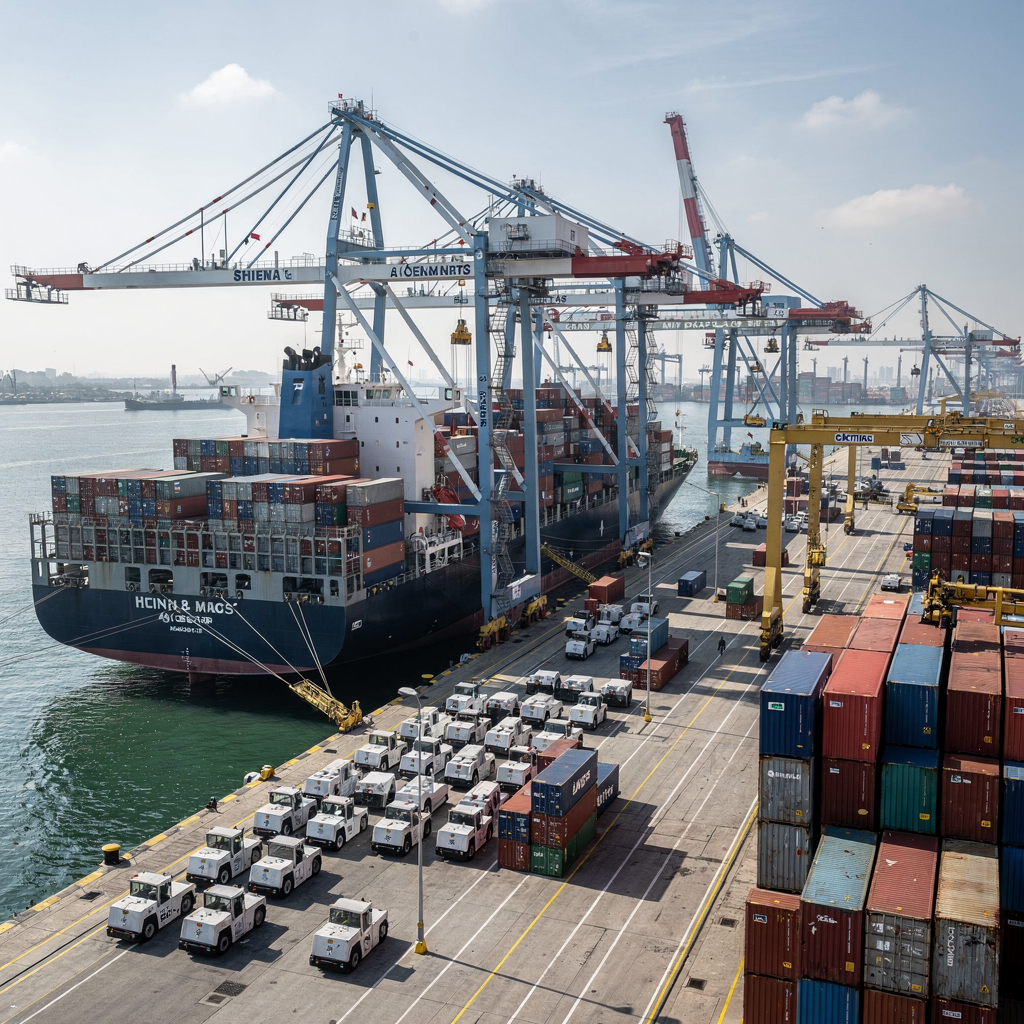
Drowning in a full terminal with replans, exceptions and last-minute changes?
Discover what AI-driven planning can do for your terminal
AI and Reinforcement Learning Approaches for Optimizing Container Handling
AI methods enable dynamic scheduling and rapid adaptation to change. Reinforcement learning and machine learning models learn from data to predict handling times and to assign tasks. Reinforcement learning uses trial-and-error learning to assign moves to cranes while maximizing long-term throughput. In particular, deep reinforcement learning has been applied to dynamic scheduling scenarios where actions are sequences of crane moves and handoffs. These AI models can respond to real-time data streams and adjust schedules accordingly. As a result, they help to reduce vessel service time and to manage stochastic disruptions.
A reinforcement learning approach models the terminal as an environment. The agent receives observations such as crane positions, container locations, and AGV availability. Then the agent issues actions like assigning a quay crane to a bay or re-sequencing tasks. Feedback comes in the form of reward signals tied to vessel turnaround, crane idle time, and container dwell time. Over many episodes the agent improves policies that aim to maximize throughput. Using deep reinforcement learning enhances the agent’s ability to handle high-dimensional state spaces such as full stowage plans and yard maps. For context on AI in deepsea operations, see AI for deepsea container port operations optimization (deepsea operations).
Forecasting is another AI pillar that supports adaptive scheduling. Machine learning models predict handling rates, equipment failures, and berth arrival variability. These predictions feed into scheduling and maintenance windows, which helps to avoid cascading delays. For example, combining predictive models with reinforcement learning yields a powerful loop: forecasts guide policy selection; policies generate actions that produce new data for forecasts. AI-driven scheduling therefore becomes both proactive and reactive. In applied projects, terminal operators moved from static plans to dynamic schedules, cutting idle crane intervals. If you want more on routing and dispatch integration, consider real-time equipment dispatch optimization in container terminals (dispatch optimization).
Genetic Algorithm and Metaheuristic Algorithm Strategies for Optimizing Crane Scheduling
Evolutionary algorithms remain a mainstay for tackling the quay crane scheduling problem. A genetic algorithm encodes candidate schedules as chromosomes, and it evolves them through selection, crossover, and mutation. This process searches a large solution space for near-optimal assignments. For QCS, encoding typically maps crane sequences, start times, and task orders into a genome. Fitness functions evaluate vessel service time, crane idle time, and interference penalties. Simulation-based genetic algorithm implementations can incorporate uncertainty by evaluating chromosomes under multiple scenarios. Al-Dhaheri et al. present a simulation-based genetic algorithm that reduced vessel turnaround in tests (simulation GA).
Hybrid metaheuristics combine global search with focused local improvement. For example, a hybrid approach might use a genetic algorithm to explore diverse schedules, then apply a local search to fine-tune crane moves. This combination balances exploration and exploitation. The Winter Simulation Conference highlighted a global and local search hybrid that outperformed simple heuristics on benchmark instances (WSC 2017). In practice, hybrid methods find high-quality schedules with reasonable compute time. They also integrate well with stochastic evaluation when simulation is available.
Simulation-based optimisation under uncertainty helps decision-makers choose robust plans. By running candidate schedules across plausible disruption scenarios, the algorithm can prioritize schedules with consistent performance. In many tests, genetic and evolutionary algorithm variants improved crane utilization by about 20% under realistic conditions (Al-Dhaheri et al.). Combining these methods with deterministic scheduling models yields a practical pathway: use an evolutionary algorithm to create baseline schedules, then refine using real-time AI adjustments. For readers interested in workload distribution and balancing, see crane workload distribution strategies in container ports (workload strategies).
Drowning in a full terminal with replans, exceptions and last-minute changes?
Discover what AI-driven planning can do for your terminal
Integrated Scheduling and Crane Operation with AI to Reduce Idle Time
Integrated scheduling aligns berth planning, quay crane assignment, and yard moves. Integrated scheduling reduces conflicts between shore-side operations and yard stacking. When berth allocation and quay crane assignment are planned together, the terminal gains flexibility. For example, integrated berth allocation and quay planning allows shifting the number of quay cranes to match expected container loading and unloading volumes. AI-driven scheduling coordinates these decisions dynamically. That leads to fewer crane idle periods and smoother AGV flows.
An integrated quay crane and yard control loop combines predictive models with optimisation. AI models forecast arrivals and container allocation, while optimisation algorithms produce schedules that balance crane efficiency and yard capacity. This type of integrated scheduling in automated container designs helps terminals cope with peaks and disruptions. Data-driven coordination also reduces container relocation by aligning container allocation with available stacking spots. The result is reduced container dwell time and better crane utilization.
Quantitatively, AI-driven scheduling can cut idle time and demurrage by measurable margins. Published studies report 15–25% reductions in vessel service time and up to 20% higher crane utilization when AI and simulation-based algorithms are combined (Al-Dhaheri et al.). In addition, integrating with digital twin technologies enables continuous resilience assessment and may lower disruptions by 10–15% (digital twin study). Therefore, pairing AI optimisation with improved human-machine workflows is a practical step toward higher crane efficiency.
AI Algorithm Case Studies for Quay Crane Performance in Container Terminal
Several case study results show the tangible value of AI algorithms for quay crane scheduling. In simulation and pilot deployments, AI-driven approaches produced a 15–25% reduction in vessel service time and roughly a 20% improvement in crane utilization (Al-Dhaheri et al.). These gains come from smarter quay crane assignment, better sequencing, and reduced interference. Also, integrating AI with digital twin models enabled terminals to test resilience scenarios and to reduce disruption impacts by 10–15% (digital twin).
Expert commentary underscores the role of evolutionary algorithm and machine learning hybrids. Dr. Al-Dhaheri notes that “The application of AI, particularly genetic algorithms, in quay crane scheduling offers a promising avenue to tackle the inherent uncertainties of container terminal operations” (Al-Dhaheri et al.). Likewise, simulation proceedings emphasize that combining global and local search heuristics produces robust schedules that outperform conventional methods (WSC 2017). These endorsements reflect both academic and operational value.
Looking ahead, the integration of AI with port automation and with systems like digital twins will shape future research. Automated container terminals considering full automation will need combined optimisation of quay and yard resources. AI models, including reinforcement learning and evolution-based optimisation, will be central to solving the dispatching and scheduling needs of next-generation terminals. For terminals pursuing practical steps today, resources on container terminal automation and optimizing yard stack density offer helpful guidance (automation overview) and (yard stack density). Finally, collaboration between AI systems and human planners remains important; intelligent scheduling works best when terminal operators and systems exchange timely, accurate data.
FAQ
What is quay crane scheduling and why does it matter?
Quay crane scheduling assigns cranes to loading and unloading tasks on container ships. It matters because efficient schedules reduce vessel service time and improve overall terminal throughput. Better scheduling lowers demurrage and increases berth availability.
How does AI improve crane operation at a container terminal?
AI predicts handling times, sequences tasks, and adapts plans in real time. It uses data from sensors, yard systems, and berth schedules to reduce idle time and to optimize resource allocation. This leads to higher crane efficiency and fewer delays.
Are genetic algorithms still relevant for the quay crane scheduling problem?
Yes. Genetic algorithm and evolutionary algorithm variants remain useful for exploring large scheduling spaces. When combined with simulation, they help produce robust schedules under uncertainty. They often form the global search component in hybrid scheduling solutions.
Can reinforcement learning handle real-time scheduling for quay cranes?
Reinforcement learning and deep reinforcement learning can learn adaptive policies for dynamic scheduling. They are effective when rich state information and continuous feedback are available. However, they require careful design to ensure safety and to respect crane interference constraints.
What role do AGVs play in integrated scheduling?
Automated guided vehicle systems link quay crane moves to yard stacking. Coordinating AGVs with cranes prevents handoff delays and reduces crane idle time. Integrated scheduling aligns AGV dispatching with quay crane operation to maximize throughput.
How much operational gain can terminals expect from AI-driven scheduling?
Published studies report vessel service time reductions in the range of 15–25% and up to about 20% improvement in crane utilization in simulation studies (study). Results vary by terminal specifics, data quality, and implementation fidelity.
What is the benefit of combining AI with digital twin technology?
Digital twins create a live simulation of terminal operations. When combined with AI, they allow stress-testing schedules and assessing resilience. Terminals can then reduce operational disruptions and test what-if scenarios safely (digital twin study).
How do hybrid approaches help in practical deployments?
Hybrid approaches pair global search heuristics with local search or learning-based refinements. This combination finds high-quality schedules faster and adapts to real-world variability. It is a practical strategy when pure learning methods are hard to train end-to-end.
What should terminal operators consider before adopting AI scheduling?
Terminal operators should assess data readiness, integration needs, and safe operational limits. They must ensure real-time feeds from yard management, crane telemetry, and berth systems.
Where can I learn more about optimizing quay crane productivity?
Start with detailed resources on crane workload distribution and automation strategies. Practical guides and research summaries include optimizing quay crane productivity in container terminals and materials on crane workload strategies (productivity guide) and (workload strategies). These resources explain techniques and metrics used in modern terminals.
our products
 stowAI
 stackAI
 jobAI
jobAI
Innovates vessel planning. Faster rotation time of ships, increased flexibility towards shipping lines and customers.
Build the stack in the most efficient way. Increase moves per hour by reducing shifters and increase crane efficiency.
Get the most out of your equipment. Increase moves per hour by minimising waste and delays.
stowAI
Innovates vessel planning. Faster rotation time of ships, increased flexibility towards shipping lines and customers.
stackAI
Build the stack in the most efficient way. Increase moves per hour by reducing shifters and increase crane efficiency.
jobAI
Get the most out of your equipment. Increase moves per hour by minimising waste and delays.