
literature review
This literature review surveys benchmark studies and operational reports that shape modern practice for rail loading and unload in inland container environments. First, the OECD benchmark provides a clear metric set for terminals and highlights the need for “reliable vehicle performance and seamless terminal access” as a foundation for container throughput OECD benchmarking. Second, the Florida Department of Transportation (FDOT) calls out the reduction of the human element to cut damage and improve reliability, noting that “minimizing the human element in loading/unloading railway cars helps reduce damage” FDOT analysis. These findings support automation and tighter process control in the container handling chain.
Third, research on container availability within domestic trade documents how coordinated inland stations reduce idle container time and speed flows; supply chain planners should treat container inventory as both a physical asset and a timing problem container availability study. Fourth, market reports stress that port and yard infrastructure investment expands capacity and allows faster loading containers cycles as global trade grows Port Infrastructure Market report. Together, these references form the evidence base for optimization interventions in inland container terminals.
However, gaps remain. Little rigorous work quantifies energy effects of combined rail-road cycles in inland intermodal terminals considering energy consumption. In particular, studies rarely unite container handling, crane scheduling, and yard travel into one total energy metric. As a result, a needed research agenda includes simulation-based analyses, measurement of energy consumption per move, and development of objective functions that include energy. The literature review also finds limited published comparisons of classical optimization versus adaptive AI in operational trials. For planners who want practical next steps, see our notes on explainable AI for planners and dynamic slotting in container yards at the Loadmaster.ai resources for deeper context explainable AI for planners and dynamic slotting in container port yards. Finally, the review notes that some algorithmic approaches in transportation research part and annals of operations research remain focused on theoretical optima without clear pilot deployments. Thus, there is space for applied studies that measure dwell-time, energy consumption, and consistency across shifts.
container
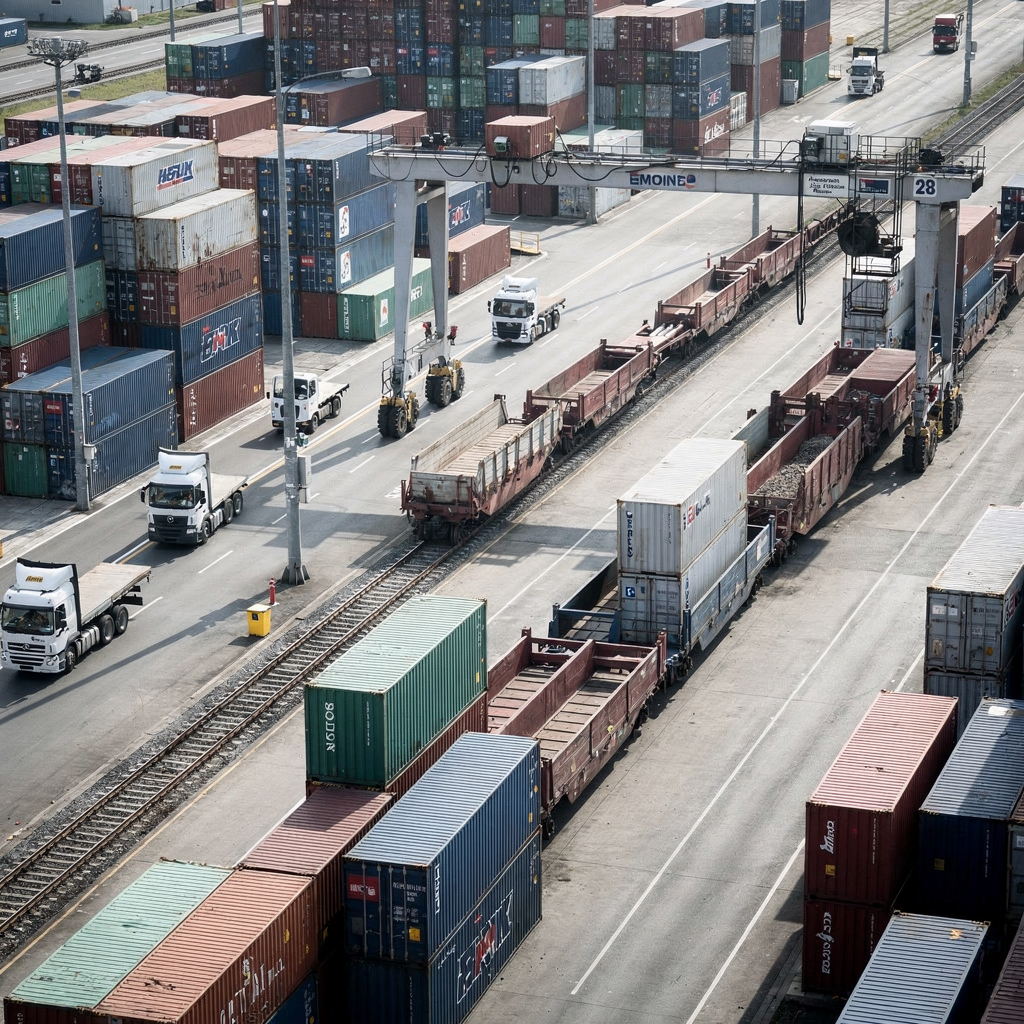
Defining container workflows in inland terminals clarifies where gains come. In typical yards, a truck arrives, hands over a container at the gate, moves into the storage yard, and then the container is staged for train loading or export drayage. Each step creates touch points for delays. Therefore, optimizing the flow of each container is essential. First, an arrival plan must match the number of containers to yard slots. Next, crane tasks must be sequenced to reduce shifters and minimize travel distance. Then, the storage yard must be organized so the total handling time and container reshuffling fall. The goal is to limit unnecessary moves and protect future flow.
Container availability strategies matter. Past work shows that vivid coordination of inland depots and rail services reduces idle time. For instance, coordinated loading plans and repositioning policies can cut dwell times. Research cited by the OECD reports terminals with optimized loading and unloading processes can reduce container dwell times by up to 20% OECD dwelling reduction. Also, a market analysis estimated that capturing 50% of direct port-to-inland movements would fill more than ten round-trip trains per operating day, which emphasizes how many containers move when rail is scaled short-haul intermodal potential. These statistics show both the scale and the payoff of better container handling.
Operational levers include automated container gates, automated container stacking and retrieval, and clearer loading plans that reduce rehandles. The phrase automated container appears briefly in studies as a growing trend. In practice, a terminal can adopt automated crane scheduling and storage algorithms to improve container access. The number of containers that can be processed per shift then rises, and loading time for train loading shortens. Planners should measure loading of containers against target throughput and energy budgets. For design guidance and yard congestion tactics see our piece on reducing yard congestion with AI in inland container terminals reducing yard congestion. Finally, the container handling workflow must include contingency lanes for late arrivals so that the planning for container mix is robust and the terminal avoids chain delays.
Drowning in a full terminal with replans, exceptions and last-minute changes?
Discover what AI-driven planning can do for your terminal
logistics
Logistics at inland nodes coordinate rail and road modes to move containers efficiently. First, a clear interface must exist between the rail operator, road haulers, and the yard dispatcher. Second, a schedule for inbound trains and trucks must be shared so that gate and yard capacity match expected arrivals. Third, yard-management systems and real-time telemetry must reconcile changes. When plans break, quick reallocation of slots keeps containers flowing.
Coordination between rail and road transport affects terminal capacity and congestion. For example, a missed train slot can cause cascading waits and increase the total energy consumption for terminal moves. A well-timed schedule reduces idle trucks and prevents peak yard stacking. In practice, advanced scheduling systems and yard-management software integrate ETA feeds, container assignment, and quay movement. These systems use algorithms to produce loading plans, crane scheduling, and truck appointment windows. They also track origin and destination pairs so planners can reduce reshuffles and the total handling time and container reshuffling. This kind of integrated planning is found in transportation research part approaches and applied implementations.
Scheduling optimization and crane scheduling influence throughput. A terminal that optimizes crane assignment raises crane productivity while protecting yard balance. The logistics system must therefore weigh quay productivity against yard congestion. Loadmaster.ai solves this through closed-loop agents that coordinate quay and yard, reducing rehandles and long driving distances. Our multi-agent approach can integrate with your TOS; for further reading on TOS integration see integrating TOS with AI optimization layers in container ports TOS integration. Additionally, better coordination accelerates intermodal freight trains and decreases dwell. Consequently, terminals that adopt real-time scheduling see higher stability, fewer firefighting episodes, and improved consistency across shifts. Shorter loading time, fewer rehandles, and increased moves per hour all follow. Finally, these logistics gains support larger modal shift targets for container transport and rail transport.
assignment problem
We can model rail-truck slot allocation as an assignment problem that matches arriving vehicles to yard slots, cranes, and time windows. An explicit container assignment problem captures which container goes to which slot and when. Objectives typically include minimize the total turnaround time, minimize costs, and reduce energy consumption. Thus, the assignment problem becomes multi-objective. Practically, planners want to minimize waiting, cut unnecessary travel, and speed loading containers onto trains.
Formally, the assignment problem assigns trucks and train wagons to storage slots and crane tasks subject to capacity and time window constraint. You can encode customer service levels, storage yard restrictions, and equipment availability. A simple programming model to minimize total delay can use linear programming relaxations before integer decisions are enforced. Yet, the complexity of real terminals often makes exact solution methods slow. Heuristic methods provide faster initial plans. For instance, adaptive large neighborhood search heuristic has been used in related loading problems. In contrast, exact integer programming model approaches give provable bounds but may not run in required decision windows.
When energy matters, model to minimize joint objectives that include total energy consumption per move and turnaround. The specific phrase rail–truck intermodal terminals considering energy applies where both rail traction and yard handling energy are counted. For terminals considering energy, the assignment problem can include energy consumption per container as a cost. A workable solution method might combine a linear programming relaxation, a greedy allocation for immediate gates, and a refinement heuristic for yard balance. This hybrid gives good compute times and practical plans. In many deployments, an initial heuristic schedule is passed to an optimization model for reallocation, then to execution. The container assignment problem is central here. Finally, classical assignment formulations remain useful when you need explainable allocations and quick conflict resolution. The planning problem for container flows therefore benefits from layered solution designs that cater to both speed and optimality.
Drowning in a full terminal with replans, exceptions and last-minute changes?
Discover what AI-driven planning can do for your terminal
integer
Integer approaches serve train formation and detailed yard planning where binary and integer decisions matter. For example, decisions that assign a container to a specific block, lane, or track are inherently integer. An integer programming model can capture grouping of containers by destination, weight limits, and crane compatibility. In practice, train loading requires determination of wagon loading sequences that respect stability and handling constraints and that minimize shifters. The optimal container loading sequence is a planning objective in these models.
Mixed-integer formulations combine discrete assignment with continuous timing variables. A mixed integer program can represent track-layout choices, crane assignment, and sequencing constraints simultaneously. These mixed integer models are powerful. They are also computationally heavy. As a result, practitioners apply decomposition or rolling-horizon planning to keep decision latency low. For larger yards, planning horizons are shortened and the integer problem is split into quay and yard subproblems. Then, a coordinating master problem links them.
Researchers have shown that integer models produce high-quality plans but that the complexity of the problem forces trade-offs. For instance, integer programming model rules capture hard constraints like weight limits, quay conflict avoidance, and gate windows. However, solving a full-sized terminal model in real time is often not viable. Therefore, many teams use an exact model to evaluate the performance of heuristics offline and to provide benchmark results. The phrase linear programming often appears as a relaxation step that speeds solution and bounds optimality. Names in the literature such as xu and yang et al illustrate solution strategies that mix heuristics and exact solvers. In applied terminals, a hybrid approach—fast heuristics for live dispatch and periodic integer re-optimizations overnight—balances quality and compute cost. The storage yard layout and the allocation of quay crane tasks remain frequent sources of integer decisions. Overall, the integer toolbox is essential for rigorous yard planning and for verifying the effectiveness of lighter-weight solution methods.
deep reinforcement learning
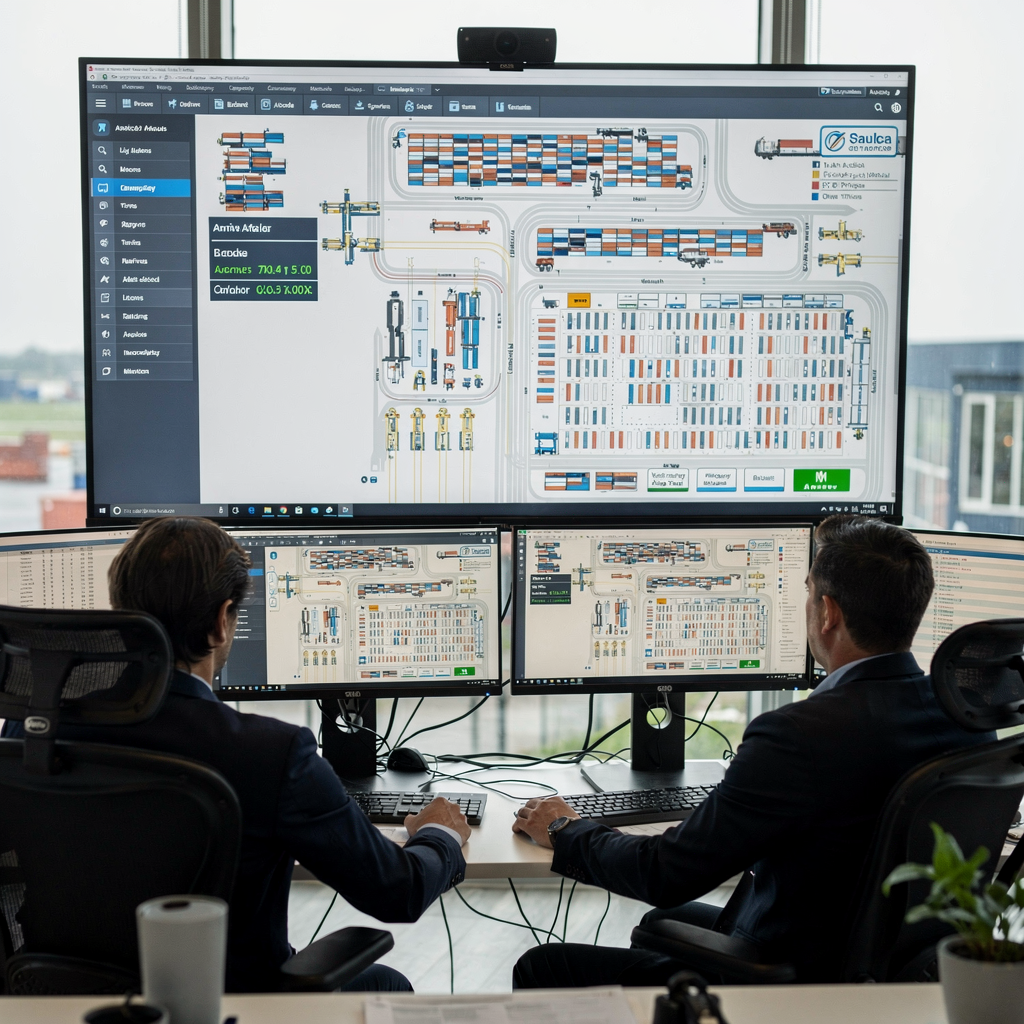
Deep reinforcement learning offers adaptive control for real-time scheduling and resource allocation. Unlike supervised models that imitate past behavior, DRL trains policies to maximize long-run KPIs in simulation. This lets agents try new strategies and learn trade-offs among crane productivity, yard congestion, and driving distance. A terminal that uses deep reinforcement learning can therefore move from reactive firefighting to proactive policy-driven control.
Case studies show DRL agents reduce rehandles and balance workload across equipment. For example, an RL strategy can assign quay tasks to protect yard flow when gates spike, then switch to maximizing crane throughput during calm periods. These dynamic shifts come from the agent’s learned policy, not from fixed rules. The technique works especially well when a digital twin models container flows and when the agent has access to real-time telemetry. Loadmaster.ai trains agents in a sandboxed digital twin and then deploys them with operational guardrails. This approach avoids the need for large historical datasets while delivering measurable improvements in moves per hour and reduced energy consumption. For more on scalable AI engines for port planning see our discussion on scalable AI engines for deepsea container port planning scalable AI engines.
When comparing DRL to classical optimization, results show DRL gains in adaptability and consistency, while optimization models remain useful for verification and for computing bounds. Integration is therefore practical: use DRL for fast near-real-time policies and use exact solvers for offline validation and for rare, critical reconfigurations. Papers in transportation research part and transportation research part e document hybrid architectures and evaluation methods. In short, combining DRL with a model-based optimizer yields robust, high-performance control. This pathway answers demands for resilient scheduling optimization in terminals and represents a promising direction for future research into intermodal terminals considering energy consumption and total energy consumption objectives. Finally, as terminals adopt DRL, they should maintain explainability and safe constraints so that human operators retain oversight and trust.
FAQ
What is the main bottleneck in optimizing rail loading and unloading in inland terminals?
The main bottleneck is coordination across modes and equipment. Delays often come from mismatched schedules, constrained yard space, and inconsistent gate processes, which together create rehandles and idling.
How much can dwell time be reduced with optimization?
Benchmarks show that optimized loading and unloading processes can reduce container dwell times by up to 20% OECD benchmarking. Results show real savings when automation and coordination are applied across the terminal.
Can automation cut container damage during loading operations?
Yes. The FDOT study notes that minimizing the human element in loading/unloading railway cars reduces damage FDOT analysis. Automated crane control and remote handling lower error rates and improve reliability.
What is an assignment problem in the terminal context?
An assignment problem matches incoming trucks and trains to slots, cranes, and time windows. The goal is to minimize wait time, energy consumption, and operational cost while respecting constraints.
Are integer programming models used in yard planning?
Yes. Integer and mixed integer models capture discrete placement and sequencing decisions such as track allocation and crane assignment. They offer high-quality plans but can be computationally heavy for real-time use.
How does deep reinforcement learning improve scheduling?
Deep reinforcement learning trains policies in simulation to maximize long-run KPIs. It adapts to changing traffic and equipment states and can outperform static heuristics in dynamic conditions.
Do terminals need historical data to use DRL?
No. DRL can be trained in a digital twin, which eliminates the need for large historical datasets. This makes cold-start adoption feasible for terminals with limited clean history.
What role does energy consumption play in optimization?
Energy consumption per move can be incorporated into objective functions to minimize total energy consumption. Modeling energy helps terminals meet sustainability targets while maintaining throughput.
How do heuristic and exact methods compare for allocation?
Heuristics give fast, practical allocations and scale to large problems. Exact methods produce bounds and proofs of optimality but may be slower. A hybrid approach uses both for live decisions and offline validation.
Where can I read more about practical AI solutions for terminals?
Practical resources include our articles on integrating TOS with AI layers and on reducing yard congestion with AI. These pages explain how AI fits with existing terminal systems and workflows TOS integration, reducing yard congestion.
our products
 stowAI
 stackAI
 jobAI
jobAI
Innovates vessel planning. Faster rotation time of ships, increased flexibility towards shipping lines and customers.
Build the stack in the most efficient way. Increase moves per hour by reducing shifters and increase crane efficiency.
Get the most out of your equipment. Increase moves per hour by minimising waste and delays.
stowAI
Innovates vessel planning. Faster rotation time of ships, increased flexibility towards shipping lines and customers.
stackAI
Build the stack in the most efficient way. Increase moves per hour by reducing shifters and increase crane efficiency.
jobAI
Get the most out of your equipment. Increase moves per hour by minimising waste and delays.