
Introduction: ai-powered eta in the maritime supply chain
ETA stands for Estimated Time of Arrival. In maritime logistics and global supply chains, ETA drives scheduling, berth allocation, and dockside labour planning. Accurate ETA helps ports reduce idle time and streamline cargo flows. First, it makes berth planning more reliable. Next, it lowers demurrage and waiting costs. For example, improved ETA systems have reduced prediction error by up to 30% in pilot studies, which in turn helps planners allocate resources more effectively Understanding and Predicting Port Congestion with Machine Learning.
AI-powered ETA modules combine Automatic Identification System feeds, weather inputs, and vessel characteristics to produce dynamic arrival estimates. For instance, Sinay’s ETA module uses historical AIS traces to model vessel routes and arrival times, and this approach helps ports anticipate vessel eta and plan operations on the quay more efficiently Deep dive: Artificial Intelligence in the maritime industry – Thetius. Also, a whitepaper shows that big data analytics paired with machine learning can cut ETA error substantially, improving the accuracy of eta predictions across major gateways Whitepaper Machine Learning in Maritime Logistics – shipzero.
Accurate ETA supports multiple stakeholders. Port authorities can sequence port calls with fewer conflicts. Terminal operators receive more predictable vessel arrival windows and can balance quay labour and equipment. Consequently, operational efficiency improves and ports face less congestion. Loadmaster.ai applies reinforcement learning agents in container yards to complement ETA-driven scheduling. For example, our StowAI and JobAI agents use forecasts and simulated scenarios to reduce rehandles and stabilize quay performance. Therefore, coupling an ai-powered eta with closed-loop operational agents can turn timely arrival forecasts into concrete productivity gains. Finally, accurate ETA links into the wider supply chain by enabling shippers and carriers to reduce slack. As a result, the global supply chain becomes more resilient and predictable.
Ensuring data quality and real-time analytics for reliable prediction
High-quality inputs are the foundation of any accurate eta or arrival time system. Key data sources include AIS tracks, vessel metadata, weather feeds, tidal information, and port traffic logs. The Automatic Identification System provides a continuous stream of position and speed that feeds algorithms. Also, historical data on port calls and average travel time informs model priors. For example, AIS observations combined with vessel type and last port of call create a rich dataset for training. In practice, ports must integrate diverse feeds to improve the accuracy of eta predictions and to reduce inaccuracy introduced by missing inputs.
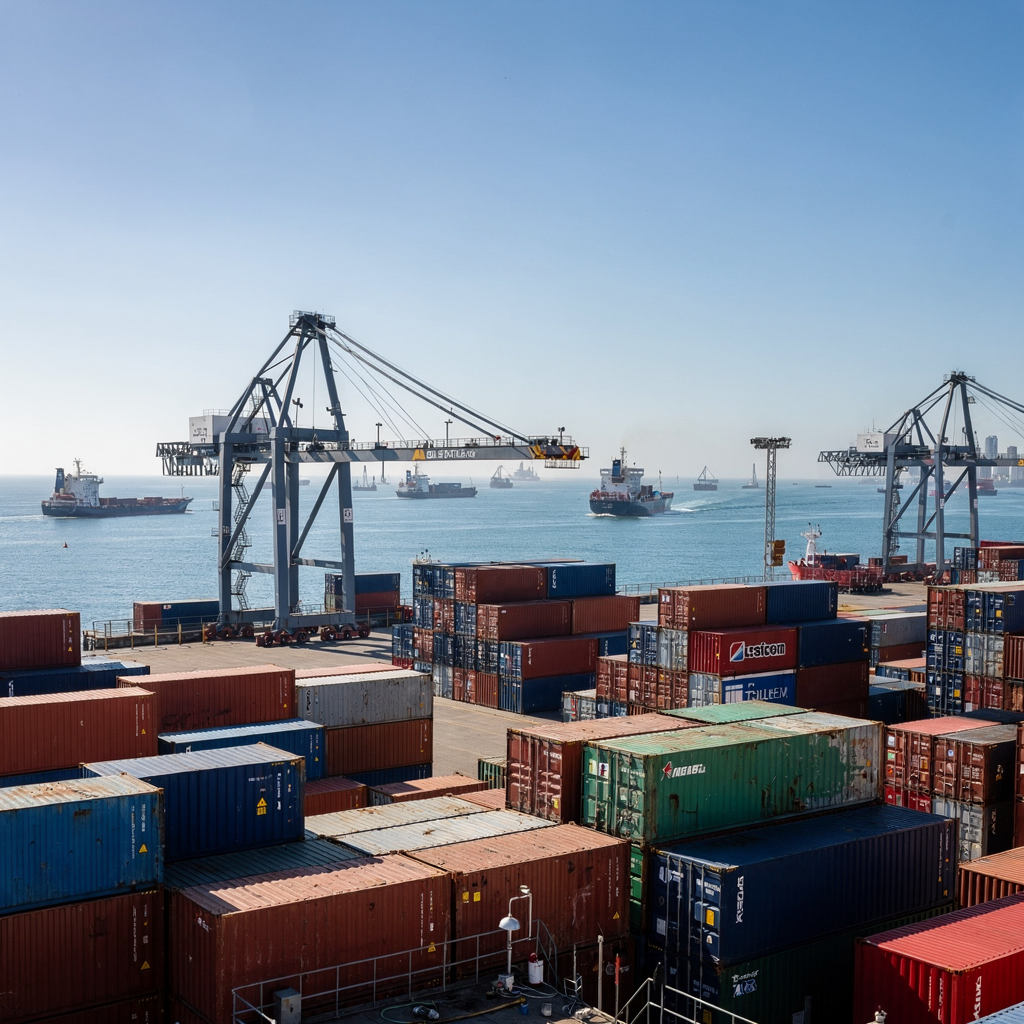
Data quality challenges are common. First, AIS messages can be noisy or sparse near congested approaches. Second, weather conditions can change quickly and cause abrupt shifts in speed and routing. Third, heterogeneous formats from different agencies create integration friction. To mitigate this, teams apply cleansing pipelines, deduplication, and time alignment. Next, feature engineering converts raw telemetry into stable inputs such as estimated speed over ground, heading stability, and port congestion indices.
Real-time analytics underpin dynamic ETA updates. Stream processing systems compute rolling features and push incremental forecasts to planners. For instance, a model can update an ETA when a vessel reduces speed due to an unexpected pilot wait. Therefore, real-time feeds reduce the lag between observation and forecast. Additionally, combining automated ingestion with human-in-the-loop checks preserves operational oversight. In short, data quality and real-time analytics create the conditions for reliable prediction models. They also support downstream uses such as berth planning and yard sequencing, and they help terminal operations shift from reactive firefighting to proactive planning. For further reading on real-time yard insights, see our piece on real-time container terminal yard density monitoring.
Drowning in a full terminal with replans, exceptions and last-minute changes?
Discover what AI-driven planning can do for your terminal
Building robust prediction models: machine learning for eta prediction
Traditional statistical forecasting methods have value. Yet machine learning finds non-linear relationships and interactions that simple regressions can miss. In many applications, tree-based methods and neural models outperform older approaches. For example, random forest and random forest regressor approaches capture categorical effects such as vessel type and port calls. Meanwhile, deep learning algorithms model temporal dependencies when AIS sequences are long. In experiments, ML-driven prediction models achieved 20–40% reductions in ETA error versus baseline methods Understanding and Predicting Port Congestion with Machine Learning.
Model choice depends on objectives. A random forest offers explainability through feature importance analysis. In contrast, recurrent networks or transformer-like architectures excel at sequence forecasting and can model vessel voyage patterns. Also, hybrid approaches combine tree-based models for static inputs with neural nets for trajectories. During development, teams split data by voyage and by destination port to avoid leakage. They then validate on held-out port calls to measure generalisability.
Continuous model retraining is essential. Ports operate under shifting traffic mixes, and the learning approach must adapt to new vessel types, changes in average travel time, and operational disruptions. Therefore, pipelines that retrain daily or weekly keep models calibrated. Also, incorporating new historical data and recent real-time corrections improves the accuracy of eta predictions. In practice, a robust machine learning model will use a curated dataset of AIS traces, weather snapshots, and port-state indicators. For transparency, teams should track model performance metrics and the prediction process in production. This includes monitoring the accuracy of eta predictions and flagging periods of degraded performance. When that happens, analysts re-examine feature drift, reweight data, or switch to a fallback heuristic until retraining completes.
Leveraging artificial intelligence to boost port operational efficiency
AI transforms planning at the quay, yard, and gate. When AI consumes accurate eta inputs it can sequence quay cranes, prioritize berth allocation, and orchestrate yard moves. For example, an ai-powered eta that predicts vessel eta with high confidence enables automated slotting and reduces idle crane time. As a result, ports report measurable gains. In pilots, improved forecasts contributed to 15–25% shorter waiting times and saved up to $10 million annually at large hubs through reduced demurrage and better berth allocation Whitepaper Machine Learning in Maritime Logistics – shipzero.
AI applications extend beyond scheduling. For instance, Loadmaster.ai’s RL agents optimize multi-objective KPIs across quay and yard, which helps terminals reduce rehandles and even out equipment utilisation. Also, decentralized AI coordination between quay, yard, and gate avoids local myopia and supports global throughput targets. If a vessel eta shifts, the agents replan stow sequences and job assignments so crane productivity remains high. Consequently, operational efficiency increases while energy use and fuel consumption fall.
Specific techniques matter. Tree-based models like random forest help score risk for each port call. Meanwhile, reinforcement learning provides closed-loop optimization to achieve sustained improvements across shifts. In addition, feature importance analysis clarifies which inputs matter most for forecasting and for downstream scheduling. For practical examples of how AI coordinates quay and yard decisions, see our article on decentralized AI agents coordinating quay, yard, and gate operations. Also, to understand slotting benefits that complement ETA-driven planning, read about dynamic slotting in container port yards. Therefore, combining accurate eta with AI-driven operational layers delivers robust gains in throughput and resilience.
Drowning in a full terminal with replans, exceptions and last-minute changes?
Discover what AI-driven planning can do for your terminal
Managing disruption: predictive analytics for port eta and congestion
Disruptions are routine in maritime operations. Severe weather, equipment breakdowns, labour actions, and unexpected traffic surges all create instability. In such scenarios, predictive analytics can help preserve flow. First, models forecast the likely evolution of congestion based on vessels’ estimated time of arrival and current queue length. Then, planners receive alternative sequences and suggested reroutes. For example, when weather conditions force slower approach speeds, real-time ETA updates keep stakeholders aligned and reduce unnecessary manoeuvres.
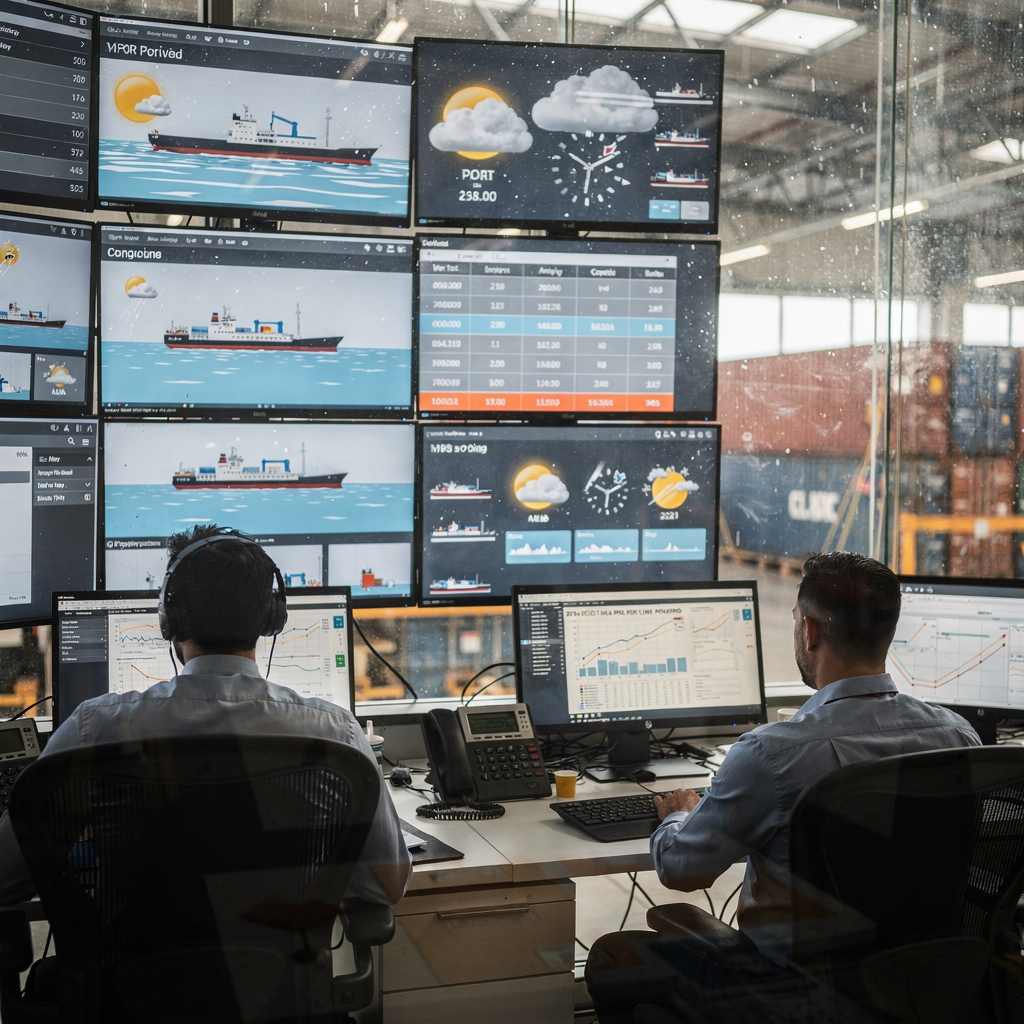
Predictive analytics also support contingency planning. By simulating the impact of a delayed vessel departure or a blocked berth, systems estimate the downstream effect on port calls and yard occupancy. Consequently, port authorities and terminal operators can implement mitigation steps. These include pre-emptive reassignments of berths, dynamic crane sequencing, and temporary gate flow limits. In addition, analytics help decide when to divert a vessel to an alternate destination port or to slow steaming to save fuel and space at peak times.
Resilience strategies rely on both models and governance. Data-driven forecasts must be paired with clear decision rules. Also, AI agents should operate within explainable guardrails so planners trust automated recommendations. For example, Loadmaster.ai trains agents in a digital twin before deployment, which reduces operational risk and avoids propagating historical inefficiencies. Finally, predictive systems that combine historical data with real-time feeds and a machine learning algorithm for rapid reforecasting perform best under stress. These systems maintain throughput while reducing the human cost of firefighting and preserving service reliability for the broader supply chain.
Future outlook: scaling ai-powered eta and predictive analytics in maritime operations
Emerging technologies will expand the scope and precision of ETA systems. IoT sensors on tugs and quay cranes, higher-frequency satellite telemetry, and edge computing at ports enable faster state updates. Also, combining satellite-derived positions with AIS reduces blind spots in high seas. In turn, this feeds richer datasets and enables a model to predict vessel ETA with finer granularity. For instance, models that consume 200 data parameters can better capture subtle effects such as tidal windows or expected pilot availability.
Standardisation and collaboration are next. Shared data schemas and APIs let carriers, port authorities, and terminal teams exchange forecasts and constraints more easily. At the same time, data privacy and commercial concerns require governance so that proprietary signals remain secure. Moreover, cross-organisation collaboration can lift the whole network: better eta accuracy upstream benefits inland carriers and downstream warehouses. To prepare for scale, organisations should invest in robust analytics stacks, continuous model validation, and explainable artificial intelligence practices that support audit and compliance with rules such as the international maritime organization frameworks.
Finally, the long-term ROI from ai-powered eta and predictive analytics looks strong. Reduced waiting times, lower fuel consumption, and fewer rehandles translate to direct savings. Also, improved predictability reduces buffer inventory across global supply chains. For ports and operators, the future of AI involves not only better forecast performance but also deeper integration with operational agents that can act on those forecasts. In short, combining accurate eta forecasts with decision-making AI will streamline maritime transportation and improve operational efficiency for years to come.
FAQ
What is ETA and why does it matter for ports?
ETA means Estimated Time of Arrival and it tells operators when a vessel is expected to arrive. Accurate ETA reduces berth congestion, improves crane scheduling, and lowers demurrage costs.
How does machine learning improve ETA prediction?
Machine learning extracts patterns from AIS, weather, and historical data to model non-linear behaviour. As a result, ML can reduce prediction error compared to traditional regression methods.
Which data sources are most important for ETA models?
Key sources include AIS tracks, weather conditions, tide and pilot schedules, and port traffic logs. Combining these sources improves data quality and model robustness.
Can real-time updates change a vessel’s ETA?
Yes. Real-time analytics ingest live telemetry and recalculate the forecast when conditions change. This keeps planners and operators aligned with the current situation.
Are ML models explainable for port planners?
Some approaches, like tree-based models, provide feature importance analysis that clarifies why a forecast changed. Also, explainable AI practices help operators trust automated recommendations.
What happens when a port faces severe disruption?
Predictive analytics simulate scenarios and suggest mitigations such as berth reallocations or speed adjustments. These tools help maintain throughput and reduce cascading delays.
How do ports protect proprietary data when sharing forecasts?
Ports implement governance, data anonymisation, and controlled APIs to balance transparency with commercial confidentiality. Agreements and technical safeguards protect proprietary signals.
Will AI replace human planners?
No. AI acts as a decision-support layer that augments planners. Humans retain oversight and handle exceptions while AI provides consistent optimisation and scenario analysis.
What is the role of reinforcement learning in port operations?
Reinforcement learning trains agents to make multi-step scheduling decisions in simulation, which improves real-world performance without relying solely on historical data. This leads to better multi-objective trade-offs in busy yards.
How should a port start implementing AI-driven ETA systems?
Begin with a clear use case, quality data pipelines, and pilot projects that validate model performance. Then scale gradually and integrate forecasts into operational layers and decision processes.
our products
 stowAI
 stackAI
 jobAI
jobAI
Innovates vessel planning. Faster rotation time of ships, increased flexibility towards shipping lines and customers.
Build the stack in the most efficient way. Increase moves per hour by reducing shifters and increase crane efficiency.
Get the most out of your equipment. Increase moves per hour by minimising waste and delays.
stowAI
Innovates vessel planning. Faster rotation time of ships, increased flexibility towards shipping lines and customers.
stackAI
Build the stack in the most efficient way. Increase moves per hour by reducing shifters and increase crane efficiency.
jobAI
Get the most out of your equipment. Increase moves per hour by minimising waste and delays.