
Port operations and terminal challenges: the case for automation in port
Global trade pushes ports to handle larger container vessels and rising container volumes. As a result, ports face intense pressure to move more cargo faster. First, bigger ships bring concentrated peaks of containers. Second, peaks collide with limited quay space and constrained yard capacity. Third, truck arrivals cluster, creating spikes at gates. These conditions expose weaknesses in traditional automation. Centralized systems struggle to balance competing goals. For example, simulation studies show centralized control can introduce delays of up to 20% in container handling across terminal scenarios. That statistic highlights the need to rethink how terminals manage flow.
Traditional automation uses fixed rules and batch schedules. As a result, it cannot react quickly to sudden disruptions. Consequently, quay operations stall, yard congestion grows, and gate queues lengthen. Port operators then deploy manual overrides. Those workarounds increase variability. They also lead to extra moves and higher operational costs. For instance, research on smart maritime ports reports predictive improvements when systems adapt, not imitate using AI-enhanced coordination. That work finds predictive accuracy gains of 15–25% in scheduling and resource allocation.
Terminals need flexible, real-time decision-making that reduces downtime and keeps cranes active. They need automation that does not merely reproduce past patterns. Instead, terminals benefit when systems anticipate arrival shifts and reroute work fast. Port authorities, terminal operators, and logistics planners must adopt solutions that automate routine tasks while leaving strategic choices to humans. For readers who want to explore quay-level optimization and crane sequencing in more depth, see our detailed guide on quay optimization and terminal operations. Loadmaster.ai builds reinforcement learning AI to address these exact issues, so terminals stop firefighting and start planning.
How ai agents for port automate terminal workflow
Decentralized AI agents assign clear roles to manage quay cranes, yard stacks, and gate lanes. An AI agent sits next to a task, watches conditions, and decides. In practice, terminals deploy three coordinated agents: one for stowage planning, one for yard placement, and one for job dispatch. These agents automate allocation, routing, and dynamic scheduling. They change plans when vessel arrival forecasts slide. They also rebalance stacks when trucks surge. This agile behavior contrasts sharply with traditional automation, which follows static, rule-based flows.
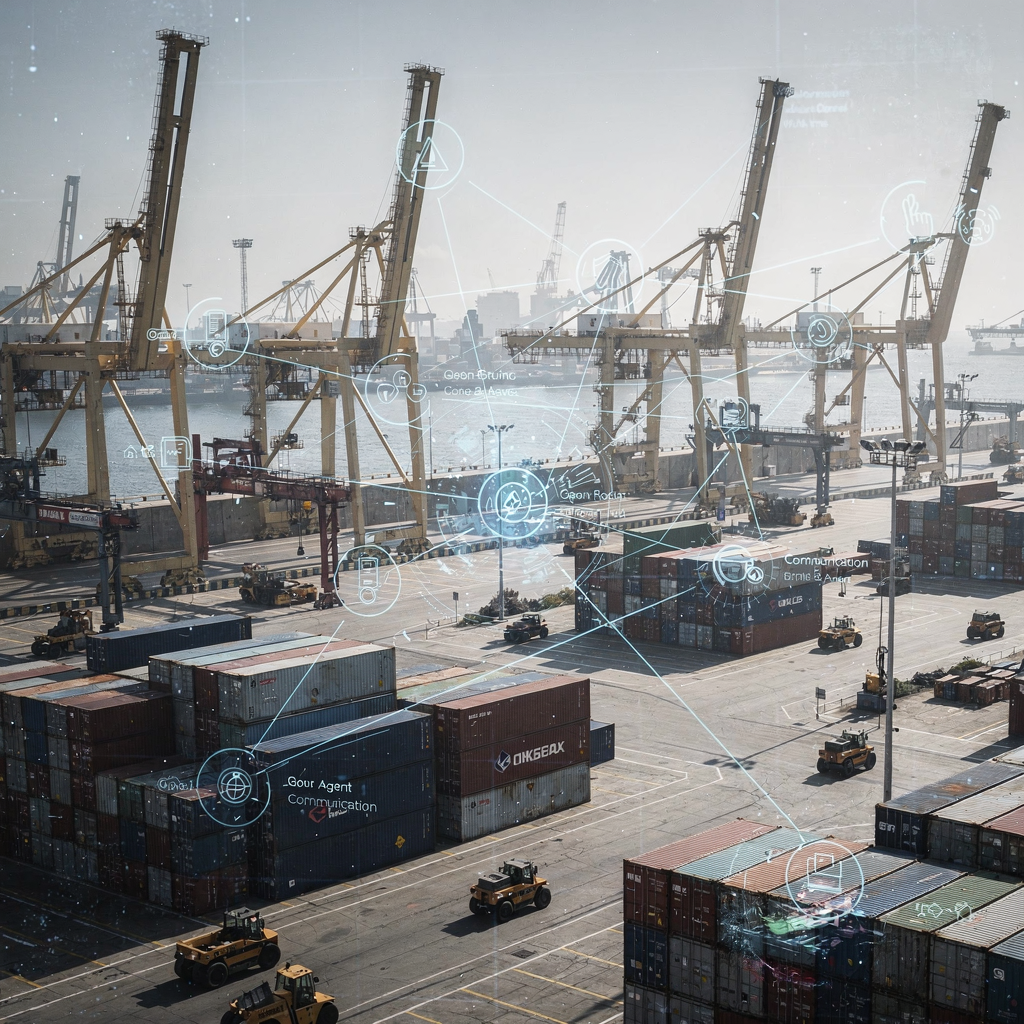
Static rule-based systems hard-code priorities and thresholds. They fail when the terminal sees novel container mixes or equipment faults. By contrast, AI-driven methods learn policies that optimize multiple KPIs. For example, agentic AI and reinforcement learning can train policies in a sandbox digital twin before live deployment. Loadmaster.ai uses this approach to train agents without needing vast historical logs. Consequently, the AI agent adapts to changing vessel mixes and yard states. That reduces rehandles and spreads workload across resources.
Simulation research supports these claims. Studies show decentralized multi-agent coordination can improve container handling efficiency by up to 20% in modeled terminals when agents share decisions across quay, yard, and gate. In South Korea, smart ports obtained predictive gains of 15–25% by moving to adaptive systems focused on AI-enhanced logistics. Therefore, terminals that adopt AI can automate repetitive work while preserving human oversight. If you want more on coordinating quay and yard automation, read our piece on yard optimization software solutions.
Drowning in a full terminal with replans, exceptions and last-minute changes?
Discover what AI-driven planning can do for your terminal
Agents integrate for real-time container tracking and crane operations
Sensor networks and IoT sensors form the nervous system of modern terminals. They stream container status, chassis locations, and equipment telemetry. Agents use this data to make fast choices. Real-time container tracking feeds crane-control agents with minute-by-minute updates. That lets cranes sequence loading and unloading to cut unnecessary moves. The result: cranes run more continuously and fewer resources wait idle.
Agents integrate yard and quay information to coordinate moves across spaces. They plan container transfers so trucks meet containers without long waits. They also schedule automated guided vehicles and automated stacking cranes where available. When a vessel’s plan changes, agents quickly recalculate sequences. Simulations report up to 20% higher handling throughput when agents share state across functions in multi-agent terminal models. That gain comes from fewer handoffs and shorter travel distances.
Real-time data also supports predictive maintenance. For example, systems use equipment telemetry and analytics to forecast wear and schedule maintenance before failures. This reduces downtime and keeps cranes productive. Learn how predictive upkeep for ship-to-shore cranes improves reliability and lowers costs in our article on predictive maintenance for STS cranes. Agents use that maintenance insight to reroute work around planned outages. Then, agents adjust job sequences so the terminal keeps moving.
Loadmaster.ai’s agents integrate with TOS and equipment telemetry via APIs. They stream status updates and adapt plans continuously. This lets terminal operators measure gains with clear KPIs such as moves per hour and reduced idle time. The approach creates resilient, scalable operations that perform consistently across shifts.
Deploy agentic ai for berth planning and port call
Agentic AI methods like reinforcement learning and digital twins open new options for berth planning. Agents learn berth allocation policies by simulating many scenarios. They practice minutes-ahead adjustments to schedules when weather, tug availability, or arrival windows change. In trials, agent-driven port call management reduces vessel turnaround by 10–15%. Those results come from smarter berth sequencing and better coordination with quay crane assignments.
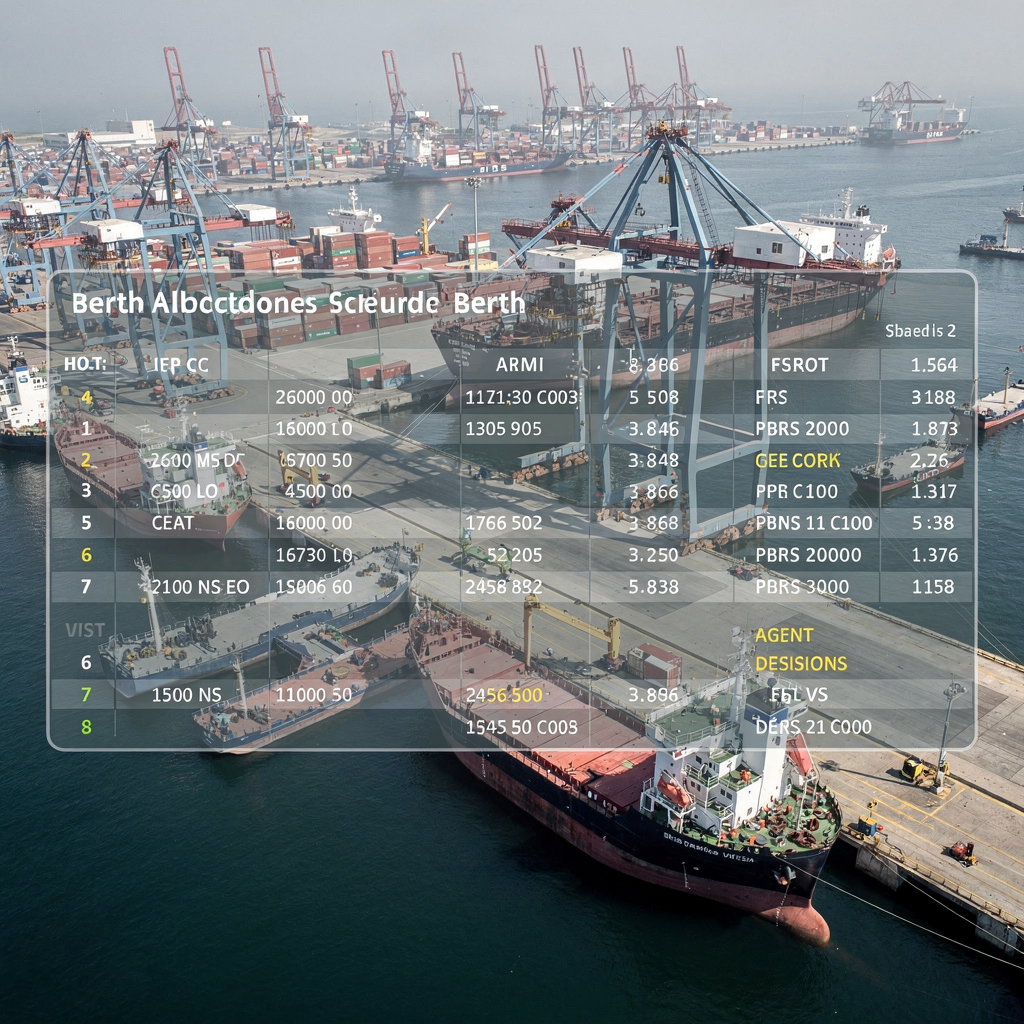
Agents predict arrival times and match berth space to crane capacity. They also balance yard pressure so container stacking does not block incoming workflows. In practice, agents ingest vessel forecasts and terminal constraints. They then propose berth moves that minimize delays and avoid last-minute reshuffles. The system cooperates with customs and port authorities to expedite clearances. For integrated procedures, see how just-in-time strategies support coordinated arrival management in our review of vessel arrival strategies.
Agentic AI models learn policies that generalize beyond past examples. This differs from supervised ML that imitates historical planner choices. Agentic AI lets terminals try new allocation strategies safely in simulation. Then, operators deploy policies with operational guardrails. The agents issue adaptive schedules and update them autonomously or with planner approval. These methods improve berth utilization and reduce vessel idle time. They also connect berth planning and container sequencing so cranes receive well-ordered lifts. For terminals aiming to modernize berth planning and container workflows, agentic AI offers measurable gains and stronger resilience.
Drowning in a full terminal with replans, exceptions and last-minute changes?
Discover what AI-driven planning can do for your terminal
Connect agents to streamline workflow and fleet management
Multi-agent communication protocols let quay, yard, and gate agents exchange messages quickly. These protocols support negotiated handoffs and status updates. As a result, terminals maintain flow across domains. For example, when a quay crane completes a move, it notifies yard agents. Then, yard agents ready a slot and inform gate agents. This choreography reduces dwell and smooths throughput.
Agents also link to fleet management systems for truck appointment scheduling and chassis supply. When agents detect gate congestion, they delay non-critical moves and prioritize trucks at risk of long waits. They adapt routing for automated guided vehicles and crews. They also coordinate charging windows for electric equipment to keep fleet availability high. For techniques that optimize routing and charging in terminals, see our write-up on AGV charging schedules.
Connected agents respond to equipment faults and traffic surges in real-time. They reassign tasks and rebalance workloads across cranes and RTGs. This minimizes downtime and prevents cascading delays. In deployed projects, teams report balanced workloads and fewer sudden bottlenecks. When agents plan moves holistically, they lower operational costs and energy use. Those shifts also improve safety by reducing congestion and manual interventions. Loadmaster.ai’s closed-loop trio—StowAI, StackAI, and JobAI—shows how integrated agents can orchestrate quay, yard, and gate to streamline terminal workflow.
ai agent use cases in autonomous port terminals drive productivity and cost savings
Real-world deployments demonstrate tangible ROI. Projects using decentralized AI coordination report up to a 30% increase in throughput and a 25% reduction in operational costs in documented case studies. ESCAP’s smart port analysis also highlights how decentralized systems let terminals process operations autonomously and optimize logistics flow at scale. Those savings come from fewer rehandles, better crane utilization, and less unnecessary travel across the yard.
Use cases include automated crane cycles where AI sequences lifts to maximize uptime. They also include gate-lane scheduling that cuts truck wait times and container repositioning policies that lower driving distance. Compared to traditional automation, autonomous or semi-autonomous software that coordinates multiple agents adapts faster to disruptions. For a practical frame on TOS integration and vessel turnaround benefits, read our analysis of TOS optimization.
Terminals have adopted AI systems to monitor container status and health. They integrate predictive maintenance to keep cranes online longer. For example, smart analytics flag wear patterns so crews can schedule fixes before failures occur. These changes reduce downtime and raise reliability. They also improve sustainability through fewer empty moves and lower fuel or electricity use. Ports looking to future-proof operations should consider agentic AI as part of a broader modernization plan. Loadmaster.ai’s approach trains agents in a digital twin, then deploys with safe guardrails so terminals see measurable improvements from day one.
FAQ
What are AI agents and how do they help ports?
AI agents are autonomous or semi-autonomous software entities that make decisions for specific tasks. In ports, they manage quay, yard, and gate tasks to automate routine work and support planners.
Can AI reduce vessel turnaround time?
Yes. Agent-driven port call management has shown reductions in turnaround by 10–15% in trials. That comes from smarter berth planning and coordinated crane sequencing.
How do agents share data across a terminal?
Agents use protocols to exchange status updates and sensor feeds. They rely on IoT sensors and real-time container tracking to keep everyone informed.
Are decentralized agents secure and auditable?
Terminals build security and audit trails into agent deployments. Systems often include constraints and explainable KPIs so operators maintain governance and compliance.
Do agents require historical data to work?
No. Some agentic AI models train in digital twins and learn from simulated experience. That means terminals can deploy agents without perfect historical logs.
How do agents handle equipment failures?
Agents detect faults via equipment telemetry and reroute work to healthy resources. They also schedule predictive maintenance to prevent many failures.
Can agents integrate with existing TOS?
Yes. Modern agents integrate via APIs and EDI to complement a terminal operating system. This lets terminals keep current workflows while adding adaptive control.
What savings can terminals expect from AI?
Deployments report measurable gains such as throughput increases up to 30% and operational costs cut by about 25%. Exact savings vary by terminal and scope.
Agents move planners from firefighting to oversight and KPI setting. Operators still control constraints while agents optimize execution and consistency.
Where can I read more about implementing AI in port terminals?
Explore resources on quay optimization, predictive maintenance for STS cranes, and just-in-time arrivals to learn practical steps. For example, see our articles on quay optimization and predictive maintenance for STS cranes for actionable guidance.
our products
 stowAI
 stackAI
 jobAI
jobAI
Innovates vessel planning. Faster rotation time of ships, increased flexibility towards shipping lines and customers.
Build the stack in the most efficient way. Increase moves per hour by reducing shifters and increase crane efficiency.
Get the most out of your equipment. Increase moves per hour by minimising waste and delays.
stowAI
Innovates vessel planning. Faster rotation time of ships, increased flexibility towards shipping lines and customers.
stackAI
Build the stack in the most efficient way. Increase moves per hour by reducing shifters and increase crane efficiency.
jobAI
Get the most out of your equipment. Increase moves per hour by minimising waste and delays.