
Container terminal yard crane operations
Double ARMG systems transform how a container terminal handles stacks. In a deepsea container terminal, two identical rail-mounted cranes work side by side inside a yard block. Each crane lifts, travels on rails, and places containers with repeatable precision. This rail-mounted gantry functionality enables parallel task execution and faster container loading and unloading. For example, studies show double ARMG operations can increase crane productivity by up to 30%. Also, the same research links improved scheduling to more consistent throughput across quay and yard.
Ports aim to reduce waiting time at berth. Effective crane scheduling and automation reduce vessel turnaround. Research reports a 15–20% reduction in turnaround time in some cases. This outcome matters for container port competitiveness and carrier costs. The Port of Antwerp case study shows automation raised measured throughput by roughly 25% at the terminal. That figure supports efforts to adopt two yard cranes per block to manage mega-ship volumes.
In practical terms, a double ARMG layout shortens cycle times. It reduces internal truck travel by grouping container storage near active blocks. It also reduces container storage shuffle moves in the storage yard. Terminal planners use simulation and an optimization model to size blocks and set crane spacing. This automation frees planners to focus on optimization and on-the-ground decisions. For further reading on automation basics, see our primer on container terminal automation fundamentals. The combination of physical gantry cranes and software improves the efficiency of container handling across the entire container terminal.
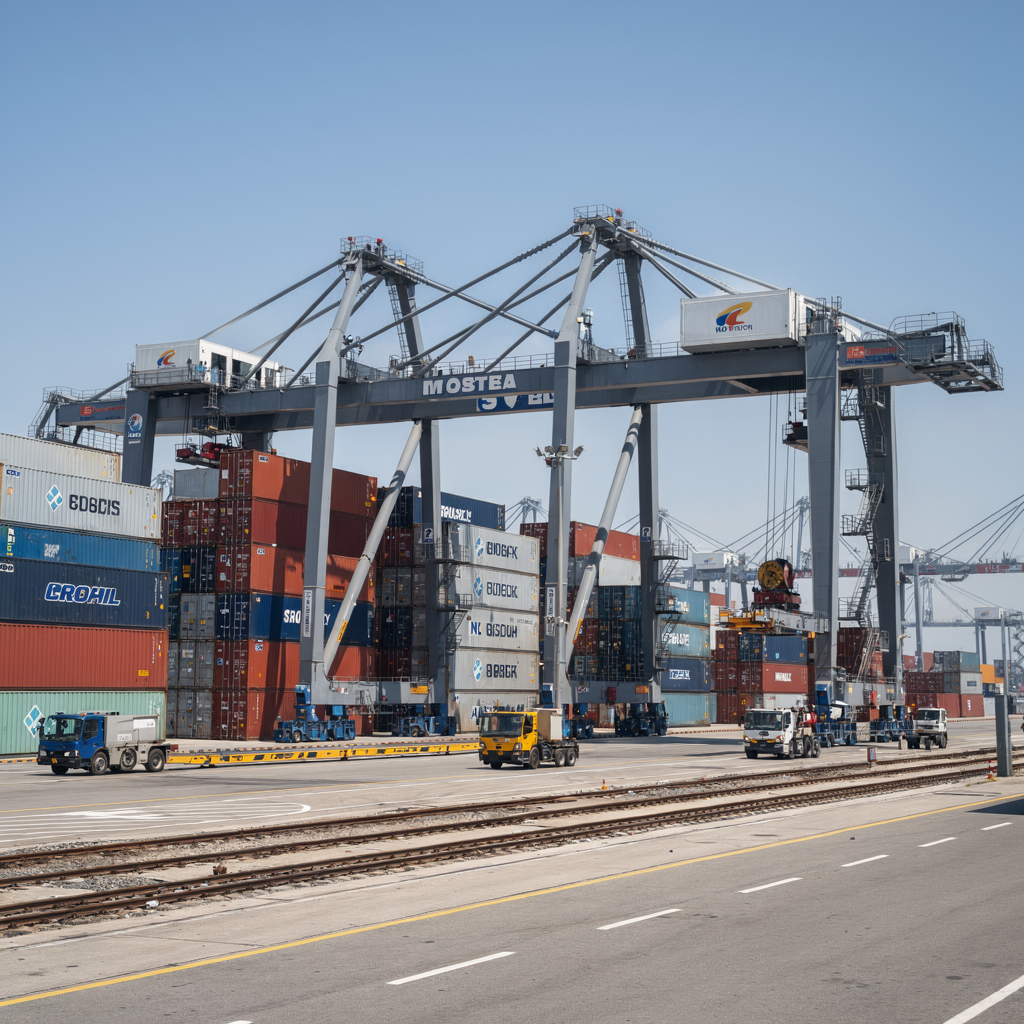
Crane scheduling and yard crane scheduling challenges
Crane scheduling in a double ARMG environment demands tight coordination. Two yard cranes must share a lane without conflict. They also must avoid interference when one passes the other. The core constraints include safety buffers on rails, hoist sequencing limits, and spatial conflict avoidance. Planners manage task overlap, stacking height rules, and the need to sequence moves for vessel calls. These constraints form a classic scheduling problem that mixes discrete choices and continuous timing.
Vessel arrival variability creates additional complexity. Ships arrive early, late, or with changing priorities. That variability forces dynamic rescheduling. For example, a late SSI discharge can cascade into longer waiting time for inland trucks. Terminals handle this by running contingency schedules and by keeping buffer capacity in the container yard. Yet buffers raise container storage costs. Therefore, many terminals prefer smarter scheduling strategies to balance speed and cost.
Operations research provides several proven approaches. Mixed-integer programming and heuristics handle base planning, while rolling horizon methods respond to changes. Researchers have proposed a specific scheduling algorithm for two identical cranes in a yard block to reduce idle periods and improve throughput (Port Technology). These methods optimize crane paths and the allocation and scheduling of moves. For terminals exploring yard crane scheduling improvements, a detailed review of yard operations highlights the need for integrated systems (Yard Operations and Management in Automated Container Terminals).
Practitioners must also think about human factors. Even in an automated terminal, operators monitor alarms and intervene when needed. Tools that reduce repetitive manual tasks help. That reduction improves planner response time. Finally, planners should test scheduling methods in live simulation before deploying them in the yard.
Drowning in a full terminal with replans, exceptions and last-minute changes?
Discover what AI-driven planning can do for your terminal
Joint scheduling model for ARMG and yard truck coordination
Joint scheduling synchronises the actions of cranes and internal vehicles. A joint scheduling model assigns moves to cranes and coordinates yard truck tasks. The model uses decision variables for start times, crane assignments, and truck pickups. It sets an objective to minimize makespan or minimize the maximum completion time. Constraints control crane interference, truck availability, and container stacking limits.
The joint scheduling approach lowers idle time for both cranes and trucks. For example, synchronised cranes and yard truck movements can cut idle periods by roughly 15%. This result appears in studies that combine crane and truck sequencing into one optimization model. The model also enforces safety clearances between cranes. It treats a yard block as a combined work cell, where two yard cranes share loading lanes and cooperating trucks deliver containers.
Theoretical models use mixed-integer formulations. They also integrate heuristics for larger instances. A typical scheduling model includes binary variables for crane-task assignment and continuous variables for timing. The objective function often blends total completion time and waiting penalties. A scheduling algorithm then searches for solutions that respect resource allocation and scheduling constraints. Planners sometimes add a soft constraint to minimize the number of vehicle moves inside the container yard to reduce handling container costs.
Joint scheduling benefits from real-time data. When truck location and crane status stream to a terminal operating system, the model can update and reassign. AI and machine learning can score alternative sequences. Readers interested in yard software solutions will find practical tools at our article on terminal operations yard optimization software solutions. In addition, coordinated scheduling reduces conflicts between quay crane scheduling and yard tasks when implemented alongside berth planning. This integration produces a better flow across the entire container terminal.
Optimization of dynamic container handling and yard truck scheduling problem
Dynamic container arrivals force frequent rescheduling. A dynamic container stream means arrivals do not follow a fixed timetable. Instead, the terminal must adapt to bursts and lulls. The yard truck scheduling problem therefore requires flexible scheduling. Planners use rolling horizon optimization to react to new arrivals while preserving earlier commitments. This approach reduces late moves and stabilizes crane workloads.
Optimization techniques vary. Mixed-integer programming gives exact solutions for moderate-sized problems. Heuristics and metaheuristics provide near-optimal results for large-scale scheduling. Particle swarm optimization and its variants have shown promise in solving complex scheduling problems in terminals. Indeed, particle swarm optimization has been used to fine-tune crane sequences and yard truck paths. Some teams implement a particle swarm optimization algorithm to speed up initial allocation and scheduling.
Automated guided vehicles and yard cranes coordination also appears in studies. Terminals that adopt automated guided vehicles and yard solutions must integrate guided vehicles and yard cranes control systems. This integration lowers handoff delays and avoids truck queuing. Many initiatives evaluate energy use too. Optimization models that include charging cycles improve both uptime and cost. For terminals interested in AGV deployment, our piece on optimizing AGV charging schedules gives practical guidance.
Beyond heuristics, reinforcement learning and adaptive control are emerging. Some experiments test scheduling based on deep reinforcement learning. These methods learn policies that adapt to traffic patterns and to container volumes. However, adoption needs careful validation. The scheduling problem using machine learning requires clear reward structures and robust data. Terminals must balance innovation with the need for reliable operations in an automated terminal environment.
Drowning in a full terminal with replans, exceptions and last-minute changes?
Discover what AI-driven planning can do for your terminal
Addressing the scheduling problem in maritime container terminals
The scheduling problem grows with vessel scale. Mega-ships increase container volumes and compress berth windows. That pressure creates a collaborative scheduling problem across quay and yard. Terminals that fail to coordinate face long queues and higher costs. To meet demand, many operators deploy integrated optimization for berth, quay crane allocation and scheduling, and yard layout. These tools aim to reduce waiting time and to increase container terminal efficiency.
Case studies from major ports show measurable gains. For instance, terminals that invested in automation and scheduling saw efficiency of container terminals improve substantially. The OECD reports cost savings across maritime container trade when ports adopt advanced handling systems (The Impact of Mega-Ships). Similarly, research at European facilities documented throughput and moves per hour improvements after automation (Port of Antwerp).
Operational metrics matter. Terminals track moves per hour, average waiting time for trucks, and maximum completion time for ship calls. They also monitor container storage utilization and number of unnecessary reshuffles in the container yard. A clear scheduling strategy aims to minimize the maximum completion time while balancing equipment wear and crew cycles. Planners sometimes use the flexible job shop scheduling problem as a proxy for yard crane 1 and yard crane 2 interaction, especially when mixed-size containers and varied tasks exist.
Tools that integrate quay crane scheduling with yard truck sequencing perform best. For planners seeking TOS-level improvements, the role of terminal operating system optimization is central. See our article on the role of TOS optimization in reducing vessel turnaround time. Importantly, successful projects combine an optimization model with human oversight and with practical rules of thumb used by experienced planners.
Port optimisation: integrated scheduling model for deepsea container terminals
Port optimisation requires a system-level lens. Integrated scheduling optimization aligns berth assignment, quay crane scheduling, and yard crane tasks. It also links yard truck flows and storage yard allocation. The goal is to create smooth flows from ship to stack. Integrated container terminal operations depend on real-time data. Artificial Intelligence and big-data analytics then refine decisions and adapt to disruptions.
AI supports dynamic scheduling and predictive maintenance. Big-data models forecast equipment failures, allowing planners to shift tasks before cranes stop. The synergistic effect of OR and big data analytics has improved responsiveness in live trials (ScienceDirect). AI modules for real-time equipment task allocation help with sudden peaks and with complex sequencing. For a deeper look at AI decision support for terminal operations, explore our materials on AI decision support for port operations.
Future developments include tighter coordination with inland gates and intermodal container flows. Automated guided vehicles and yard cranes will interoperate with scheduling platforms. Systems will prioritize moves based on revenue, on perishable cargo constraints, and on carrier contracts. Some teams test particle swarm optimization and other hybrid metaheuristics inside an integrated optimization stack. Others implement joint scheduling method prototypes for large-scale scheduling to balance throughput with energy efficiency.
Operational change also demands organizational readiness. The platform reduces email triage and preserves context during schedule updates. Teams gain time to test next-generation scheduling schemes and to validate scheduling results in live operations. Looking ahead, terminals that combine smart equipment, reliable scheduling algorithm design, and a structured rollout will lead on container terminal efficiency.
FAQ
What is a double ARMG system?
A double ARMG system uses two identical rail-mounted gantry cranes working together in a container block. These cranes handle stacking and retrieval to speed container handling and to reduce manual moves.
How does crane scheduling reduce vessel turnaround?
Effective crane scheduling sequences moves to avoid idle periods and to match truck arrival patterns. This coordination cuts waiting time at berth and can reduce vessel turnaround by roughly 15–20% in reported cases (OECD).
What is joint scheduling for cranes and trucks?
Joint scheduling assigns tasks to both cranes and yard truck resources simultaneously. The approach minimizes handoff delays and reduces idle time by aligning arrival and service times for equipment.
Which optimisation techniques work best for dynamic scheduling?
Mixed-integer programming suits smaller or medium problems, while heuristics and metaheuristics suit large-scale scheduling. Particle swarm optimization and reinforcement learning offer robust alternatives for specific dynamic container challenges.
Can automation fully replace human planners?
Automation improves consistency and speed, but human oversight remains essential for exceptions and for strategic planning.
What is the yard truck scheduling problem?
The yard truck scheduling problem coordinates truck flows with crane tasks to minimize total moves and waiting time. Solving it requires mapping truck availability and container locations in real time.
How do terminals measure success after optimization?
Terminals track moves per hour, vessel turnaround, and container storage utilization. They also monitor the maximum completion time for ship calls and the frequency of unnecessary reshuffles.
Are there case studies showing benefits of integrated scheduling?
Yes. Major European terminals report throughput gains and cost savings after automation and integrated scheduling upgrades. See research on Port of Antwerp and industry reports for specifics (Port of Antwerp).
What role does AI play in future port optimisation?
AI improves prediction, dynamic scheduling, and equipment task allocation. Combined with operations research, AI helps terminals adapt to changing container volumes and to reduce disruptions (ScienceDirect).
Where can I read more about yard optimization tools?
For practical software and implementation guidance, consult resources on terminal operations yard optimization software solutions. Also, the role of TOS optimization provides concrete steps to reduce vessel turnaround (yard optimization) and (TOS optimization).
our products
 stowAI
 stackAI
 jobAI
jobAI
Innovates vessel planning. Faster rotation time of ships, increased flexibility towards shipping lines and customers.
Build the stack in the most efficient way. Increase moves per hour by reducing shifters and increase crane efficiency.
Get the most out of your equipment. Increase moves per hour by minimising waste and delays.
stowAI
Innovates vessel planning. Faster rotation time of ships, increased flexibility towards shipping lines and customers.
stackAI
Build the stack in the most efficient way. Increase moves per hour by reducing shifters and increase crane efficiency.
jobAI
Get the most out of your equipment. Increase moves per hour by minimising waste and delays.