
container fundamentals and STS crane operations
Ship-to-shore (STS) cranes serve as the backbone of modern container transfer between ship and quay. In a typical container transfer, an STS crane lifts a container from the ship and moves it to a truck or a yard position. The role combines heavy lifting, precise placement, and timed coordination with yard crane and truck flows. STS cranes enable a terminal to move large volumes quickly, and planners measure performance in moves per hour. For example, a well-optimised multi-lane setup can reach up to 30 moves per hour per crane under favourable conditions (World Bank data). This figure helps benchmark productivity across ports and berths.
Multi-lane operations mean several container rows on the vessel are handled at once by multiple cranes. Each crane works a lane or a split of a lane. The goal remains clear: reduce vessel dwell and improve throughput. To achieve that, planners must design a resource schedule that defines which crane handles which section and when. Resource scheduling reduces idle time and improves operational flow. The trade-offs are subtle. Teams want cranes fully utilised, yet interference must be avoided.
Crane interference arises when adjacent equipment conflicts on rail or outreach. Thus, quay cranes must be spaced and coordinated to prevent collision or mutual blocking. Planners use berth planning and berth allocation models alongside stowage plan information to align work sequences. A classic observation in the literature states that “the loading and discharging of containers onto/from container vessels with ship-to-shore cranes (STS cranes) require precise coordination to optimize terminal throughput” (Koivula, modelling and simulation). That quote highlights why scheduling matters for every operation at the berth.
Short-term operational choices shape long-term terminal efficiency. For instance, yard stacking affects how quickly export containers are retrieved and loaded onto the ship. If stacks are deep or access is poor, the quay operation slows. Therefore, terminals monitor yard crane cycles, truck arrival patterns, and equipment operations. They use visibility tools to map constraints and to optimize cranes’ tasks. When a vessel arrives, planners align the stowage plan, crane assignments, and truck queues to ensure cargo is loaded onto the ship in planned sequences. This reduces rehandles and improves overall performance.
container terminal design for multi-lane scheduling
Quay layout and lane allocation form the foundational design choices that determine how effectively cranes can work in parallel. A quay with multiple lanes must balance spacing, rail alignment, and berthing depth so that each crane has enough operational envelope. Good rail placement reduces lateral conflicts. For that reason, many ports review rail geometry and adjust crane mounting to minimize downtime. For deeper discussion of quay optimisation, see an in-depth resource on terminal quay optimisation terminal operations quay optimization explained.
Lane allocation strategies include fixed splits and dynamic split approaches. Fixed splits keep the same crane-to-lane assignments across a vessel call. Dynamic splits adjust assignments as the operation progresses. Dynamic splits can adapt to changes in container mix or to equipment breakdown. However, they require robust resource scheduling software and clear operator interfaces. When managers redesign a quay to support multi-lane STS crane work, they often combine mechanical changes with updated operational planning and automation elements.
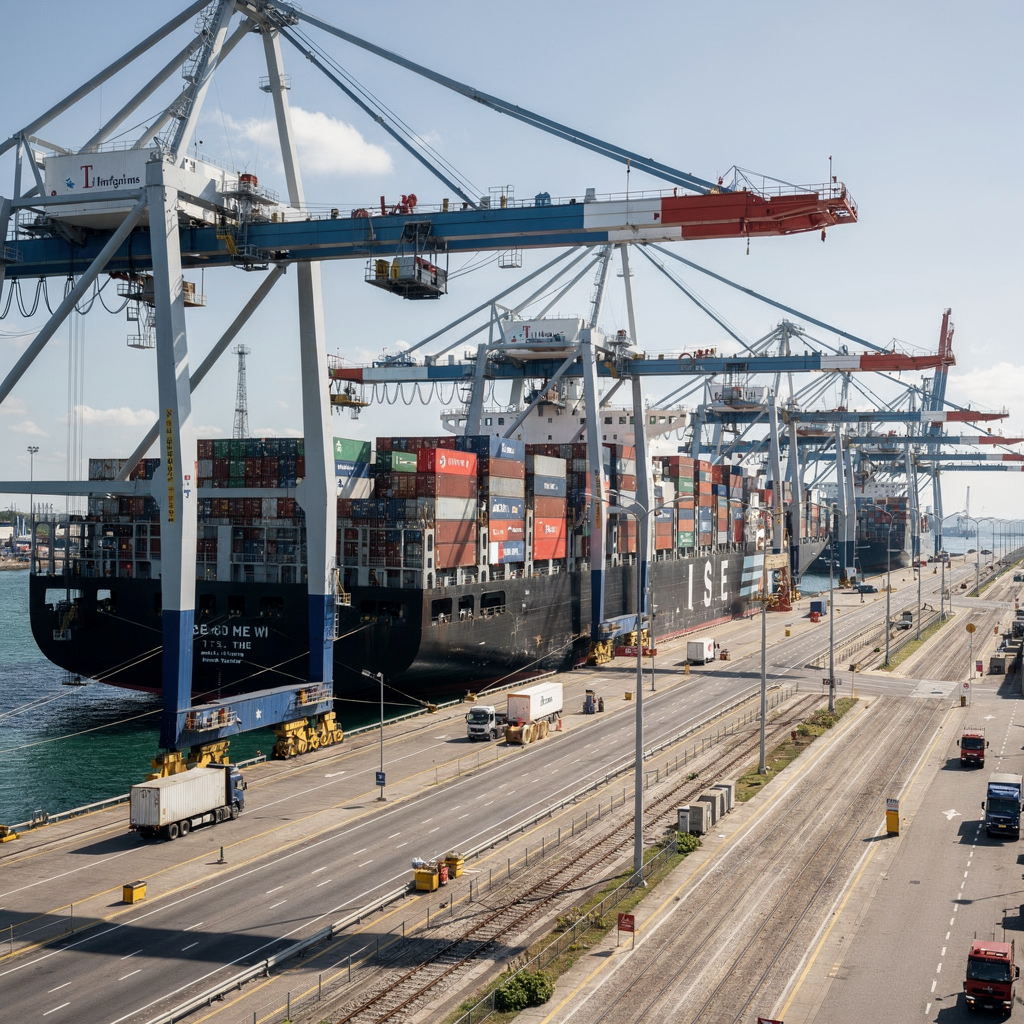
Case evidence supports layout investment. For example, the Port of Antwerp reported throughput improvements of around 18% after implementing advanced scheduling and layout changes for multi-lane operations (Port of Antwerp study). These gains came from better crane spacing, refined berth planning, and synchronized yard operations. In practice, the redesign combined civil modifications with enhanced operational planning that touched berth allocation and truck flows. Such multi-pronged redesigns also reduced congestion on the quay and improved time frames for loading and discharge.
Design solutions often link to software for container-terminal-yard optimization and yard density forecasting. When terminals invest in a planning stack they can better match quay cranes to the stowage plan. For terminals interested in yard-side improvements, a review of container terminal yard optimization software is useful container terminal yard optimization software solutions. And when discussion turns to AI-driven planning for berth and gate coordination, dedicated modules can automate repetitive tasks, freeing planners for exception handling. The result is a safer, more predictable berth operation with clearer visibility across transport and truck sequences.
Drowning in a full terminal with replans, exceptions and last-minute changes?
Discover what AI-driven planning can do for your terminal
terminal challenges: crane interference and yard constraints
Adjacent cranes share a limited rail corridor. Consequently, physical interference threatens any attempt to fully utilize all cranes. When outreach zones overlap, operators must sequence moves to avoid blocking. Coordination matters most when cranes cross lanes to access certain stacks on the vessel. Temporal interference occurs when two cranes need the same position at nearly the same time. To prevent a delay, the operation manager may pause one crane or reassign a move. That choice reduces immediate productivity but prevents larger conflicts.
Yard constraints add another layer of complexity. Storage space allocation and stack height limits affect retrieval times for export containers. If a targeted container sits deep in a stack, yard crane cycles lengthen. This increases the chances that a quay crane will be idle waiting for the container to be retrieved. Terminals that measure yard dwell time also monitor equipment breakdown frequencies and maintenance windows. Preventive maintenance and predictive maintenance schedules can lower unplanned stops and smooth the quay operation. For planners focusing on equipment health, predictive maintenance for STS cranes is an important read predictive maintenance for STS cranes in container ports.
Container size variability complicates scheduling further. A mix of 20ft and 40ft boxes, plus special cargo and heavy lifts, changes handling times. The crane must adjust rigging and spreader settings. These adjustments add seconds per move, and they add up over hundreds of moves. As a result, planners include container handling times in their optimisation models. They also consider truck windows, gate throughput, and AGV routing where applicable. In some terminals, automated guided vehicles (agvs) reduce yard crane queues but require integrated schedules to avoid creating new bottlenecks.
Human elements still matter. The operator must work with equipment that sometimes behaves unpredictably. Remote-control and assistive automation can help. They reduce operator fatigue and improve consistency. Additionally, well-designed exception handling procedures cut the impact when a vessel arrives with last-minute changes to the stowage plan. Ultimately, terminals balance full utilization against the risk of creating cascading conflicts. This is the central constraint in multi-lane scheduling.
container scheduling methods and throughput gains
Scheduling methods vary from simple heuristics to full optimisation engines and simulation-based strategies. Heuristics deliver fast, practical schedules. They often follow rules like “assign nearest idle crane” or “fill export boxes first.” Optimisation models use mathematical programming to find near-optimal assignments under constraints such as crane interference, berth allocation, and yard availability. Simulation lets planners stress-test schedules under realistic randomness. Discrete-event simulation is common for testing how a schedule behaves across time frames and equipment interactions (modeling and simulation study).
Trade-offs are clear. Optimization can reduce total moves and time, but it may require more compute and more input data. Heuristics perform reliably with less data. Hybrid approaches combine optimisation for strategic splits and heuristics for local adjustments. Terminals that adopt simulation-driven optimisation can achieve measurable throughput improvements. Studies show that multi-lane STS scheduling can reduce vessel turnaround time by 15–25% when combined with real-time adjustments and better coordination (Antwerp efficiency study). Those gains directly affect berth performance and annual capacity.
Another measured benefit concerns crane idle time. When terminals integrate predictive scheduling and live data, crane idle time can drop substantially. A study on digital readiness found that real-time integration and predictive models could reduce idle by up to 40% (digital readiness research). Those reductions produce cost savings on equipment operations and lower the terminal’s effective turnaround time. To further explore optimisation of inter-terminal and yard flows, terminals often deploy AI decision support to fine-tune crane splits and resource schedules AI decision support for port operations.
Planners must remember one central tension: pushing for maximised crane use can lead to interference and longer effective job times. Conversely, conservative allocation reduces conflicts but leaves capacity idle. A scheduling solution balances utilisation and risk. For practical operations, a rule-based scheduler backed by a short-term optimiser often hits the best compromise. It generates an actionable plan while keeping room for exception handling when the unexpected occurs.
Drowning in a full terminal with replans, exceptions and last-minute changes?
Discover what AI-driven planning can do for your terminal
container terminal simulation and digital solutions
Discrete-event simulation models reproduce terminal workflows step by step. They model cranes, trucks, yard cranes, and stack movements. By simulating many scenarios, teams find bottlenecks before they appear in live operations. Simulation also evaluates layout choices, helping assess trade-offs between crane spacing and quay length. When planners simulate multi-lane operations, they can see how small changes ripple across the entire operation.
Real-time data integration enhances these models. IoT sensors on cranes, GPS on trucks, and gate scanners feed live state into scheduling algorithms. In response, AI-driven predictive models forecast which moves will be late and which resources will become constrained. Many terminals now integrate AI to automate repetitive planning tasks and to propose corrective actions. That saves time and reduces the chance that an operator misses a critical update.
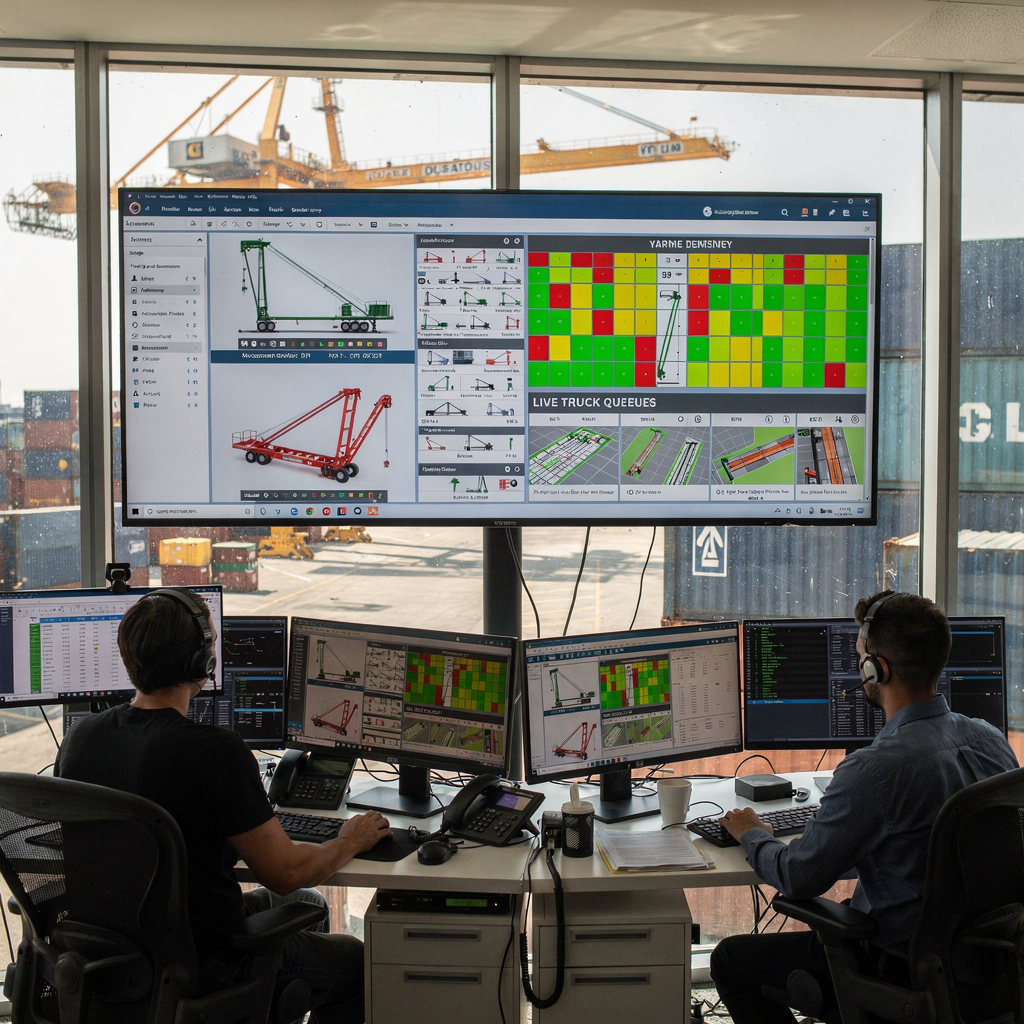
Automation and terminal automation trends include remote-control cabins, digital twins, and improved visibility across transport chains. Digital twins let planners test innovative technologies virtually. They allow what-if experiments that include equipment breakdown scenarios, or variations when a vessel arrives late. Terminals that add 5G connectivity see lower latency and improved remote-control performance. Combined with AI, these innovations help automate routine coordination. They also let humans focus on escalation and strategy rather than manual scheduling tasks.
Finally, digital integration improves supply chain visibility. When a terminal links its systems to carriers and inland partners, planners can anticipate the next port needs and optimize storage space allocation. This improves the flow of export containers and reduces stack rehandles. The benefits extend beyond the quay to the wider global supply chain.
terminal performance metrics and future research
Key indicators guide improvement efforts. Crane productivity measures moves per hour. Crane productivity remains central to assessing equipment performance. Vessel turnaround measures how long a berth call takes from arrival to departure. Yard dwell time quantifies how long containers sit before being moved. Planners also track berth allocation efficiency, gate throughput, and stack rehandles. Collectively, these metrics reveal where optimisation can best enhance performance.
Emerging trends include automation, digital twins, and 5G connectivity. Automation will continue to automate repetitive tasks, and digital twins will help evaluate strategic choices before committing capital. Innovative technologies such as AI-driven resource scheduling and predictive maintenance reduce the impact of equipment breakdown. Research must continue into adaptive scheduling under uncertain demands. Adaptive models should respond automatically when a vessel arrives with a revised stowage plan or when truck windows shift unexpectedly.
Future work should focus on robust optimisation that accepts uncertainty. For instance, planners need models that incorporate time frames for maintenance, and they need to account for exception handling when a crane goes offline. Studies should also investigate how to optimize AGV charging schedules and how to balance yard crane cycles with quay crane tempo. To explore AI modules for automated planning and their effect on operational planning, see AI modules for automated container port planning AI modules for automated container port planning.
To summarize, improvements in optimisation, integration, and digital tools can enhance terminal efficiency. They can also optimize costs and improve service to shipping lines. For terminals chasing incremental gains, combining better berth planning, predictive maintenance, and simulation-driven scheduling yields the most reliable improvements. As research advances, terminals will continue to improve throughput and reduce congestion across the port ecosystem. For further reading on minimizing container rehandles in stacks, a focused analysis is available minimizing container rehandles in deepsea container port stacks.
FAQ
What are STS cranes and how do they differ from quay cranes?
STS cranes, or ship-to-shore cranes, are large lifting machines that move containers between a ship and the quay. Quay cranes is another name used in some contexts; however, STS cranes refer specifically to the crane at the berth that handles ship-side lifts.
How do multi-lane operations improve container handling?
Multi-lane operations let multiple cranes work different rows on a vessel at the same time, increasing parallel work. This reduces vessel dwell and can raise moves per hour when well coordinated.
What is the typical productivity benchmark for STS in optimised systems?
In optimised multi-lane systems, crane productivity can reach around 30 moves per hour per crane under ideal conditions. This depends on vessel size, container mix, and yard readiness (World Bank).
What causes crane interference and how is it managed?
Interference comes from overlapping operational envelopes and timing conflicts between adjacent cranes. Terminals manage it by spacing cranes, sequencing tasks, and using dynamic scheduling to reduce overlap.
How do yard constraints affect quay operations?
Stack depth, storage space allocation, and yard crane availability determine how fast export containers can be retrieved. Poor yard performance can cause quay cranes to wait and reduce terminal efficiency.
Which scheduling methods are used for crane allocation?
Planners use heuristics for quick decisions, optimisation for strategic splits, and discrete-event simulation to test schedules. Hybrid approaches often balance speed and optimality.
Can digital tools reduce crane idle time?
Yes. Real-time integration, predictive models, and AI-driven scheduling can reduce idle time significantly; research shows reductions up to about 40% in some cases (digital readiness study).
How does maintenance planning affect terminal operations?
Planned maintenance and predictive maintenance lower the frequency of equipment breakdown and unplanned stops. This keeps cranes fully utilized and supports reliable berth planning.
What role do automation and remote-control systems play?
Automation and remote-control improve consistency in moves and reduce human fatigue. They also enable terminals to automate repetitive coordination tasks and to focus humans on exceptions.
Where can I learn more about integrating AI into terminal planning?
For applied resources, see sections on AI decision support and yard optimisation that describe modules and practical implementations in container terminal environments AI decision support for port operations and container terminal yard optimization software solutions.
our products
 stowAI
 stackAI
 jobAI
jobAI
Innovates vessel planning. Faster rotation time of ships, increased flexibility towards shipping lines and customers.
Build the stack in the most efficient way. Increase moves per hour by reducing shifters and increase crane efficiency.
Get the most out of your equipment. Increase moves per hour by minimising waste and delays.
stowAI
Innovates vessel planning. Faster rotation time of ships, increased flexibility towards shipping lines and customers.
stackAI
Build the stack in the most efficient way. Increase moves per hour by reducing shifters and increase crane efficiency.
jobAI
Get the most out of your equipment. Increase moves per hour by minimising waste and delays.