
Port Context: Importance of Inter-Terminal Transport for Modern Ports
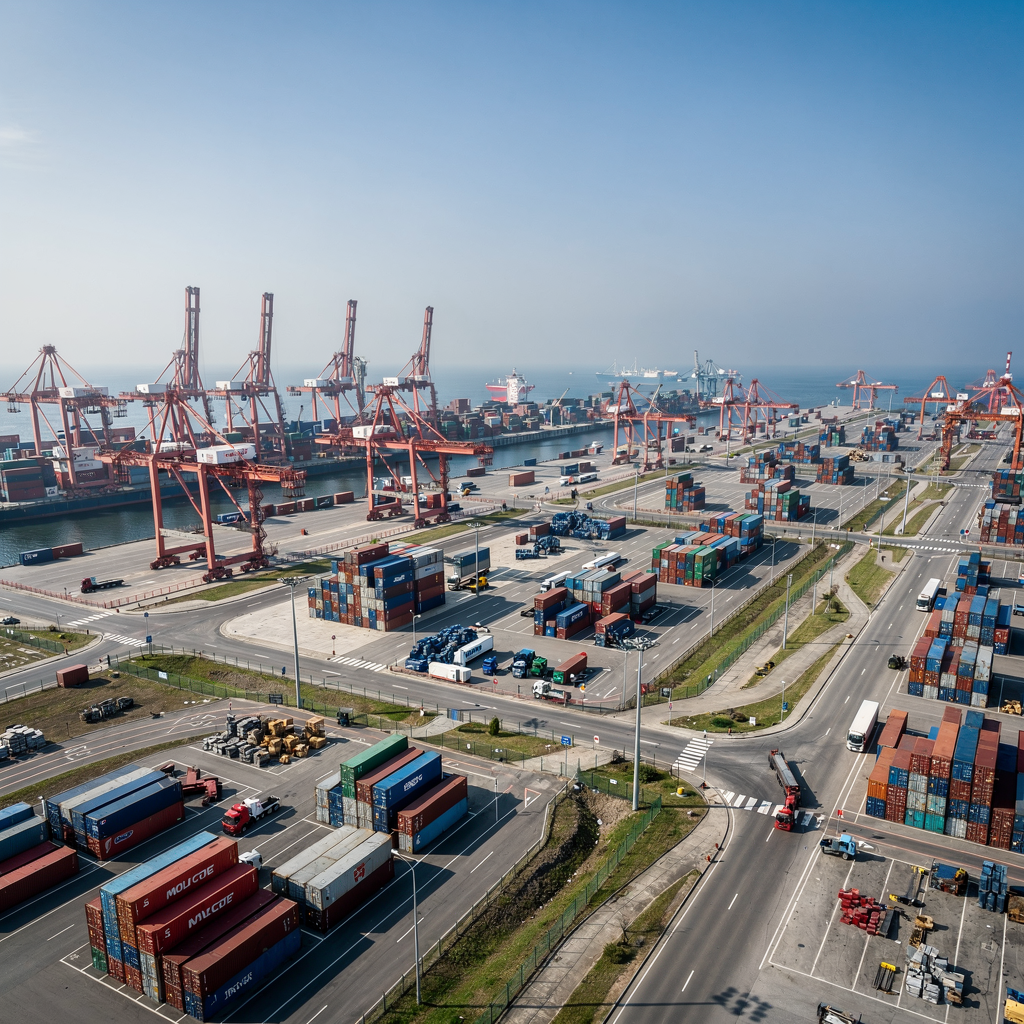
Inter-Terminal Transport (ITT) describes the movement of containers between terminals within a port area. It is known as interterminal transport in some studies and it links berth activity to yard operations and to hinterland gateways. ITT supports vessel calls, transshipment work and feeder connections. Also, ITT underpins just-in-time schedules and helps reduce waiting time for trucks at gates. According to a port digitalisation study, inter-terminal transportation can represent 20–30% of internal container movements at major ports Smart Port Development – ESCAP. This statistic frames why managing the movement of containers inside a port matters for berth planning, gate throughput and overall port productivity.
Firstly, efficient ITT shortens dwell times at container terminal yards. Secondly, it lowers the frequency of empty container relocations that increase truck transportation and congestion. Thirdly, better ITT reduces the complexity of scheduling across five container terminals or more in large port complexes. For ports around the world this matters for competitiveness and for resilience against supply chain shocks. In practice, port authorities must balance vessel sequencing, yard stacking and internal transport capacity to maintain port performance. For example, when a container terminal cannot clear import boxes fast enough, chassis pools fill and truck queues lengthen. Therefore, the development of the multiterminal system escalates the complexity of decisions that port managers must make.
Further, the value of ITT extends beyond a single terminal. It links port areas and the hinterland to regional distribution nodes. Consequently, an efficient inter-terminal network connected by rail, road and specialised vehicles can reduce total truck trips and emissions. The volume of global containerized transport continues to grow, and optimizing port-level flows becomes essential. In this context, operations teams increasingly seek digital solutions that help manage the planning of interterminal transport and the scheduling of container movements. By reducing manual triage, teams can focus on system-level decisions that improve port efficiency and port productivity.
Literature Review: Studies on Inter-Terminal Transport Optimization
This literature review surveys key findings on ITT and related innovations. Research on port digitalisation highlights ITT as a critical efficiency factor for container terminals and the broader port ecosystem Smart Port Development – ESCAP. The study describes how data consolidation across terminals reduces idle times and boosts throughput. Also, open-data platforms and faster flow of data between sensors, equipment and software applications enable better coordination across berth, yard and gate. In addition, the researchers stress information systems with built-in sharing protocols to support the scheduling of container transfers between terminals.
Another feasibility study examined short-haul rail shuttle services and found that shifting a portion of ITT from road to rail could cut truck traffic by 15–25% Anacostia – Feasibility and Benefits of Intermodal Service. This modal change can reduce port congestion and improve environmental performance. The researchers modelled scenarios that factored in terminal layout differences and hinterland connections. Results showed that the proposed shift led to transport capacity improvement and lower emissions while maintaining service levels for importers and exporters. In practice, integrating such shuttles requires coordination with port authorities and careful planning of transfer windows and yard capacity.
The market outlook frames investment patterns. Port infrastructure spending is projected to grow substantially by 2032 as ports invest in rail, road and ITT vehicles to handle rising throughput Port Infrastructure Market Size, Share & Trends | Report [2032]. This investment supports state-of-the-art facilities of the future and the increasing introduction of digital systems that interconnect terminals within a port. A recent review of digital shipping corridors also highlights AI and big data as critical to predicting demand and dispatching vehicles across terminals An Overview of Critical Success Factors for Digital Shipping Corridors. The literature review therefore points to two approaches: one focuses on physical modal changes like short-haul rail, and the other prioritises data-driven coordination and automation for scheduling of container moves.
Drowning in a full terminal with replans, exceptions and last-minute changes?
Discover what AI-driven planning can do for your terminal
Terminal Interconnectivity: Digitalisation to Optimize Container Flows
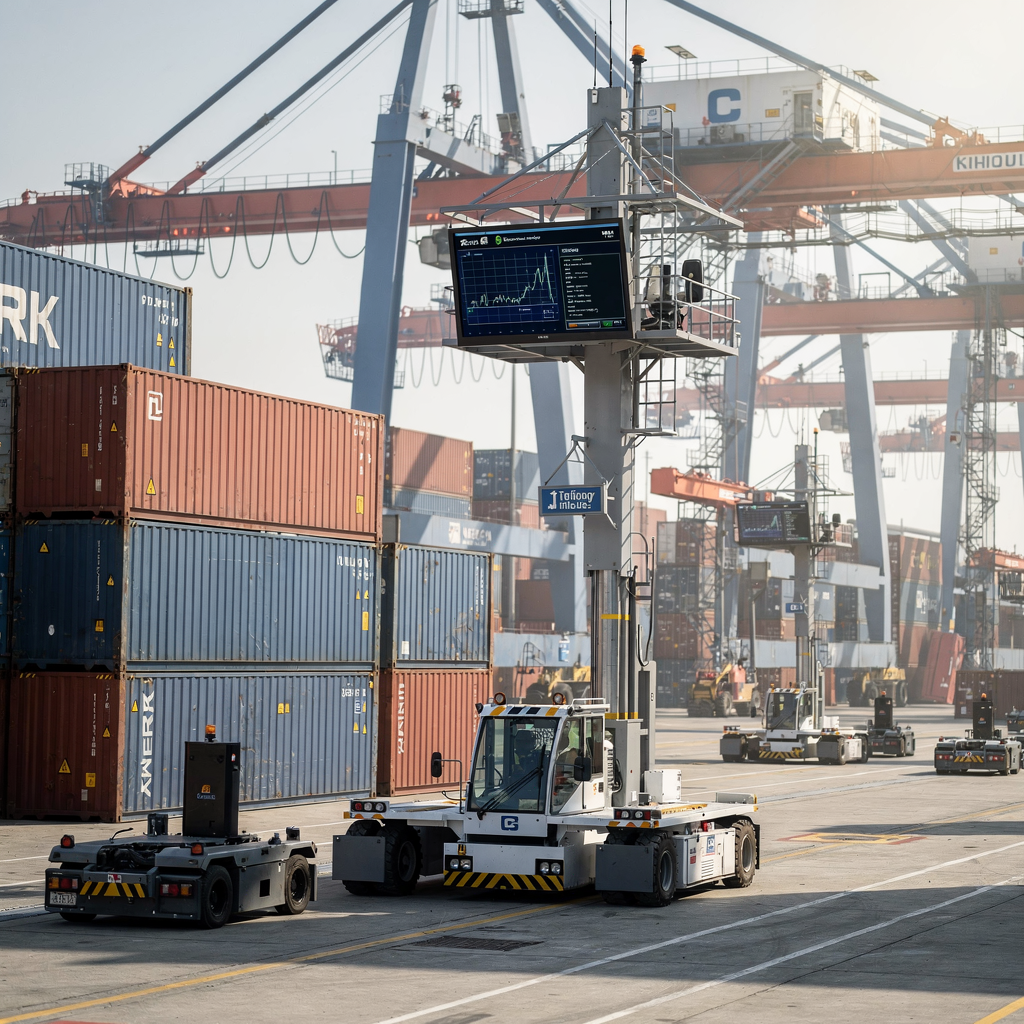
Smart port initiatives use IoT, AI and big data analytics to optimize vehicle dispatch and yard moves. For example, AI-driven routing and predictive analytics anticipate peaks and recommend when to reposition equipment. Also, faster flow of data between sensors and software applications helps planners allocate slots, avoid conflicts and reduce idle equipment. Applications to enable the smart infrastructure driving ports include real-time trackers and shared dashboards that present gate bookings and yard capacity. In practice, these tools automate alerts that otherwise would travel by email and manual calls. This reduces handoffs and helps maintain customer satisfaction.
Open-data platforms enable real-time container tracking across terminals and simplify data exchange among shipping lines, terminal operators and freight forwarders. One research note puts the emphasis on open data as a facilitator for multi-stakeholder coordination Port Digitalization with Open Data: Challenges, Opportunities, and …. By sharing status updates on vessel ETA, yard occupancy and gate queues, terminals within a port can sequence transfers to minimise truck idling and berth waiting. Additionally, an inter-terminal network connected via standard APIs makes it easier to adopt automated container handling solutions and to integrate automated container cranes and vehicles into a single flow.
Data consolidation has produced measurable gains at several ports. The ESCAP study reported lower idle times and higher throughput after terminals adopted common data standards and tools Smart Port Development – ESCAP. The benefits include improved berth assignment and reduced container shortages and severe delays. As a practical step, operators should evaluate AI modules for yard and gate scheduling and link them to email workflows.
Managing Port Congestion: Tactical and Operational Approaches
Port congestion often stems from mismatched capacity between berth, yard and the ways vehicles move inside the port. Congestion increases if vessel arrival patterns cluster or if terminals within a port overbook gate slots. Poor visibility of container status worsens stacking inefficiencies. Consequently, planners must adopt tactical and operational measures to cope with variability. Tactical and operational coordination includes scheduling coordination, capacity allocation and buffer planning to smooth peaks. The problem of jointly solving integrated berth and yard schedules arises when ports try to reduce conflicts across several terminals.
One approach is to tightly couple berth planning with truck appointment systems. Port terminals can use dynamic slot allocation to shift moves to less busy hours. Also, a coupled tactical and operational optimization strategy can reduce waiting time for trucks and minimise the costs associated with long queues. The use of programming model structures helps planners model the schedule of container transfers and assess its performance. In trials, tightly coupled tactical and operational frameworks showed that the proposed method could lower dwell times and improve customer satisfaction for importers and carriers.
Additionally, practical rules—for example, reserve lanes for inter-terminal transfers or designate peak windows for rail shuttles—help reduce port congestion. A two approaches framework balances short-term operational rules with longer-term investments such as rail access and expanded gate capacity. For ports implementing automation, combining software that resolves conflicts between equipment pools with human oversight yields better outcomes. Finally, to manage demand variability, terminals can use predictive tools that forecast container arrivals and adjust staffing and equipment allocation accordingly. This reduces bottlenecks and helps maintain steady port performance even under stress.
Drowning in a full terminal with replans, exceptions and last-minute changes?
Discover what AI-driven planning can do for your terminal
Logistics and Transportation Review: Multimodal Strategies for Optimizing Port Terminals
Comparing road, rail and specialised vehicle modes shows clear trade-offs for ITT. Road remains flexible but increases truck transportation and gate congestion. Rail offers high-capacity, low-emission shifts that can reduce truck trips by 15–25% when implemented as short-haul shuttle services Anacostia – Feasibility and Benefits of Intermodal Service. Intermodal operations can unlock transport capacity improvement and reduce environmental impact. Also, specialised terminal tractors and electric shuttle vehicles provide middle-ground solutions for dense port areas and tight transfer windows.
Environmental benefits matter to port stakeholders and to local communities. Modal shift to rail reduces emissions and lowers road congestion near gate areas. In turn, this helps improve port efficiency and public perception. The logistics and transportation review highlights how combining rail with optimized yard operations reduces empty container repositioning and cuts fuel use. For inland transfers, intermodal hubs and better coordination between terminals and hinterland depots can lower truck mileage and emissions while maintaining service levels.
Resilience improves when ports diversify their transport modes. The Chamber of Marine Commerce report notes that diversifying links—especially enhanced inter-terminal rail—reduces exposure to external shocks and supports competitiveness CMC Container Study – Chamber of Marine Commerce. Also, integrating inland rail, short-sea feeders, and efficient truck routing spreads operational risk. From an operational angle, tools such as optimal truck routing and interterminal truck routing optimization using AI algorithms lower delay risk. To dig deeper into yard-level solutions, see our overview of ai-driven container port yard management systems which explains yard forecasting and equipment coordination AI-driven container port yard management systems.
Tactical and Operational Optimization Models: Future Directions in ITT Efficiency
Researchers and operators rely on mathematical and simulation models to manage dynamic container flows. Tactical and operational optimization models capture both strategic slot allocation and short-term dispatch decisions. A programming model can represent constraints for berth, truck windows and rail shuttle schedules. The problem of jointly solving integrated berth and yard assignments is central to reducing transfer friction. Coupled models that span time scales have shown significant gains in simulated experiments.
AI-driven routing and predictive analytics offer practical next steps. Machine learning forecasts provide state inputs for reinforcement learning agents that dispatch vehicles and assign tasks. For example, experiment results showed that the proposed scheduling algorithm improved throughput under peak loads. Also, tabu search algorithm to solve combinatorial allocation problems can support near-real-time decision-making for complex terminal networks. These methods help tackle the complexity of the container transport and the development of the multiterminal system.
Operational deployment should combine analytics with human-in-the-loop controls. Software applications to enable coordinated decision-making must connect to existing TOS, ERP and gate systems. Information systems with built-in escalation rules can route exceptions as structured messages. For ports that plan to optimize further, recommended directions for future research include integrating digital shipping corridors, testing tightly coupled tactical and operational approaches, and validating optimal truck routing under variable demand. To explore related operational tools and yard optimisation, review container-terminal yard optimization software solutions which covers assignment and density forecasting techniques container-terminal yard optimization software solutions. Finally, for berth coordination and vessel turnaround impacts, see our piece on the berth allocation problem in terminal operations berth allocation problem in terminal operations. Results from these combined models can reduce port congestion, minimize the costs of transfers, and improve customer satisfaction across supply chains.
FAQ
What is inter-terminal transport (ITT)?
Inter-terminal transport (ITT) is the movement of containers between terminals within a port. It covers transfers by truck, rail or specialised vehicles and links berth operations to yard and hinterland activities.
Why does ITT matter for port performance?
ITT accounts for a large share of internal container movements and affects berth turnaround, yard stacking and gate throughput. Efficient ITT reduces congestion and helps maintain steady port performance.
How much of port internal movement does ITT represent?
Studies estimate ITT can represent 20–30% of internal container movements at major ports Smart Port Development – ESCAP. That share makes it a strategic area for improvement.
Can modal shifts reduce truck congestion?
Yes. Short-haul rail shuttle services and intermodal transfers can cut truck traffic by 15–25% under studied scenarios Anacostia – Feasibility and Benefits of Intermodal Service. That reduces emissions and gate queues.
What role does digitalisation play in optimizing container flows?
Digitalisation provides data exchange, predictive analytics and AI routing to match vehicles to containers in real time. Systems that consolidate terminal data reduce idle times and improve decision-making Smart Port Development – ESCAP.
How do ports reduce congestion tactically?
Ports use scheduling coordination, capacity allocation and dynamic slot management to smooth peaks. They may also reserve lanes for inter-terminal transfers and deploy time-windowed gate systems to lower waiting time.
What are the environmental benefits of ITT optimization?
Modal shifts to rail and better coordination cut truck miles and emissions. Reducing empty container moves and optimising routes both minimize fuel use and reduce environmental impact.
How can AI and automation help daily operations?
AI-driven routing, predictive models and automated dispatch reduce manual planning and speed responses. Automation also reduces errors, which helps maintain customer satisfaction and lowers operational costs.
What immediate steps can port operators take?
Start by consolidating terminal data and adopting shared APIs for real-time tracking. Pilot short-haul rail or shuttle services and deploy software that resolves real-time conflicts between equipment pools.
By reducing manual triage, it helps teams act faster on scheduling changes and maintain consistent communication during transfers.
our products
 stowAI
 stackAI
 jobAI
jobAI
Innovates vessel planning. Faster rotation time of ships, increased flexibility towards shipping lines and customers.
Build the stack in the most efficient way. Increase moves per hour by reducing shifters and increase crane efficiency.
Get the most out of your equipment. Increase moves per hour by minimising waste and delays.
stowAI
Innovates vessel planning. Faster rotation time of ships, increased flexibility towards shipping lines and customers.
stackAI
Build the stack in the most efficient way. Increase moves per hour by reducing shifters and increase crane efficiency.
jobAI
Get the most out of your equipment. Increase moves per hour by minimising waste and delays.