
port: Defining Port Equipment Pools and Real-Time Conflict Scenarios
Ports are complex systems where shared equipment pools—cranes, trucks, chassis and yard tractors—drive daily throughput. In a busy port, multiple stakeholders compete for the same assets. For example, terminal operators, shipping lines, haulage companies and rail operators all request cranes and trucks at overlapping times. Consequently, conflicts arise when the demand for a crane or chassis spikes while another operator holds the asset. Therefore, understanding how equipment pools behave matters for every port planner, every terminal manager and every logistics lead.
First, define what a shared equipment pool is. A pool is a set of assets that different users may request. Next, list typical conflict cases. Simultaneous demand happens when two vessels or trucking waves arrive together and require the same crane or truck. Idle time and queue build-up occur when schedules misalign, when one operator waits for a truck that is assigned elsewhere, or when a crane sits unused because the required container has not arrived from rail. As a result, throughput drops and turnaround times stretch.
For a container port, handling peaks and troughs is routine. Real-time visibility helps. Real-time alerts and monitoring show which crane or truck is free and which equipment will become available. AI and modeling can predict contention points before they manifest. For instance, simulation tools let planners simulate peak arrivals and see queue patterns. If a port wants to simulate berth operations and crane use, then a simulation model gives insight into the likely bottlenecks. You can read about terminal simulation approaches in a dedicated overview for container terminals here.
Stakeholder roles shape conflicts. Shipping lines may request priority for a particular vessel to meet landside connections. Trucking firms may need a quick turnaround to meet delivery windows. Terminal operators must balance these requests and maintain service levels. Therefore, protocols that define preemption and priority are necessary. At the same time, ports need to track servicing and maintenance windows to avoid unexpected downtime for key assets like quay cranes. Finally, a holistic view links equipment allocation to berth and yard planning so that the port can keep vessels on schedule and reduce delay risks.
operational: Identifying Operational Challenges in Equipment Allocation
Operational challenges in equipment allocation cause many of the delays and extra costs that ports face. First, multiple terminal operators and transport modes vie for limited assets. Each operator optimizes for its own yard or schedule and not always for the port system as a whole. Consequently, conflicting requests overlap. Second, synchronization issues appear when inbound trucks, rail arrivals and vessel operations do not align. That mismatch creates idle periods for cranes and peak overloads for trucks. Third, equipment-holding inefficiencies amplify the problem: when one operator holds a unit longer than planned, other users cannot access it.
Case insight from the Port of Tema shows how equipment-holding capacity affected cargo handling rates and caused delays. The study documented how private stevedores’ equipment practices lowered throughput and increased waiting time for vessels and trucks Port Management Case Studies – TrainforTrade. Therefore, port managers must consider both asset counts and governance rules. Otherwise, a shortfall in synchronization forces the port into reactive cycles and worsens congestion.
In addition, mega-vessels intensify scheduling pressures. When a mega vessel arrives, many quay cranes and landside trucks are needed simultaneously. Thus, a port that lacks adaptive allocation rules sees a spike in queue build-up and a longer vessel stay. A linked problem shows up in maintenance and breakdowns. If quay cranes operate beyond optimal utilization, breakdown risk rises and the port loses resilience. Studies show that optimal equipment utilization typically ranges between 70-85%; below that the port underuses assets, and above it conflicts and breakdowns increase sharply Port Management Case Studies – TrainforTrade and The Management of Port Equipment Maintenance.
Operational policies must bridge the gaps. Create synchronized schedules, share real-time status, and define priority rules so that the port can assign assets quickly. Integration of TOS data and sensor feeds reduces manual lookup tasks. In practice, ports that integrate yard and quay planning gain speed and clarity; see research on yard management systems for further ideas AI-driven container port yard management systems. Finally, allow short-term re-allocation rules to react to deviations in planned arrival and loading times. That keeps the port agile and lowers the chance that vessel or truck waiting time cascades into larger delays.

Drowning in a full terminal with replans, exceptions and last-minute changes?
Discover what AI-driven planning can do for your terminal
ai: Leveraging AI for Real-Time Conflict Detection and Prediction
AI plays a central role in detecting and forecasting conflicts across equipment pools. First, digital twins and decision support systems synthesize sensor data, terminal operating system inputs and schedule feeds to produce a live model of the port. For instance, a 2021 study emphasized that an optimal computing budget allocation policy matters to apply a digital twin at real-world scale and to maintain real-time performance A decision support system for maintaining a resilient port. Therefore, ports must balance compute cost and the need for fast alerts.
Second, machine learning models analyze sensor streams and historical schedule patterns to forecast contention points. AI models predict which crane or truck will be oversubscribed within the next hour. They also estimate likely waiting time and service time per job. As a result, operators can reschedule assignments or preemptively route trucks to alternative gates. Third, AI reduces manual email load and repetitive tasks. They read intent, fetch data from ERP or TOS, and draft or send replies, which frees human planners to focus on mitigation and optimization.
Additionally, combining AI with modeling and simulation lets ports simulate the impact of a reschedule before they act. For example, you can simulate shifting a crane from one berth to another and immediately see the effect on vessel turnaround and on adjacent container stacks. That capability avoids ad hoc decisions that might worsen congestion. Also, AI can help integrate berth allocation and equipment assignment decisions to reduce deviation between planned arrival and actual operation. For more on algorithmic berth allocation and planning, consult material on the berth allocation problem and vessel planning berth allocation problem in terminal operations and integrating high-hoisting constraints.
Finally, AI improves decision support by ranking feasible assignments against operational constraints. AI augments rule-based systems with predictions of disruption probability and optimal reassignments. Consequently, the port gains faster responses and fewer errors in hectic periods. The use of AI therefore strengthens monitoring, reduces manual triage, and helps the port maintain steady throughput even when disruptions arise.
optimization: Employing Optimization Techniques for Resource Allocation
Optimization delivers measurable operational gains in equipment assignment and scheduling. First, heuristic algorithms and mathematical programming models solve allocation problems that change in minutes. Heuristics give near-instant assignments. Linear programming and integer models deliver optimal or provably feasible plans when the problem scale allows. For large ports the optimum may be computationally heavy. Therefore, ports adopt hybrid strategies that combine fast heuristics for immediate decisions and deeper optimization for scheduled planning.
Second, computing budget allocation matters for large-scale port applications. As a recent study showed, an optimal computing budget policy helps apply digital twins in real time without excessive compute cost A decision support system for maintaining a resilient port. Thus, a port must choose where to spend CPU on fine-grained assignments and where to use coarser heuristics. Third, optimization yields clear quantitative gains. Improved equipment utilization often moves from under 70% toward the 70-85% window, lowering breakdowns and idle time. In practice, better allocation reduces idle time, trims waiting time for trucks, and shortens vessel stay; equipment inefficiency can raise operational costs by 15-25% when left unchecked The Management of Port Equipment Maintenance.
Fourth, optimization ties directly to simulation and modeling. You can optimize a plan and then simulate it to confirm the result under stochastic arrivals. That loop—optimize, simulate, adjust—helps ports handle uncertainty and disruption. For ports that want to optimize chassis pools across carriers, look at work on chassis pool optimization through AI chassis pool optimization through AI. Also, integrating yard planning software with optimization engines yields better assignment of containers to slots and reduces empty driving distances; see yard management solutions container terminal yard optimization.
Finally, optimization supports priority rules and reschedule decisions. An algorithm can assign a crane to a high-priority vessel while minimizing the ripple effect across the port. That reduces deviation from planned arrival and preserves service levels across stakeholders. The result is a more resilient, measurable, and operationally sound port.
Drowning in a full terminal with replans, exceptions and last-minute changes?
Discover what AI-driven planning can do for your terminal
tactical & solve: Tactical Strategies to Solve Equipment Bottlenecks in Real Time
Tactical strategies address bottlenecks as they arise and prevent small problems turning into major disruption. First, collaborative sharing agreements and real-time protocols help operators resolve contention without heavy negotiation. Agreements can specify time-limited holds, penalty rules for excessive equipment holding, and preferred handover gates. Second, priority rules guide quick decisions. A terminal can prioritize a vessel with tight inland connections or a truck carrying time-sensitive cargo. Those priorities must be transparent and enforced by the TOS and by real-time allocation agents.
Third, real-time re-allocation is essential. When an algorithm or an AI model forecasts a shortage, the system can instantly reassign trucks or shift a crane. It can also suggest short diversions such as moving a container stack to free a lane. Fourth, collaborative models such as shared chassis pools have proven effective. For instance, intermodal chassis provisioning reduced idle hours and eased conflicts between ocean carriers and inland transport providers Intermodal Chassis Provisioning and Supply Chain Efficiency. That arrangement cut idle time substantially, and in some implementations idle hours fell by up to 20%.
Fifth, use clear escalation rules and automated email handling to accelerate decisions. As a result, human operators spend less time finding data and more time executing tactical moves. Sixth, enforce short-term reschedule windows. A port can allow a five- or ten-minute window for trucks to arrive at a new gate, and then reassign assets if they miss the window. That reduces cascading waiting time and keeps the quay moving.
Finally, couple tactical moves with analytics so that every re-allocation is recorded, measured and fed back into models. This loop lets the port learn which maneuvers actually reduce queue build-up and which ones merely shift the problem. Over time the port strengthens its operational playbook and lowers the chance that bottlenecks recur.
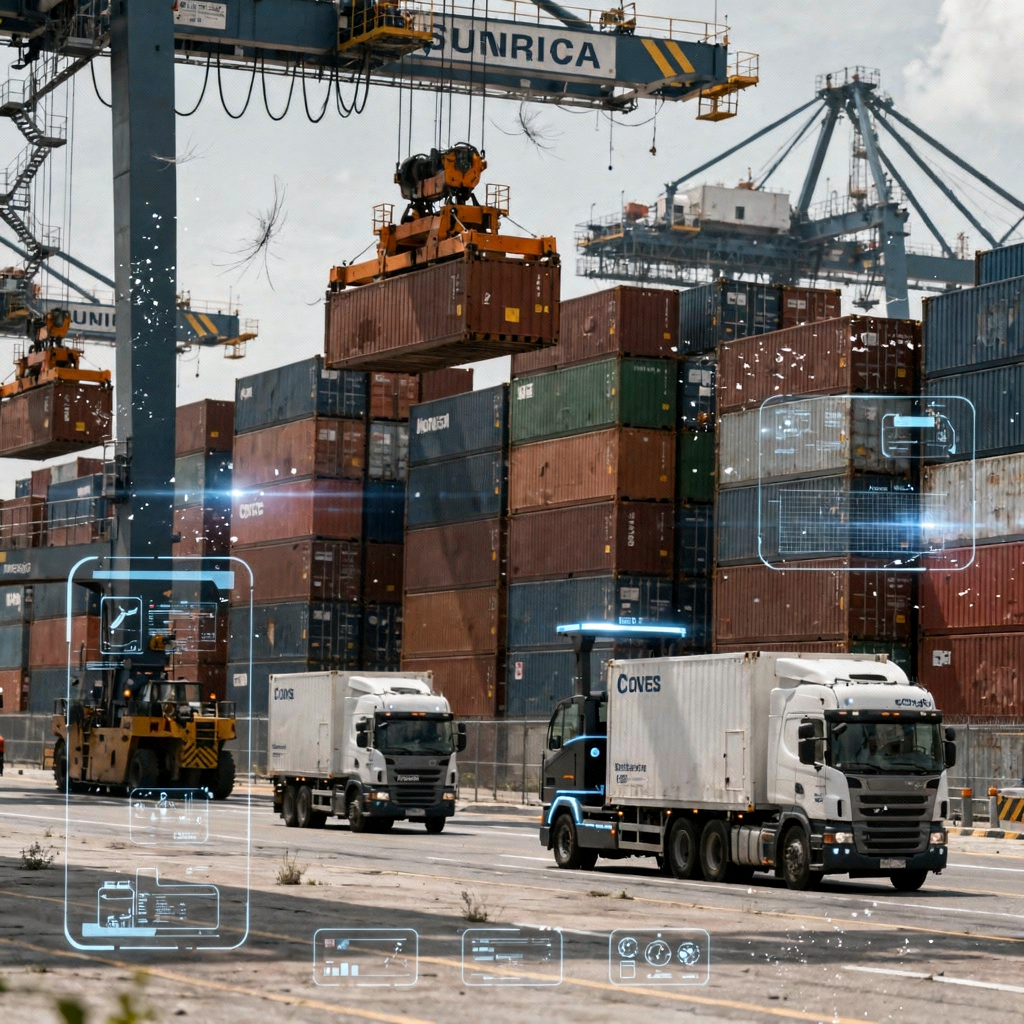
analytics & congestion: Analytics-Driven Approaches to Reduce Congestion and Enhance Resilience
Analytics transforms reactive port actions into proactive, data-driven strategies. First, real-time dashboards and KPIs show equipment status, queue lengths, average service time and waiting time. Decision makers use these metrics to spot hotspots early. Second, root-cause analysis applied to historical data reveals recurring congestion fingerprints. For example, a recurring pattern may show that trucks arriving in a particular slot consistently trigger crane idle time due to misaligned truck gates. Third, analytics supports scenario testing. Analysts can compare outcomes of different allocation algorithms and measure the impact on vessel turnaround.
Fourth, historical data helps predict likely peak windows and prepare the port in advance. Using modeling and simulation with historical distributions reduces the risk that a single deviation causes widespread delay. You can also use analytics to evaluate the cost-benefit of investing in more cranes versus adopting shared equipment models. Studies indicate that underinvestment in equipment leads to higher operational costs and longer vessel stays; congestion can extend vessel turnaround by up to 30% in some cases PORT CONGESTION PROBLEM, CAUSES AND SOLUTIONS.
Fifth, analytics informs maintenance scheduling to avoid asset downtime during peak operations. Predictive maintenance reduces unexpected crane or truck failures and therefore lowers disruption risk. Sixth, analytics links to staffing and email workflows. Automating email workflows with AI reduces time lost to triage and accelerates decision loops. For terminals that aim to reduce productivity loss from equipment handling tasks, integration across data sources matters; see work on minimizing twistlock handling and on asset-tracking systems for further operational context minimizing productivity loss from twistlock handling and asset tracking systems for port operations.
Seventh, measurable outcomes include shorter vessel turnaround, reduced waiting time for trucks, lower operational costs and higher equipment utilization moving into the 70-85% band. Finally, analytics supports continuous improvement. By measuring every assignment, every delay and every reschedule, the port builds evidence for better policies and for investments that deliver resilient, efficient operations.
FAQ
What are common causes of equipment conflicts in ports?
Common causes include simultaneous demand from multiple vessels or trucking waves, poor synchronization between rail, road and sea schedules, and equipment-holding practices by operators. In addition, unexpected breakdowns and maintenance can create sudden shortages that trigger wider contention.
How does real-time detection reduce vessel turnaround?
Real-time detection flags incoming conflicts and allows operators to reassign assets before queues form. By reducing waiting time and idle time, the port lowers vessel stay and improves overall throughput.
What role does AI play in conflict forecasting?
AI analyzes sensor and schedule data to forecast contention points and to recommend reassignments. AI models can predict short-term demand spikes and estimate which assignments minimize ripple effects across the port.
Can shared chassis pools really cut idle hours?
Yes. Collaborative chassis provisioning reduced idle hours and eased conflicts between carriers and inland transport in documented cases. Shared pools improve utilization and lower the chance that a single operator monopolizes scarce assets.
How should terminals choose between heuristics and full optimization?
Use heuristics for urgent, real-time decisions and deeper optimization for scheduled planning. Heuristics give speed; linear programming and mathematical programming provide more optimal plans when compute permits.
What metrics should a port monitor to spot congestion early?
Monitor queue lengths, average service time, waiting time, equipment utilization and predicted deviation from planned arrival. Dashboards that show these KPIs allow rapid detection and response to congestion hotspots.
How do digital twins support equipment allocation?
Digital twins create a live model of the port by integrating sensor feeds, TOS inputs and schedules. Planners can simulate reassignments and see the downstream effects before they act, which reduces the risk of costly missteps.
What governance measures reduce operator conflicts?
Establish clear priority rules, time-limited holds, penalty clauses for excessive equipment holding and transparent escalation paths. Such rules lower ad hoc disputes and make real-time re-allocation smoother.
How can email automation improve operational response?
Email automation speeds data retrieval and reduces manual triage, so decisions happen faster and with better context. Systems that draft and route replies grounded in ERP, TOS and other sources free planners to focus on tactical moves.
Where can I learn more about container yard and chassis optimization?
Explore resources on AI-driven yard management, chassis pool optimization and container terminal simulation for deeper technical guidance. For instance, see AI-driven yard management and chassis pool optimization pages for practical case studies and tools AI-driven container port yard management systems and chassis pool optimization through AI.
our products
 stowAI
 stackAI
 jobAI
jobAI
Innovates vessel planning. Faster rotation time of ships, increased flexibility towards shipping lines and customers.
Build the stack in the most efficient way. Increase moves per hour by reducing shifters and increase crane efficiency.
Get the most out of your equipment. Increase moves per hour by minimising waste and delays.
stowAI
Innovates vessel planning. Faster rotation time of ships, increased flexibility towards shipping lines and customers.
stackAI
Build the stack in the most efficient way. Increase moves per hour by reducing shifters and increase crane efficiency.
jobAI
Get the most out of your equipment. Increase moves per hour by minimising waste and delays.