
allocation: Principles of dynamic equipment pool allocation
Dynamic allocation differs from static schedules in a clear way. Static plans lock equipment into predefined shifts and bays. Dynamic allocation reacts to demand, and it reallocates cranes, trucks, and yard handlers when and where they are needed. In a busy terminal the approach reduces idle time, and it shortens queues. It also improves throughput and resource utilization. Key handling assets include quay cranes, yard trucks, straddle carriers, and RTGs. These assets must be seen as a flexible pool, and the controller must treat them as interchangeable where possible. The method reduces the need for infrastructure expansion and additional equipment, and it often proves preferable than infrastructure expansion for cost control.
By design, dynamic allocation treats the transfer equipment fleet as a shared asset. It treats individual machines as nodes in a network, and it connects them with arrival forecasts and yard state. When a vessel is delayed, reallocating quay cranes to other berths can save hours. When a peak in the container yard appears, shifting yard trucks and straddle carriers cuts dwell time. One proven effect is that dynamic approaches bring a positive effect on the productivity. A model aims to minimize idle time and handle peaks with minimal extra investment. Therefore the viewpoint of investment effect often favours smarter software and process change over new cranes.
Design principles focus on visibility, rules, and feedback loops. First, operators must have a single source of truth in their operation system and dashboards. Second, rules must encode priorities for priority boxes, transshipment, and time-critical lifts. Third, a simulation-led rollout helps prove benefits before full deployment. For example, a transfer system based on real-time simulation can validate schedules without disrupting live work. In practice, terminals combine real-time monitoring and scheduled windows to create robust plans that raise port competitiveness and improve service quality. For further reading on decision support for these topics see our piece on container terminal decision support systems.
arrival time: Integration and analytics of real-time arrival time data
Accurate arrival time feeds are the backbone of dynamic systems. Data comes from AIS signals, Terminal Operating Systems (TOS), and IoT sensors. It also comes from port authority feeds and carrier messages. Combining these sources yields a clearer picture of incoming workload. Real-time data collection by using radio frequency identification and other sensors helps reduce uncertainty. For instance, “the development of green supply chains has been significantly enhanced by reliable data at any time”, and that statement confirms why continuous streams matter in modern terminal operations.
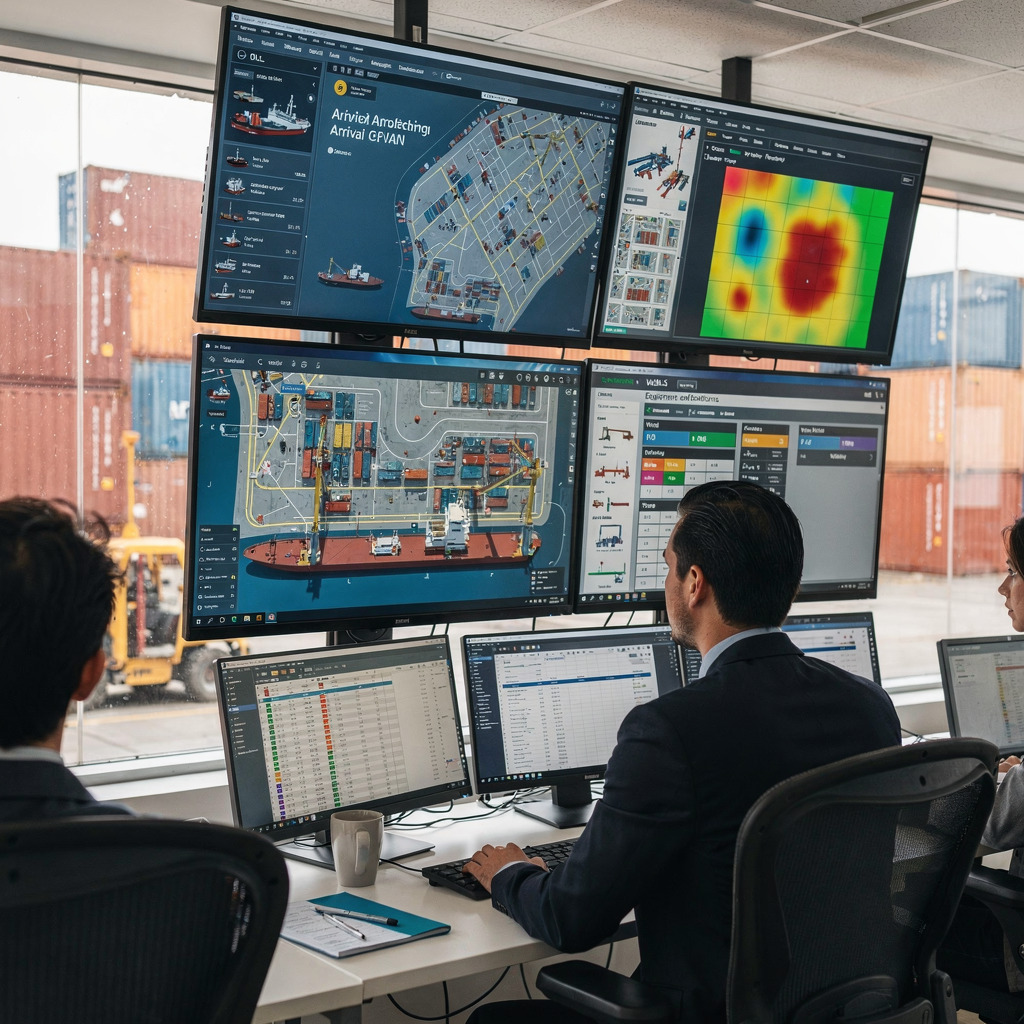
Data processing typically uses streaming pipelines, and it feeds dashboards, alerts, and optimization engines. Streams flow into a message bus, and they update predictive models within seconds. Dashboards present vessel ETAs, yard density, and equipment status. Alerts flag conflicts, and they trigger automated reassignment rules. This flow reduces friction, and it supports an operational management of the dynamic environment. A well-tuned pipeline can reduce vessel waiting times by up to 20% as research shows. That statistic demonstrates the scale of gains when arrival time is used well.
Machine learning models predict short-term peaks and suggest allocation actions. These models consume AIS, gate scans, and crane telemetry, and then they offer ranked actions. The system based on real-time positioning refines those rankings further, and it pushes instructions to operator consoles and mobile apps. For advanced case studies on predicting yard congestion and planning, see our work on predictive analytics for port operations yard congestion. Also, integration must handle data quality, latency, and vendor APIs. In practice, terminals that combine streaming ingestion with rule-based fallbacks gain resilience and faster response times, and they realize better berth schedule adherence and smoother container operations.
Drowning in a full terminal with replans, exceptions and last-minute changes?
Discover what AI-driven planning can do for your terminal
berth: Dynamic berth planning for improved terminal throughput
Berth planning faces continuous change. Variable arrival patterns and berth windows create a complex assignment problem. Terminals must coordinate tug availability, pilot windows, and quay space. A previously planned berth schedule often becomes outdated, and real-time updates are needed. Dynamic berth planning adjusts the berth window and the quay crane mix in response to new information. That change can increase crane productivity, and it can lift berth occupancy rates significantly.
Real-time feeds inform berth window adjustments and resource allocation. When a vessel’s arrival time shifts, planners can modify the berth plan and reassign quay cranes. The assignment based process considers vessel length, container mix, and shore power needs. Tools that integrate AIS, TOS, and gate loads make those choices visible and faster. In fact, research shows that dynamic approaches can reduce vessel waiting times by up to 20% and that equipment utilization improved by about 15% at the Port of Antwerp. These numbers matter for port managers seeking to raise port competitiveness.
Metrics to track include berth occupancy, crane productivity, and yard queue length. A small change in berth assignment can cascade, and it can reduce terminal congestion. To optimize berth decisions many teams run simulation scenarios before committing changes. A bay allocation module can test swaps in minutes, and the results guide the operator. For applied examples of quay crane and yard optimization see our article on AI-driven quay crane scheduling and yard optimization. Overall, dynamic berth planning links arrival time intelligence to crane deployment, and it aligns quay and the container yard to lower costs and faster turnarounds.
allocation model: Algorithmic frameworks for equipment scheduling
Optimization methods range from linear programming to heuristics and meta-heuristics. Linear models give exact solutions for small instances, and heuristics scale to the large, noisy problems in live port operations. Meta-heuristics like genetic algorithms and simulated annealing balance solution quality with compute time. A robust allocation model blends mathematical optimization with pragmatic rules. That hybrid approach enables fast decisions and avoids risky oscillation in assignments.
Machine Learning supports demand prediction and decision support. ML models estimate short-term container volumes and yard density, and they then feed optimization engines. One study explains that “integrated real-time data analytics enable terminals to respond proactively rather than reactively” and improve resilience. The allocation model must accept live inputs, and it must output prioritized move lists for cranes and yard teams. For simulation-driven testing, planners use a digital twin or a container terminal emulation to validate policies before rollout. Several tools use reinforcement learning for crane scheduling and it is becoming more common in research and practice. For technical background on multi-vessel crane scheduling see our guide to multi-vessel crane scheduling optimization.
Integration of live data streams is critical. The model subscribes to vessel ETAs, gate counts, and crane telemetry. Then it computes assignments and dispatches work orders. A transfer system based on real-time feeds may also produce yard allocation changes. These changes must respect maintenance schedules and labour shifts. The algorithmic framework must incorporate constraints like crane availability, and it must respect safety and union rules. In sum, the methodology is a mix of optimization, ML, and operational rules that together deliver measurable productivity improvement and resource utilization gains.
Drowning in a full terminal with replans, exceptions and last-minute changes?
Discover what AI-driven planning can do for your terminal
allocation: Managing system integration and data reliability
Integration is the unseen work that makes dynamic systems run. Data accuracy, latency, and communication architecture determine whether models can act quickly. Terminals must bind AIS data, TOS records, and IoT telemetry into a coherent stream. A secure middleware layer often handles message transformation and routing. APIs are used to push instructions into mobile apps, and the operation system must accept automated updates.
Challenges include noisy sensors, missing scans, and delayed carrier messages. Therefore operators build fallbacks and reconciliation steps. For instance, when gate scans fail the system can use historical trends and manual overrides. Using radio frequency identification and RFID tags on key containers helps reduce missing data. Real-time data collection by using radio frequency identification improves visibility at the gate and in the yard. The management of the dynamic transfer requires clear rules that define when automated reassignment occurs and when humans step in.
Maintenance schedules and labour shifts add constraints that the scheduler must honor. The allocation model must avoid assigning equipment that is due for service, and it must respect shift handovers. The dynamic operation of YT requires particular attention to driver breaks and licensing. Best practices include well-documented APIs, robust middleware, encrypted networks, and audit trails. Also, information technology enhancement activities should be staged, and they should begin with low-risk pilots. From a practical standpoint, data governance and governance checklists cut risk and improve trust. When systems are aligned the effect on the productivity improvement is clear: faster turnarounds, stable crane productivity, and higher overall terminal throughput.
berth: Case studies on competitive performance and future outlook
Leading ports prove the case for dynamic allocation. At the Port of Antwerp a dynamic strategy produced an equipment utilization improvement of roughly 15% which cut idle equipment time and cost. In other cases real-time models reduced vessel waiting times by up to 20% and improved berth occupancy. These results show that smarter execution brings a positive effect on the productivity for many terminals.
Lessons learned often revolve around stakeholder collaboration, and they include phased roll-outs and clear KPIs. Operators should align shipping lines, truckers, and terminal teams early. They should also use simulation to stress-test new rules, and they should use a transfer system based on real-time simulation to validate outcomes. Pilot programs typically start with a dock block or a single quay and then expand. This staged method reduces risk and builds buy-in.
Looking forward, AI-driven digital twins, 5G connectivity, and cloud-native platforms will change the game for scheduling and control. Advanced operation systems will enable faster analysis and richer what-if scenarios. For those preparing investment cases the viewpoint of investment effect is often favorable when compared with expansion and additional equipment acquisition. In other words, smarter software can be preferable than infrastructure expansion. Finally, terminals that link predictive analytics with automated email and alerting tools see faster decision cycles. As ports pursue sustainable growth, these innovations will raise port competitiveness and support more resilient maritime supply chains.
FAQ
What is dynamic equipment allocation in a container terminal?
Dynamic equipment allocation assigns cranes, trucks, and yard handlers based on current conditions rather than a fixed plan. It uses live feeds and models to reassign resources to high-priority tasks quickly, and it reduces idle time and delays.
How does real-time arrival time data improve terminal decisions?
Real-time arrival time feeds, such as AIS and carrier messages, let planners update schedules as conditions change. As a result, terminals can adjust berth windows and reassign cranes to avoid queues and reduce vessel waiting time.
Which data sources matter most for real-time scheduling?
Key sources include AIS signals, the Terminal Operating System, gate scans, and IoT sensors. Combining these inputs gives a more accurate layout of pending work, and it supports automated reassignment and alerts.
What algorithms are used for allocation models?
Algorithms range from linear programming to heuristics and meta-heuristics. Machine Learning augments these with demand prediction, and a hybrid approach often yields the best trade-off between speed and solution quality.
Can dynamic berth planning be tested before go-live?
Yes. Simulation and digital twin tools let planners run scenarios without affecting live operations. A simulation study helps validate policies and identify corner cases that the allocation model must handle.
How do terminals handle data reliability and latency?
Terminals build middleware, fallbacks, and reconciliation routines. They use RFID and redundant sensors to reduce missing scans, and they design safe rules so humans can override automated decisions when needed.
What operational constraints must allocation systems respect?
They must honor maintenance windows, labour shifts, safety rules, and equipment certifications. The model incorporates these constraints so schedules remain legal and realistic during execution.
Do ports see measurable gains from dynamic allocation?
Yes. Studies report up to 20% reduction in vessel waiting times and around 15% uplift in equipment utilization at some ports. These improvements translate into faster turnaround and lower operating costs.
How does an automated container terminal fit with dynamic allocation?
Automated container terminals rely on real-time feeds and centralized control to coordinate robotic cranes and AGVs. Dynamic allocation principles apply, and they further optimize dispatching and container flow.
How can operations teams adopt dynamic allocation with minimal disruption?
Start with pilot blocks, use simulation, and keep human-in-the-loop controls.
our products
 stowAI
 stackAI
 jobAI
jobAI
Innovates vessel planning. Faster rotation time of ships, increased flexibility towards shipping lines and customers.
Build the stack in the most efficient way. Increase moves per hour by reducing shifters and increase crane efficiency.
Get the most out of your equipment. Increase moves per hour by minimising waste and delays.
stowAI
Innovates vessel planning. Faster rotation time of ships, increased flexibility towards shipping lines and customers.
stackAI
Build the stack in the most efficient way. Increase moves per hour by reducing shifters and increase crane efficiency.
jobAI
Get the most out of your equipment. Increase moves per hour by minimising waste and delays.