
container terminal fundamentals: lashing constraints in yard layout
Understanding lashing forces matters for every container terminal planner and operator. Lashing forces describe the mechanical loads applied by lashing equipment and by stack interactions. They act when a vessel rolls and pitches, and they transfer forces into container stacks and into the yard when containers return to shore. For safety and for cargo protection, terminals must account for these loads early in planning and in layout decisions. The goal remains to optimize yard space and to reduce damage, and therefore to protect value for shipping companies and shippers.
Stowage and lashing on board create constraints that affect container storage on shore. When planners ignore lashing limits, they risk higher re-handles, more repairs, and longer waiting times. Experimental work shows that measured peak forces can approach allowable limits and that poor arrangements increase damage probability; this is supported by detailed experiments and modeling that found peak forces reached up to 80% of allowable lashing strength [experimental study]. Those figures matter to a terminal operator who must balance quay productivity and yard health.
Standards guide safe practice and help terminals comply with regulatory expectations. The dnv rule-set and related guidance detail minimum checks for cargo securing and for lashing equipment and for component installation. For example, dnv research clarifies the need for accurate installation and verification of lashing components to avoid functional failures [accuracy evaluation]. Planners should therefore use these rules when they design yard blocks and when they assign container storage.
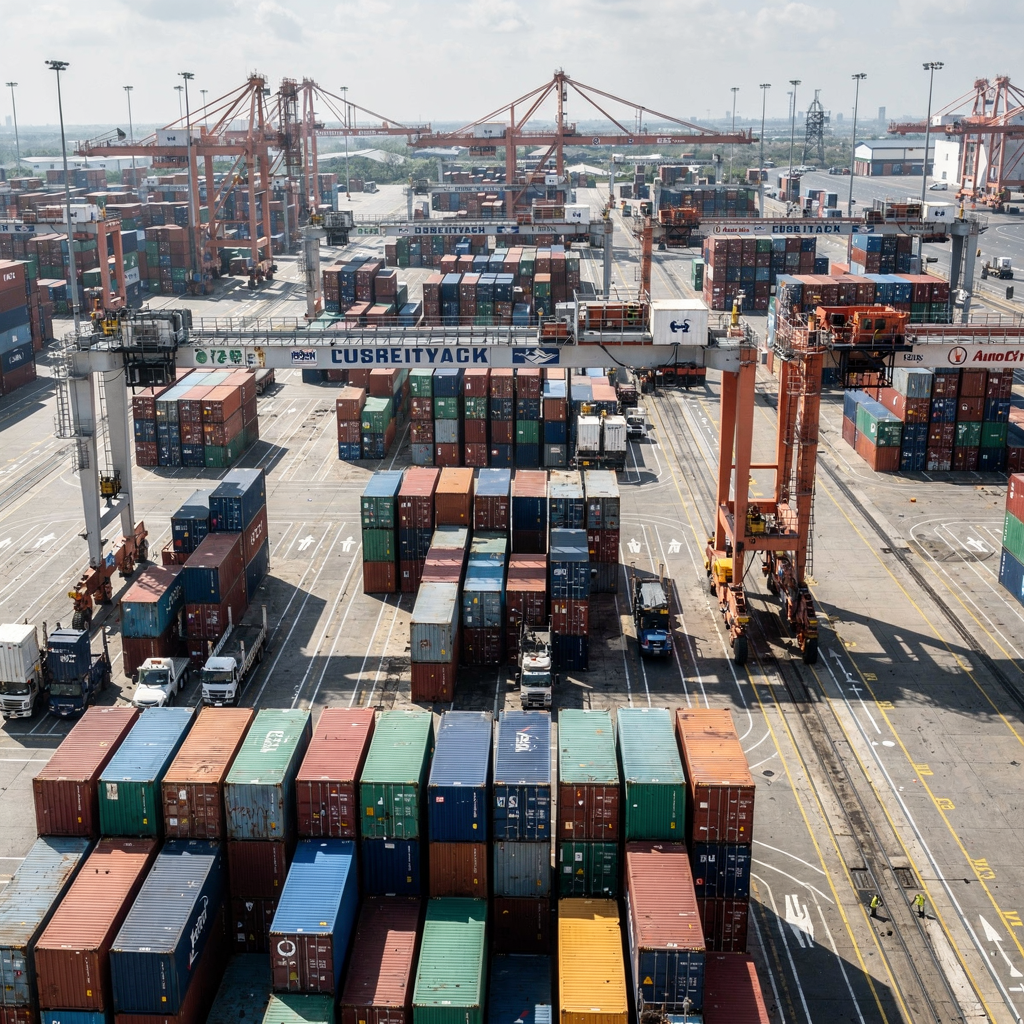
Practically speaking, container loading decisions and yard layout choices must embed lashing considerations. Planners need a calculation method to estimate forces acting on stacks and to map those estimates into stacking rules. For terminals that want to optimize layout, combining an engineering force calculation and a simple yard policy yields rapid gains. Loadmaster.ai uses simulation and RL agents to help terminal operators move from firefighting to planned strategies, and the approach helps to balance quay workflow and yard space and to lower labor costs while improving safety.
port operations and supply chains: impact of lashing on efficiency
Lashing constraints shape port throughput and affect hinterland supply chains. When a terminal must re-handle damaged boxes, the quay cranes slow, and truck turnaround times increase. As a result, waiting times rise and shipping lines face schedule slips. Short delays cascade, and regional supply chains see longer delivery windows. For this reason, planners must include lashing force limits in container loading and in yard assignments to minimize downstream disruption.
Operators find that fewer damaged units translate into smoother container movements and fewer surprises. Studies indicate that embedding lashing constraints into planning can reduce container damage by roughly 30% [optimization study]. That statistic links directly to reduced re-handling and to faster loading and unloading operations. In a busy port, each saved rehandle saves minutes, and those minutes add up across thousands of moves. Consequently, ports that act see lower operational costs and better crane rhythms.
Terminal operators and port operators benefit when they coordinate policies with shipping companies and with hinterland carriers. For example, if yard space and stacking rules respect lashing equipment limits then trucks and trains meet their slots more reliably. That coordination helps to streamline maritime logistics and to improve the predictability that shippers require. Planners who want more detail can review simulation-based capacity planning resources and related TOS migration best practice guides container port capacity planning and handling TOS migration.
Finally, the link between lashing-aware planning and hinterland performance proves clear. When terminals cut damage rates, they cut truck turn times. When they cut turn times, they free up chassis and reduce gate congestion. In practice, careful planning that factors in lashing constraints can deliver measurable gains in operational efficiency and in customer satisfaction.
Drowning in a full terminal with replans, exceptions and last-minute changes?
Discover what AI-driven planning can do for your terminal
maritime simulation of lashing forces and stack dynamics
Numerical and experimental simulation methods help to predict lashing force peaks and to guide safe stacking. Tank testing, scaled model experiments, and finite element analyses all contribute. For example, a four-tier container stack model study used Froude scaling and produced force predictions within ±10% of measured values, which gives confidence to planners who rely on simulated outcomes [four-tier study]. Likewise, finite element work has clarified where lashing rods and twist locks concentrate stresses [strength analysis].
Simulation does several jobs for a terminal. First, it helps the planner estimate lashing force amplitudes for a given container stowage, for given sea states, and for particular container weights. Second, it allows decision-makers to test alternative yard configurations and to see how a container stack reacts when forces act. Third, simulation enables validation of new calculation method variants before they go live. Planners can therefore simulate several scenarios and then choose the best yard block assignments to reduce risk.
Machine learning and deep models also add value. “The application of deep learning models has significantly improved the prediction accuracy of lashing forces, facilitating safer stowage planning and reducing operational risks” [lashing force prediction]. AI-driven predictions work well when integrated into a digital twin, and when they feed short-term planning loops. In practice, that means a terminal can simulate related to vessel arrival, then update yard assignments to protect vulnerable stacks.
Terminals can adopt simulation to streamline planning and to improve safety. For more on how simulation supports container port capacity work see our practical guide on using simulation for capacity planning here. By doing so, operators can test gantry cranes patterns, check handling operations, and ensure the safe container storage across blocks before implementing layout changes.
stack dynamics and container stack stability: balancing weight distribution and safety
Container stack stability depends on careful weight distribution and on correct use of lashing equipment. Statistical data show that stack displacements increase when heavy and light units mix without control, and when high stacks face significant ship motions. For example, experimental measurements on Ro-Ro and container ship models recorded large lashing force spikes when asymmetric weight profiles occurred [experimental measurements]. Those spikes create unsafe conditions and demand corrective action.
To limit lashing loads, yard planners use straightforward procedures. First, they group heavy boxes near lower tiers and central lanes. Second, they avoid excessive height when a container’s mass would create lever effects. Third, they reserve specific blocks for containers that a calculation method flags as high risk. Together, these rules reduce the chance that forces acting will exceed equipment ratings. As a result, the terminal can minimize rehandles and can also lower labor costs.
Stack performance metrics tie back to yard capacity. If a yard can safely stack more boxes per block then it increases effective yard space without expanding physical area. That lets a terminal maximize space utilization and improve throughput. Conversely, if stability metrics degrade then the terminal must reduce allowed stack heights and thereby lose capacity. The trade-off therefore links safety and business outcomes.
Operational practices that help include regular checks of lashing rods, frequent verification of twist locks, and staff training for correct cargo securing. Terminals can also use real-time sensors and internet of things telemetry to detect unusual shifts. Loadmaster.ai’s StackAI agent demonstrates how policy-driven placement and reshuffles can keep the yard balanced and can protect future plans, and the approach fits into broader planning and optimization workflows. By combining calculation method outputs with data-driven decision rules, terminals can optimally assign containers and thereby optimizing safety and flow.
Drowning in a full terminal with replans, exceptions and last-minute changes?
Discover what AI-driven planning can do for your terminal
heuristic optimization techniques for yard layout planning under lashing constraints
Heuristic models provide a practical route to embed lashing force limits into yard layout planning. Methods such as genetic algorithms, tabu search, and greedy heuristics can search large configuration spaces fast. They yield near-optimal layouts while respecting operational constraints. For a terminal that seeks rapid gains, heuristic approaches identify feasible block plans that minimize shifters and that obey lashing limits.
These methods work in stages. First, the planner defines a fitness function that includes lashing force penalties, crane productivity, and travel distances. Second, heuristics generate candidate layouts and test them under a simulation loop. Third, the best candidates become the basis for operational rules. Studies indicate that embedding lashing constraints in stowage and yard planning led to up to 30% fewer damaged containers in test cases [optimization study]. That figure translates to measurable savings in re-handling and in repair costs.
Heuristic approaches also permit inclusion of other terminal goals. For example, the planner can add objectives for minimizing turnaround times and for maximizing crane utilization. By doing so, the algorithm balances competing KPIs and finds robust trade-offs. Loadmaster.ai uses reinforcement learning agents together with heuristic search to produce closed-loop policies that learn from simulated experience. The agents simulate millions of decisions and then deliver operational guardrails that terminal operators trust. For further reading on reducing crane idle time and on algorithmic allocation, see our work on reducing crane idle time with better planning crane idle time and on smart algorithms for container location assignment location assignment.
Finally, heuristic optimization techniques remain useful when the terminal faces ever-increasing vessel mixes and when historical data prove scarce. They combine easily with machine learning predictions and with real-world telemetry from gantry cranes and from automated yard trucks. The combined approach helps the operator to identify the most effective stacking rules while still supporting seamless execution.
optimization: integrating DNV standards for secure and efficient operations
Integrating dnv standards into yard planning and into automated workflows ensures that safety and compliance travel together. Key dnv rules such as DNV-E271 and guidance on component installation highlight the need for accurate lashing component verification and for certified force calculation approaches [DNV accuracy evaluation]. Terminals should adopt these rules in their planning and in their audits to validate procedures and to reduce functional failures.
A practical workflow combines AI-driven lashing force prediction with yard layout tools. First, predict lashing force for each planned stow using machine learning or physics-based models. Second, feed those predictions into an optimization engine that accounts for crane patterns, yard block configuration, and handling operations. Third, enforce hard constraints from dnv and from company governance before execution. This pipeline supports decision-making and supports regulatory compliance.
The application of artificial intelligence alongside classical optimization yields tangible benefits. For instance, an AI-stewarded layout can reduce unnecessary shifters, minimize travel, and lower operational costs. Loadmaster.ai’s three agents—StowAI, StackAI, and JobAI—provide a closed-loop system that trains on a digital twin and then deploys with safe guardrails. This approach helps terminal operators adapt to disruptions and to maintain consistent outcomes without heavy reliance on noisy historical data.
Terminals that align algorithmic outputs with dnv and with operational governance can both ensure the safe handling of cargo and improve space utilization and improve throughput. The expected gains include fewer damaged containers, shorter turnaround times, and better crane rhythms. To learn how to scale AI safely across operations, see our resource on scaling AI across port operations scaling AI across operations. By combining standards, simulation, and smart automation, terminals can protect assets, streamline workflow, and enhance the overall efficiency of terminal operations.
FAQ
What are lashing forces and why do they matter in a container terminal?
Lashing forces are mechanical loads applied by securing devices and by container interactions during vessel motion. They matter because they can cause container damage and can force terminals to rehandle cargo, which increases waiting times and operational costs.
How do lashing constraints affect yard layout choices?
Lashing constraints limit stack heights, block assignments, and which boxes share a block. As a result, terminals may need to reserve certain yard space for sensitive loads or to change container storage rules to ensure safety and to minimize re-handling.
Can simulation really predict lashing forces accurately?
Yes. Physical experiments and numerical models such as Froude-scaled tests and finite element analyses yield predictions within useful margins, often around ±10% for specific configurations [study]. Combining simulation with ML further refines accuracy.
What practical steps reduce lashing-related damage in a terminal?
Steps include grouping heavy containers low, verifying lashing rods and twist locks, using a calculation method for high-risk boxes, and applying policy-driven reshuffles. These measures lower forces acting on stacks and reduce damage rates.
How do heuristic optimization techniques help yard planners?
Heuristics such as genetic algorithms and tabu search explore layout options quickly and can embed lashing penalties into fitness functions. They produce near-optimal assignments that balance crane productivity and yard safety.
Is there evidence that integrating lashing constraints reduces damage?
Yes. Optimization studies report up to 30% fewer damaged containers when lashing constraints enter stowage and yard planning [optimization]. That reduction lowers rehandles and improves throughput.
How do DNV standards fit into this planning process?
DNV provides rules on lashing component design and installation and on verification practices. Terminals should align their force calculation and installation checks with dnv guidance to validate safe operations [DNV].
Can AI tools work without historical data?
Yes. Reinforcement learning agents can train in a digital twin and generate policies without depending on historical logs. This cold-start capability helps terminals avoid repeating past mistakes and improves consistency across shifts.
What role do gantry cranes and automation play?
Cranes play a central role in executing stowage plans. Automation and smart algorithms help sequence moves to minimize travel and reduce waiting times. Integrating crane patterns with lashing-aware layouts yields smoother operations.
Where can I read more about applying simulation and AI in port planning?
For practical guides and resources, see Loadmaster.ai’s materials on simulation for capacity planning and on scaling AI across port operations simulation and scaling AI. These pages provide case studies, methods, and deployment tips.
our products
 stowAI
 stackAI
 jobAI
jobAI
Innovates vessel planning. Faster rotation time of ships, increased flexibility towards shipping lines and customers.
Build the stack in the most efficient way. Increase moves per hour by reducing shifters and increase crane efficiency.
Get the most out of your equipment. Increase moves per hour by minimising waste and delays.
stowAI
Innovates vessel planning. Faster rotation time of ships, increased flexibility towards shipping lines and customers.
stackAI
Build the stack in the most efficient way. Increase moves per hour by reducing shifters and increase crane efficiency.
jobAI
Get the most out of your equipment. Increase moves per hour by minimising waste and delays.