
reinforcement learning
Reinforcement learning defines a class of algorithms where an agent interacts with an environment to maximize cumulative reward. In practice, an RL agent observes a state, chooses actions, and receives feedback through a reward signal. First, the agent explores possible moves. Then, the agent exploits what it learned to improve performance. This learning method suits decision-making under uncertainty because it optimizes over sequences of choices rather than single steps. For terminal operations, this approach fits well. Ports, airports, and logistics hubs have episodic tasks that end in a terminal state that marks a completed operation cycle. For a clear definition of terminal state in operations, see the industry overview on terminal states here. Consequently, modeling the process as a markov decision process helps to formalize the decision process, to optimize long-term outcomes, and to evaluate policies against expected return.
State representation matters a great deal. The agent and the environment communicate through the current state and action pair. Therefore, the choice of features in the state space sets the limit on what the agent can learn. As Richard S. Sutton notes, “The choice of state variables is critical because it determines what the agent can learn and how well it can perform” (Sutton & Barto). First, designers include observable variables such as queue lengths, crane locations, and truck arrivals. Next, designers may enrich the state by adding predictive inputs from AI models. This enriches the agent’s view, thus letting it make proactive trade-offs between quay productivity and yard congestion. For an example of how predictive features improve performance in trading, see a study that reported a roughly 15% improvement when predictive features were included here.
Finally, reward design guides agent behaviour. A clear reward function aligns the agent with KPIs such as throughput, rehandles, and travel distance. Then, the agent learns a value function that estimates expected return for actions. Next, policy optimization updates the policy to take actions that maximize those estimates. In terminal operations, you design rewards that balance competing goals. For instance, Loadmaster.ai uses explainable KPIs inside a digital twin to teach agents to optimize multiple objectives while honoring operational constraints. Consequently, the terminal benefits from proactive policies that reduce firefighting and produce more consistent shifts.
AI
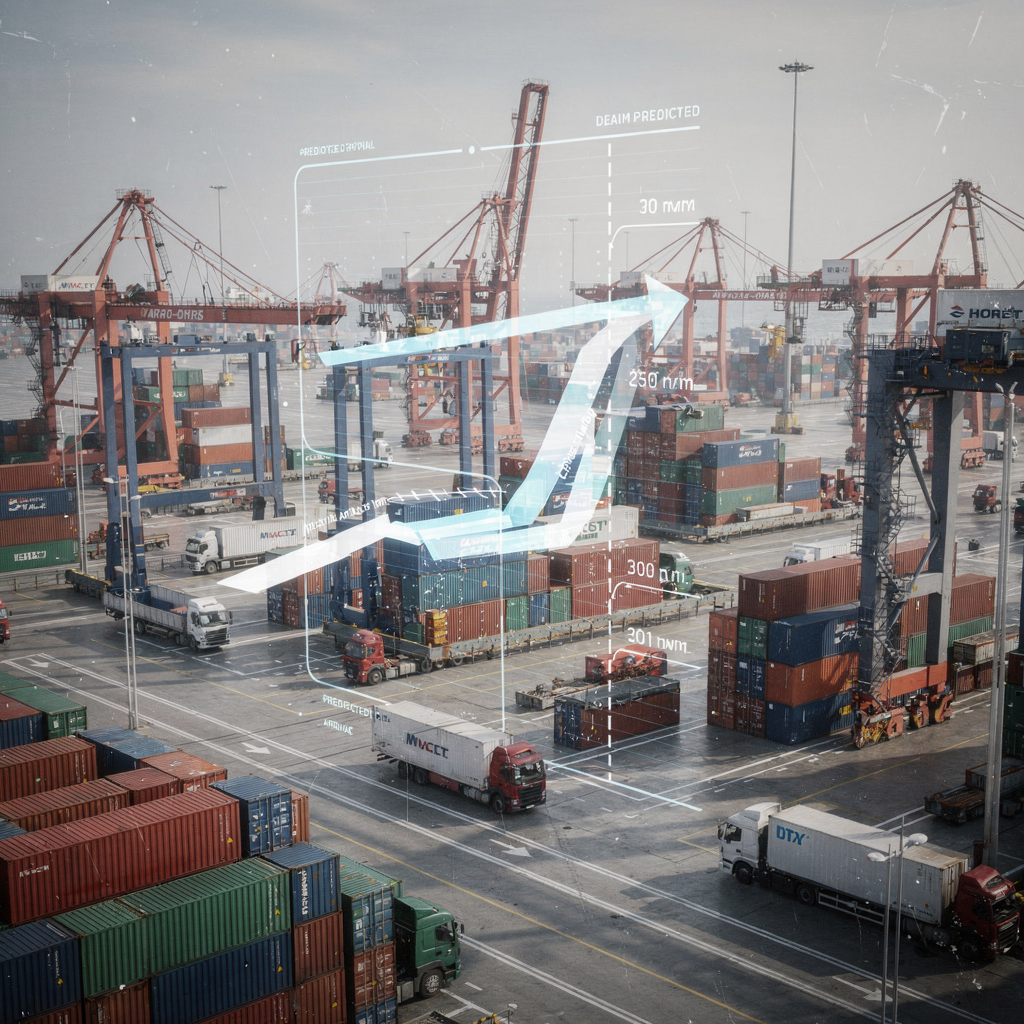
AI predictions give foresight that complements sensors and human input. First, predictive models estimate arrival times, equipment failures, gate dwell, or yard congestion. Then, planners and RL agents use those estimates as additional input to make better decisions. For example, an AI model can predict container arrival windows, thus giving a planner or RL agent time to pre-position equipment. In practice, such predictions reduce last-minute reroutes and lower driving distance. Furthermore, AI can output probabilities for equipment breakdowns so agents can hedge schedules and allocate backups.
How do these predictions get generated? Supervised learning models and time series models ingest historical telemetry, TOS logs, and weather feeds. Next, feature engineering creates inputs such as dwell trends, vessel mixes, and past gate patterns. Then, neural networks or gradient-boosted trees output forecasts. However, supervised learning has limits. It mimics past patterns and therefore may fail when the future differs substantially from the past. To address that, Loadmaster.ai prefers to simulate experience and to train agents in a digital twin. In that way, AI and RL work together: AI supplies predictive insights, and RL supplies policy learning that can adapt to new policies and disruptions.
Latency matters. Terminal operations demand real-time decisions. Thus, AI inference must run with low compute and minimal delay. Consequently, architects choose lightweight models or edge-deployed inference for mission-critical tasks. Alternatively, some predictions run in batch for strategic planning while others run in streaming mode for control tasks. For more on integrating berth and quay planning, see the practical integration guide on berth-call optimization here. Also, multi-agent coordination frequently uses AI predictions to inform each agent while still meeting tight latency budgets. Therefore, careful design of data pipelines and compute placement allows AI to supplement observable variables without slowing down operations.
Drowning in a full terminal with replans, exceptions and last-minute changes?
Discover what AI-driven planning can do for your terminal
machine learning
Machine learning models underpin the predictive inputs that feed into reinforcement learning. Common ML models used in terminal settings include gradient-boosted trees, recurrent neural networks, and simpler linear models. These models predict demand spikes, queue length, or equipment breakdown probabilities. For demand or arrival time forecasting, time series models—sometimes enhanced with exogenous features—work well. For anomaly detection, unsupervised learning identifies deviations from healthy equipment behaviour. In many cases, neural networks and deep neural networks help when the dataset has complex interactions across features. However, deep learning often requires more data and compute, which can be a constraint for some terminals.
Data requirements vary. A robust dataset should include timestamps, equipment telemetry, TOS events, gate scans, and environmental signals. Feature engineering transforms these raw logs into features such as rolling averages, time-to-next-arrival, and equipment cycle times. Label quality matters; if labels are noisy, the model will inherit the noise. Yet, models often still add value because they extract subtle patterns that humans miss. Typical prediction accuracy varies by task. For example, arrival time forecasts can reach median absolute error margins of minutes to tens of minutes depending on data richness. In the trading study mentioned earlier, adding predictive features improved agent profit by ~15% source. Meanwhile, richer state representations have reduced episodes-to-convergence by 20–40% in empirical RL studies source.
Prediction accuracy affects downstream RL performance. If a model consistently overestimates arrivals, the rl agent may allocate too many resources and increase idle time. Conversely, accurate forecasts let the agent optimize schedules and reduce rehandles. Therefore, evaluate models not only on statistical metrics but also on operational impact. First, run offline staging tests. Then, simulate the predicted inputs inside the training loop to see how the rl model reacts. For hands-on simulation guidance, see our guide on using simulation for capacity planning here. Finally, continuously monitor ML drift and retrain models as terminal conditions change so that the AI inputs remain useful for the agent’s decision-making.
algorithm
Integrating ML outputs into RL state definitions changes the learning dynamics. First, designers augment the observable state with predictive features such as arrival time distributions, failure probabilities, and expected queue growth. Then, the RL algorithm ingests that extended state as input to its policy or value estimator. For value-based methods like Q-learning, the value function approximator learns Q(s, a) where s now includes predictive inputs. For policy-based methods, including policy gradient or proximal policy optimization, the policy directly maps the richer state to action probabilities. In both cases, the algorithm can make more informed trade-offs because it sees near-term forecasts.
Value-based and policy-based methods behave differently when you add predictive inputs. Value-based rl often benefits from stable inputs because Q estimates can be sensitive to noise. Conversely, policy-gradient methods can tolerate noisy inputs better because they optimize expected return directly through sampled trajectories. Therefore, when predictions carry uncertainty, policy optimization may prove more robust. Nevertheless, if you prefer model-based approaches, you can incorporate the predictive model into a planning module that simulates futures and then uses tree search to choose actions. For an overview of model-based gains in finance, consult the RL evolution review here.
Higher dimensional state spaces complicate learning. Adding predictions raises state space size and may require larger neural networks or regularization. To mitigate that, use feature selection, dimensionality reduction, or hierarchical policies that split decision tasks. Also, combine predicted summaries rather than raw distributions; for example, include expected delay and variance rather than full time series. In addition, curriculum learning and reward shaping accelerate training. As a practical step, train agents in a simulated digital twin where you can control noise levels and slowly increase prediction uncertainty. This staged approach helps the rl agent learn useful behaviors before it faces full production complexity. Finally, measure compute needs and ensure the rl algorithm meets latency targets for real-time terminal control.
Drowning in a full terminal with replans, exceptions and last-minute changes?
Discover what AI-driven planning can do for your terminal
reinforcement learning algorithms
Choosing the right reinforcement learning algorithms depends on terminal constraints. Model-free RL algorithms such as Q-learning, policy gradient, and proximal policy optimization learn policies directly from sampled interactions. They shine when building a robust policy without a reliable system model. Model-based rl and model-based approaches instead learn or use a predictive model of the environment to plan ahead. Model-based RL often accelerates learning because it can simulate additional rollouts internally. In fact, model-based approaches have shown up to ~30% increases in learning efficiency in some domains source. Consequently, for terminals that need fast adaptation and limited real interactions, model-based approaches can be compelling.
Deep reinforcement learning brings deep neural networks into the picture for function approximation. A deep reinforcement learning approach can handle high-dimensional state and action spaces such as combined quay and yard control. Yet, you must temper expectations because deep models need careful tuning and more compute. For continuous action spaces and continuous control tasks, policy-gradient and actor-critic methods like asynchronous advantage actor-critic or proximal policy optimization work well. For discrete scheduling decisions, value-based methods like Q-learning can be effective. In practice, combining methods often works best: use a model-based planner to propose options and a model-free rl model to refine execution.
Empirical results support enriched state inputs. Studies show that adding predictive features and better state design reduces training episodes by 20–40% and improves task performance. For instance, enriched state inputs have improved agent policies by 15–30% in several case studies, including market making and operational simulations market making and empirical RL. Therefore, terminals can expect faster convergence, higher throughput, and lower operational costs when ML and RL collaborate. Finally, remember to evaluate both the learning rate during training and the policy’s behaviour in edge cases. Use benchmarks and simulated stress tests to ensure reliability and safety before deploying policies to live operations.
real-world applications
Real-world applications show how these ideas translate to operations. In container terminals, RL agents that incorporate predictive inputs can optimize stowage, yard placement, and job scheduling. For example, Loadmaster.ai trains three cooperating agents—StowAI, StackAI, and JobAI—inside a digital twin to reduce rehandles and balance workloads. The agents learn by simulating millions of decisions, so they need no clean historical dataset. This cold-start approach contrasts with traditional machine learning methods that require lots of past data.
Specific deployments include container stacking, gate assignment, and crane sequencing. In container stacking, RL agents reduce unnecessary shifters and cut driving distance. In gate scheduling, predictive AI for arrival times helps the RL model allocate lanes and resources to cut wait time. For narrow berth windows, integrating berth-call optimization with quay planning reduces conflicts; see our discussion on berth-call and quay crane integration here. Also, simulation-driven approaches help scale pilots to full yards; our article on scaling AI across port operations explains how to move from sandbox to live deployment read more.
Key metrics to measure include throughput, resource utilization, and decision latency. Empirical studies report throughput gains and faster convergence when predictive inputs enrich the state. For instance, incorporating ML forecasts reduced training episodes needed for convergence by 20–40% in empirical studies source. Meanwhile, specific pilots show policy improvements in the 15–30% range when predictive features are used in the state. Finally, future directions include robust handling of prediction uncertainty, multi-agent reinforcement learning coordination, and online learning for continuous adaptation. Overall, combining AI forecasts with RL training inside simulation creates resilient, higher-performing policies for real-world scenarios.
FAQ
What is the difference between reinforcement learning and supervised learning?
Reinforcement learning trains an agent through interactions with an environment using rewards, while supervised learning trains models on labeled examples. RL optimizes long-term expected return, whereas supervised learning minimizes prediction error on a dataset.
How do AI predictions improve terminal control?
AI predictions add foresight such as arrival windows or failure probabilities, which the agent can use as input to make proactive decisions. As a result, the agent can reduce rehandles, shorten driving distances, and balance workloads more effectively.
Can terminals use RL without historical datasets?
Yes. You can train policies in a digital twin using simulation to generate experience, which avoids dependence on historical data. This method allows cold-start deployments that improve from day one and then refine online with live feedback.
Which ML models work best for arrival time forecasting?
Time series models, gradient-boosted trees, and recurrent neural networks are common choices depending on data complexity. Model selection depends on feature richness, latency constraints, and available dataset size.
How do we manage prediction uncertainty inside the RL state?
Design the state to include uncertainty measures such as variance or probability scores, and use policy optimization methods that tolerate noisy inputs. Alternatively, use model-based planning to simulate multiple futures and choose robust actions.
What latency is acceptable for AI predictions in terminal operations?
Latency requirements vary by task; tactical decisions need low milliseconds-to-seconds latency, while strategic planning can tolerate minutes. Engineers often deploy lightweight inference at the edge for time-critical control tasks.
Do RL agents require deep neural networks?
Not always. For many scheduling or discrete tasks, smaller function approximators suffice. However, deep neural networks or deep reinforcement learning models help when the state space becomes high-dimensional.
How do you evaluate a policy before deployment?
Simulate the policy in a digital twin under diverse scenarios and stress tests, then measure KPIs such as throughput, crane utilization, and expected return. Also, run A/B pilots with guardrails to compare live performance safely.
What is multi-agent reinforcement learning and when is it useful?
Multi-agent refers to systems where multiple cooperating or competing agents learn together, for example, quay and yard controllers. It is useful when separate agents must coordinate to optimize shared KPIs across the terminal.
How does Loadmaster.ai approach integration with existing TOS?
Loadmaster.ai trains policies in simulation and then integrates with TOS via APIs or EDI, allowing safe, incremental deployments without disrupting operations. The architecture supports explainable KPIs and operational guardrails for governance and EU AI Act readiness.
our products
 stowAI
 stackAI
 jobAI
jobAI
Innovates vessel planning. Faster rotation time of ships, increased flexibility towards shipping lines and customers.
Build the stack in the most efficient way. Increase moves per hour by reducing shifters and increase crane efficiency.
Get the most out of your equipment. Increase moves per hour by minimising waste and delays.
stowAI
Innovates vessel planning. Faster rotation time of ships, increased flexibility towards shipping lines and customers.
stackAI
Build the stack in the most efficient way. Increase moves per hour by reducing shifters and increase crane efficiency.
jobAI
Get the most out of your equipment. Increase moves per hour by minimising waste and delays.