
IMDG CODE and Segregation Requirement: Foundations of Safe Dangerous Goods Handling
The IMDG Code sets international standards for the safe transport of dangerous goods by sea. It binds ship operators, port authorities, and terminal planners to clear rules. Port operators must respect the segregation requirement in yard design and operations. The imdg code defines segregation requirement details, including segregation group listings and stowage instructions. Because dangerous goods can cause fire, explosion, toxic release, or environmental contamination, the imdg code aims to reduce those risks. The European Maritime Safety Report warns that “potentially dangerous cargos may go unnoticed in ports, increasing the risk of accidents” EMSA 2022. That report supports strict enforcement of the segregation requirement at all deepsea container ports.
Under the imdg code, a port or terminal must plan storage and handling so that incompatible substance types do not react dangerously. The imdg code cites segregation group concepts and requires marked areas for class 1 explosive, class 3 flammable, class 8 corrosive, and other classes of dangerous goods. Port operators need procedures to ensure a cargo transport unit is accepted only with proper documentation, including the dangerous goods list entry, UN number, and proper shipping name. For example, some container ships must be arranged to keep class 1 away from flammable and oxidising substances.
Non-compliance with the segregation requirement can trigger fines, terminal shutdowns, and catastrophic incidents. The imdg code imposes criminal and civil liabilities in many jurisdictions. Therefore, ports must invest in training, equipment, and planning systems. Our team at Loadmaster.ai helps terminals plan safe stowage and yard placement using RL agents like StowAI and StackAI. These tools improve compliance, reduce rehandles, and make the segregation of dangerous goods more reliable while also reducing yard congestion. For more on our digital tools that support yard strategy, see our work on AI-driven yard strategy optimization.
Dangerous Goods and Dangerous Goods List: Identifying and Classifying Risks
The dangerous goods list in the imdg code is the primary resource to classify and identify each substance. It lists UN numbers and proper shipping names, plus packing group and subsidiary risk entries. When a shipper declares an item, port staff consult the dangerous goods list to assign a classification and to check if the substance belongs in one segregation group or another. The list shows when two goods of different classes must be separated. A correct classification avoids a dangerous reaction during stacking, stow, or transport.
There are nine classes of dangerous goods. These classes of dangerous goods span explosive (class 1), gases (class 2), flammable liquids (class 3), flammable solids (class 4.1), oxidisers, toxic, infectious, radioactive, and corrosive (class 8). Generally, class 3 and class 8 items need careful handling in the yard. The imdg code and national rules, including references like 49 CFR in some national systems, guide classification and stowage. For example, class 2.1 flammable gas and class 3 flammable liquid entries require attention to vapor accumulation and proper ventilation.
Classification can be complex when a substance has multiple properties or a subsidiary risk. The imdg code requires shippers to provide the correct UNS and to mark N.O.S entries when appropriate. When a consignment is N.O.S, the port must apply extra controls and often consult section 3.1.4 of the imdg code for details. The Code of Practice for Packing of Cargo Transport Units clarifies how to pack a cargo transport unit and how to respect load distribution to prevent shifting during stowage and lifting operations CTU Code. Terminals that integrate automated checks in gate and yard software reduce mis-declarations. See our article on low-latency data processing for ways to detect mismatches between paperwork and declared goods.
Drowning in a full terminal with replans, exceptions and last-minute changes?
Discover what AI-driven planning can do for your terminal
Segregation Group and Substance: Grouping Hazardous Materials
The segregation group is a practical tool created from scientific compatibility of substances. The imdg code segregation group concept groups substances that share similar risks or that react dangerously with other groups. Each substance receives a segregation group code in the dangerous goods list. That code tells planners whether two substances are compatible, require segregation, or must be separated by an intervening barrier. When a group of substances includes oxidisers, those substances must be segregated from flammable materials to prevent a violent reaction or accelerated burning.
Compatibility depends on the chemistry and the form of the substance. For example, sodium metal reacts dangerously with water and certain oxidisers. Sodium is therefore restricted and the group of substances it sits in requires special isolation. The imdg code and the general segregation table help staff decide when two substances may be stowed together. The segregation group are listed beside UN numbers and proper shipping names, making it easier for a yard clerk to check. Specific segregation codes like X, Y, Z, and W indicate special rules. A code X often means the two items must be separated by an intervening complete compartment or hold on a vessel or by segregated areas in a yard.
Practical examples help. Oxidisers versus flammable liquids must not be adjacent in the yard. Corrosive class 8 materials should not be stored with class 3 flammable liquids if the packaging could be compromised. The imdg code requires that certain two substances be separated longitudinally by an intervening complete compartment or hold when on board a vessel; similar logic applies on land in container stacks. Port planners must map each cargo transport unit and ensure the stow pattern respects segregation group rules. Our StackAI helps terminals choose placements that respect segregation group assignments while balancing yard productivity and reducing rehandles. For more on embedding safety rules into AI, see our piece on embedding operational safety rules into AI decision models.
Segregation Table: How to Consult the Segregation Table for IMDG Segregation
The segregation table in the imdg code is a matrix that shows compatibility between different classes and segregation group codes. To consult the segregation table, first identify the UN number and the group of substances or class. Then find the corresponding row and column in the table. The table indicates whether two items may be stowed together, require segregation, or demand specific separation like “separated by a complete compartment” or “separated longitudinally by an intervening complete compartment or hold.” The general segregation table provides a quick reference for most cases.
Key columns in the segregation table include class numbers, segregation group letters, and symbols that show compatibility. The imdg code uses colours and symbols to improve readability. When a cargo transport unit carries multiple entries, consult the table for each pair and apply the most restrictive requirement. When in doubt, use the table indicates restrictions and check the more detailed directives in section 3.1.4 and section 3.1.4.4. The table 7.2.4 is central for stowage and segregation checks. Always confirm you use the current edition; amendments can change the table or add new specific segregation clauses.
A step-by-step run-through: identify the dangerous goods are shown with UN number; note any subsidiary risk; find the segregation group; consult the segregation table; then apply any special segregation like longitudinally or compartment separation on vessel stowage or by designated yard blocks. For mixed cargoes, repeat this for each two substances pair. If N.O.S entries are present, further classification work may be necessary. Terminals that link gate declarations to automated checks can speed this work and reduce human error. Read about our simulation models for terminal operations to test segregation scenarios before going live simulation models.
Drowning in a full terminal with replans, exceptions and last-minute changes?
Discover what AI-driven planning can do for your terminal
Stowage, Vessel and CTU: Practical Considerations for Yard Layout
Stowage planning starts at vessel loading and continues through the container yard. Vessel stowage decisions affect how the yard must accept and arrange cargo. The imdg code requires that certain items must be stowed on deck or under specific holds, and that some must be separated longitudinally on the vessel. These vessel factors then impact how terminals allocate space. For example, container ships that carry many class 3 loads need adjacent yard blocks that can fit class 3 separation rules and safe handling limits.
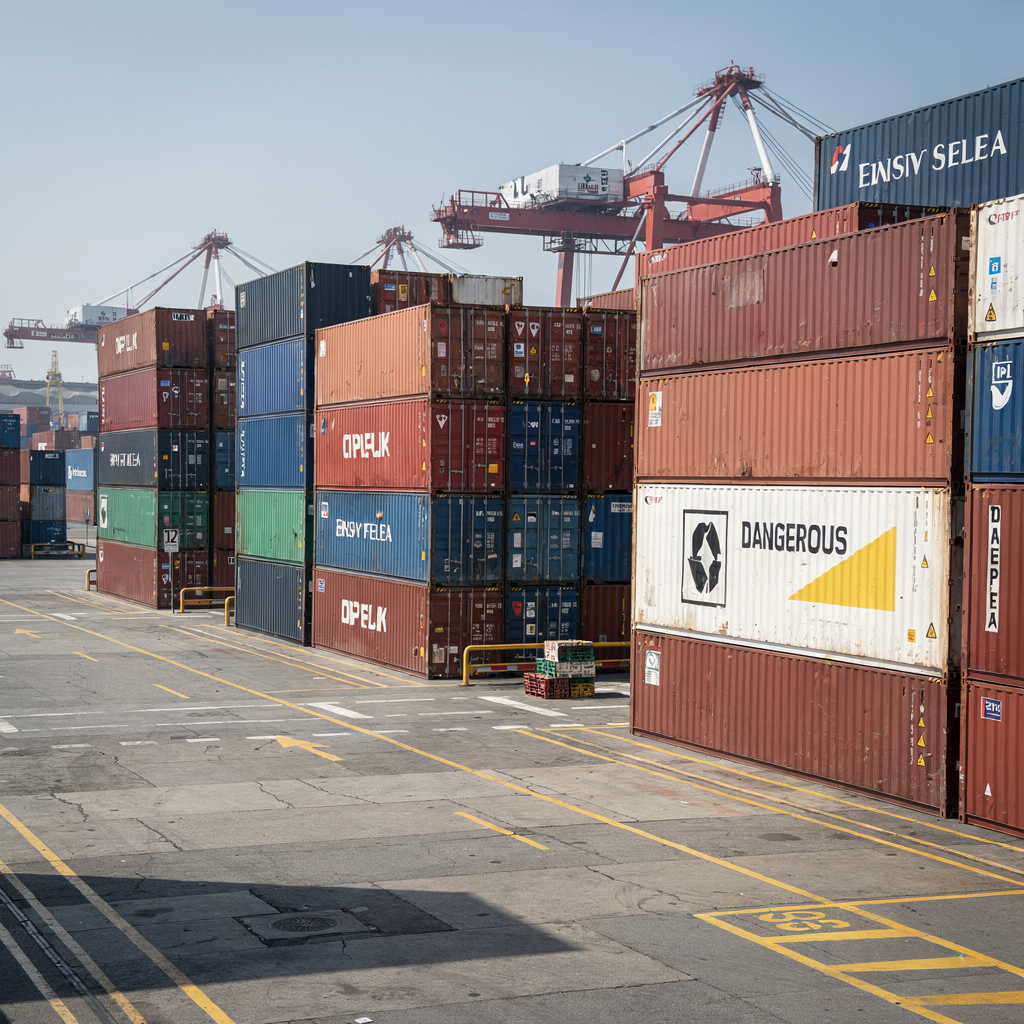
Container yard layout must include designated dangerous goods terminals or zones. Ports often create dedicated blocks for class 1 explosive and class 8 corrosive goods. A cargo transport unit is assigned to a block that meets required separation distances and emergency access. CTU packing rules under the Code of Practice for Packing of Cargo Transport Units specify how a load must be secured to avoid movement that could breach packaging or release vapour. Staff must ensure tank containers use pressure relief valves and other safety fittings to remain safe during yard storage.
On a vessel, stow decisions consider weight, balance, and separation between incompatible items. For yard stow, planners use rules like must be stowed away from high-traffic lanes and must be segregated “away” from other classes. The imdg code and practical yard safety plans use longitudinally separated stacks for higher-risk goods. When specific segregation is needed, a physical buffer or an empty stack can act as an intervening complete compartment analogue on land. Our StowAI and StackAI simulate millions of stowage permutations to find plans that reduce rehandles and keep segregation intact. For technical details on combining stowage and AI-driven optimization see our article on balancing stowage quality and crane productivity.

N.O.S. and Exceptions from Segregation: Managing Special Cases
N.O.S entries complicate routine segregation. N.O.S means Not Otherwise Specified. Such entries may be used when a substance does not match a specific named entry. When a consignment is N.O.S, terminals must confirm the correct classification and check section 3.1.4 for guidance. The imdg code allows some exceptions from segregation when strict controls and authorisations exist. However, exceptions must be documented and approved by a competent authority or the vessel operator.
Common exceptions from segregation include limited quantities, certain inner packagings, and mixed loads where the table indicates an acceptable pairing under strict conditions. The imdg code explains specific segregation exceptions in part 7 and in table 7.2.4. For example, some aerosols may be shipped together under restrictions that would not apply to larger bulk flammable gas consignments. Also, the imdg code sometimes permits “regardless of their class” handling when the table or a special provision allows it. Still, terminals must assess hazard and perform a risk assessment before granting an exception.
Documentation matters. A shipper’s declaration, supporting safety data sheets, and the dangerous goods list entry should accompany any request to ship N.O.S. The terminal must track authorised exceptions and ensure proper CTU packing is used to prevent leaks or dangerous vapors. For hazardous materials that may react dangerously when mixed, terminals generally refuse exceptions. If a terminal considers an exception, they should involve port authorities and use digital approval flows to record decisions. Our governance-ready AI helps manage approvals and audit trails to maintain compliance with the imdg code and local rules governance-ready AI.
FAQ
What is the IMDG Code and why does it matter for ports?
The IMDG Code is the international guideline for transporting dangerous goods by sea. It matters because ports must follow its segregation requirement and stowage rules to prevent incidents and legal penalties.
How do I find a substance on the dangerous goods list?
Search the dangerous goods list by UN number or proper shipping name in the imdg code. The list shows the classification, packing group, subsidiary risk, and segregation group for each substance.
What does segregation group mean in practice?
A segregation group classifies substances by compatibility so planners can avoid dangerous reactions. The segregation group helps determine whether two substances must be separated in the yard or on a vessel.
When must I consult the segregation table?
Consult the segregation table when planning mixed cargoes, accepting a cargo transport unit at gate, or arranging stowage on a vessel. The table indicates whether two substances can be stowed together or require separation.
Can N.O.S shipments be accepted without restrictions?
No. N.O.S shipments need extra documentation and often require expert review. Terminals should consult section 3.1.4 and apply risk assessments before allowing N.O.S consignments.
How do vessel stowage rules affect yard layout?
Vessel stowage often dictates where containers must be held in the yard for quick reworking or safety. If a vessel requires certain items to be stowed on deck, the yard must reserve nearby blocks that meet separation rules.
What are common incompatible pairings to avoid?
Avoid storing oxidisers near flammable liquids and metals like sodium near water-reactive materials. Incompatible pairs can react dangerously and threaten the entire terminal.
Are there digital tools to help enforce segregation rules?
Yes. Digital twins, low-latency data processing, and AI-driven yard strategy tools help detect mis-declarations and plan compliant stowage. Loadmaster.ai provides RL agents that optimize placement while enforcing safety rules.
What is the difference between CTU and CTUs packing rules?
CTU refers to cargo transport unit. CTU packing rules define how to secure goods inside containers to prevent movement or leakage. Proper CTU packing supports safe transport and reduces the chance that a substance will breach its packaging.
Who approves exceptions from segregation?
Exceptions typically require approval from competent authorities, the ship operator, or port safety officials. Terminals must document approvals and maintain traceable records for audits.
our products
 stowAI
 stackAI
 jobAI
jobAI
Innovates vessel planning. Faster rotation time of ships, increased flexibility towards shipping lines and customers.
Build the stack in the most efficient way. Increase moves per hour by reducing shifters and increase crane efficiency.
Get the most out of your equipment. Increase moves per hour by minimising waste and delays.
stowAI
Innovates vessel planning. Faster rotation time of ships, increased flexibility towards shipping lines and customers.
stackAI
Build the stack in the most efficient way. Increase moves per hour by reducing shifters and increase crane efficiency.
jobAI
Get the most out of your equipment. Increase moves per hour by minimising waste and delays.