
Introduction to kalmar autostrad™ and automated container handling
Straddle carriers move containers within the yard and they anchor many terminal workflows. Kalmar Autostrad™ is a specific solution that automates that work and coordinates yard moves, and autostrad provides a platform for linked equipment and software. In simple terms, a straddle carrier lifts a container, drives it across the stack, and lands it for storage or pickup. Therefore terminals face pressure to reduce delays, to increase throughput, and to manage limited space. As a result many operators choose to automate yard operations so they can scale without expanding land area. For example, the AutoStrad™ family of systems has been shown to lift throughput and to smooth landside flows when paired with a coherent yard strategy and with stack discipline (BITRE report).
Terminals need to automate because vessel schedules tighten and because customer expectations rise. Also terminals must manage intermodal handoffs between quayside and landside, and they must coordinate quay crane cycles with horizontal transport. In practice this means the stack, the yard truck lanes, and the gate all require synchronized control. Loadmaster.ai builds reinforcement learning agents that simulate and optimize those interactions so planners can choose the level of automation that fits their operation; see our discussion on interfaces for data exchange for more technical context interfaces for data exchange.
The scope of this article covers both stack and landside workflows. First we describe how we automate scheduling and how we reduce conflicts. Next we outline key components such as yard management integration, AGVs and crane coordination, and safety. Then we explain Kalmar’s approach to connecting carriers, cranes, and gates, including the kalmar one automation system. Finally we review measured gains, and we close with future trends. Throughout we use evidence from industry studies and we quote experts to support claims (Yu et al.).
How we automate container handling scheduling
Manual job assignment in a busy terminal often becomes firefighting. Planners and dispatchers juggle thousands of constraints, and they react to vessel timing, stacking conflicts, and truck surges. So delays grow, and equipment idles. To prevent that, we automate scheduling to keep jobs flowing, and we use real-time telemetry plus predictive models to keep carriers productive. Specifically, automation uses live data from quay cranes, gate systems, and yard sensors. Then decision engines assign tasks to each straddle carrier and they balance short-term demand with longer-term yard quality.
Real-time data feeds and predictive routing allow the dispatch system to foresee congestion and to reroute carriers before holds form. For example, automated scheduling algorithms reduce idle times and they re-sequence moves to reduce rehandles, and that leads to higher quay productivity and fewer yard delays (ScienceDirect). As Yu et al. note, “The key to unlocking terminal efficiency lies in the integration of automated equipment with intelligent yard management systems that can dynamically schedule and dispatch tasks to automated straddle carriers” (Yu et al.). That quote highlights why terminals combine predictive routing with simple guardrails.
Minimising delays and avoiding carrier conflicts requires several layers. First, short interval planning assigns moves to the nearest available straddle carrier and it accounts for current stack state. Second, conflict detection checks for route overlaps, and it reassigns tasks when paths cross. Third, dynamic prioritization temporarily favors quay work during vessel peaks, and it protects gate throughput during truck surges. Loadmaster.ai augments dispatch with JobAI so the dispatcher can move from firefighting to proactive control; for technical details on simulation-based training see our piece on simulation-first AI simulation-first AI.
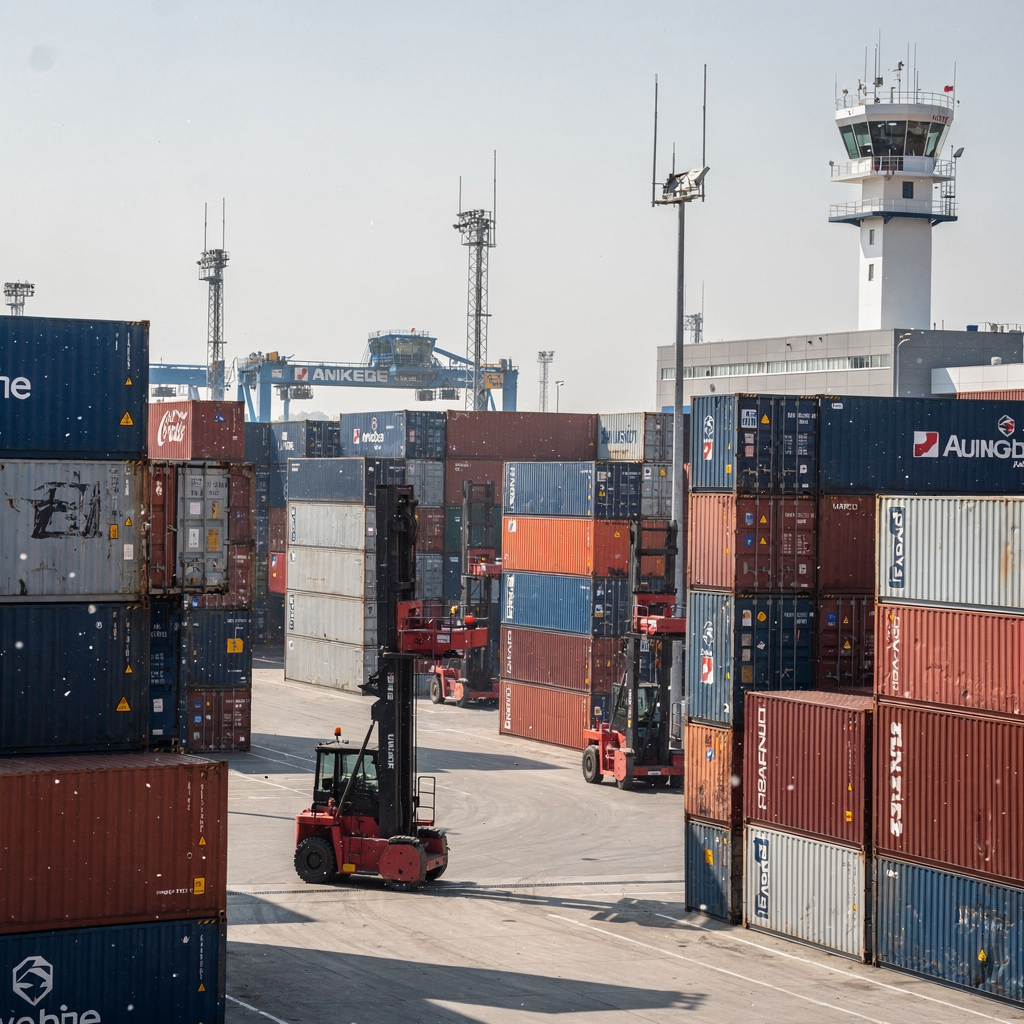
Drowning in a full terminal with replans, exceptions and last-minute changes?
Discover what AI-driven planning can do for your terminal
Key components of automation in straddle carrier operations
Automation in the yard rests on tight integration. A yard management system links the TOS, the cranes, and the handling equipment. Then it provides the single source of truth for job status, container location, and equipment health. Yard systems integrate with gate systems and with quayside control so the terminal can sequence moves efficiently. For readers who want a technical roadmap, our terminal operations digitalization discussion explains how interfaces, APIs, and telemetry streams connect terminal operations digitalization.
Communication between automated guided vehicles, cranes, and straddle carriers uses deterministic messaging for tasking and for safety. In practice agvs and AGVS speak with a central dispatcher that enforces safe separations and that dynamically routes traffic. An agv or an AGV will accept a job, report its state, and then yield or reroute when a higher-priority quay crane sequence needs space. That cooperation reduces queuing at the quay and it smooths landside operations. The same messaging also synchronizes with the quay crane cycle so handovers occur at the precise millisecond needed for efficiency.
Safety protocols and remote monitoring protect people and assets while automation scales. For example, geofenced speed limits, proximity sensors, and automatic braking prevent incidents. Remote operators watch health dashboards, and they can intercede when exceptions appear. The system also logs events so analysts can improve policies. In addition, terminals that plan to automate should prepare warehouses or depot spaces for buffer storage and for temporary holding. Finally maintenance teams use condition-based alerts to keep a broad range of straddle carriers available; this ensures high utilisation and reduces disruption to quayside and landside operations.
Kalmar’s approach to fully automated container terminals
Kalmar takes a modular view of the yard and of the quayside. The hardware includes a range of straddle carriers, and the software stacks connect to the kalmar one automation system to provide coordinated control. Kalmar’s architecture layers fleet control above individual vehicle controllers, and it exposes APIs so third-party systems can integrate. The kalmar one automation system acts as a bridge between cranes, carriers, and terminal systems. That approach reduces integration risk, and it helps terminals decouple your operations when needed.
Hardware and software architecture for Kalmar’s AutoStrad family pairs robust hoist and chassis designs with fleet orchestration software. The solution coordinates primary cranes and quay crane handlers so that lifts align with transport windows. For example, the system sequences pick-and-drop operations to avoid double handling and to keep quay cranes at high throughput, and the coordination improves moves per hour at the berth (Efficiency study). Kalmar also provides options for hybrid straddle setups that let terminals choose the level of automation while preserving manual fallback.
Maintenance strategies focus on uptime and on predictable interventions. Kalmar recommends condition-based maintenance, and it pairs fleet telematics with scheduled checks. That reduces unscheduled downtime and increases overall equipment effectiveness. Kalmar’s cloud services and on-premise control tie alarms to maintenance workflows. Kalmar also offers solutions for large terminals that require clustering of carriers across multiple stacks. For terminals in the US that need to scale quickly, examples include pilots that interface with terminals in the us such as the port of los angeles and with specific sites like pier 400 terminal to validate operations before broader rollouts. In short, Kalmar provides both vehicle hardware and integrated software that helps terminals move toward a fully automated container approach while maintaining service continuity.
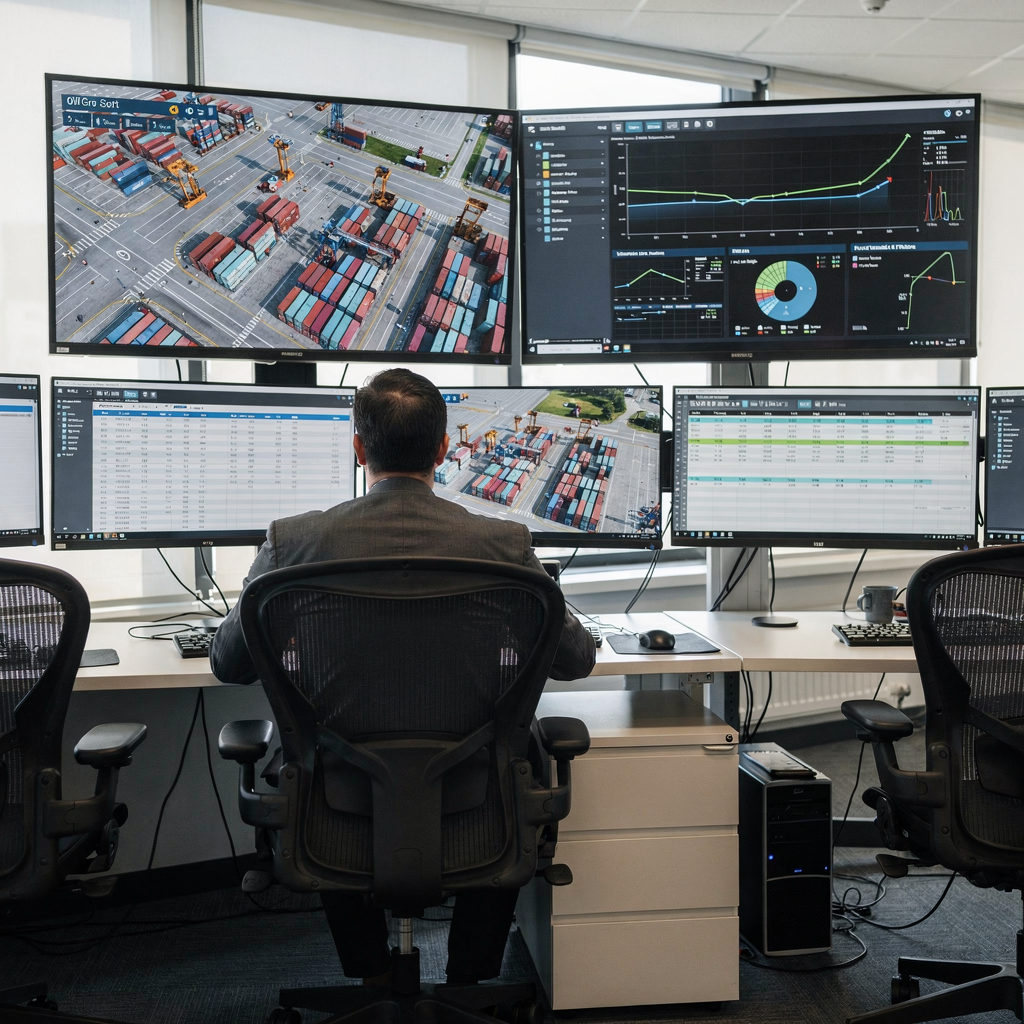
Drowning in a full terminal with replans, exceptions and last-minute changes?
Discover what AI-driven planning can do for your terminal
Measuring gains from automated container systems
Quantitative evidence shows measurable gains from automated container handling. Terminals that adopt automated straddle carrier systems often report handling rate improvements in the 20–30% range, and this increases moves per hour at the quay (20–30% handling rate increase). Additionally automation reduces turnaround times for yard moves by roughly 15–25% and it cuts unnecessary repositioning (efficiency study). Utilisation of carriers climbs too, frequently reaching 85–90% compared with sub-70% levels in manual operations (ResearchGate).
These improvements translate into concrete capacity gains. For example, a berth with optimized sequences and fewer rehandles can increase effective TEU throughput, and this reduces vessel dwell at the berth. Stated differently, the terminal handles more container vessels with the same quay space, and this raises revenue capacity without land expansion. Industry experts emphasize the necessity of integrated yard planning. As a senior terminal operations manager observed, “The automation of straddle carriers … enables continuous operations with minimal downtime and precise job scheduling that adapts to real-time conditions” (expert quote). That testimony supports the statistical findings above.
From an operational KPI perspective, automation improves crane productivity and reduces rehandles. For terminals with complex vessel mixes, the gains are larger when job scheduling intelligence protects quay crane cycles. Our own Loadmaster.ai pilots demonstrate that coordinated RL policies reduce driving distance, and that they lower energy use. In addition, electric options such as kalmar electric and the electric straddle variant reduce onsite emissions and they support a transition toward zero emissions goals. Finally terminals should measure ROI across gate, berth, and yard to capture the full value of automation, and they should consider hybrid deployments where automated equipment works alongside human teams.
Future trends: fully automated container and automation synergy
AI, digital twins, and tighter integration will shape the next phase of terminal automation. Digital twins let operators simulate peaks, and they let planners test sequences before deployment. In particular AI models trained in realistic simulations can explore policies that humans cannot easily evaluate. For example Loadmaster.ai trains RL agents that create closed-loop control across quay, yard, and gate; these agents help terminals move from rule-based planning to AI optimization from rule-based planning to AI optimization. As a result planners shift from firefighting to confident decision-making.
Scaling AutoStrad and other automated systems for larger terminal footprints will require modular control layers and resilient messaging. In practice that means more distributed fleet control, and more edge computing per stack. Digital twins and AI will also improve resilience to disruption. For example, when a berth spike occurs, the system can temporarily favor quay sequences, and then it can rebalance the stack using predictive placement. Fully automated container terminals will combine AGVs, automated trucks, and automated straddle equipment to achieve higher throughput. Terminals should choose the level of automation that fits their business case, and they should plan human roles for supervision and exception handling. Tools for exception-handling workflows and human-in-the-loop vessel planning are already proven methods to preserve flexibility exception handling workflows.
Other trends include tighter emission targets and more electric fleets. Zero emissions goals will push adoption of electric straddle machines and of hybrid straddle modes. AI will also enable predictive maintenance and longer asset lifecycles. Finally, terminals that want ultimate flexibility will decouple operations and they will run mixed fleets during the automation journey. That choice helps pilot projects at mid-size sites before expanding to large terminals. For operators that serve high-volume ports like the port of los angeles, lessons from pilots at pier 400 terminal can guide scale decisions. In short, automation that is right for each site will use AI, digital twins, and staged deployments to achieve efficiency without loss of resilience.
FAQ
What is Kalmar Autostrad™ and where does it fit in a terminal?
Kalmar Autostrad™ is a fleet orchestration solution for straddle carrier operations that links vehicles to yard and quay control. It fits between the TOS and the vehicle controllers so that carriers, cranes, and gates can be coordinated.
How do automated straddle carriers improve throughput?
Automated straddle carriers reduce idle time and they follow optimized routing, which increases moves per hour. Studies show handling-rate improvements in the 20–30% range when automation is paired with intelligent scheduling (BITRE).
Can terminals run mixed fleets of manual and automated equipment?
Yes. Many terminals run hybrid deployments where manual crews work alongside automated equipment during transition. This staged approach helps protect operations and allows teams to choose the level of automation that suits their risk tolerance.
What role does AI play in yard scheduling?
AI can predict congestion, optimize routing, and balance short-term demand with yard quality goals. Reinforcement learning in particular trains policies that adapt to changing vessel mixes and yard states without relying solely on past data.
Are there measurable energy or emission benefits?
Yes. Electric straddle machines and optimized routing reduce fuel use and lower emissions. Terminals that combine electric fleets with smarter dispatch show reductions in idle time and progress toward zero emissions targets.
How do automated systems handle exceptions or breakdowns?
Automated systems include alarms, remote monitoring, and human-in-the-loop exception workflows so operators can intervene quickly. Robust simulation and sandbox testing also ensure policies behave safely under fault conditions.
What is the impact on staffing and skills?
Automation shifts staff roles toward supervision, exception management, and systems engineering. Training focuses on system oversight and on interpreting analytics rather than on manual driving tasks.
Can smaller terminals benefit from automation?
Yes. Smaller yards benefit from improved utilisation and from reduced rehandles. Scaled solutions and modular control let smaller operations pilot automation before expanding to a fully automated container layout.
How does Kalmar integrate with third-party terminal systems?
Kalmar exposes APIs and integration layers that connect with TOS and with telemetry feeds. This interoperability reduces integration risk and allows terminals to retain existing systems while adding automation features.
Where can I read more about deploying AI-driven yard strategies?
For practical resources, review simulation-first AI and interface guidance on our site, which explain how to train policies and connect to existing TOS. See our technical pages on simulation-first AI and on interfaces for data exchange for deeper explanations simulation-first AI, interfaces for data exchange.
our products
 stowAI
 stackAI
 jobAI
jobAI
Innovates vessel planning. Faster rotation time of ships, increased flexibility towards shipping lines and customers.
Build the stack in the most efficient way. Increase moves per hour by reducing shifters and increase crane efficiency.
Get the most out of your equipment. Increase moves per hour by minimising waste and delays.
stowAI
Innovates vessel planning. Faster rotation time of ships, increased flexibility towards shipping lines and customers.
stackAI
Build the stack in the most efficient way. Increase moves per hour by reducing shifters and increase crane efficiency.
jobAI
Get the most out of your equipment. Increase moves per hour by minimising waste and delays.