
container terminal operations – Overview of terminal operation and container handling
A container terminal manages the flow of container cargo from ship to shore, yard to truck, and rail to hinterland. In practice, container terminal operations include berth planning, crane work, yard stacking, and gate processing. Key equipment in a modern container terminal includes straddle carriers, automated guided vehicles, yard trucks, and quay cranes. For clarity, I will refer to cranes as CRANE when describing critical quay work. The role of container handling sits at the heart of throughput. When planners assign a CRANE to a vessel bay, they change the pace of the entire container terminal.
Throughput, dwell time, and equipment utilisation are the primary performance metrics for the container terminal. Throughput measures the number of TEUs moved per hour or per vessel call. Dwell time tracks how long a container stays in the yard before pick-up or shipment. Equipment utilisation shows how busy CRANE, yard trucks, and terminal tractors are during a shift. Terminal operation teams monitor these metrics to optimize resources, reduce delay, and protect vessel turnaround. The interplay between berth planning and yard layout shapes operational priorities. For example, tight berth windows force CRANE sequences to run faster, which can increase travel for yard trucks and raise dwell time.
Terminal operators aim to balance quay productivity with yard flow, and that balance requires precise allocation of CRANE and truck moves. Loadmaster.ai provides RL agents that help stow planners and dispatchers make these complex choices. Our JobAI coordinates moves that cut truck waiting time and reduce rehandles. This approach supports terminal efficiency and helps the terminal reach higher equipment utilisation without adding shifts.
Monitoring real data matters. The ACCC report shows that schedule reliability at Australian terminals has measurable shortfalls, and that internal transport delays contribute to those issues (ACCC 2023–24). Research reviews also point to the need for data-driven decision systems across container terminal processes (literature review). Therefore, terminals that invest in better planning and in automating allocation see steady gains in operational metrics and in vessel turnaround time.
scheduling problems and yard truck scheduling for truck allocation
Scheduling problems appear in every container terminal. Dynamic container arrivals, stochastic vessel windows, and equipment failures create shifting constraints. Peak loads at the gate and sudden vessel delays generate queues. These issues create conflicts between CRANE tasks and yard truck routes. When a terminal fails to assign trucks effectively, waiting time rises and yard density increases. The result is more rehandles and lower terminal performance.
Yard truck scheduling is a particular pain point. A good yard truck scheduling method must consider berth assignment, yard layout of the container terminal, and the availability of container storage blocks. Traditional scheduling methods often use first-come first-served logic or simple priority rules. Those methods break down under variability. Advanced yard truck scheduling techniques use dynamic dispatching, route optimization, and prioritised allocation to reduce truck idle time and reduce driving distance. Terminals that adopt agent-based dispatch or optimisation see measurable benefits. For instance, improving internal transport job scheduling can increase equipment utilisation by up to 15% and reduce dwell times by about 10% (performance analysis).
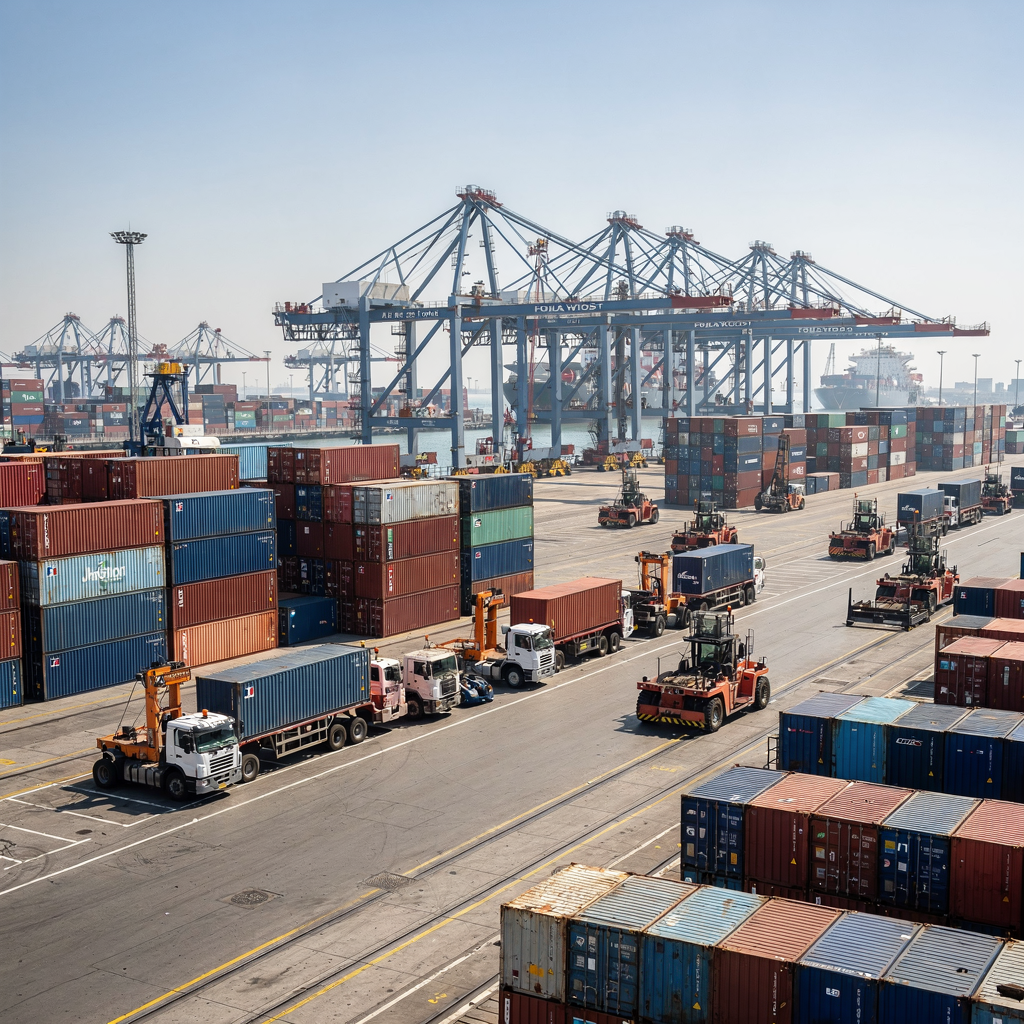
Practical challenges include equipment conflicts and mixed fleets. A terminal may operate terminal tractors alongside automated guided vehicles and straddle carriers. Each vehicle type requires different scheduling logic. For example, AGV scheduling must integrate with quay CRANE cycles and with gate throughput. The scheduling of container moves involves trade-offs: prioritise quay tasks to protect vessel turnaround or prioritise yard balancing to limit future rehandles. Loadmaster.ai addresses this by training RL agents to balance these trade-offs in a digital twin. Our approach reduces firefighting and makes truck allocation more robust across shifts.
Poor scheduling increases waiting time at the gate and for trucks at the quayside. That waiting time translates to higher port costs and lower service quality for shippers. Therefore, terminals must invest in smarter scheduling algorithms and in cross-equipment visibility. For further reading on cross-equipment prioritization and preventing bottlenecks, see our piece on cross-equipment job prioritization. Effective yard truck scheduling reduces congestion and helps terminals keep vessel schedules on track.
Drowning in a full terminal with replans, exceptions and last-minute changes?
Discover what AI-driven planning can do for your terminal
terminal planning and schedule integration for transportation flows
Terminal planning sets the stage for container flows. Key objectives in terminal planning include berth assignment, yard layout optimization, and smooth gate operations. Berth planning assigns vessel windows and CRANE resources at the quay. Yard layout dictates where containers go and how far trucks must drive. Gate operations control the tempo for trucks arriving and leaving the container terminal. When these elements fit together, the terminal runs efficiently. When they do not, transport delays ripple into the wider supply chain.
Integrating schedules across vessel, rail, and truck flows is essential. Vessel planning must coordinate with gate slots for truck pickups. Similarly, rail windows require stable yard stacking to avoid late lifts. Joint scheduling systems link berth planning with yard assignments and truck dispatch. Tools that support this integration include simulation models and optimisation algorithms. Simulation helps planners test berth assignment scenarios. Optimisation algorithms suggest the best assignment of CRANE resources and truck routes. These tools help terminals automate decisions and reduce manual rework.
Academic and industry research underscores the value of integrated planning. For example, scheduling research identifies that coordination in transport logistics is “the primary solution for congestion and inefficiencies reduction” (performance analysis). Terminals that connect vessel planning with yard strategy lower the frequency of late moves and rehandles. At the tactical level, an integrated schedule can specify when to assign a CRANE to a vessel bay and which yard block should receive containers to reduce future travel for terminal tractors.
Practical tools also include predictive berth availability models and dwell-time prediction. Those models support proactive decisions about vessel turnaround and gate slot offers. Loadmaster.ai’s StowAI augments vessel planning by proposing QC sequences that minimize shifters and maximize CRANE productivity. For a deeper look at predictive berth models and how they support berth planning, see our analysis of predictive berth availability modeling. Integrated planning reduces transport delays and improves terminal performance across the board.
integrated scheduling to optimize operational performance and container throughput
Integrated scheduling frameworks combine planning for CRANE, yard, and gate activity. These frameworks layer job assignment, routing, and timing into a single control loop. The goal is to optimize operational KPIs such as throughput, CRANE utilisation, and vessel turnaround time. In practice, integrated scheduling asks: which CRANE should work which bay, which yard block should receive the incoming containers, and which truck should perform the move?
Optimization techniques vary. Mixed-integer programming provides exact solutions for small-to-medium problems. Heuristics and metaheuristics scale to large terminal instances. AI-driven methods, such as reinforcement learning, learn policies that perform well under uncertainty. Loadmaster.ai uses RL agents that train against a digital twin. The agents learn policies for stowage, stacking, and job dispatch. They run closed-loop optimization with StowAI, StackAI, and JobAI to balance quay productivity and yard congestion simultaneously.
Research shows the benefit of integrated scheduling. A recent study reported up to a 15% gain in equipment utilisation and about a 10% reduction in dwell time when terminals improved job scheduling and coordination (performance analysis). Those gains translate to faster vessel turnaround and lower terminal operating costs. Also, schedule reliability improves when the terminal reduces unexpected transfer bottlenecks. The ACCC monitoring report also links internal transport scheduling to terminal access charges and operator costs (ACCC 2023–24).
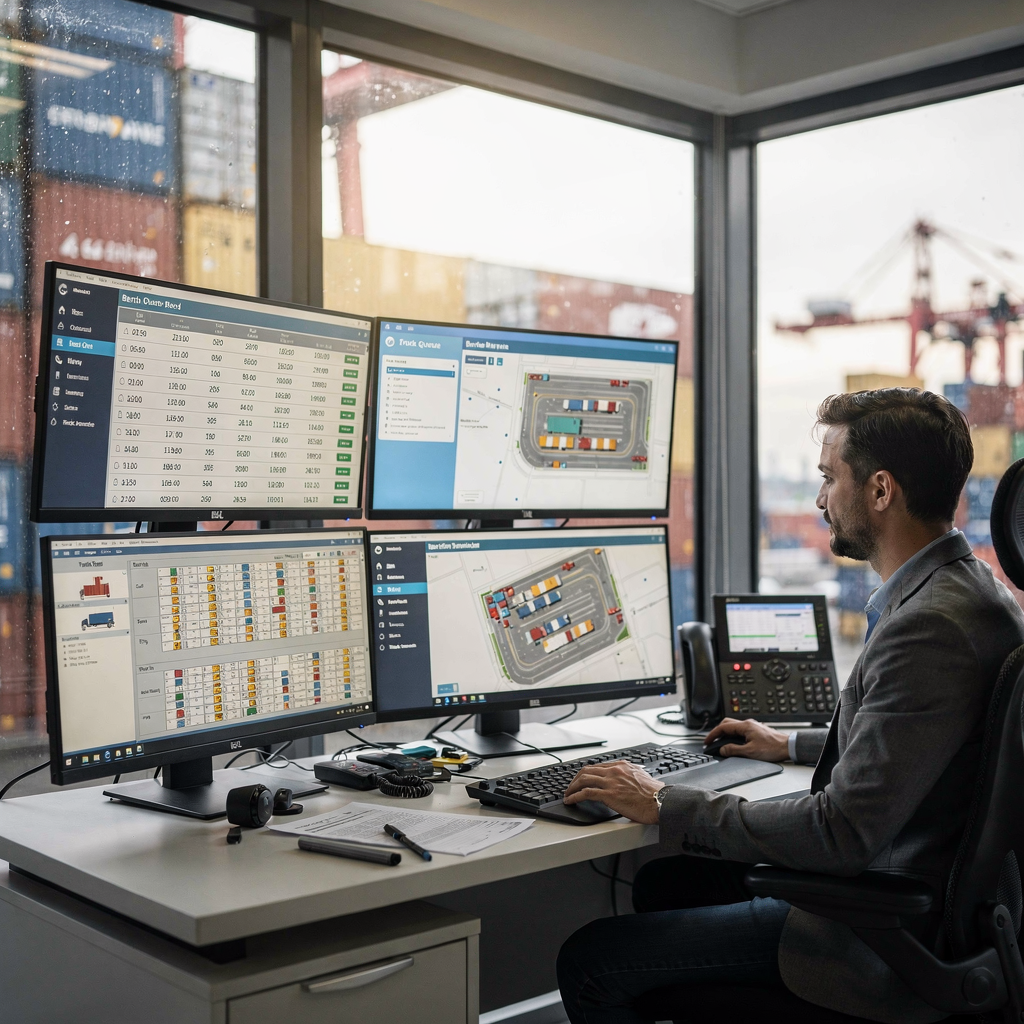
To implement integrated scheduling, terminals need data, models, and guardrails. Data feeds include CRANE telemetry, truck positions, and gate scans. Models include scheduling algorithms and predictive modules. Guardrails enforce safety and contractual constraints, so the AI never violates hard rules. For readers seeking practical deployment tips, our articles on AI-based equipment pool optimization and ASC job scheduling explain how to integrate automation into mixed manual and automated environments equipment pool optimization and ASC job scheduling. Integrated scheduling optimizes throughput while keeping operations robust under real-world variability.
Drowning in a full terminal with replans, exceptions and last-minute changes?
Discover what AI-driven planning can do for your terminal
coordination strategies to reduce congestion in container terminal operations
Congestion shows up at yard cranes, gate entries, and truck queues. Those congestion points slow vessel turnaround and raise operational costs. To reduce congestion, terminals must improve coordination among quay, yard, and gate teams. Real-time data sharing, predictive scheduling, and slot booking form the core strategies. Each strategy reduces uncertainty and aligns resource allocation with actual demand.
Real-time data sharing ensures that job dispatchers and vessel planners operate from the same facts. For example, live CRANE cycle times and truck GPS positions let the scheduling system assign the next move with confidence. Predictive scheduling uses forecasts for arrivals and gate loads to assign slots proactively. Slot booking gives trucks a time window and thereby smooths gate peaks. Combined, these tactics reduce the length of truck queues and the number of simultaneous CRANE requests for the same yard block.
Coordination also means cross-equipment prioritisation. When a vessel faces a tight berth window, the terminal can reassign trucks to protect the quay. Conversely, when gate peaks threaten to stall yard operations, the terminal can shift priorities to clear the gate and maintain flow. Loadmaster.ai’s JobAI coordinates across quay, yard, and gate to keep equipment busy and reduce waiting time. Our approach creates stable schedules that are resilient to breakdowns and delay.
Case studies show concrete results. Terminals that implement predictive scheduling and slot booking can reduce truck-side congestion and improve schedule reliability. As one industry report states, “coordination in transport logistics is the primary solution for congestion and inefficiencies reduction” (performance analysis). Effective coordination reduces delay, lowers terminal access charges, and keeps vessel schedules on time. For more on solving congestion with analytics, see our post on predictive analytics for congestion.
supply chain implications of schedule optimisation and operational efficiency
Terminal schedule performance affects the wider supply chain. When a container terminal improves schedule and allocation, carriers, trucking firms, and shippers all benefit. Better vessel turnaround improves shipping schedules. Reduced dwell time frees yard capacity for more cargo. Lowered transport delays ease inland transport planning. These changes reduce total landed cost for shippers and improve service predictability.
Cost impacts show up quickly. Fewer rehandles mean lower labour and fuel costs. Higher CRANE utilisation spreads fixed quay costs over more moves. Improved truck throughput reduces waiting time at the gate and reduces trucker idle hours. The ACCC report connects internal transport delays to added terminal access charges and operator fees (ACCC 2023–24). Therefore, investments in scheduling systems often pay back through lower operational overhead and better customer service.
Best practices for continuous improvement include monitoring terminal KPIs, running digital twins for scenario testing, and adopting closed-loop optimisation. Loadmaster.ai’s approach of training agents in a digital twin lets terminals test policies before live deployment. That process reduces the risk of operational disruption and preserves tribal knowledge as staff change. For technical teams, reading about KPIs and ROI measurement for AI in port operations can clarify expected gains AI KPIs in port operations and measuring ROI of AI.
Finally, terminals should treat schedule optimisation as a continuous programme, not a one-off project. Data quality, simulation fidelity, and operational guardrails need ongoing care. With the right systems, terminals can optimize allocation and reduce congestion, thereby strengthening the whole supply chain and improving competitiveness.
FAQ
What is the difference between a container terminal and a port?
A container terminal is the facility within a port that specifically handles container loading and unloading. A port may include container terminals as well as bulk, breakbulk, and passenger terminals.
How does yard truck scheduling affect vessel turnaround time?
Yard truck scheduling affects how quickly containers move between CRANE and storage. When trucks arrive late or idle, CRANE must wait and vessel turnaround slows down.
What technology helps reduce congestion at gate entry?
Slot booking systems, predictive scheduling, and real-time gate scanning help smooth truck arrivals. Together they reduce peak queues and shorten truck waiting time.
Can AI replace human planners in container terminals?
AI can augment planners by testing scenarios and suggesting optimized allocation, but human oversight remains crucial for complex decisions. Loadmaster.ai uses reinforcement learning to support planners while enforcing operational guardrails.
What metrics should terminals track to measure schedule performance?
Key metrics include throughput, container dwell time, CRANE utilisation, and truck waiting time. Monitoring these KPIs helps identify bottlenecks and validate optimisation gains.
How much improvement can optimized scheduling deliver?
Studies report gains such as up to 15% higher equipment utilisation and about a 10% reduction in dwell time when scheduling improves (performance analysis). Results vary by terminal.
What is integrated scheduling in container terminals?
Integrated scheduling aligns berth planning, yard allocation, and truck dispatch into a single coordinated plan. It reduces conflicts and lowers the chance of transport delays.
Are automated container terminals better at scheduling?
Automated container terminals can benefit from precise telemetry and deterministic equipment motion, but they still need robust scheduling algorithms. Hybrid terminals often require AI that handles mixed manual and automated fleets.
How does improved terminal scheduling impact the supply chain?
Better scheduling shortens vessel turnaround and lowers transport delays, which improves carrier reliability and reduces shipping costs. Those benefits propagate downstream to shippers and inland transport providers.
Where can I learn more about applying AI to container stacking and yard strategy?
Loadmaster.ai publishes articles on stacking optimization and scheduling strategies, including container stacking techniques and ASC job scheduling for yard optimization. See our resources for deep technical and practical guidance.
our products
 stowAI
 stackAI
 jobAI
jobAI
Innovates vessel planning. Faster rotation time of ships, increased flexibility towards shipping lines and customers.
Build the stack in the most efficient way. Increase moves per hour by reducing shifters and increase crane efficiency.
Get the most out of your equipment. Increase moves per hour by minimising waste and delays.
stowAI
Innovates vessel planning. Faster rotation time of ships, increased flexibility towards shipping lines and customers.
stackAI
Build the stack in the most efficient way. Increase moves per hour by reducing shifters and increase crane efficiency.
jobAI
Get the most out of your equipment. Increase moves per hour by minimising waste and delays.