
Understanding Yard Density and Gross Crane Rate
Yard density measures how tightly containers pack into terminal space, and it often appears as containers per unit area or containers per yard crane. First, this definition helps planners compare layouts across terminals. Also, the metric shows how storage choice affects retrieval times, and it informs stacking rules. Second, gross crane rate refers to the average number of container moves each quay crane executes per hour. For example, planners speak of moves per hour per crane when they track productivity. Next, both metrics matter for terminal throughput because they act on linked workflows. Specifically, yard density sets the background conditions for yard machine cycles, and gross crane rate reveals how well quay operations proceed. Therefore, operations that aim for fast vessel turnaround must manage both variables. Furthermore, yard density impacts transfer vehicle travel, and transfer vehicle travel in turn affects crane idle time. Thus, a congested yard can force quay cranes to wait, and that reduces moves per hour. Importantly, vessel planners, yard strategists, and dispatchers must balance these measures in real time. For instance, Loadmaster.ai trains RL agents that coordinate STOW, STACK, and JOB decisions so quay productivity and yard balance improve at the same time. In addition, short-term tactics such as prioritised pick lists and staged blocks change the effective yard density during a call, and long-term strategies like lane spacing set the baseline density for many calls. Finally, keeping these definitions clear helps teams select KPIs and simulation scenarios. For a deeper view on stacking rules and yard strategies, read our guide on container stacking optimization (container stacking optimization techniques). Also, to learn how cross-equipment sequencing prevents slowdowns, see our paper on cross-equipment job prioritization (cross-equipment job prioritization). Consequently, teams gain a shared vocabulary, and they reduce misalignment between quay and yard shifts.
Relationship Between Yard Density and Gross Crane Rate
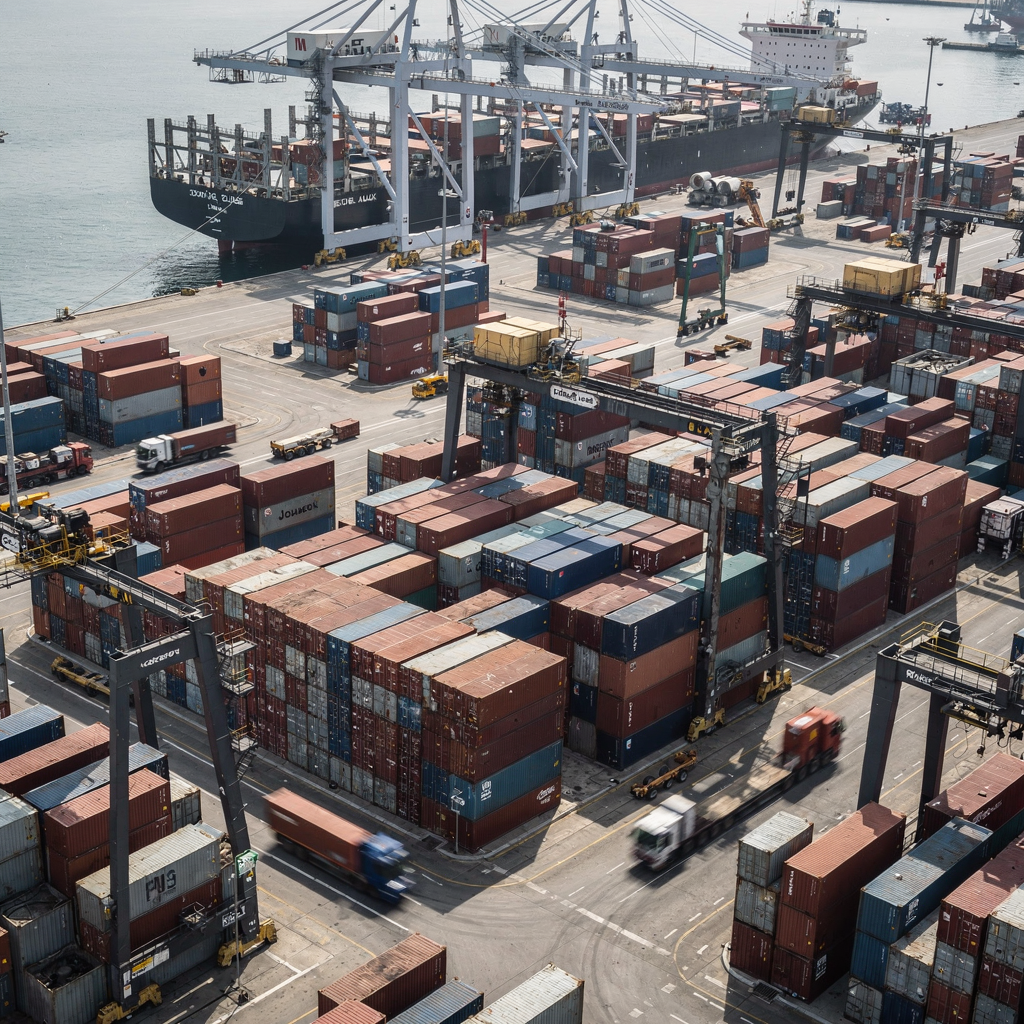
High yard density constrains the flow of transfer vehicles, and that constraint often becomes the main bottleneck for quay cranes. First, when stacks sit close together, RTGs and straddles must make extra maneuvers, and those moves add seconds to each transfer. Next, if transfer-vehicle queues form, quay cranes must pause more frequently, and pauses lower the gross crane rate. For clarity, the World Bank notes that “how close together containers are stored” affects crane utilization and throughput (Container Port Performance Index 2020). Also, the Seaport Capacity Manual highlights that a lack of yard machines will stop transfer vehicles from keeping up with quay cranes, and that mismatch reduces gross crane rate (Seaport capacity manual). Therefore, planners must treat yard density and yard-equipment sizing as a coupled decision. For example, adding quay cranes without increasing yard handling capacity will often cause diminishing returns. Similarly, tight yard spacing can raise rehandle counts, and that adds more moves into the yard cycle. Consequently, the gross crane rate drops by consuming time in non-quay moves. On the other hand, some terminals sustain high crane productivity despite compact yards. The International Transport Forum documents cases where rail-mounted gantry cranes and smart layouts keep gross crane rates above 30 moves per hour even with dense stacking (ITF – The Impact of Mega-Ships). Still, the common pattern holds: uncontrolled yard density increases complexity, and complexity reduces effective crane hours. To manage this link, Loadmaster.ai applies RL policies that change stacking locations, and then those policies reduce travel and rehandles while protecting quay throughput. In short, yard density does not act alone; it interacts with transfer-vehicle cycles, yard crane availability, and quay crane scheduling to produce the observed gross crane rate.
Drowning in a full terminal with replans, exceptions and last-minute changes?
Discover what AI-driven planning can do for your terminal
Quantitative Data and Statistics
Quantitative evidence helps set realistic expectations. For instance, the Port of Melbourne review recorded maximum observed crane rates near 31 moves per hour under optimal conditions for quay and yard operations (Port of Melbourne Capacity Review). Also, multiple studies report that elevated yard density can cut gross crane rates by about 10–15%, and that reduction comes from longer transfer cycles and extra rehandles (Le-Griffin 2006, Key Findings on Terminal Productivity). Therefore, a terminal that aims for 30 moves per hour must protect yard throughput to avoid that 10–15% penalty. Meanwhile, terminals with advanced yard technology and layout often sustain over 30 moves per hour even when yard stacks remain compact; the ITF analysis of mega-ship handling shows such outcomes where rail-mounted gantry cranes and planned transfer flows align (ITF – mega-ships report). Importantly, these figures assume good crane uptime and effective transfer vehicle fleets. In practice, equipment downtime lowers gross crane rate much more than stacking density alone. For example, downtime prediction studies show that unexpected equipment failures reduce moves per hour, and predictive maintenance can recover lost productivity (Port Equipment Downtime Prediction). Consequently, planners must consider three levers: effective yard density, sufficient yard equipment, and strong maintenance programs. To explore solutions that hide capacity and raise moves per hour, see our research into identifying hidden capacity with AI (identifying hidden capacity with AI). Also, our work on predictive KPIs connects maintenance and uptime to crane performance (predictive KPIs for shortsea terminals).
Expert Insights and Quotations
Experts tie yard-equipment availability directly to crane performance. Le-Griffin (2006) observed that “The number and movement rate of quayside container cranes are indirectly related to yard equipment availability and yard density. Efficient yard operations are essential to maintain high gross crane rates.” The quote highlights two linked variables that planners must measure together (Le-Griffin 2006). Also, the World Bank stressed that “Crane density and yard density must be balanced carefully. Overcrowded yards reduce crane productivity, while underutilized yard space leads to inefficiencies in container storage and retrieval.” This statement frames balance as the operational objective, and it clarifies the trade-off teams face (Container Port Performance Index 2021). Industry white papers add practical colour. For example, the Seaport Capacity Manual explains that insufficient yard machines will keep transfer vehicles from matching quay crane pace, and that mismatch reduces gross crane rate (Seaport capacity manual). Collectively, these voices advise integrated planning, and they encourage investment in yard cycles and telemetry. In response, technology vendors propose tools that predict congestion and guide moves. Loadmaster.ai builds closed-loop RL agents that learn operational trade-offs, and then they suggest decisions that preserve quay productivity while smoothing yard workload. In practice, our StowAI reduces shifters and protects crane productivity, StackAI balances yard blocks, and JobAI coordinates execution to lower waits. Therefore, expert guidance plus adaptive AI yields measurable gains in throughput and consistency. Finally, the evidence shows that no single change suffices; rather, a suite of policies and equipment choices must align to sustain high gross crane rates under varying yard densities.
Drowning in a full terminal with replans, exceptions and last-minute changes?
Discover what AI-driven planning can do for your terminal
Implications for Port Management
Port managers must treat yard density and gross crane rate as co-dependent variables. First, they should design yard layouts that reduce transfer distances and separate flows. Second, they should size yard cranes and transfer vehicles to match quay crane capacity. Also, scheduling matters. For example, optimised transfer-vehicle routing and staggered pickup windows prevent queues. In addition, automated guided vehicles (AGVs) and well-tuned RTG assignments can raise effective throughput. To learn about AGV charging strategies and fleet choices, see our page on opportunity charging for electric AGVs (AGV opportunity charging). Moreover, predictive scheduling that includes equipment health prevents sudden drops in crane rate. Therefore, ports should adopt real-time analytics and predictive maintenance tools. Research shows that predictive maintenance recovers moves lost to failures, and that improves average gross crane rates (downtime prediction study). Furthermore, digital twins enable scenario testing so managers can see how higher yard density affects crane throughput before they change layouts. Loadmaster.ai uses a digital twin to train RL agents, and that approach finds stacking and sequencing policies that lower rehandles and travel without relying on historical mistakes. Also, tactical measures such as block reservation and buffer lanes protect quay flows during peaks. Finally, cross-equipment job prioritization prevents bottlenecks by aligning yard tasks with quay rhythm; for more on this, read our cross-equipment prioritization research (cross-equipment job prioritization). To summarise, managers gain by coordinating layout, fleet sizing, scheduling, and analytics; these levers together sustain higher gross crane rates even as yards densify.
Conclusion
Balanced yard density and gross crane rate determine terminal performance. First, high yard density raises transfer complexity and can cut gross crane rates by roughly 10–15% in many observed cases (productivity study). Second, optimised yards with the right equipment and layout can sustain crane rates near 30 moves per hour or more, and the Port of Melbourne reported optimal peaks near 31 moves per hour under good conditions (Port of Melbourne report). Therefore, ports should align stacking policy, equipment pools, and quay plans. Also, they should use predictive analytics and maintenance to protect uptime. Loadmaster.ai offers RL-driven STOW, STACK, and JOB agents that balance quay productivity and yard congestion, and they do so in a sandbox digital twin before live deployment. In practice, this reduces rehandles, shortens transfer distances, and raises moves per hour. Finally, the payoff appears as lower vessel wait times, higher slot utilization, and steadier shift-to-shift performance. Thus, by planning for the link between yard density and crane rate, terminals increase throughput and make operations more resilient.
FAQ
What is yard density and why does it matter?
Yard density measures how many containers occupy a given yard area or how many containers sit per yard crane. It matters because denser yards increase transfer times, raise rehandle counts, and can delay quay cranes, which reduces overall terminal throughput.
How does yard density affect gross crane rate?
High yard density forces transfer vehicles and yard cranes to perform extra moves, and that adds cycle time between quay lifts. As a result, quay cranes may idle more often, and gross crane rate falls, sometimes by 10–15% in practice.
What gross crane rate should terminals aim for?
Many modern terminals target around 30 moves per hour per quay crane as a practical benchmark. Under optimal conditions some terminals achieve around 31 moves per hour, but that outcome depends on yard balance, equipment uptime, and transfer vehicle performance.
Can terminals keep high crane rates with compact yards?
Yes, some terminals maintain high crane rates with dense stacking when they deploy rail-mounted gantries, efficient layouts, and tight transfer coordination. The ITF shows examples of terminals that sustain over 30 moves per hour despite compact yards.
What operational levers reduce the negative effects of high yard density?
Key levers include increasing yard crane availability, optimising transfer-vehicle schedules, creating buffer lanes, and lowering rehandles through better stow planning. Real-time analytics and predictive maintenance also help sustain crane productivity.
How can AI help balance yard density and crane rate?
AI, especially reinforcement learning, can test millions of stacking and sequencing strategies in a digital twin, and then propose policies that balance quay productivity and yard congestion. Loadmaster.ai uses RL agents to coordinate STOW, STACK, and JOB decisions to reduce rehandles and improve moves per hour.
What role does maintenance play in gross crane rate?
Maintenance keeps cranes and yard machines available, and higher availability keeps gross crane rates stable. Predictive maintenance reduces unexpected downtime and helps recover moves lost to failures.
When should a port change its yard layout?
Ports should change layout when recurring congestion, high rehandles, or persistent vessel delays indicate that existing spacing and flow patterns limit throughput. Simulation and digital twins let managers assess layout changes before physical investment.
Are automated vehicles a necessary investment to manage density?
Automated vehicles can reduce human-driven variability and improve repeatable transfer cycles, but they are not always necessary. Effective fleet control, scheduling, and integrated planning can also yield significant gains, and Loadmaster.ai supports mixed manual and automated fleets.
Where can I learn more about practical solutions to congestion?
You can explore our articles on stacking optimisation, cross-equipment prioritization, and predictive KPIs for concrete strategies. For instance, read our pieces on container stacking optimization and cross-equipment job prioritization to get actionable guidance.
our products
 stowAI
 stackAI
 jobAI
jobAI
Innovates vessel planning. Faster rotation time of ships, increased flexibility towards shipping lines and customers.
Build the stack in the most efficient way. Increase moves per hour by reducing shifters and increase crane efficiency.
Get the most out of your equipment. Increase moves per hour by minimising waste and delays.
stowAI
Innovates vessel planning. Faster rotation time of ships, increased flexibility towards shipping lines and customers.
stackAI
Build the stack in the most efficient way. Increase moves per hour by reducing shifters and increase crane efficiency.
jobAI
Get the most out of your equipment. Increase moves per hour by minimising waste and delays.