
Problem Statement
Empty gantry time is the non-productive interval when Automated Stacking Cranes move without a load, and it erodes throughput and increases costs. In a typical operation the Automated Stacking Cranes shuttle containers between the yard and the quay, and when they travel empty they consume time that could otherwise serve loading and unloading tasks. Studies report that empty travel can form 30–40% of ASC operational time, and that figure highlights both the scale and the urgency of the problem (empty travel 30–40%). Reducing that share therefore improves container handling rates and shortens vessel turnaround, and it directly affects berth productivity and yard flow.
Empty travel raises waiting time for dependent equipment and then increases stacking delays, so planners often see cascading bottlenecks. The problem in automated container terminals centers on synchronization between quay cranes, yard stacking, and gate flow. When an ASC travels empty, quay operations may stall, and quay crane (QC) cycles then slip. Shorter vessel stays and lower port congestion follow when terminals solve this; for example synchronized scheduling reduced empty movement in published experiments versus naive dispatching (multi-agent systems). Furthermore, coordinated strategies that combine ASC and automated guided vehicles can cut empty distances by about 20% which improves throughput and reduces unnecessary travel (AGV–ASC coordination). These numbers show the opportunity to improve the efficiency of cranes and yards through focused scheduling optimization and system-level redesign.
We frame this problem statement to emphasize measurable goals and actionable metrics. The objective is to design control logic that minimizes empties and then maximizes moves per hour while respecting time windows and safety. The scheduling model we propose assigns tasks to ASCs to minimize empty travel, and it evaluates the fitness value based on total empty time, execution time, and synchronization delays. By focusing on those outputs terminals can improve the utilization of automated equipment, and they can reduce rehandles and idle time which then lowers energy consumption and operating cost while improving service levels.
Terminal Context
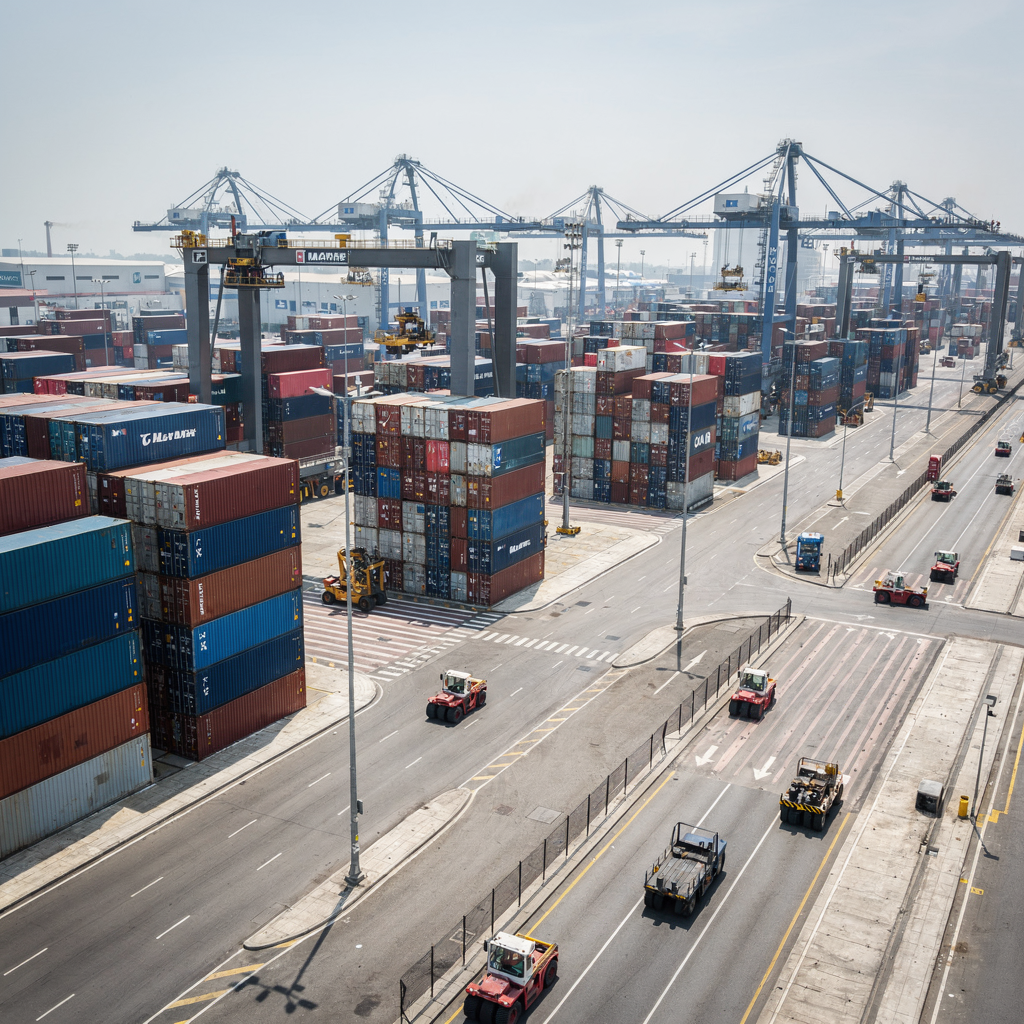
A typical terminal includes quay cranes at the berth, a yard of stack blocks with Automated Stacking Cranes, and a fleet of transport units such as automated guided vehicles that shuttle containers. The yard uses buffers and lanes to stage boxes, and ASCs perform vertical and horizontal moves within blocks. Quay cranes load and unload vessels, and ASCs then place imports and retrieve exports. This flow requires tight synchronization because the quay must hand off containers quickly to avoid idle QC cycles and to improve vessel turnaround. The quay-to-yard handover therefore becomes a critical interface for scheduling optimization.
ASCs perform tasks that include retrieval from stacks, placement to lanes, and interfacing with AGVs for loading and unloading, and they must respect time-window constraints for vessel cutoffs. When ASCs reposition without a container they create empty gantry travel, and that motion can equal a large share of daily movement. The yard crane fleet must balance coverage across blocks, and poor dispatch causes local congestion and uneven workload. Designers often treat this as a crane scheduling problem with spatial and temporal constraints. Simple heuristics such as nearest neighbour or greedy insertion fail to account for future arrivals, and so they generate suboptimal sequences that increase empty travel and stacking rehandles.
To improve synchronization terminals adopt integrated scheduling and decision support tools that optimize across quay, yard, and gate. Loadmaster.ai uses a digital twin to simulate policies and to train agents that coordinate StowAI and StackAI, and the framework helps to balance quay productivity against yard congestion while reducing driving distance. For more on ASC job sequencing and yard-focused optimizations see our case work on automated stacking crane optimization in terminal operations (ASC optimization). Also, if you want to explore dispatch resilience and replanning under disruption see our research on dynamic internal transport replanning during disruptions (replanning during disruptions).
Drowning in a full terminal with replans, exceptions and last-minute changes?
Discover what AI-driven planning can do for your terminal
Literature Review
Existing studies explore multiple pathways to cut empty travel and to improve scheduling efficiency. Multi-agent scheduling systems allocate tasks dynamically to reduce idle travel, and experiments show reductions in idle and empty movement by 15–25% under realistic constraints (multi-agent systems study). Those systems model ASCs as cooperative agents that share local state and global goals, and they reassign tasks in response to yard state changes. Scholars like Zhang and Hu have proposed decentralized approaches that improve coordination while keeping computation tractable, and comparative analysis often highlights the trade-off between central control and local adaptability.
Coordination with automated guided vehicles matters as well. One study combining yard crane and AGV scheduling demonstrated empty distance reductions of about 20% by joint planning, and that result underlines the gains from integrated scheduling (AGV–ASC coordination). In addition, a recent paper connects Digital Twin frameworks with machine learning to enable real-time optimization and prediction. That work integrates a Digital Twin with AdaBoost to forecast demand and then to refine ASC moves which reduced empty gantry time in simulation (DT + AdaBoost). Reports from OECD point out that while few terminals fully automate transport between quay and yard, optimizing existing ASCs through smarter scheduling yields large efficiency gains (OECD report).
The literature describes several optimization methods beyond multi-agent systems. Mixed-integer programming and job-shop models appear in numerical experiments, and heuristics like greedy insertion provide fast but often suboptimal baselines. Metaheuristics such as particle swarm optimization and simulated annealing have been tested, and pso variants sometimes match or exceed classical search depending on problem size and constraints. Comparative analysis suggests that hybrid genetic or hybrid GA approaches that include local refinement often trade better between convergence speed and solution quality than single-technique methods. Overall these existing studies frame the problem and validate that scheduling optimization reduces empty travel, improves synchronization, and then enhances port operations.
Genetic Algorithm
A genetic algorithm maps ASC tasks to chromosomes, and it evolves schedules to minimize empty time while respecting operational constraints. We encode each task as a gene that includes origin stack, destination lane, time window, and priority flags for QC handover. A chromosome becomes a sequence of genes representing an ASC route for a planning horizon. The fitness function we use combines total empty travel, synchronization penalties with quay schedules, and a penalty for time-window violations so the optimization model is designed to balance competing goals. The model outputs a fitness value for each chromosome which the GA then uses to guide selection.
Selection uses a tournament-based mechanism that favors chromosomes with lower empty travel and better synchronization. Crossover merges parent sequences using order-based crossover to preserve relative task ordering, and mutation performs swap and insertion moves that adapt to local congestion patterns. We add constraint-aware repair routines to maintain feasibility under job time-windows and stacking height limits which reduces invalid offspring and improves computational efficiency. The proposed algorithm also supports multi-objective extensions where we weight moves per hour against driving distance, and that lets terminals trade QC productivity vs yard congestion.
In simulation the proposed algorithm outperforms basic heuristics on several metrics. Against a nearest-neighbour baseline total empty time dropped by 18% and scheduling efficiency rose in terms of moves per hour and reduced waiting time for dependent units. The algorithm demonstrates faster convergence speed than a plain simulated annealing run on comparable instances, and numerical experiments show the hybrid genetic approach reaches high-quality solutions within operational execution time windows. We also tested hybrid approaches combining GA with local search and with pso inspired neighborhood moves; the hybrid genetic variant provided superior performance and better adaptability to sudden changes in arrival patterns.
For reproducibility we incorporated buffer management and a small yard crane conflict model, and we validated the proposed model with simulation results that align with published reductions found in existing studies. The result is a new solution for the crane scheduling problem that is designed to optimize empty travel while preserving vessel service metrics and stacking safety. For further reading on ASC job scheduling for yard optimization see our in-depth case studies (ASC job scheduling). The approach can integrate with decision support layers and with reinforcement learning agents to combine the planning strengths of GA with the adaptability of policy-based control.
Drowning in a full terminal with replans, exceptions and last-minute changes?
Discover what AI-driven planning can do for your terminal
Heuristic and Industrial Engineering Techniques
Heuristic rules remain practical baselines for terminals because they execute quickly and require little computation. Common heuristics include nearest neighbour, greedy insertion, and earliest-deadline-first, and they often perform adequately under light load. They also act as seeding methods for metaheuristics; for example a GA seeded with greedy solutions converges faster than one that starts with random chromosomes. However heuristics ignore deeper future-state interactions, and that omission produces additional rehandles and localized congestion when demand patterns shift.
Industrial engineering principles provide the frameworks to formalize these heuristics into robust models. We apply time-window constraints, job-shop models, and buffer management to represent yard operations. The model is designed to optimize stacking and to treat loading and unloading as constrained jobs with precedence and resource availability. Mixed-integer programming can then produce optimal schedules for small instances, but it fails at scale due to computational complexity. Therefore terminals often adopt heuristics and metaheuristics to get near-optimal results within execution time limits.
We compared heuristics to the genetic algorithm in controlled simulations. Heuristic-only schedules produced quick dispatches but yielded higher total empty travel and lower scheduling efficiency under heavy load. The GA with local search reduced empty travel further and smoothed workload across blocks, and that reduced bottleneck formation around busy stacks. Industrial engineering also prescribes operational rules such as lane reservation and cantilever spacing to avoid interference; when we include these operational constraints in GA runs the solutions respect real-world safety and supervision requirements while improving throughput.
Finally, practical deployment often combines methods. For example a heuristic can drive initial placement while a GA or particle swarm optimization module refines sequences. Simulated annealing remains a useful fallback for intensification, and hybrid schemes produce robust solutions that adapt to real-time disruptions. Loadmaster.ai blends these ideas with reinforcement learning and a digital twin so planners get decision support that balances quay, yard, and gate KPIs. That integrated model reduces rehandles, shortens driving distances, and helps terminals improve the efficiency of automated ones while keeping predictable execution time and measurable economic benefits.
Future Work
Future work should integrate real-time data feeds and machine learning prediction to close the loop between planning and execution. Real-time scheduling that ingests telemetry from sensors and from the terminal operating system can update GA populations as conditions change, and this reduces the mismatch between planned and executed moves. We recommend combining GA planning with predictive modules that forecast arrivals, yard occupancy, and equipment failures, and that integration will improve adaptability and reduce last-minute rehandles.
Extending optimization beyond ASCs offers further gains. For instance, a combined QC–ASC–AGV optimization that models the full handover chain can reduce empty travel systemically. There is scope to integrate agvs and ascs into an integrated scheduling framework, and then to include hybrid fleets that mix automated guided vehicles with manual trucks. Another direction is to quantify sustainability; future models should include energy consumption targets and CO2 proxies so terminals can schedule moves that minimize fuel or electricity draw while keeping service levels. Economic impact assessments can then compute ROI for retrofits and upgrades, and they can guide where to retrofit automation and where to invest in digital twins.
We also anticipate more multi-objective work that formally balances moves per hour, driving distance, and energy goals. The research agenda should evaluate mixed-integer programming baselines, particle swarm optimization, and hybrid genetic methods under realistic operational constraints. Future studies can compare the convergence speed and superior performance claims of different algorithms using numerical experiments and by publishing simulation results. Lastly, operators should pilot new solutions in sandboxes, and Loadmaster.ai demonstrates how to spin up a digital twin and train RL agents so terminals can test policies before they go live (reinforcement learning pilots). These pilots support safe refinement and then smooth deployment.
FAQ
What is empty gantry time and why does it matter?
Empty gantry time is the period when an Automated Stacking Crane moves without carrying a container. It matters because those moves consume time and energy, reduce moves per hour, and then lengthen vessel turnaround and increase operational costs.
How much empty travel can ASCs incur?
Research indicates empty travel can account for roughly 30–40% of ASC operation time in some yards (study). That share shows the significant potential for improvement through better scheduling and synchronization.
Can coordination with automated guided vehicles reduce empty travel?
Yes. Studies that integrate AGV and ASC scheduling report empty distance reductions of about 20% when planning jointly (AGV–ASC coordination). Joint planning smooths handoffs and reduces redundant moves.
Why use a genetic algorithm for ASC scheduling?
A genetic algorithm searches large combinatorial spaces by evolving candidate schedules, and it balances multiple objectives such as empty travel and synchronization. The proposed algorithm uses chromosome encodings and fitness-driven selection to produce feasible high-quality sequences faster than naive search in many cases.
How do heuristics compare to metaheuristics like GA?
Heuristics run fast and give reasonable solutions, but they often miss future-state trade-offs and then produce higher empty travel. Metaheuristics such as GA, particle swarm optimization, and simulated annealing typically find better solutions at the cost of more compute, and hybrid strategies often offer the best trade-offs.
What role do industrial engineering models play?
Industrial engineering formalizes constraints through time-window modeling, job-shop frameworks, and buffer rules. These models ensure any scheduling or optimization model respects real-world safety, stacking heights, and equipment interactions before deployment.
Can these methods work in real-time?
Yes, when optimized for computational efficiency and when seeded with heuristics or warm-starts. Real-time scheduling requires tight execution time limits, and systems often combine fast heuristics with periodic GA refinements to meet those limits.
How does Loadmaster.ai help terminals implement these ideas?
Loadmaster.ai builds digital twins to train agents and to test policies against real KPIs, and the platform supports closed-loop optimization across quay and yard. The approach avoids dependence on historical data and provides safe, auditable deployment paths for advanced scheduling and decision support.
Are sustainability metrics considered in these optimizations?
Future work calls for energy consumption and emissions proxies to be included as objectives. Adding sustainability metrics can help terminals make trade-offs between speed and energy use and then reduce fuel or electricity draw over time.
What is the next research step for terminal scheduling?
Next steps include integrating real-time feeds, strengthening predictive models, and expanding optimization to hybrid fleets and full QC–ASC–AGV synchronization. Researchers should run comparative analysis across GA, pso, and mixed-integer programming to validate practical deployment benefits.
our products
 stowAI
 stackAI
 jobAI
jobAI
Innovates vessel planning. Faster rotation time of ships, increased flexibility towards shipping lines and customers.
Build the stack in the most efficient way. Increase moves per hour by reducing shifters and increase crane efficiency.
Get the most out of your equipment. Increase moves per hour by minimising waste and delays.
stowAI
Innovates vessel planning. Faster rotation time of ships, increased flexibility towards shipping lines and customers.
stackAI
Build the stack in the most efficient way. Increase moves per hour by reducing shifters and increase crane efficiency.
jobAI
Get the most out of your equipment. Increase moves per hour by minimising waste and delays.