
Overview of Deep Reinforcement Learning for Container Terminals
Reinforcement learning trains an agent to make sequential choices and to learn from rewards and penalties. And therefore this approach fits dynamic logistics tasks at a CONTAINER TERMINAL. Next, researchers combine REINFORCEMENT LEARNING ALGORITHMS with sensors, telemetry, and historical records to help planners react faster, and to predict outcomes before they occur. For example, a learning agent can select a sequence of moves that reduces crane idle time and limits yard rehandles. Also, these agents can use a DEEP NEURAL NETWORK to map complex states to actions and to generalise across unseen situations.
And so the main benefits are clear. First, efficiency improves when the system learns to balance quay throughput against yard congestion. Next, costs drop as travel distances shrink, and as idle equipment falls. Then, operators get real-time adaptation to delays, equipment failure, and changing vessel mixes. Additionally, planning becomes less reliant on human memory and static rules, and the terminal gains consistency across shifts.
Typical applications include truck routing, crane scheduling, and berth allocation at the PORT. For truck flows, a study on interterminal truck routing optimization using deep models reported substantial reductions in waiting time. Likewise, berth assignment and crane sequencing benefit from agents that can look ahead and trade off KPIs. For readers who want to model yard behavior, see our guide on maritime terminal simulation tools for yard planning at maritime terminal simulation tools for yard planning, which explains the use of digital twins and simulation for training agents.
Finally, this field blends MACHINE LEARNING techniques with domain knowledge. For example, supervised learning can initialise policies, and unsupervised learning can cluster traffic patterns to reduce state complexity. Yet the agent optimises via reward-driven trial and error, so the system can exceed past practice. In sum, REINFORCEMENT LEARNING offers a structured way to improve decision making at a CONTAINER TERMINAL while preserving operational constraints and safety.
planning problem in Container Yard Operations
The PLANNING PROBLEM in container yards covers many linked tasks. First, where to place a container affects future moves, and then assigning cranes and trucks to those moves is a separate decision. And so the combined complexity creates an ALLOCATION PROBLEM that planners face every shift. To address this, researchers apply learning models that treat the yard as a state space and moves as actions, and then train agents to reduce rehandles and travel.
One applied example is interterminal truck routing. Research named interterminal truck routing optimization using deep methods found up to 30% reductions in truck waiting times. This statistic shows how much impact the right policy can produce. Also, for CRANE-TO-TRUCK ASSIGNMENT, agents minimise crane idle time while guaranteeing that quay tasks follow execution rules. For the ACTION SPACE design, each possible move, slot, or truck assignment becomes an action. The agent then learns which actions yield high KPI scores over simulated days.
Designing reward and penalty functions is central. If rewards only focus on moves per hour, then the agent may cause yard congestion. So the reward should combine multiple KPIs. For example, weigh crane productivity, truck wait, and expected rehandles. And then use penalties for illegal moves, unsafe stacking, or destabilising the schedule. This multi-objective view mirrors what Loadmaster.ai builds in practice: closed-loop agents that follow explainable KPI weights in a digital twin, and that are safe by design.
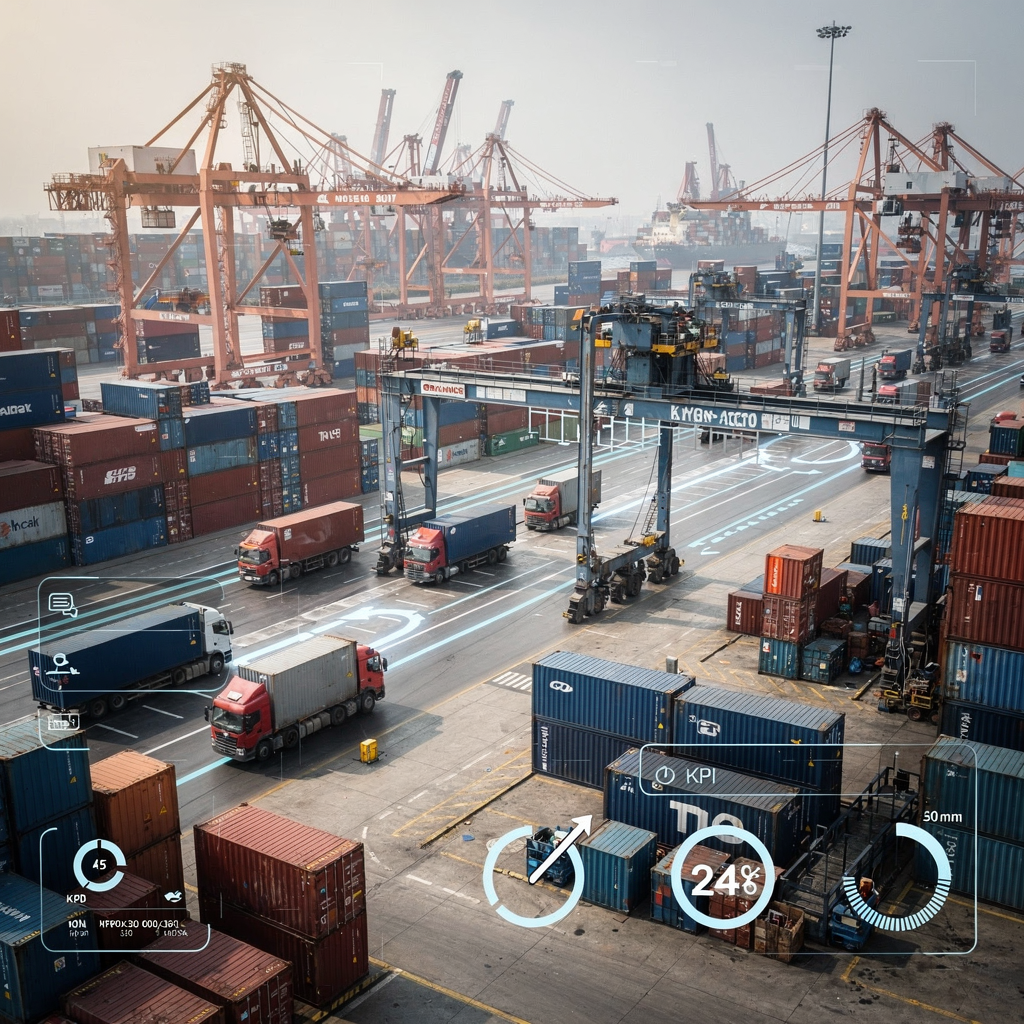
Moreover, learning algorithms can be single-agent or multi-agent. MULTI-AGENT REINFORCEMENT LEARNING helps when several equipment types act independently, and when they must coordinate to avoid conflicts. Yet simpler single-agent policies can still bring large gains in constrained blocks. For planning robustness, simulation is key. Train agents in a sandboxed digital twin until policies generalise. For more on modelling yard behavior and setting up simulations, review our piece on how to model container yard operations. Finally, the yard planning process must consider container TYPE, container arrival patterns, and the probability of gate peaks to build resilient policies.
Drowning in a full terminal with replans, exceptions and last-minute changes?
Discover what AI-driven planning can do for your terminal
ship stowage planning problem: Deep RL for Load and Discharge
The ship stowage planning problem is about where to place each container on a vessel to satisfy safety, stability, and operational goals. For a given call, the planner must sequence loading and discharge moves so that handlers can execute the plan without extra moves. And so this problem sits at the intersection of vessel operations and yard coordination. The complexity grows with mixed container TYPE, weight limits, and port-specific discharge patterns.
A DEEP REINFORCEMENT LEARNING APPROACH models the vessel bay layout and the target container list as a state. Next, an agent chooses container selection and placement actions. The goal is to reduce crane moves and to maintain vessel stability. For example, agents can sequence cargo moves to minimise crane relocations and to lower the number of shifters needed on deck. A DEEP REINFORCEMENT LEARNING MODEL can learn to prefer placements that simplify future discharges, and to avoid maneuvers that cause stowage conflicts.
Researchers have explored blending learning with classic optimisation. For example, a DEEP Q-NETWORK or DEEP Q-NETWORKS variant can value state-action pairs representing specific container transfers. Then planners can use those values to guide master bay planning problem solutions, and to generate executable QC plans. Additionally, hybrid schemes combine a genetic algorithm for coarse allocation and a learning algorithm for sequencing moves. This hybrid delivers both global search and adaptive control.
Practically, improvements shorten turnaround time and increase berth utilisation. And therefore vessels spend less time at the quay, and the overall terminal throughput rises. For port terminals aiming to optimise container loading and unloading, simulating vessel calls before deployment is essential. See our simulation tools for berth scheduling at simulation tools for port berth scheduling optimisation for examples that show how vessel and yard planners can test policies prior to live traffic. Finally, the agent must respect constraints like lashing rules, weight distribution, and one-container-per-bay requirements to remain operationally valid.
Quantitative Benefits: Efficiency, Congestion and Emissions
Data shows measurable gains when learning models meet terminal realities. First, congestion models built with AIS and deep learning improved prediction accuracy by roughly 25% in one study, and that helps terminals allocate tugs, berth slots, and cranes in advance A deep learning approach for port congestion estimation and prediction. Second, interterminal truck routing work demonstrates up to a 30% drop in truck waiting time when routes are optimised, and that directly boosts yard flow interterminal truck routing optimization using. Third, optimised queuing and routing can lower CO2 emissions by up to 15% when queues shrink and travel distances shorten Investigation of a port queuing system on CO2 emissions from.
And so the environmental benefit follows the productivity gain. Less idling trucks, fewer empty returns, and balanced crane hours reduce fuel burn and emissions. Also, optimised container transfer between quay and yard reduces unnecessary REHANDLES, and that saves diesel and electricity. For terminals focused on sustainability, such reductions matter in reporting and in meeting regulatory targets.
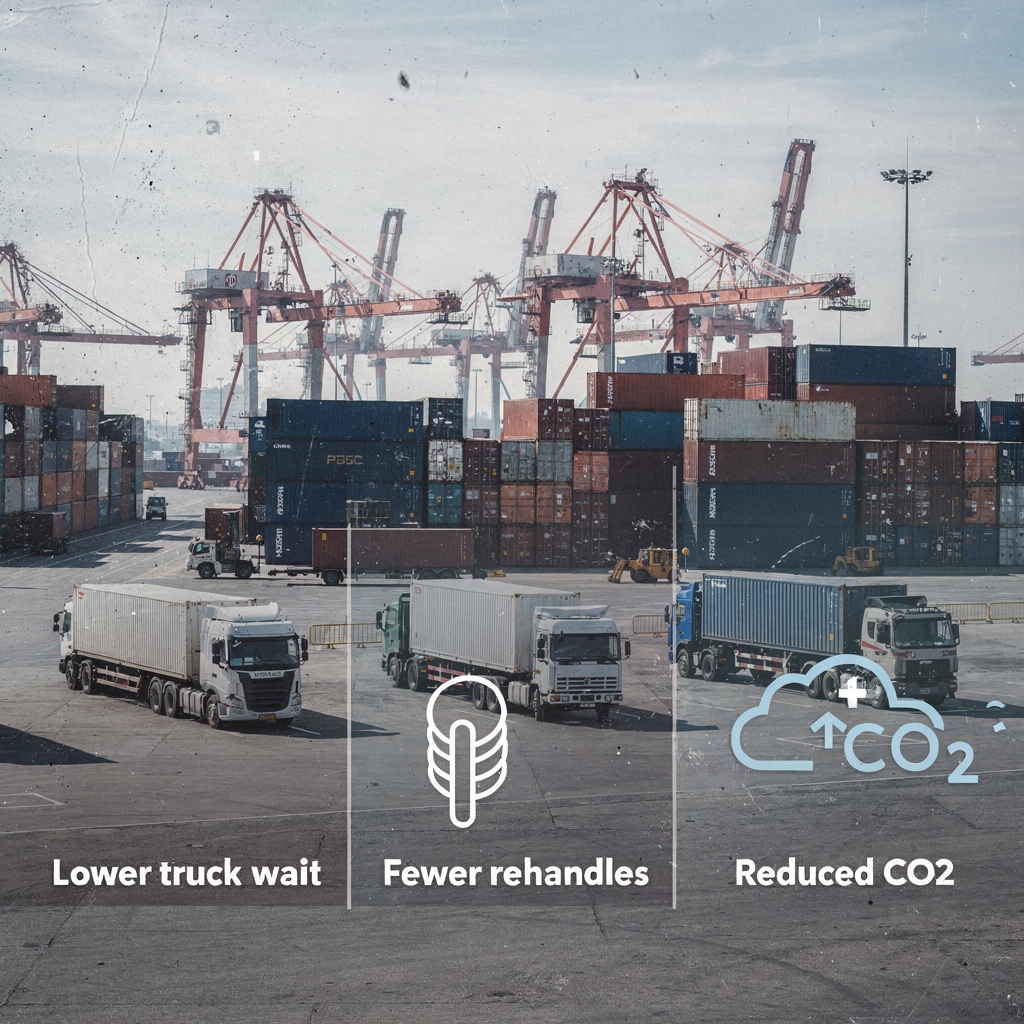
Using DEEP REINFORCEMENT LEARNING in policy training can accelerate these benefits because agents learn policies that anticipate future congestion, and that coordinate across equipment. For example, LOADMASTER.AI trains agents in a digital twin so the system learns millions of scenarios without production risk. Then terminals get tested policies that reduce rehandles and improve CRANE UTILISATION, and that are cold-start ready. Finally, when discussing KPI gains note that results vary with terminal layout, vessel mix, and local traffic, and therefore pilots remain essential before broad roll-out.
Drowning in a full terminal with replans, exceptions and last-minute changes?
Discover what AI-driven planning can do for your terminal
Data and Infrastructure Requirements for Real-World Deployment
Real-world deployment needs data, compute, and integration work. First, agents need high-quality AIS feeds, gate timestamps, equipment telemetry, and yard inventory locations. Also, the terminal must stream near-real-time updates so the agent can act on current states. Consequently, the system requires robust APIs and telemetry that fit within existing TOS workflows. For more on TOS integration see our overview of terminal operating system TOS, which explains how RL agents can plug into live operations without replacing legacy systems.
Next, simulation environments and digital twins matter. Training agents in a sandbox lets teams explore risky strategies at scale. And so our approach spins up a digital twin that mirrors terminal layout, crane kinematics, and truck patterns. This step mirrors practices described in literature where simulation-based training avoids the need for massive historical data. Also, it helps when terminals have limited clean history because the learning framework can generate realistic episodes.
Integration challenges include latency, guardrails, and validation. For instance, guardrails must stop the agent from suggesting unsafe container transfers. And therefore hard constraints and explainable KPIs are non-negotiable. Another hurdle is legacy hardware that lacks telemetry; bridging that gap requires retrofitting or using proxy sensors. Finally, operations teams must accept policy-driven decisions, and so rollout plans include human-in-the-loop modes where planners review recommendations before enactment.
In short, deploying RL demands data pipelines, simulation libraries, and TOS connectors. See our resources on terminal performance modelling and simulation-case studies at terminal performance modelling software and simulation case studies. These pages show how training in simulation, then validating in controlled pilots, yields safe and scalable improvements.
Future Trends and Expert Perspectives in Port Automation
Looking forward, automation in maritime container ports will expand across vessel and yard domains. For example, autonomous ship navigation research shows that reward design influences the success of unmanned ship strategies Advancing Ship Automatic Navigation Strategy with Prior Knowledge. Also, terminal automation continues with unmanned yard-handling vehicles and automated guided vehicles in container flows. These trends make multi-modal coordination a key research and deployment focus.
Experts note the potential and the limits. Dr Jane Smith explains that “Reinforcement learning offers a transformative approach to port operations by enabling systems to learn and adapt in real-time, which is essential for handling the dynamic and stochastic nature of container terminals” The growing role of artificial intelligence in smart container ports. In addition, a recent survey found that over 70% of terminal operators view AI and RL technologies as key enablers for future automation and sustainability initiatives Stakeholders’ attitudes toward container terminal automation. These views support continued investment.
Finally, Loadmaster.ai builds on these trends by delivering closed-loop agents such as StowAI, StackAI, and JobAI. These agents train in a digital twin, and then operate with guardrails and KPIs. And so the company helps terminals shift from firefighting to proactive planning, and to reduce OPERATIONS RESEARCH friction. For those interested in simulation libraries and scheduling tools, our resources on terminal equipment scheduling and simulation platforms describe practical steps to pilot and scale automation. As future research explores multi-agent coordination, adaptive data generation, and hybrid optimisation like genetic algorithm hybrids, terminals will keep improving resilience and sustainability.
FAQ
What is deep reinforcement learning and how does it apply to container terminals?
Deep reinforcement learning combines reinforcement learning with deep neural networks to map complex states to actions. In container terminals, agents learn policies for tasks like truck routing, crane scheduling, and container allocation so operations can adapt in real time.
Can RL reduce truck waiting times at terminals?
Yes. Studies show that routing and dispatch policies trained with learning approaches can cut truck waiting times significantly, with some work reporting up to 30% reductions. These gains come from better sequencing and anticipation of terminal workload.
Do RL systems require historical operational data?
Not strictly. Many approaches train agents in a digital twin and generate experience via simulation, so terminals with limited clean history can still deploy effective agents. That said, live telemetry helps refine policies during online learning.
How does RL affect CO2 emissions at the port?
Optimised routing and reduced idling translate into lower fuel use. Research indicates that improved queuing and scheduling can reduce CO2 emissions by up to 15% in certain scenarios, which supports sustainability goals.
What infrastructure is needed to deploy RL agents?
Terminals need reliable telemetry, API access to TOS, and a simulation environment for training. Integration also requires guardrails, validation workflows, and secure deployment options like on-premise or cloud.
Are RL agents safe to use in live terminal operations?
Yes, when designed with hard constraints and explainable KPIs. Safe-by-design architectures and human-in-the-loop release modes reduce operational risk and support regulatory compliance.
How do RL agents handle variation in vessel mixes and container types?
Agents train on many simulated scenarios that include variations in vessel calls, container TYPE, and traffic patterns. This diversity helps policies generalise and remain robust during real-world shifts.
What role do digital twins play in RL training?
Digital twins emulate the terminal layout and equipment behavior so agents can be trained at scale without risking live operations. They enable millions of episodes and support cold-start deployments.
Can RL integrate with existing Terminal Operating Systems?
Yes. Modern RL deployments are TOS-agnostic and use APIs or EDI to exchange instructions and telemetry. Integration enables agents to recommend or execute moves alongside current workflows.
How should a terminal start a pilot for RL-based optimisation?
Begin with a focused task such as crane scheduling or stack optimisation. Then train in a digital twin, validate performance against KPIs, and run a supervised pilot with planners before full automation. This phased path reduces risk and proves value.
our products
 stowAI
 stackAI
 jobAI
jobAI
Innovates vessel planning. Faster rotation time of ships, increased flexibility towards shipping lines and customers.
Build the stack in the most efficient way. Increase moves per hour by reducing shifters and increase crane efficiency.
Get the most out of your equipment. Increase moves per hour by minimising waste and delays.
stowAI
Innovates vessel planning. Faster rotation time of ships, increased flexibility towards shipping lines and customers.
stackAI
Build the stack in the most efficient way. Increase moves per hour by reducing shifters and increase crane efficiency.
jobAI
Get the most out of your equipment. Increase moves per hour by minimising waste and delays.