
simulation model and digital twin for terminal operations
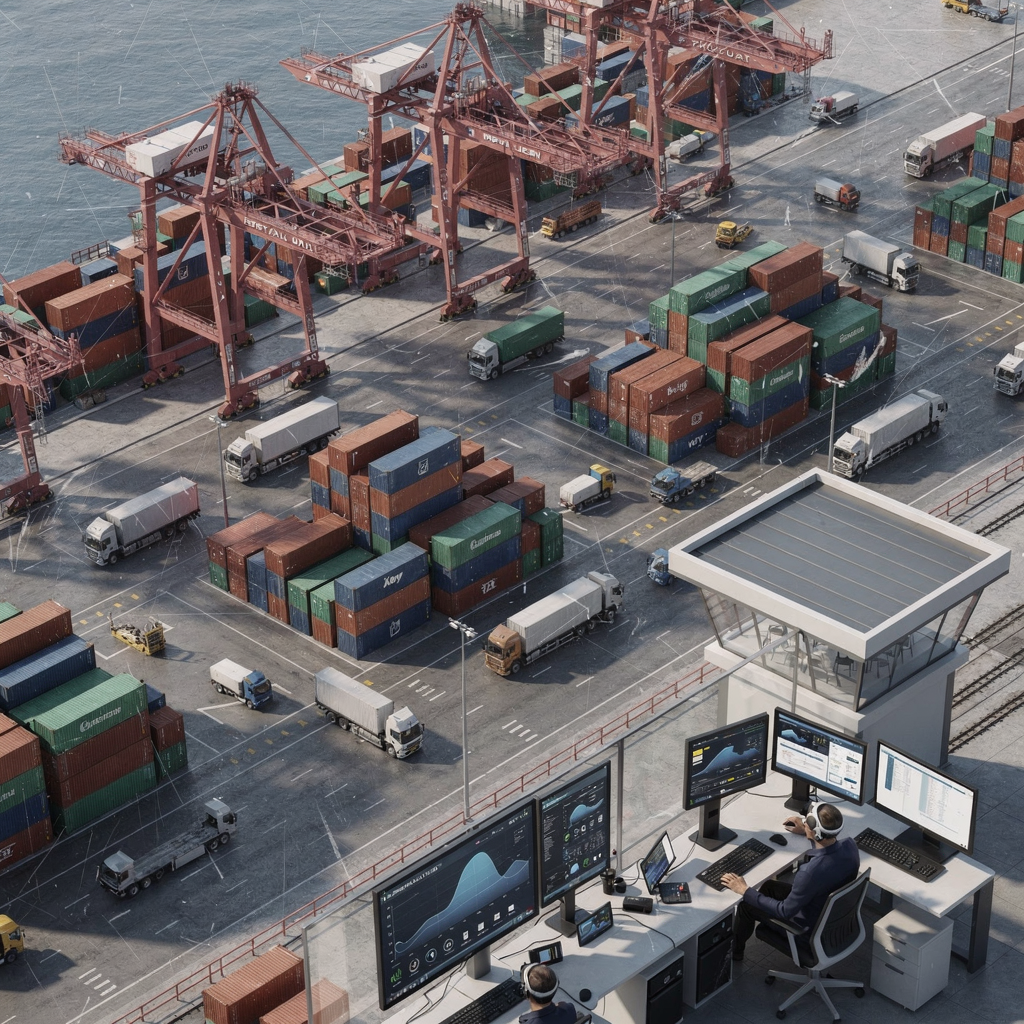
A simulation model in a terminal context is a structured digital copy of workflows, rules, and physical layout that decision-makers use to test scenarios. First, the model represents quay, yard, gate, and truck interactions. Then, it layers arrival patterns, equipment cycles, and human decisions. The digital twin expands that idea. A digital twin runs in a sync loop with the live terminal, so analysts can compare predicted behavior with what actually happens today. For that reason, many teams treat the digital twin as both a planning and verification asset. The literature notes that “simulation should be seen as a form of decision support system, that is, it supports decision-making rather than making decisions on behalf of” users, which captures this intent and gives authority to simulation outputs [source].
Virtual replicas let teams run stress tests in a risk-free environment. For example, planners can run multiple vessel arrival profiles, then test yard strategies and quay crane allocations without disrupting live operations. This approach helps to surface hidden trade-offs, such as when boosting crane moves per hour increases driving distance in the container yard. Loadmaster.ai uses a digital twin to train RL agents so the agents learn by simulation millions of decisions before any real-world deployment. That method reduces dependency on historical data and helps the terminal to plan for unfamiliar vessel mixes.
Benefits for infrastructure design and capacity planning are clear. Designers and port authorities can forecast berth occupancy, evaluate terminal layout changes, and vary equipment fleets. When validated, the simulation model becomes verifiable and provides visual feedback for stakeholder reviews. In addition, running stress tests helps with risk mitigation and disruption response by quantifying idle time and demurrage under different scenarios. Practically, the digital twin and model let teams validate control system changes and measure system performance before capital spends. For more on building a practical testbed, see our guide to terminal optimisation digital twin for related workflows and methods.
Finally, a well-built model improves communication between planners, operations teams, and engineering. It supports capacity planning, informs maintenance windows, and guides new terminal projects. Because the digital twin reflects both infrastructure and operational constraints, it becomes a powerful tool for decision-making across short-term and strategic horizons.
simulation software, port simulator and port simulation software for ports and terminals
Choosing the right simulation software matters. Popular platforms such as Arena and AnyLogic each offer strengths for port and terminal contexts. Arena has been applied in port studies to improve routing and timing, reducing waiting costs for ships and trucks, which directly lowers idle time and demurrage in many cases [source]. AnyLogic supports hybrid modeling and agent-based approaches that suit complex vessel mixes and multimodal transportation. Both tools can model discrete events, resources, and queues so planners can compare alternatives under identical assumptions.
Port simulators and terminal simulation software share common features. They model container yard flows, quay crane operations, gate throughput, and truck sequencing. Typical port simulator capabilities include 3D visual feedback, KPI dashboards, and the ability to run multiple scenarios in parallel. Terminal teams rely on those features to test yard layout changes and to optimize port handling rules. Advanced solutions also integrate with the terminal operating system so that simulation outputs can be compared with real-time telemetry and TOS schedules. If you want to explore how to link your TOS and a digital twin, our review of simulation and optimisation tools for TOS describes common architectures and APIs.
Integration with real-time feeds is a key differentiator in modern terminal simulation software. Live timestamps, gate scans, and equipment telemetry let the port simulator reflect current congestion and then propose near-term adjustments. This real-time capability improves decision support and permits short-run corrections to vessel stow plans or gate schedules. Users can thus run a discrete event simulation to measure expected queue lengths and predict waiting times, and then adjust staffing or allocation.
For terminals that face unpredictable volumes, simulation tools become a trusted way to test “what if” trade-offs. For example, teams can test increasing RTG counts or changing shift patterns and then measure equipment utilization, moves per hour, and throughput. If you need a practical how-to, our guide on how to simulate container terminal operations shows a step-by-step workflow for building scenarios, selecting variables in a simulation model, and validating results.
Drowning in a full terminal with replans, exceptions and last-minute changes?
Discover what AI-driven planning can do for your terminal
decision support and optimization in terminal simulation to optimize operations
Simulation supports decision support by turning model output into actionable choices. First, a simulation run produces KPIs such as berth occupancy, queue lengths, and crane productivity. Next, analysts feed those metrics into optimization algorithms to balance objectives. For example, berth allocation routines use optimization algorithms to minimize vessel waiting while keeping yard congestion manageable. Then, the dispatch rules tested in simulation inform the terminal operating choices applied by the operator team.
Optimization methods range from mixed-integer programming to heuristic search and reinforcement learning. In practice, many terminals use simulation-based optimization to handle nonlinear constraints and stochastic arrivals. A good decision support workflow links simulation runs to an optimizer, and then to a set of ranked plans that planners can review. In one study, combining AHP with simulation helped identify critical performance factors and led to measurable gains across dry and maritime ports [source]. That combined approach shows how qualitative weights can translate into quantitative operational plans.
There is a trade-off between tactical and strategic planning. Tactical decisions—such as crane sequencing for a single vessel—require rapid responses and small-horizon models. Strategic planning—such as terminal expansion—uses longer horizons and broader scenarios. Running both types of runs in the same simulation environment helps anchor tactical choices in strategic goals. For instance, the terminal operating system can accept a recommended berth schedule from a simulation optimization and then execute via API. Our internal work at Loadmaster.ai demonstrates closed-loop optimization where RL agents trained in a digital twin make coordinated choices for stow, stack, and job dispatch. This method shifts teams from firefighting to proactive control by reducing rehandles and balancing workloads.
Decision support also helps with validation and audit trails. When planners select a plan, the simulation run and optimizer logs provide a verifiable record. This is essential for governance and for tuning future runs. Overall, simulation-based decision support turns complex inputs into robust, explainable proposals that terminal operators can endorse and implement.
automation and allocation: rtg, gantry and straddle carrier
Modern terminals use a mix of RTG, gantry, and straddle carrier equipment to handle containers. Automation affects both equipment roles and allocation models. Automated guided vehicles and control systems can handle repetitive transfers, while humans focus on exceptions. A well-designed allocation model assigns moves to RTG cranes or gantry units to reduce driving distance and to keep shifts productive. For instance, allocation routines can prioritize minimizing travel time, then protect quay resources during peak arrivals. This kind of multi-objective control is where simulation is a powerful tool for port planners.
Resource allocation models often include constraints such as reachability, interference, and safety buffers. Simulation modeling helped terminals estimate the right mix of automated and manual equipment by running scenarios that vary the number of RTG cranes and straddle carrier fleets. Those experiments reveal sensitivity to arrival patterns and reveal the marginal return of adding an extra gantry. In many cases, an extra RTG yields diminishing returns beyond a certain yard utilization threshold, while smarter allocation yields better gains with less capital.
The impact on labour, energy use, and operational flexibility must be assessed. Automation can reduce manual driving, but it can also require higher up-front investment and different skills. Simulation allows teams to compare life-cycle outcomes: energy use, utilization, maintenance windows, and service continuity. Terminal operators can test policies such as swapping RTG shifts or redefining gantry coverage without risking day-to-day throughput. For those looking to benchmark software tools before committing, see our enterprise simulation tools for port logistics review for comparative features and system requirements.
Finally, allocation models inform training and governance. When automation is phased in, the operator roles evolve. Simulation yields training scenarios and validates that the control system integrates with the terminal operating system. That test proves the new workflows before operations change, reducing disruption response time and protecting operational KPIs.
Drowning in a full terminal with replans, exceptions and last-minute changes?
Discover what AI-driven planning can do for your terminal
crane bottleneck analysis to optimize throughput
Crane-related issues are a common source of delay at the quay. Identifying crane bottleneck points is essential to optimize throughput. A focused analysis starts with data: cycle times, downtime logs, and interference patterns. Then, the simulation model tests variations in crane numbers, positions, and assignation policies. This approach quantifies the trade-offs between adding a quay crane and improving quay scheduling. For example, increasing crane count may cut vessel turnaround initially, but without aligned yard allocation it can create congestion inland.
Using simulation, teams can test specific changes and then measure moves per hour and queue lengths. You can simulate alternative crane cycles, and then measure how changes reduce waiting times for ships and trucks. In one report, discrete event simulation was used in port terminals to tune crane allocations and to lower waiting costs [source]. That study shows how a structured test in a simulation environment produces verifiable gains in vessel handling.
Methods to optimise throughput include altering crane spacing, changing crane work windows, and testing split-gantry patterns. It is also useful to model human factors: handovers, shift changes, and planned maintenance. When planners run a stress test that introduces an unplanned breakdown, the model reveals how resilient the quay plan is and which cranes are critical. The outcome helps set maintenance priorities and improves berth occupancy forecasts. For readers planning such an analysis, our guide on how to simulate container terminal operations includes sample variables in a simulation model and practical checklists for data collection.
Finally, combine crane analysis with yard allocation and gate scheduling to unlock full value. Small changes in crane sequencing often cascade into significant reductions in rehandles and shorter vessel stays. By testing these changes in a model, terminals reduce risk and improve decision quality. For further reading on integrated approaches, see the resilient port decision support study that explains simulation-optimization architectures for large-scale problems [source].
real-world case studies on passenger flow
Real-world examples show how simulation improves passenger flow by 20–30% in airports and transport hubs. For instance, passenger-focused terminal simulation tools can quantify bottlenecks at security, check-in, and boarding gates. CAST Terminal provides a clear example of how modeling passenger flow and capacity yields tactical and strategic benefits; its 3D visualizations and statistics help planners decide where to add checkpoints or reassign staff [source]. In airport contexts, improvements often arise from re-sequencing processing steps rather than from costly expansion.
Ports that handle ferry and cruise passengers also benefit from simulation. A model can simulate embarkation and disembarkation schedules, queueing at immigration, and the allocation of holding areas. These case studies often show measurable reductions in queue lengths and faster turnaround for vessels. For example, passenger processing simulation reduced dwell time in a cruise terminal scenario that then cut peak congestion by meaningful percentages. Those lessons generalize to other terminals that handle mixed flows of cargo and people.
Key performance indicators in these projects include average wait per passenger, peak queue length, and staff utilization. These KPIs guide decisions about where to place resources, how many check points to open, and when to call in surge staff. The same simulation approaches transfer well to port terminals that combine vehicle and foot traffic. In addition, simulation can estimate the impact of environmental factors such as weather-related delays on passenger throughput.
Case studies also teach operational lessons. First, simulations must be validated with live observations to avoid miscalibrated assumptions. Second, user-friendly visualization accelerates stakeholder buy-in. Third, running multiple scenarios builds confidence in plans and prepares teams for disruption. For practitioners, a mix of discrete event and agent-based methods often works best, and you can explore open-source options in our post on open source terminal simulation software. Overall, these studies confirm that simulation can be used to make measured, low-risk changes that improve passenger and port or terminal efficiency.
FAQ
What is a simulation model for a terminal?
A simulation model for a terminal is a virtual representation of physical layout, equipment, and workflows. It lets planners test changes in a risk-free environment before real-world implementation.
How does a digital twin differ from basic simulation?
A digital twin syncs with live data and mirrors current conditions, while basic simulation often runs on historical or synthetic inputs. This live linkage enables near-term decision support and validation against observed performance.
Which simulation software do terminals commonly use?
Terminals use platforms like Arena and AnyLogic for discrete event and hybrid modeling. You can read comparisons and tool reviews in our enterprise simulation tools for port logistics and on selection guides.
Can simulation help reduce waiting times at gates?
Yes. By modeling queueing and staff allocation, simulation can show where to add checkpoints or reassign personnel, helping to reduce waiting times and peak queues.
Is automation always better for a container terminal?
Not always. Automation can lower labour needs and energy use but requires capital and new skills. Simulation helps balance these trade-offs before investment.
How many quay cranes should a terminal have?
There is no one-size-fits-all number. Simulation lets you test crane counts and positions under varying arrival patterns to find the marginal benefit for throughput and berth occupancy.
What benefits do RL agents provide in terminal control?
Reinforcement Learning agents can search policy space beyond historical averages, adapt to changing conditions, and balance competing KPIs. Loadmaster.ai trains RL agents in a digital twin so they can optimize stow, stack, and dispatch decisions without relying on past mistakes.
How does simulation support decision support workflows?
Simulation produces KPIs and scenario outputs that feed optimization routines. Those routines produce ranked plans, which planners then review and execute, creating a verifiable record of choices.
Can passenger flow studies be applied to ferry terminals?
Yes. The same methods model embarkation, immigration, and holding areas and can reduce queue length and improve vessel turnarounds. Visual dashboards help operational teams see impacts quickly.
Where can I learn to build a terminal simulation?
Start with guides that cover variables in a simulation model, data needs, and validation checks. Our how to simulate container terminal operations page offers practical steps and links to discrete event simulation software options.
our products
 stowAI
 stackAI
 jobAI
jobAI
Innovates vessel planning. Faster rotation time of ships, increased flexibility towards shipping lines and customers.
Build the stack in the most efficient way. Increase moves per hour by reducing shifters and increase crane efficiency.
Get the most out of your equipment. Increase moves per hour by minimising waste and delays.
stowAI
Innovates vessel planning. Faster rotation time of ships, increased flexibility towards shipping lines and customers.
stackAI
Build the stack in the most efficient way. Increase moves per hour by reducing shifters and increase crane efficiency.
jobAI
Get the most out of your equipment. Increase moves per hour by minimising waste and delays.