
Port Simulation Software and Simulation Model Fundamentals
Port simulation tools model complex workflows so planners can test changes without shutting live systems. In practice, a discrete-event simulation model represents events such as crane arrivals, truck queues, and container moves. For clarity, discrete-event approaches let users step through each interaction. This makes it simpler to measure KPIs and validate layout choices.
Core modules usually include quay crane logic, yard management, gate and truck flows, plus schedule and berth allocation. Each module links to the next. For instance, quay crane sequences affect yard stacking and truck assignment. Therefore a realistic model must reproduce the interplay between crane operations and yard layout. This helps teams identify bottlenecks and improve utilization.
A leading commercial product is AnyLogic, which offers mixed-method modelling and 3D visualization for terminals. AnyLogic supports agent-based and discrete-event constructs, and so it is suitable for both detailed operational studies and higher-level strategy tests. Researchers report that discrete-event methods dominate recent studies; over 70% of port research projects apply simulation for terminal analysis [literature review].
Users should expect modules for quay, yard, gate, and truck flows, plus interfaces to TOS and telemetry. When choosing tools, check for export/import options and an editable simulation model. Also verify the product supports scenario comparison and validation against real metrics. For practical guides on building models and connecting a TOS, see our walkthrough on how to simulate container terminal operations.
This chapter used discrete-event concepts and industry examples to set the base for deeper comparisons. In addition, simulation enables safe experimentation and the ability to verify changes before deployment. Finally, teams should balance fidelity with usability to keep learning curves manageable.
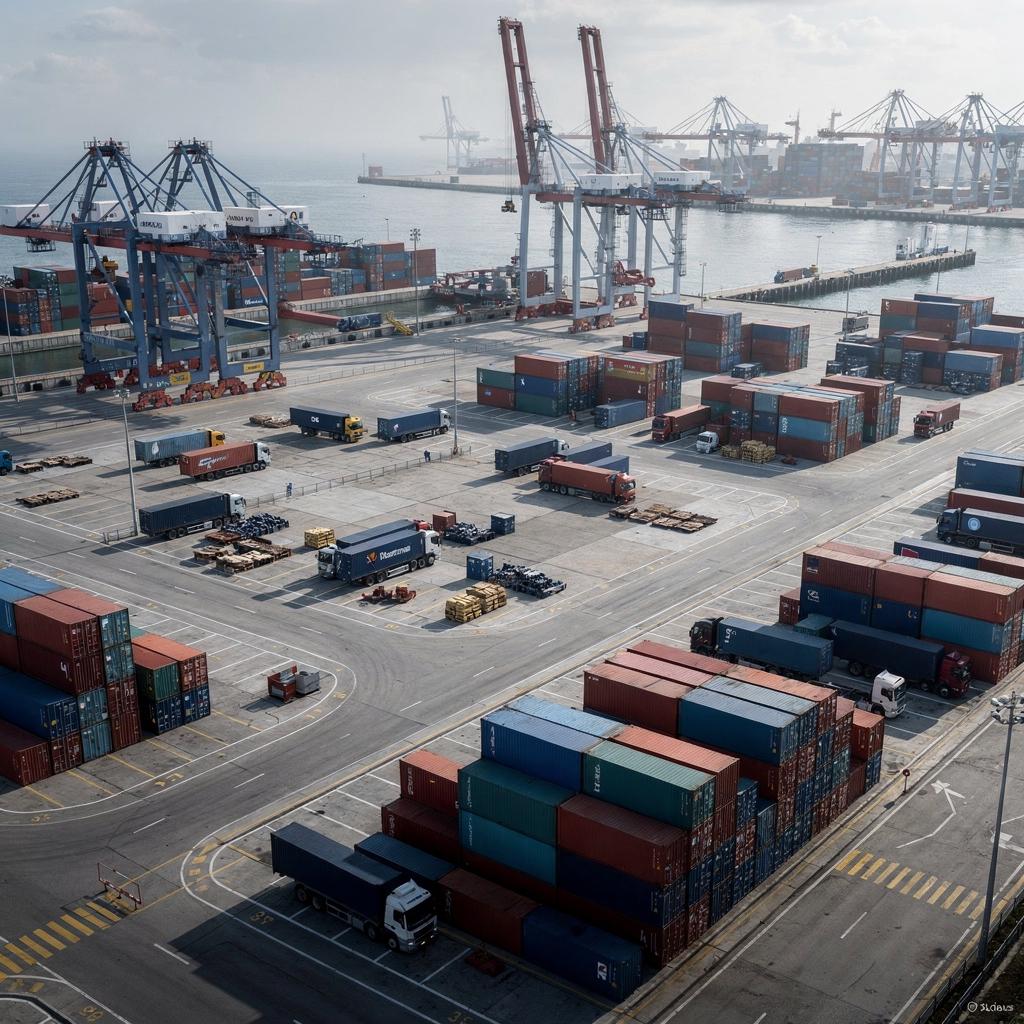
Comparing Simulator and Software for a Port Terminal
Choosing a simulator for a port terminal requires comparing licensing, interface, and integration. Popular products include AnyLogic, FlexSim, Simio, and WITNESS. Each offers distinct strengths. For instance, some focus on rapid model building while others prioritize granular equipment-level fidelity. A practical comparison highlights ease of use, the learning curve, and support for TOS integration.
Licensing varies from node-locked seats to server-based deployments. Flexible licensing can reduce total cost during pilot work. Also check whether the vendor offers sandboxes for testing. If you want a quick demo, ask for a tailored scenario. A short demo helps teams evaluate configuration effort and validate assumptions before committing.
User interfaces matter. Visual drag-and-drop modelers speed up early development. Meanwhile, code-based platforms grant deeper control. Consider whether staff prefer visual modeling or scriptable APIs. For terminals aiming to integrate with a terminal operating system, verify compatibility. Many ports require connections to Navis or alternative TOS solutions, so look at available connectors and adapters. For a comparison of TOS choices that may matter during integration, see our analysis of best terminal operating systems.
Integration also affects real-time data ingestion and validation. Some simulators include out-of-the-box connectors for telemetry and EDI. Others need middleware. If the goal is to shift from offline what-if studies to online decision support, prioritize products with robust APIs and a clear path for deployment. For enterprise-level tool guidance, review our roundup of enterprise simulation tools for port logistics.
Finally, evaluate how the product handles verification, benchmarking, and scenario replication. Ideally the tool should produce reproducible outputs, allow stepwise validation, and export metrics for reporting. Ask vendors for a benchmark against your KPIs and confirm expected utilization and throughput metrics in a pilot model before wider rollout.
Drowning in a full terminal with replans, exceptions and last-minute changes?
Discover what AI-driven planning can do for your terminal
Optimize Port Operations: Automation, Bottleneck Analysis and Cost Savings
Simulation helps teams identify yard and quay bottleneck points quickly. By replicating vessel arrival patterns and yard stacking rules, a model can surface unexpected congestion. You can then test changes to dispatch rules, crane sequencing, or gate staffing. This approach reduces guesswork and supports data-driven decisions about investments.
Automation scenarios are often explored in simulation. For example, modelling automated stacking cranes, AGVs, or assisted vehicles reveals impacts on route lengths, crane dwell, and labor roles. The right scenario can lower operational costs and increase moves per hour. One case study shows simulation reduced operational costs by up to 15% and increased throughput by roughly 10–20% through better resource allocation [AnyLogic case] and [case study].
Loadmaster.ai uses simulated training to improve dispatch and sequencing. Our RL agents spin up a sandbox digital twin, train policies, and then deploy with guardrails to reduce rehandles and shorten driving distances. This closed-loop approach lets terminals test policies in a risk-free environment and then push those policies live with confidence. Use of sim-trained agents can maximize crane utilization while cutting congestion and delay.
Quantified cost savings include lower fuel and labor hours, fewer rehandles, and improved throughput. These savings are often expressed as reductions in operational costs and as improved utilization of equipment. For terminals assessing potential gains, run a benchmark scenario that tracks crane operations, yard travel, and truck turnaround. The outputs give a clear metric set for ROI decisions.
When you optimize with simulation, remember to validate assumptions. Run sensitivity tests, vary arrival patterns, and verify results against historical peaks. Then use validated scenarios to guide phased automation deployment and schedule updates that protect yard balance and throughput.
Digital Twin and Real-World Support in Port Logistics
A digital twin differs from a traditional model by linking live feeds and enabling continuous alignment with the physical estate. Where a simulation is an offline what-if tool, a digital twin ingests telemetry to reflect current states. This supports proactive responses and faster decision-making in busy marine environments.
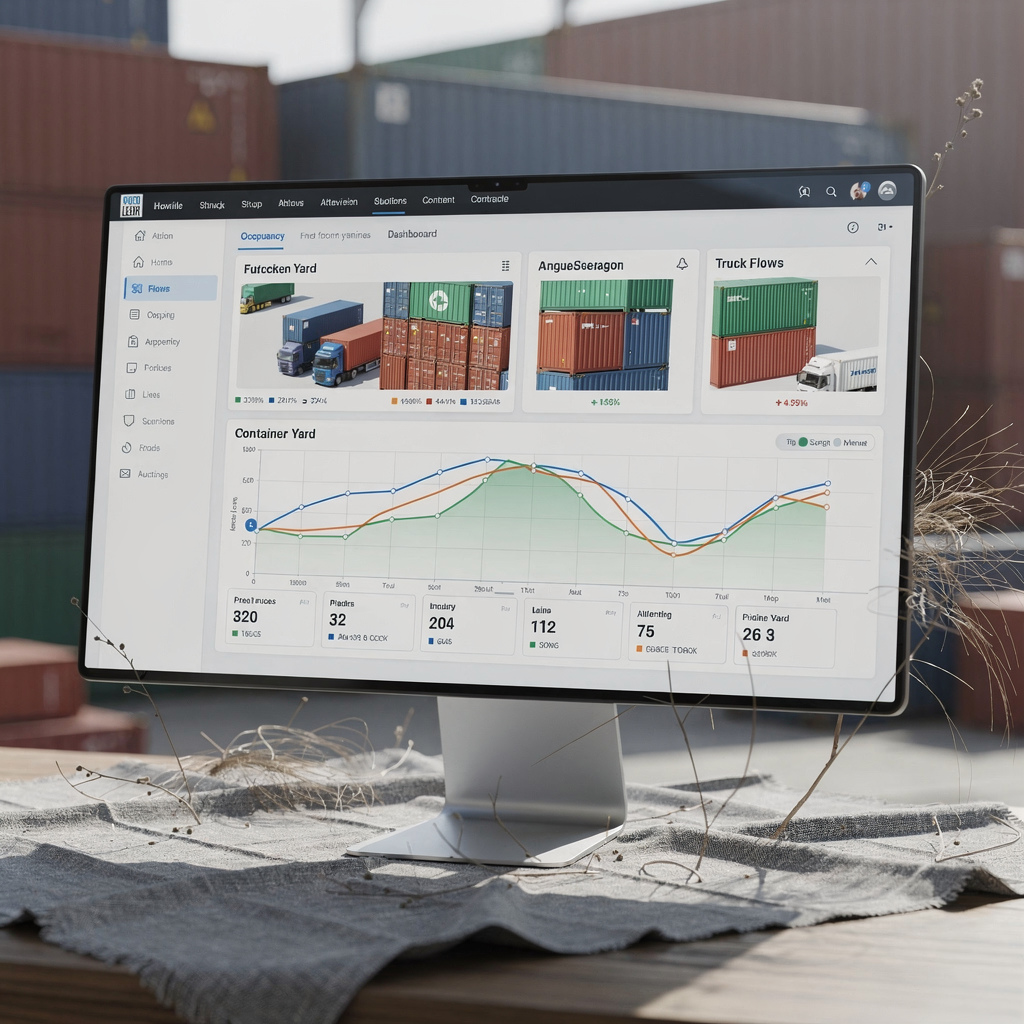
Digital twins provide real-time dashboards that improve visibility. Live dashboards combine metrics like queue lengths, crane productivity, and key metric alerts. For example, a dashboard can flag a pending gate surge and suggest schedule adjustments before congestion grows. This improves visibility and helps staff take proactive measures.
Integration of live feeds requires connectors to TOS and equipment telemetry. Good twins offer APIs to integrate EDI, GPS, and RTG telemetry so that the virtual model stays aligned. This enables scenario replay and helps verify new assignments or reconfigurations under realistic conditions. The difference shows when teams must validate strategies under stress.
Benefits include faster decision-making, better predictability, and improved contingency handling during disruptions. A digital twin supports verify-and-deploy cycles and lowers risk during live rollouts. A recent study shows that combining simulation with analytics improves throughput forecasting accuracy by around 12–18% [analytics study].
Finally, twin architectures should be robust and secure. Make sure the architecture supports safe deployment and meets regulatory requirements. Loadmaster.ai’s approach trains agents in a replica twin and then deploys policies with safety checks, which helps terminals adopt novel control logic while preserving governance and audit trails.
Drowning in a full terminal with replans, exceptions and last-minute changes?
Discover what AI-driven planning can do for your terminal
Simulation Software for Port Terminal: From Forklift Handling to Full Automation
Simulation can model simple manual tasks such as forklift moves and expand to full automation scenarios. At the smallest scale, modelled forklift activities reveal micro-level delays, idle times, and handling mistakes. A careful representation of forklift routes and docking reduces conflict and shortens task times.
From there, models scale to manual yard processes and then to semi-automated arrangements. These include assisted stacking and automated transfer vehicles. Finally, the same framework can represent fully automated terminals, where cranes, AGVs, and yard systems follow scripted or learned policies. This staged path helps teams manage change without disrupting container terminal operations.
When modelling manual processes, include forklift cycle times, shift patterns, and safety clearances. For automated scenarios, capture controller logic and inter-vehicle coordination. Successful pilots show that balancing yard layout against crane scheduling improves throughput and reduces rehandles. Use a review of container terminal simulation to compare staged results and scalability.
Safety and labour impact also deserve attention. Automation often reduces repetitive strain and enhances safety, but it also changes staffing needs and training. For human-centered transitions, include realistic assignment rules and shift rotation in the model. That helps verify human–machine handoffs under normal and stressed conditions.
Finally, evaluate performance using a consistent metric set. Track moves per hour, average delay, and utilization. Running these benchmarks offers a clear comparison between forklift-led and fully automated workflows. Use the results to plan phased deployment, training, and management software updates so the terminal reaches improvements with minimal disruption.
Future of Port Simulation: Twin, Software Support and Advanced Optimization
Looking ahead, AI-driven simulation and predictive analytics will shape future terminal control. Hybrid models that combine agent-based techniques with reinforcement learning let systems learn policies tailored to specific layouts and KPIs. These methods can help verify algorithms before live deployment and reduce the learning curve for new strategies.
Cloud deployment and mobile access will broaden who can run experiments and view dashboards. That means teams can spin up a sandbox twin and run stress tests from any location. Platform options will support fast deployment and will let operators evaluate changes rapidly. For tools that link simulation and TOS, consider our guide to simulation and optimisation tools for TOS.
Advanced optimization will include predictive schedule updates and proactive resource rebalancing. Reinforcement learning agents can leverage millions of simulated decisions to produce robust policies that adapt to vessel mix or weather. These agents help validate a range of configurations and provide a safe path to operational adoption.
To ensure uptake, focus on usability and explainability. Operators must trust the outputs and be able to validate choices against familiar metrics and KPIs. Running benchmarks and validation suites helps teams verify gains and replicate results. For capacity planning, simulation tied to terminal capacity planning software yields clear forecasts and investment guidance [capacity tools].
As software and twins converge, expect shorter demos, faster pilots, and more measurable cost savings. Finally, keep governance front and center: validated deployments that include audit trails will support regulatory readiness and long-term adoption. This pragmatic path will help terminals leverage new models without risking daily operations.
FAQ
What is port simulation and why use it?
Port simulation models terminal processes to test scenarios without affecting live operations. It helps teams predict throughput, verify schedules, and reduce risk before making physical changes.
Which software tools are commonly used for terminal modelling?
Common options include AnyLogic, FlexSim, Simio, and WITNESS. Each tool offers different balances of fidelity, usability, and API access for integration.
How does a digital twin differ from traditional simulation?
A digital twin links live telemetry to a virtual model for continuous alignment with the physical terminal. Traditional simulation is typically offline and used for what-if analysis rather than ongoing synchronization.
Can simulation quantify cost savings?
Yes. Published case studies report reductions in operational costs and improvements in throughput when terminals adopt optimized sequences and automation. Those studies provide benchmarks you can use to estimate ROI for similar layouts.
How do I validate a simulation model?
Validation involves checking model outputs against historical metrics and running sensitivity tests. Also, perform step-by-step verification of logic for critical modules like quay and yard sequences.
Is it possible to integrate simulation with a TOS?
Integration is possible and common. Many enterprise tools provide APIs or adapters to exchange data with terminal operating systems for scenario replay and real-time dashboards.
What role does AI play in modern terminal simulation?
AI such as reinforcement learning can learn policies by simulating millions of decisions in a twin. This yields robust control strategies that adapt to changing vessel mixes and disruptions.
How do pilots and demos usually work?
Pilots start with a sandbox model of the terminal, run targeted scenarios, and measure improvements in key metrics. Demos focus on a few representative use cases to evaluate configuration needs and expected benefits.
What metrics should terminals track when using simulation?
Track moves per hour, average delay, utilization, yard travel, and rehandles. These metrics give a clear picture of operational performance and help verify improvements from changes.
How long does it take to see results from a simulation project?
Small pilots can deliver insights in weeks, while full deployments may take a few months including validation, integration, and staff training. The timeline depends on data readiness and the scope of scenarios.
our products
 stowAI
 stackAI
 jobAI
jobAI
Innovates vessel planning. Faster rotation time of ships, increased flexibility towards shipping lines and customers.
Build the stack in the most efficient way. Increase moves per hour by reducing shifters and increase crane efficiency.
Get the most out of your equipment. Increase moves per hour by minimising waste and delays.
stowAI
Innovates vessel planning. Faster rotation time of ships, increased flexibility towards shipping lines and customers.
stackAI
Build the stack in the most efficient way. Increase moves per hour by reducing shifters and increase crane efficiency.
jobAI
Get the most out of your equipment. Increase moves per hour by minimising waste and delays.