
How simulation Enhances terminal Capacity Planning
Terminal capacity planning defines limits, forecasts demand, and allocates space and staff. The goal is to plan for rising passenger and cargo volumes while avoiding costly expansion. However, growth often brings peaks, variability, and complex interactions. Also, long queues and inconsistent service appear when planners react rather than plan. Simulation provides a method to test ideas without disrupting real operations. For example, a simulation can replay busy days and reveal a hidden bottleneck at security or a gate. Then planners can test new staffing schedules, altered layout, or different queue rules. This reduces risk and accelerates informed decisions.
Simulation pinpoints bottleneck locations with data-driven clarity. It can show which check-in islands, gates, or baggage belts cause delays. Next, planners can test layout changes and staff schedules before any construction or contracts. Simulation also helps decision support by quantifying trade-offs. For instance, it can compare extra gate capacity versus faster transfer lanes and show which yields the best return on investment. A study shows that advanced planning tools and simulation can increase throughput by 20–30% without adding infrastructure. Also, other reviews report a typical 15% reduction in operational costs from capacity planning and modeling.
Simulation supports multiple metrics. It measures waiting times, queue lengths, utilization, and service levels. It also calculates space needs for future traffic and estimates facility requirements. Also, planners can run what-if scenarios to estimate the impact of a new airline route, seasonal peaks, or a sudden staff shortage. Simulation then produces a set of actionable outcomes that planners can trust. For airport managers and port planners, this translates into fewer surprises and measurable throughput gains. Finally, simulation builds a safer, more sustainable terminal. It can recommend changes that minimize congestion, reduce energy use, and lower emissions while keeping passengers and cargo moving.
Key Features of terminal simulation software and simulation modeling
Demand forecasting modules combine historical data and real-time feeds to predict peak loads. They can ingest flight schedules, cargo manifests, and sensor streams. Also, these modules support algorithmic forecasts and user overrides. Planners can test scenarios using the forecast and then refine assumptions. Resource allocation tools then assign gates, berths, cranes, and storage slots with clear rules. The system can allocate based on priority, ETA, or service level targets. Also, resource allocation helps balance workloads and reduce idle time for equipment and staff.
3D visualization and scenario-based simulation modeling provide clear, visual reports. Planners can watch animated flows and see which terminal layouts cause congestion. This makes it easier to test different terminal layouts before any build. A platform that integrates with Terminal Operating Systems delivers automation and better yard management. For example, a TOS integration can export berthing plans and import telemetry for cranes. Links to practical tools and reviews help teams choose the right stack. See this guide on simulation and optimisation tools for TOS for options and setup advice.
Advanced simulation software often supports both discrete event and agent-based approaches. This enables multi-agent behavior for passengers, ground handling companies, and vehicles. Also, AnyLogic and similar platforms provide flexible modeling libraries for airport and container terminal problems. For teams on a budget, there are open-source alternatives and guides on open-source terminal simulation software. The right simulation tools deliver a user-friendly dashboard, scenario management, and a pathway to automation. They can also connect to a digital twin. A digital twin creates a live, testable copy of terminal facilities and operational processes. Using simulation and a digital twin together allows planners to refine strategies in a risk-free environment. Finally, a simulation software license should include support for calibration, validation, and training so teams can trust the outputs.
Drowning in a full terminal with replans, exceptions and last-minute changes?
Discover what AI-driven planning can do for your terminal
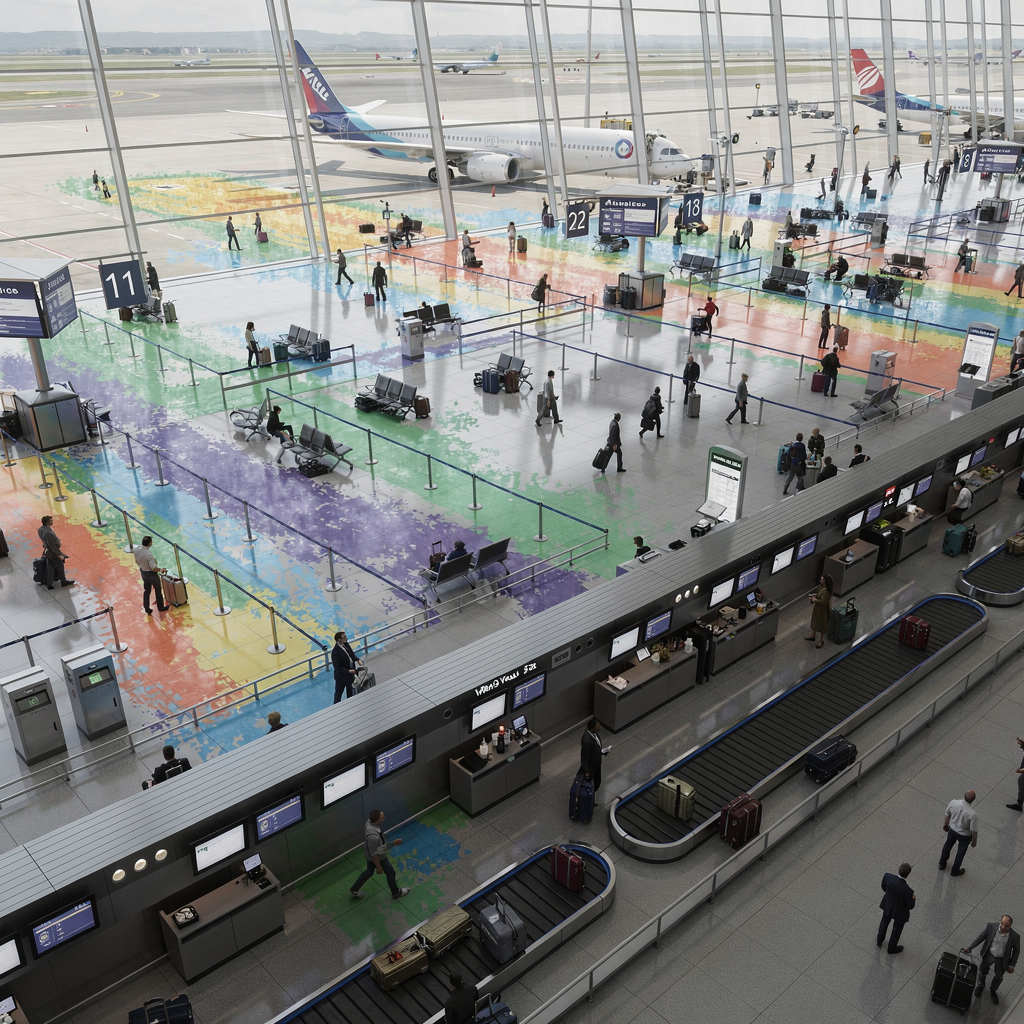
Building a discrete event model of passenger flow in airport terminal
Discrete event techniques work well for passenger flow because they model events like check-in, screening, and boarding. They capture queues and service times precisely. Also, discrete event models let you simulate arrival bursts tied to flight schedules. The model treats each passenger as an entity that triggers events. These events move passengers through check-in, security, retail, and boarding. Data inputs include flight schedules, arrival rates, processing times at check-in and security, and transfer times between zones. Also, you feed in staff rosters and equipment counts to reflect real-world constraints.
Model outputs provide queue lengths, dwell times, space utilisation, and service levels. You can also extract waiting times per process and identify peak congestion periods. Also, outputs help set staffing levels and facility requirements. To validate the model, compare simulated outputs with logs or sensor data from days with typical traffic. Calibration adjusts service distributions and arrival patterns until simulated waits match recorded waits. Use a validation set of days for an unbiased check. Also, use statistical measures like mean absolute percentage error to quantify fit.
Tools like AnyLogic support building a robust simulation model developed for passenger-centric flows. The model can incorporate agent-based elements such as passenger choice behavior and route selection. Also, plug in a digital twin to visualize results and to test different terminal layouts. For airports, a well-calibrated model helps quantify the impact of added security lanes, new gates, or modified queuing policies. It lets airline operations test boarding strategies and reduces last-minute changes. Finally, model outputs feed into broader airport capacity planning and resource allocation processes. This gives airport operators the evidence they need to make informed decisions and to justify investment in processes or infrastructure.
Optimization of container terminal operations with port simulation software
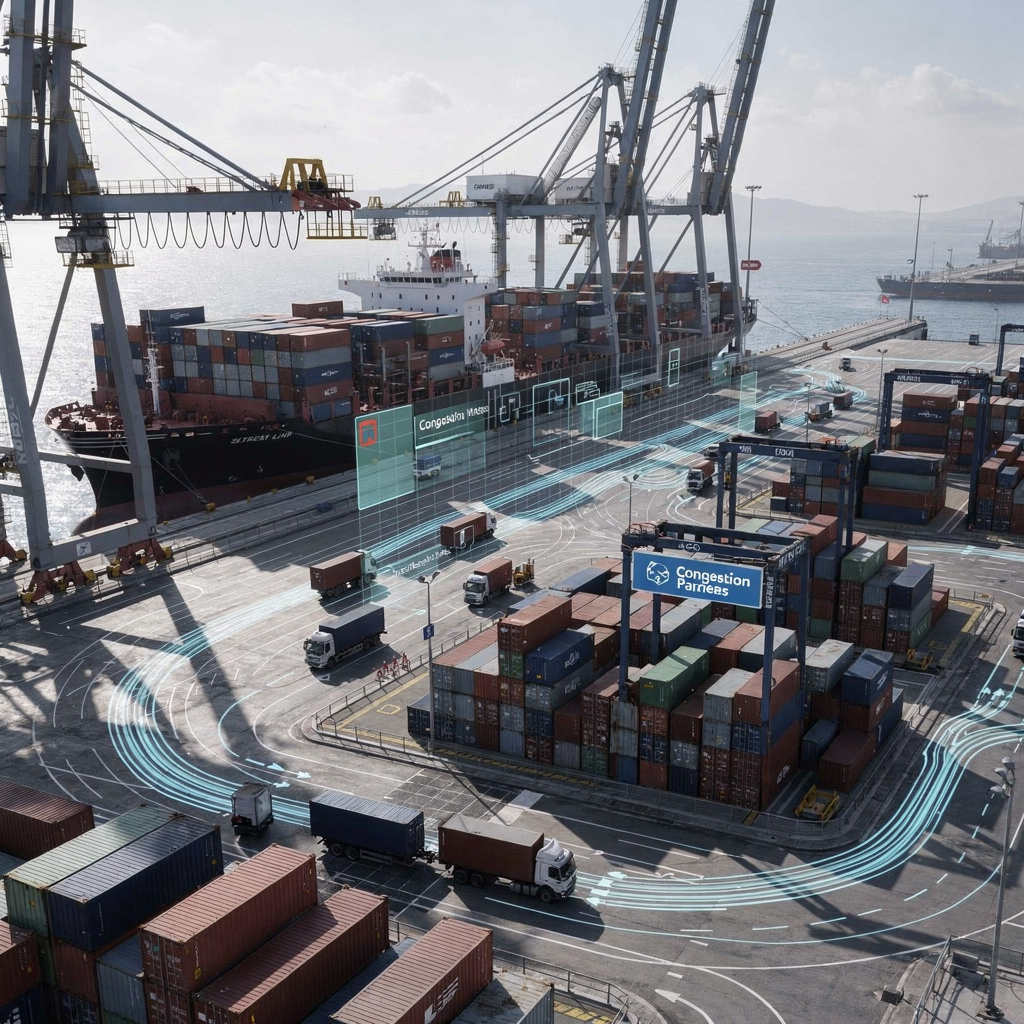
Port simulation software schedules vessel berthing, allocates cranes, and sequences container moves. It models quay operations, yard stacks, and gate dispatch. Also, simulation helps allocate cranes to maximize moves per hour and to minimize rehandles. A case study shows that integrating TOS and planning tools can reduce vessel turnaround by up to 30%. In practice, planners use port and terminal models to test quay layouts, crane deployment, and berth windows. These models also test different stack strategies to reduce driving distance and even out workload among RTGs.
Loadmaster.ai applies reinforcement learning inside a digital twin to refine quay and yard policies. For example, StackAI and StowAI explore multi-objective trade-offs to reduce rehandles and balance workload. Also, JobAI coordinates dispatch to cut waiting times and idle time for equipment. This closed-loop approach runs millions of simulated episodes to discover policies that outperform historical rules. A proven result is higher crane utilization and shorter crane idle time without sacrificing yard stability. Also, many terminals report measurable operational costs savings and improved throughput after such projects.
Yard-stack planning and truck scheduling are central to smooth gate throughput. Simulation tests stack height, lane access, and truck appointment rules. Also, optimization algorithms can recommend where to place incoming boxes to reduce future reshuffles. Planners can run scenario sweeps and then refine policies that balance quay productivity and yard congestion. For more on simulating full terminal workflows, consult practical guides such as how to simulate container terminal operations. Finally, continuous improvement is possible by automating scenario analysis and by embedding feedback loops so the system learns from operational changes.
Drowning in a full terminal with replans, exceptions and last-minute changes?
Discover what AI-driven planning can do for your terminal
Integrating terminal simulation into supply chain for container port efficiency
Linking terminal simulation with upstream shipping lines and inland transport improves end-to-end flow. Simulation can accept ETA feeds and inland truck schedules to forecast yard congestion. Also, planners can test appointment systems and appointment windows to smooth peaks. This reduces dwell time and avoids costly delays. A container port that aligns truck gates, rail slots, and berth windows can reduce truck queues and better match quay output to inland capacity.
Forecasting cargo flows helps avoid stock-outs and yard congestion. Simulation can model seasonal demand, blank sailings, and hinterland disruptions. Also, it can quantify how a delayed feeder or a blocked rail link will cascade through the system. Planners then decide whether to reallocate boxes, change berthing priorities, or call additional equipment. The net effect is lower emissions and fewer needless moves. For instance, smoother handling reduces truck idling and cuts fuel use without hardware changes.
Integration builds resilience by allowing teams to test disruption scenarios at scale. Run a what-if case to evaluate the impact of port strikes, bad weather, or sudden surges in imports. Then refine contingency plans and identify which contracts or resources to call. Also, simulation supports multimodal optimization across rail and road and helps set system requirements for TOS and automation. Loadmaster.ai’s approach trains agents in a digital twin so policies are robust to unexpected loads. This reduces reliance on historical patterns and helps terminals adapt fast. Finally, an integrated simulation approach empowers planners and stakeholders with clear evidence for capital projects, operational changes, and strategic planning.
Case studies: terminal simulation software and simulation in real operations
Real deployments show measurable gains. A major airport hub used terminal simulation software to cut passenger delays by about 25% after redesigning queues and reallocating staff. The airport used a mix of discrete event and agent-based models to test passenger flows and to refine check-in layout. Also, that project linked simulation outputs to operations dashboards so staff saw live performance against targets. A quote sums the strategic value: “Terminal capacity planning is not just about managing space; it’s about aligning resources with demand in a way that maximizes throughput and minimizes delays,” says a senior analyst at DataCalculus.
A container port case study deployed port simulation software and then achieved top-quartile storage performance. Emerson reports clients reaching industry-leading capacity metrics after combining automation with planning modules. Also, another implementation achieved a 15% reduction in operational costs and better resource allocation across quay and yard. The learning here is clear: high-quality data and stakeholder engagement matter as much as the tool. Getting planner buy-in and phasing roll-out keeps projects on track and builds trust.
Lessons learned across case studies include four points. First, data quality is essential. Clean, timely inputs let you validate the simulation model and quantify results. Second, stakeholder involvement reduces resistance. Bring ground handling teams, airline reps, and TOS operators into the testing loop. Third, a phased roll-out lets you test different modules and refine the algorithm weights that reflect business priorities. Fourth, measure ROI through simple KPIs such as reduced waiting times, fewer rehandles, and higher utilization. A final note: a case study shows how simulation can change daily dispatch behavior and long-term investment choices. For terminals planning a program, consider tools that integrate with your TOS and that support a sandbox digital twin for safe testing. See reviews comparing TOS choices and approaches on pages like best terminal operating systems and practical TOS integrations such as TerminalControl TOS.
FAQ
What is terminal capacity planning software?
Terminal capacity planning software assesses how many passengers or containers a terminal can handle. It then helps prioritize resources and design layouts to meet demand while minimizing delays.
How does simulation improve airport capacity decisions?
Simulation models passenger flow and service processes, so planners see queue build-ups and peak loads. They can then test staffing and layout changes before making real-world investments.
What data is needed to build a discrete event model of passenger flow?
You need flight schedules, arrival patterns, processing times at check-in and security, and staff rosters. Also, sensor data and historical logs help calibrate and validate the model.
Can port simulation software reduce vessel turnaround time?
Yes. Studies show that integration of planning tools and TOS can cut vessel turnaround by about 30% in some cases. This results from better berth scheduling and crane allocation.
Is a digital twin required for effective simulation?
No, but a digital twin makes testing more realistic and repeatable. It also enables closed-loop training for AI agents and supports safer roll-outs into live operations.
How do optimization algorithms work in terminal simulation?
Optimization algorithms evaluate many scenarios and then select the best solution against defined KPIs. They can be heuristics, mathematical solvers, or AI-powered agents like reinforcement learning.
What role does the TOS play in simulation projects?
The Terminal Operating System supplies execution data and receives scheduled plans from the simulator. Tight integration reduces manual hand-offs and speeds up automation.
How long does it take to see ROI from simulation projects?
It varies, but many terminals report measurable improvements within months after deployment and integration. Quick wins often come from schedule and gate reallocation changes.
Can small terminals benefit from simulation tools?
Yes. Even small terminals can use simulation to test layout changes, truck appointment rules, and staffing shifts. Open-source and scaled tools make this affordable.
How do I validate a simulation model?
Validate by comparing model outputs with real operational data and by using statistical measures. Also, run sensitivity tests and get stakeholder feedback to ensure the model reflects operational processes.
our products
 stowAI
 stackAI
 jobAI
jobAI
Innovates vessel planning. Faster rotation time of ships, increased flexibility towards shipping lines and customers.
Build the stack in the most efficient way. Increase moves per hour by reducing shifters and increase crane efficiency.
Get the most out of your equipment. Increase moves per hour by minimising waste and delays.
stowAI
Innovates vessel planning. Faster rotation time of ships, increased flexibility towards shipping lines and customers.
stackAI
Build the stack in the most efficient way. Increase moves per hour by reducing shifters and increase crane efficiency.
jobAI
Get the most out of your equipment. Increase moves per hour by minimising waste and delays.