
Terminal model Architecture and Digital Twins
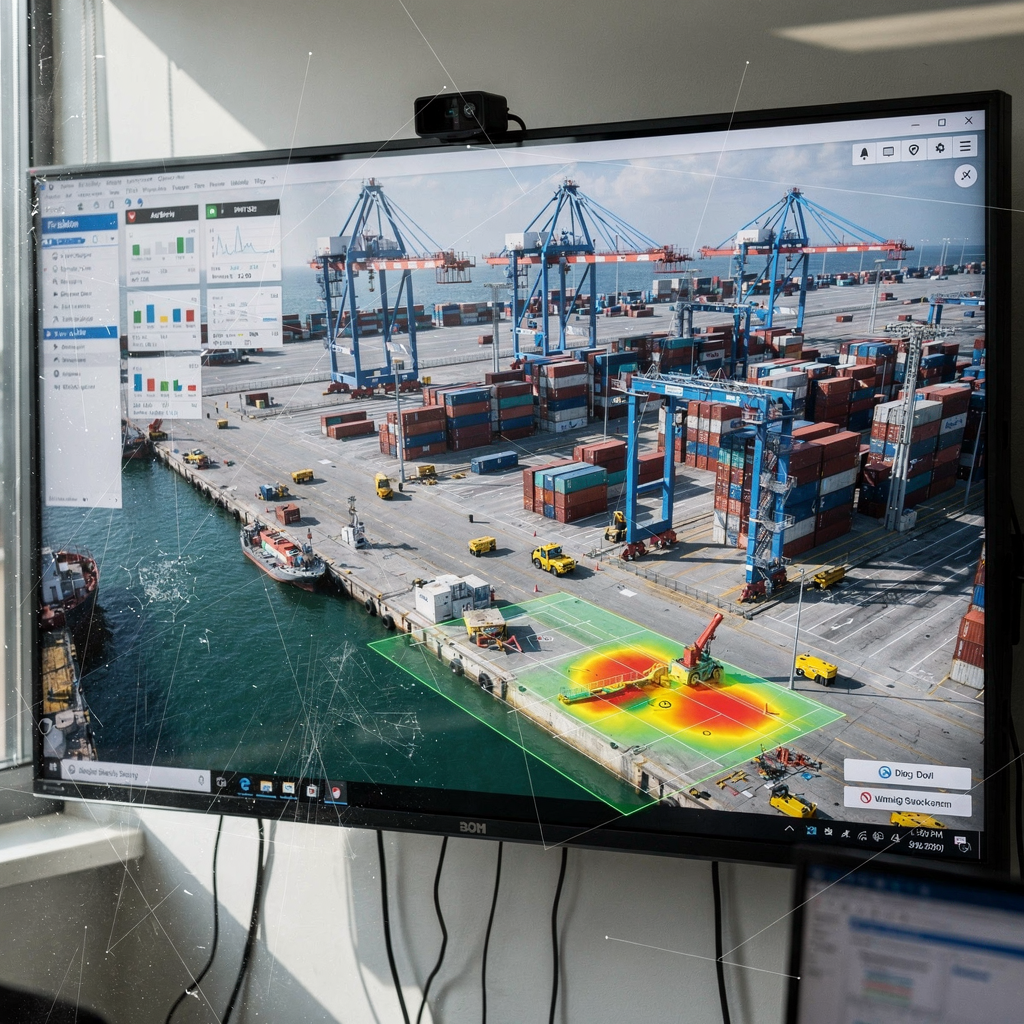
The TERMINAL model definition starts with a clear split of physical modules and control logic. First, a digital twin represents the yard, the quay, the gate, and the vessel modules as separate, linked components. This approach lets planners and engineers test layout changes and traffic rules in a copy of the live layout. The digital twin ingests real-time equipment telemetry, historical throughput logs, and GIS maps as primary input and then runs continuous analysis and short-term prediction. The architecture treats each QUAY CRANE, AGV, and RTG as an interactive agent. Each agent uses local rules and a global scheduler to represent realistic behaviour. The model layers include geometry, resource constraints, schedule data, and human shift patterns. These layers together enable what-if experiments and allow safe virtual testing of new procedures.
Digital twin benefits are both operational and strategic. For example, early trials have shown up to a 20% throughput gain when yards and quay sequencing were tuned in a twin environment (industry report). Simulation and modeling and simulation tools let teams run peak traffic, equipment failure, and weather delay studies without risking live operations. The twin also supports training and system rollouts, so staff learn new functionality before a production launch (testing, tuning and training TOS).
Architecture must serve integration. Middleware exposes APIs, message brokers, and OPC UA connectors to gather sensor streams and to deliver commands to equipment controllers. This makes the twin useful for both planning and live emulation, and it makes the twin friendly to TOS integration. Loadmaster.ai builds a sandbox digital twin to train reinforcement learning agents and to test policies before go-live, and that process keeps the operator in control while the AI searches for better strategies. For readers who want more technical reference on digital twin pipelines and terminal-level modeling, see our terminal digital twin software overview (terminal digital twin software).
Virtual simulation Environments and Scenario Testing
Simulation environments differ from emulation in a key way. A simulation abstracts the physical plant and runs faster or slower than real time. An emulation accepts live TOS commands and replies as if it were physical equipment. Both modes serve complementary goals. Scenario design begins with representative traffic mixes and then layers constraints. For example, one scenario might simulate peak traffic and a gate closure. Another might represent a crane breakdown or heavy weather and restricted vessel windows. Teams define target KPIs and then run batches of scripted runs to build statistical confidence.
Key performance indicators include vessel turnaround time, crane utilisation, and yard congestion. These KPIs focus planning and keep tests measurable. In one reference study, scripted scenarios reduced crane idle time by 25% through sequence optimization and improved dispatch logic (PORTMOD study). Scenario testing also supports safety assessment and helps shift teams from firefighting to planned responses (simulation-based safety framework).
Designing scenarios requires accurate input data. Real-time telemetry and historical logs feed variability into arrival and handling models. Analysts then sample distributions for vessel ETA jitter, crane speeds, and gate processing times. This statistical approach makes the scenario representative and repeatable. A robust procedure will include warm-up periods, control runs, and sensitivity sweeps. Finally, software and hardware-in-the-loop tests verify that emulation fidelity matches the control system. For actionable guidance on what-if scenario design integrated with TOS, consult our what-if scenarios resource (what-if scenarios for terminal TOS).
Drowning in a full terminal with replans, exceptions and last-minute changes?
Discover what AI-driven planning can do for your terminal
Key tool Platforms for TOS Emulation
Several commercial packages support terminal emulation and planning. Leading platforms include PORTMOD, FlexSim, AnyLogic, and SimPort. Each tool offers strengths. PORTMOD focuses on container allocation and crane sequencing and has published case studies on reduced idle time (PORTMOD). FlexSim and AnyLogic deliver flexible modeling primitives and agent libraries. SimPort targets port-level decision support and stakeholder collaboration. These choices make it easier to select a package that fits terminal scale, budget, and technical expertise.
AI and machine learning features are increasingly common. Predictive scheduling, demand forecasting, and dynamic slot allocation use predictive models to represent short-term changes. Several vendors now support interfaces to ECS and Port Community Systems, which simplifies integration and reduces manual coding. Integration choices affect licensing and deployment. On-premise installations protect sensitive telemetry, and cloud deployments scale compute for agent training. Buyers should evaluate total cost of ownership, including license fees, integration engineering hours, and ongoing support.
Loadmaster.ai integrates with leading TOS and uses a TOS-agnostic approach. Our closed-loop agents run in a sandbox twin and then deploy behind operational guardrails. This development path reduces risk because the AI trains in millions of simulated decisions rather than depending on historical patterns. For teams deciding between off-the-shelf packages and bespoke builds, our guide to container terminal simulation software can help with comparison and practical next steps (container terminal simulation software). When you need a deep technical reference on integrating simulation with a TOS, see our integration guide (terminal operating system simulation integration).
Component analysis Techniques and Bottleneck Identification
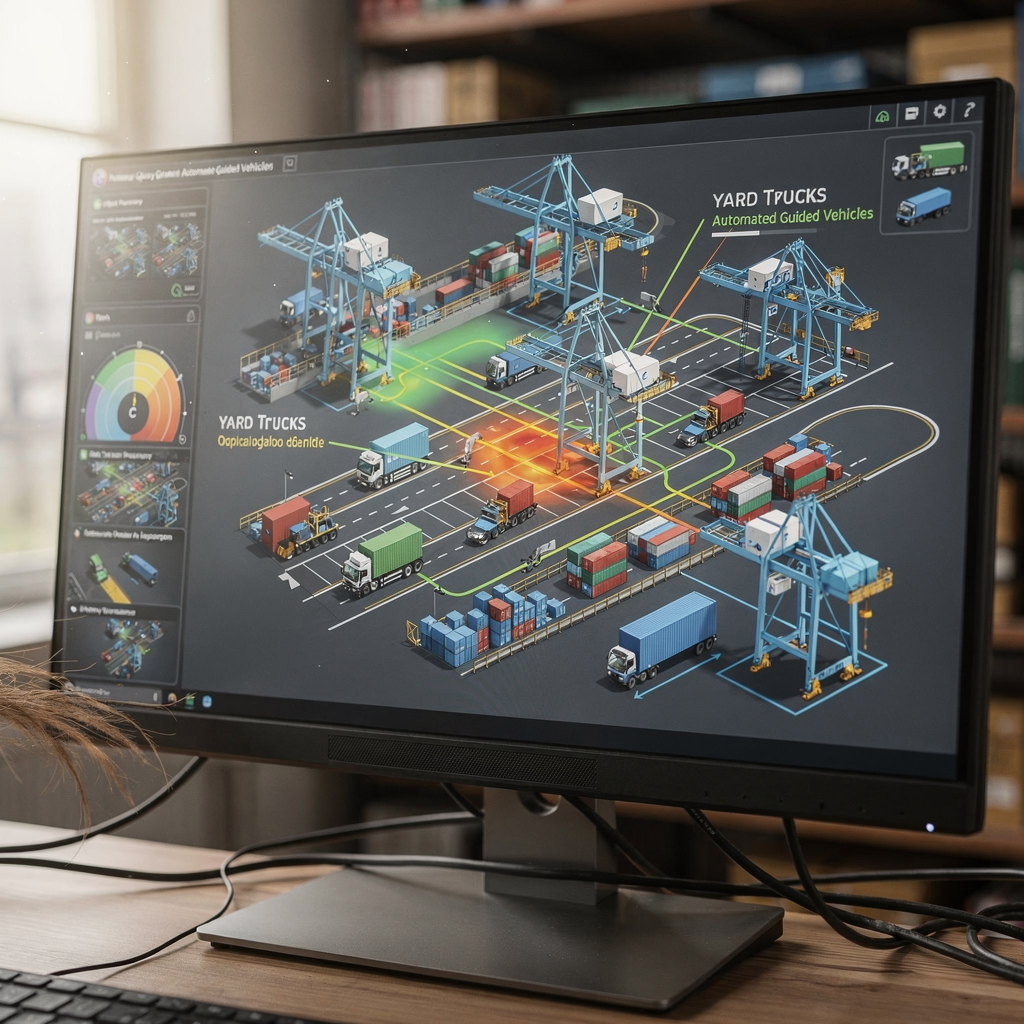
Component mapping begins at the quay and moves inland. Analysts map interactions between quay cranes, AGVs, and yard tractors to spot critical handoffs. A discrete-event approach models events such as lift start and lift end. An agent-based approach models each vehicle or operator as an independent decision-maker. Discrete-event suits high-level throughput analysis, and agent-based methods better represent interaction-driven congestion. Teams often use both, and then compare results to validate findings. This hybrid method helps to identify chokepoints like gate queues and stacking yard density.
Optimization loops close the gap between investigation and improvement. Planners run a simulation model, extract bottleneck metrics, apply a heuristic or a genetic algorithm, then run the new configuration. This iterative loop can produce steady gains. For example, a study reported a 25% reduction in equipment idle time when optimization loops targeted crane allocation and yard placement rules (PORTMOD). Analysts must also consider mathematical characteristics of the search, including convergence behavior and exploitation vs exploration trade-offs.
Tools for analysis must support interactive visualisation, time-series charts, and heatmaps that represent density and travel distances. A recommended procedure includes bottleneck identification, root-cause analysis, and rapid prototyping of alternatives. Loadmaster.ai uses reinforcement learning agents to optimize stow plans and yard placement. The agents simulate millions of scenarios, and that approach reduces the need for large historical datasets. For practical simulation-based evaluation that targets throughput and balanced workloads, explore our terminal throughput simulation resource (terminal throughput simulation).
Drowning in a full terminal with replans, exceptions and last-minute changes?
Discover what AI-driven planning can do for your terminal
Integration method and Emulation with FCS
Emulation with Field Control Systems requires careful middleware design. Typical designs use APIs, message brokers, and OPC UA connectors to bridge TOS commands and the emulator. The middleware buffers messages, timestamps events, and enforces security rules. This flow supports a TOS→simulation→feedback control loop where the TOS sends commands and receives simulated telemetry instead of live device signals. Time-step alignment and data fidelity are persistent challenges. Engineers must decide whether to run the emulator in real time or in a slowed mode for investigation and debugging.
Developed pipelines should include logging, replay, and rollback capabilities. These features enable repeatable tests and speed problem diagnosis. One useful pattern pairs a message broker for asynchronous events with an API gateway for synchronous calls. This separation helps when a TOS expects near-instant confirmations. Synchronisation problems often appear as drift between scheduler clocks and simulator time steps. To reduce drift, use heartbeat messages and deterministic event ordering. Where possible, validate message schemas and field units to avoid unit conversion bugs and to reduce subtle errors.
Reference case studies show how ports upgraded with emulation before rolling out new functions. For example, commercial ports and military logistics hubs have run full-stack emulations to test gate automation, to test new container yard layouts, and to rehearse operational changes (insights into terminal simulation). The emulation step lowers deployment risk and shortens commissioning time. Loadmaster.ai’s approach uses sandbox twin training and a staged deployment to on-premise or cloud-hosted systems, so operational guardrails and audit trails remain intact. This method makes the rollout safer and more predictable while keeping the terminal’s technical staff in the loop.
Force Applications: Military Simulation Use Cases
Military terminals and forward supply bases benefit from virtual training and stress-testing. A military logistics twin can represent rapid-deployment ports, and it can run contested scenarios that include degraded sensors and constrained routes. These simulations evaluate performance under pressure and quantify readiness. Evaluation metrics include material throughput under fire, resilience to degraded communications, and the speed of redeployment. A single representative scenario might simulate a surge of vehicles arriving at a damaged pier while congested roads reduce distribution capacity.
Interoperability with defence simulation suites is critical. The twin must interact with C2 systems and wargame platforms so it can participate in joint exercises. That implies strict interface standards and secure middleware. Simulation-driven training helps crews practice procedures and test alternative distribution concepts without moving real assets. A useful program will inject electronic warfare effects and degraded sensor feeds to assess decision-making and to probe procedures for robustness. Those assessments reveal how communication loss or a variable supply chain affects throughput and convoy scheduling.
Military planners require detailed technical reports and reproducible runs for after-action review. The virtual environment should allow step-by-step replay, annotated timelines, and linkage to the mathematical models that drove outcomes. Loadmaster.ai’s software package supports virtual training by training agents in a sandbox and by offering explainable policies and audit trails. This reduces the chance of nostalgic, history-only models dominating training and makes a virtual program both interactive and effective for defence applications. For a practical guide to force logistics modeling and to understand integration patterns, see the reference materials and studies listed above.
FAQ
What is a terminal digital twin and how does it differ from a simulation?
A terminal digital twin is a virtual representation of a terminal’s physical layout and operations that runs continuously and often in sync with live data. A simulation typically runs discrete experiments or scenario batches and may not mirror the live state at every moment.
Can emulation replace live testing when deploying a new TOS feature?
Emulation can significantly reduce risk by accepting live TOS commands and replying with realistic equipment responses. It cannot fully replace final integration testing on physical hardware, but it reduces the number of risky changes and shortens commissioning time.
Which KPIs should I track during scenario testing?
Key KPIs include vessel turnaround time, crane utilisation, yard congestion, and equipment idle time. These metrics provide clear, actionable signals for planners and help prioritize interventions.
What tools are commonly used for TOS emulation?
Common platforms include PORTMOD, FlexSim, AnyLogic, and SimPort. Choice depends on budget, integration needs, and the level of fidelity required for the project.
How does AI improve terminal planning in a twin environment?
AI, especially reinforcement learning, trains policies in a sandbox without relying on historical data. This allows the system to explore alternative strategies and to adapt to changing vessel mixes and yard states.
Is it difficult to integrate a simulator with existing ECS and PCS?
Integration requires middleware, message brokers, and standard connectors such as OPC UA. It is a technical task that benefits from clear schemas and staged testing, but it is a solved engineering problem with established patterns.
Can military logistics use the same modeling approaches as commercial ports?
Yes. The modeling methods are similar, but military scenarios add contested environments, electronic warfare effects, and stricter security requirements. Interoperability with C2 and wargame platforms is also essential.
How do I identify bottlenecks in a terminal?
Use a combination of discrete-event and agent-based analysis, then visualise heatmaps of travel and stacking density. Iterative optimization runs and sensitivity sweeps help confirm root causes.
What are the typical costs associated with adopting simulation tools?
Costs include licensing, integration development, and staff training. Cloud deployments can reduce capital expenses, while on-premise setups often suit operators who prioritize data control.
How can I start a pilot project for terminal emulation?
Begin with a focused scope such as a single berth or yard block, gather telemetry and historical logs, and run representative scenarios. Use a sandbox twin to prototype, and then expand to full-yard pilots once results are validated.
our products
 stowAI
 stackAI
 jobAI
jobAI
Innovates vessel planning. Faster rotation time of ships, increased flexibility towards shipping lines and customers.
Build the stack in the most efficient way. Increase moves per hour by reducing shifters and increase crane efficiency.
Get the most out of your equipment. Increase moves per hour by minimising waste and delays.
stowAI
Innovates vessel planning. Faster rotation time of ships, increased flexibility towards shipping lines and customers.
stackAI
Build the stack in the most efficient way. Increase moves per hour by reducing shifters and increase crane efficiency.
jobAI
Get the most out of your equipment. Increase moves per hour by minimising waste and delays.