
simulation in Container Terminal Operations
First, define what simulation means for a modern container terminal. In short, it creates a digital replica of physical port processes so planners can test decisions before they touch real equipment. Next, the model represents berth, yard and gate activities in a controlled test environment. For example, berth handling, crane moves and gate processing appear as distinct modules within a process simulation that mirror real workflows. Then, planners can run various operational scenarios and evaluate the impact on system performance rapidly. The approach gives decision support where risks remain low and learning stays safe.
Also, key functionalities cover berth management, yard layout and gate sequencing. They often include a realistic 3d visual layer and tools to generate detailed statistics about moves per hour, waiting times and equipment control. Thus, teams can examine performance indicators for quay cranes, RTGs and transporters. Furthermore, simulation supports testing of scheduling rules, dispatch logic and production schedules. As a result, planners can adjust the planning horizon and tuning without harming throughput or live service levels. This reduces firefighting and improves planning and analysis.
Importantly, a strong test environment enables training tools for new staff. For instance, train operators can practice crane sequencing and gate handling inside a virtual environment that mirrors terminal operating rules. Also, operators learn to manage material flow and JIT deliveries with less risk. In practice, simulation tools can measure allocation of resources and reveal a potential bottleneck in yard traffic or quay access. This helps terminals to improve productivity and operational performance.
Additionally, the method aligns with initiatives for digital twin simulation and discrete event simulation. For a technical reference, one white paper explains how systems “combine a simulation of the physical processes at a container terminal and real planning control software (Terminal Operating System)” tba group. Finally, many operators link simulation with terminal management dashboards to track key performance indicators and to support decision support across shifts. For more detail on integrating a model with your TOS, see our guide to container terminal simulation software.
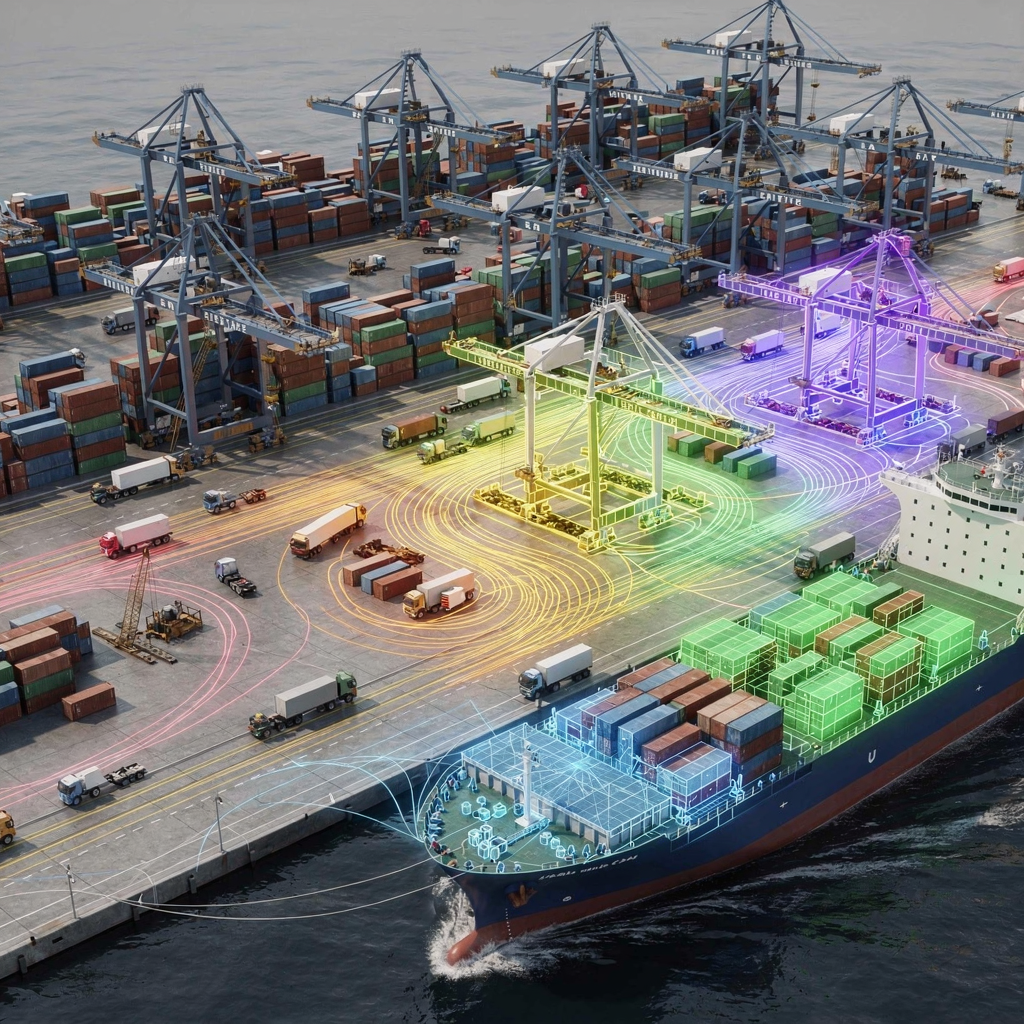
simulation model for Terminal Operating Systems
Start by explaining how a simulation model mirrors TOS rules and workflows. A simulation model reproduces the terminal operating logic, including scheduling rules, planner constraints and equipment capabilities. It takes input such as vessel schedules, yard layouts and equipment specs. Then, the model enacts moves and calculates metrics such as dwell time, crane idle time and production efficiency. This lets teams evaluate alternative arrangements and choose a plan that best meets the terminal’s objectives.
Also, parameters matter. You must set crane speeds, truck cycles, stacking capacities and gate processing strategies. Moreover, a clear specification helps. The model uses detailed operational parameters and object-oriented agents to mimic real work. Next, it can include process simulation layers for gate arrival patterns and production processes across shifts. This produces simulation results that planners can inspect, compare and use to optimise resource deployment.
Further, integration points with a live TOS matter for seamless data exchange. A simulation environment can ingest real-time telemetry or historical feeds to test configuration changes before they reach production. For example, a planning and analysis loop may send plans to a testing module and then receive feedback on system performance. This reduces trial-and-error and preserves service levels. Loadmaster.ai uses a sandbox digital twin to train RL agents, which then propose better plans without relying on flawed historical patterns. That approach delivers closed-loop optimisation that protects live operations.
Finally, the model supports process validation against a terminal’s decision support rules. Vendors often use emulation to verify how a TOS will behave with new allocation policies. A helpful resource describes how simulation and emulation operate throughout a terminal life cycle tba group. If you want to see tool options and proof points, review our material on terminal operating system simulation integration and a practical tos simulation model tools overview.
Drowning in a full terminal with replans, exceptions and last-minute changes?
Discover what AI-driven planning can do for your terminal
tos planner: Bridging Planning and Execution
The TOS planner converts simulation outputs into actionable plans and schedules. First, planners receive optimized stowage and quay sequences from a simulation run. Then, the planner turns those suggestions into plans and schedules that guide crane drivers and trucks. This workflow tightens the link between planning and execution. As a result, teams can reduce rehandles and make production plans more robust.
Also, resource allocation gets clearer. The planner assigns cranes, trucks and personnel while tracking allocation of resources by shift. Next, the system tests scheduling rules against realistic demand spikes. For example, planners adjust allocation to avoid a yard bottleneck during peak arrivals. In practice, good plans lower average driving distances and help to improve productivity across the quay and yard.
Moreover, the planner supports dynamic re-planning in response to real-time events. When a berth delay arrives, the system can rescore production schedules and dispatch changes immediately. This real-time feedback loop keeps the terminal resilient. Loadmaster.ai augments these steps using reinforcement learning agents—StowAI, StackAI and JobAI—that learn policies inside a digital twin. The agents suggest allocations that balance quay productivity and yard congestion without human guesswork.
Finally, the planner must offer a clear user interface and strong accessibility for shift teams. A short training cycle matters, because planners need to trust the proposals. A quotation captures the value of simulation-capable systems: “Terminal simulation systems are software applications of simulation technology for decision making processes on the terminal, enabling operators to optimize resource allocation and operational workflows effectively” rbs-emea. For readers focusing on yard-TOS linkage, consider our page on simulate yard operations tos integration.
virtual terminal and emulation for Safe Testing
Define a virtual terminal. It is a contained virtual environment that reproduces a live terminal’s systems, rules and telemetry. Emulation runs the real TOS against a mirrored hardware and software stack. Consequently, teams can validate new configuration or control algorithms safely. For example, you can validate an equipment control change or new scheduling rules inside a test environment before deployment.
Also, realistic 3d visualisation helps stakeholders see the effect of changes. A virtual terminal with realistic 3d models clarifies vessel operations, crane work and yard flow. One provider explains how a “3D model” enables testing, training and optimisation without interruption CHESSCON. In addition, a digital-twin “light” approach can plug into the live TOS to capture enough telemetry for meaningful validation without full system overhaul digital twin example.
Next, these environments serve as training tools for planners and operators. Trainers can use the virtual terminal to train operators on new dispatch sequences and to practice emergency procedures. Meanwhile, the emulation layer runs the actual TOS logic and produces simulation results that verify compliance with scheduling rules. This approach protects operations while allowing innovation and automation trials.
Finally, a test environment helps with compliance and governance. Teams can check audit trails, review system performance and confirm data privacy measures during simulated runs. For a practical white paper that outlines lifecycle use, see the guidance from TBA Group on emulation. If you need practical tools to build your own virtual terminal, see our resources on terminal digital twin software.
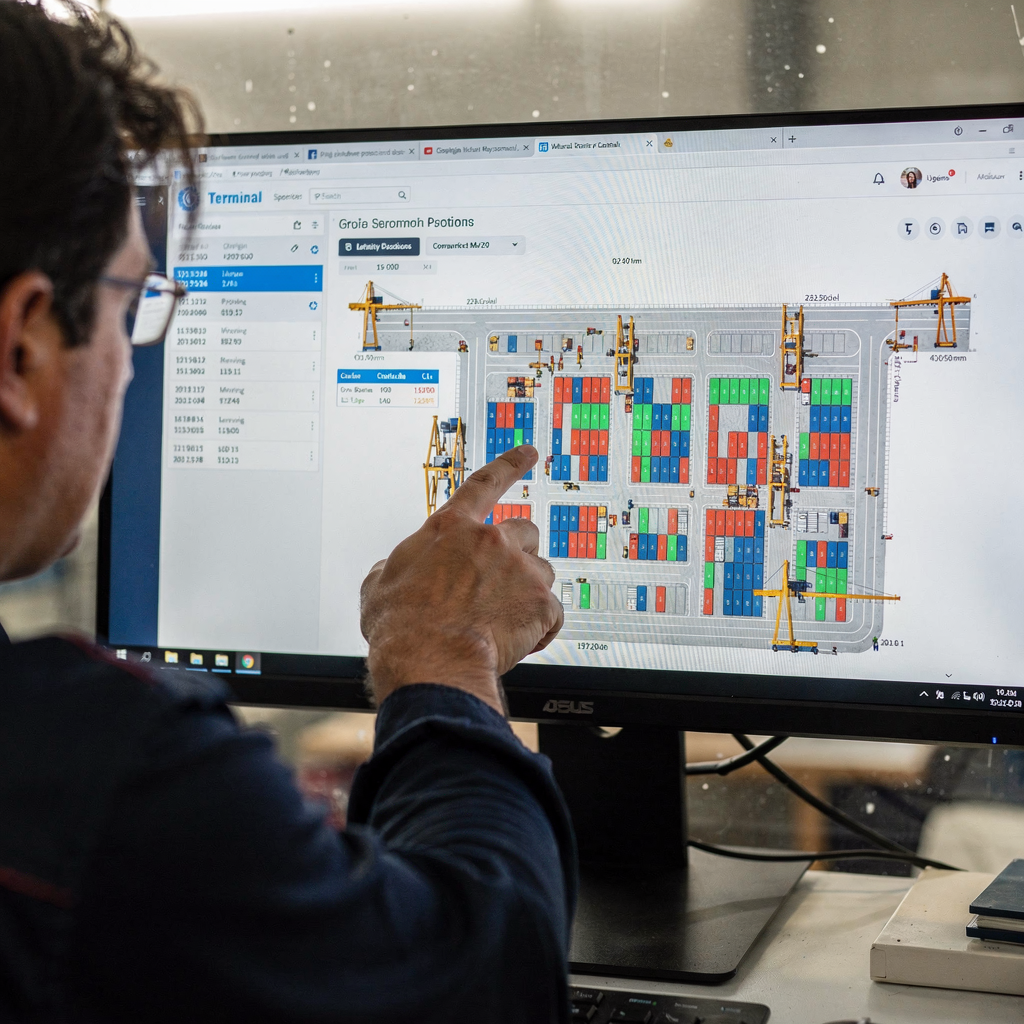
Drowning in a full terminal with replans, exceptions and last-minute changes?
Discover what AI-driven planning can do for your terminal
simulate Scenarios to optimize Productivity
Outline common scenarios to run in planning simulations. First, peak arrivals and berth congestion tests show if the terminal can absorb surges. Second, yard reblocking and stacking experiments reveal risks of unnecessary rehandles. Third, gate spikes and truck bunching scenarios assess how plans handle sudden pressure. Running various scenarios exposes bottleneck points and helps to plan mitigation steps.
Also, use metrics to quantify gains. Industry sources report that simulation-driven planning can improve crane productivity by up to 15–20% and reduce vessel turnaround time by 10–25% Thetius market overview. Moreover, yard utilisation can increase by 10–15% with better allocation and sequencing AltexSoft on terminal systems. These figures show how targeted experiments can boost throughput and boost profitability simultaneously.
Furthermore, iterative “what-if” studies refine production planning and scheduling. Teams can tweak scheduling rules, change allocation of cranes, or reassign truck fleets to evaluate consequences. Then, they can evaluate trade-offs using clear performance indicators such as moves per hour, dwell and average travel distance. This supports evidence-based decisions rather than gut-driven changes.
Finally, advanced simulation and digital twin simulation allow testing of automation strategies. For example, a RL-trained agent can be evaluated across various operational scenarios to ensure safe rollout. Loadmaster.ai applies this pattern by training agents in a digital twin, then validating live performance with controlled rollouts. This reduces launch risk and helps to improve productivity across shifts while preserving system performance.
optimise Operations with Data-Driven Insights
Argue for continuous tuning of simulation parameters and TOS rules. Start by collecting rich inputs from the terminal and from the wider supply chain. Then, update the model periodically to reflect new vessel mixes and yard constraints. This keeps plans realistic and effective across changing demand patterns. Also, a cloud-based analytics backbone helps scale experiments across blocks or terminals.
Next, tie findings to operational production and to production management goals. Use simulation results to adjust production plans, to adapt production efficiency targets, and to refine allocation of resources. In particular, planners can identify a recurring bottleneck and then propose an allocation change that improves system performance. Over time, this continuous loop drives operational excellence.
Moreover, measure value with relevant key performance indicators. Track system metrics such as crane moves per hour, average truck turnaround, and yard occupancy. Also, generate detailed statistics and dashboards that stakeholders can read quickly. This supports transparent decision support and gets buy-in from every stakeholder in the planning process.
Finally, the market trend supports investment. The global TOS market that includes simulation capabilities is forecast to grow at roughly 8–10% CAGR over the next five years market research. Therefore, investing in advanced simulation tools and TOS-aligned optimisation pays off in higher throughput and lower costs. If you want a practical start, review our practical notes on what-if scenarios for terminal TOS and on terminal throughput simulation.
FAQ
What is the difference between a simulation model and a digital twin simulation?
A simulation model is a crafted representation of processes and rules used to test scenarios. A digital twin simulation often extends that model with live data feeds and richer 3D or telemetry layers so the replica stays synchronized with the live site.
How does emulation help validate an updated TOS configuration?
Emulation runs the actual TOS logic against a mirrored data stream in a test environment. This lets teams validate behaviour, assess risks and verify that scheduling rules and dispatch logic perform as expected without touching production.
Can simulation improve crane productivity by double digits?
Yes. Industry studies show simulation-driven planning can boost crane productivity by around 15–20% when applied correctly source. The gains come from better sequencing, reduced rehandles and improved allocation of resources.
How does a TOS planner use simulation outputs during daily operations?
The planner converts simulation outputs into executable plans and production schedules. Then, they apply those plans to dispatch and to equipment control to reduce idle time and to smooth yard flows.
What role do training tools and a virtual terminal play?
They provide a safe space for operators and planners to practice and to learn new procedures. Also, training reduces errors during rollout and helps to maintain consistent operational performance across shifts.
Are these systems compatible with cloud-based deployments?
Yes. Many vendors support cloud-based analytics and sandbox environments to run planning simulations at scale. Cloud solutions can speed experimentation while preserving data privacy and accessibility.
How do planners evaluate trade-offs between quay productivity and yard congestion?
Planners run various operational scenarios and evaluate key performance indicators such as moves per hour and yard occupancy. Then, they select the plan that best balances objectives based on clear decision support criteria.
What is the value of discrete event simulation for terminal operations?
Discrete event simulation captures the sequencing of moves and the timing of events, which is ideal for busy terminals where order and timing matter. It helps to reveal bottleneck points and to test countermeasures with low risk.
How do reinforcement learning agents fit into this planning ecosystem?
RL agents can be trained inside a digital twin to learn policies that address multiple KPIs simultaneously. They then suggest plans and allocations that standard historical models might miss, improving production efficiency and resilience.
Where can I learn more about integrating simulation with my TOS?
Start with vendor white papers and practical guides that explain emulation and integration best practices. For hands-on resources, consult pages on terminal operating system simulation integration and container terminal simulation software on our site for step-by-step guidance.
our products
 stowAI
 stackAI
 jobAI
jobAI
Innovates vessel planning. Faster rotation time of ships, increased flexibility towards shipping lines and customers.
Build the stack in the most efficient way. Increase moves per hour by reducing shifters and increase crane efficiency.
Get the most out of your equipment. Increase moves per hour by minimising waste and delays.
stowAI
Innovates vessel planning. Faster rotation time of ships, increased flexibility towards shipping lines and customers.
stackAI
Build the stack in the most efficient way. Increase moves per hour by reducing shifters and increase crane efficiency.
jobAI
Get the most out of your equipment. Increase moves per hour by minimising waste and delays.