
Overview of container terminal and terminal operation
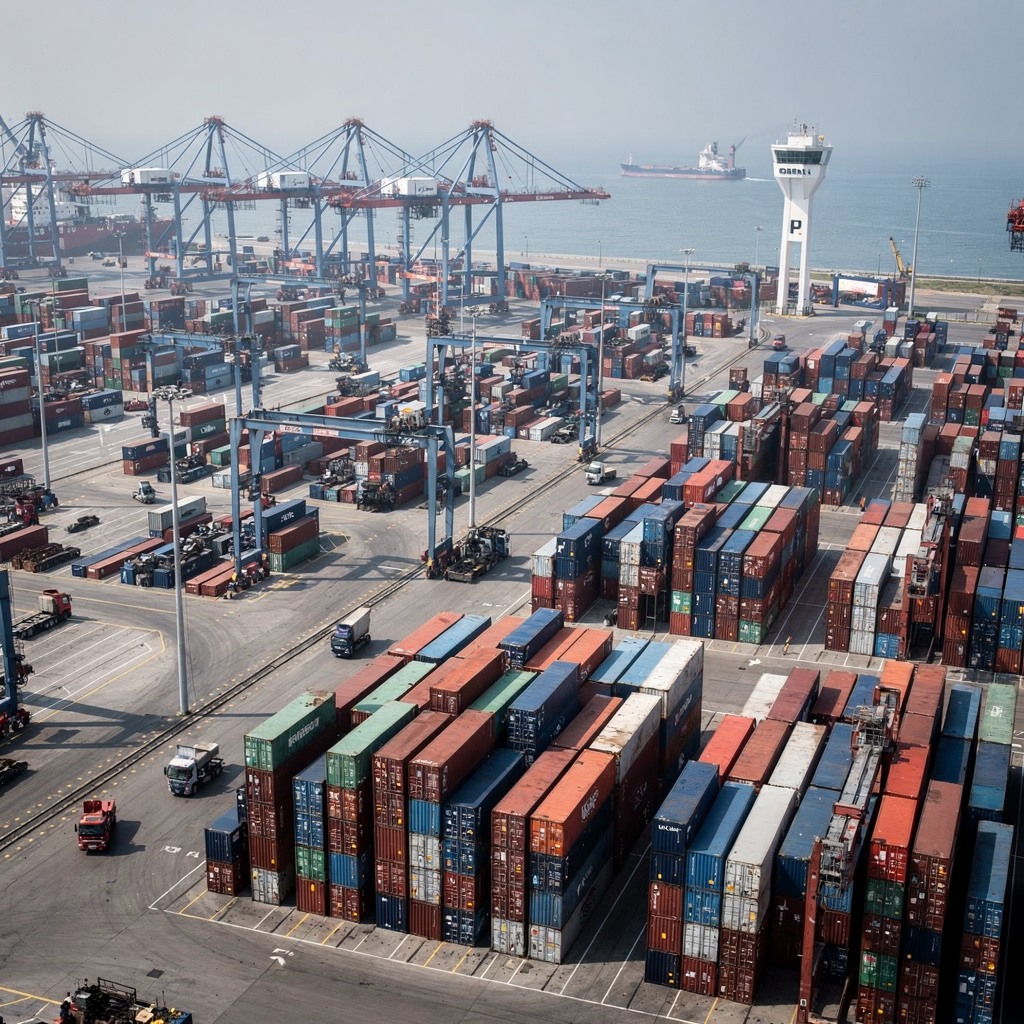
A container terminal is a focused area where ships are served, containers are moved, and logistics are coordinated. First, the layout brings quayside, yard and gate together. Second, storage blocks, feeder berths, and landside interfaces support intermodal flows. Third, handling equipment such as quay cranes, RTGs and straddle carriers move boxes between vessel and storage. In a practical container terminal the quay, yard and gate act as linked work zones. The arrival pattern of ships and trucks sets the daily tempo. For example, a long berth call followed by heavy truck arrival can overload yard space, so planners must prioritize moves to avoid a full yard.
Storage yard and container yard function as the main staging areas. In the storage yard containers await landside pickup or vessel loading. Yard management assigns locations, monitors stack heights, and plans reshuffles. Container storage decisions balance short-term access against long-term yard capacity and yard throughput. Key processes include storage, retrieval, stacking and routing. Container stacking strategies influence travel distance and rehandles. Loading and unloading at the berth need smooth handoffs with yard trucks and cranes to maintain throughput.
The terminal operating system links quayside with yard workflows and orchestrates moves across the terminal. A terminal operating system provides schedules, work orders, and resource allocation rules to equipment and operators. It also ingests real-time data from gates and sensors and exports notifications to carriers. A terminal operator uses the TOS console for arrivals, allocations and performance indicators. For more on how simulation and TOS interact, see our guide to simulation vs TOS integration. As a result, the combined system supports efficient container flow and reduces avoidable congestion.
Operational efficiency depends on predictable patterns, resilient control, and real-time visibility. Terminal managers measure key performance and monitor yard capacity, handling time, and berth utilization. In addition, predictive maintenance of cranes and yard equipment reduces downtime. Finally, advances in software and algorithms now allow operators to automate routine decisions while planners focus on exceptions and strategy.
Integrate tos to automate storage yard
To automate a storage yard you must integrate the TOS with yard cranes, yard trucks and other handling equipment. The TOS issues work orders and then tracks completion in real time. Also, APIs and EDI feeds deliver arrival notices, gate scans and telemetry. Integration enables the TOS to command crane cycles and to coordinate AGVs or yard tractors where present. For terminals that want to automate, the TOS becomes the central planner that assigns moves and enforces constraints.
Practical automation routes include automated job assignment, dynamic resource allocation and prioritised dispatch. For example, a TOS can prioritize inbound containers for immediate stacking near gates so as to shorten travel distance. Next, the system can reassign cranes to reduce idle time when vessel arrival slips. Algorithms that optimize yard space and crane scheduling help reduce handling time and improve throughput. Our work at Loadmaster.ai shows how closed-loop AI agents such as StackAI and JobAI can automate placement and execution while respecting operational guardrails.
Nevertheless, integration challenges remain. Real-time data exchange requires reliable connectivity and consistent message formats. Interoperability between vendor systems is often uneven, so mapping and adapters are necessary. Change management is also essential; staff must learn new workflows as automation grows. Moreover, decision transparency and auditability are required for governance and for regulatory readiness. For terminals exploring implementation, a staged rollout into a simulation environment gives safer validation. You can explore technical tools in our post about terminal operating system simulation integration. Overall, when the TOS connects to cranes and yard devices, terminals can automate repetitive tasks while operators remain focused on exceptions.
Drowning in a full terminal with replans, exceptions and last-minute changes?
Discover what AI-driven planning can do for your terminal
Simulation model for optimization of container handling
Simulation provides a safe way to test strategies for container handling without interrupting real operations. A simulation model replicates flows, arrival patterns and resource behaviours for quay cranes, yard equipment and gate lanes. Common model types include discrete event models, agent-based models and hybrid approaches. Each model can represent the key constraints that shape terminal performance. Using a calibrated simulation model, planners can test stack rules, truck dispatch policies and crane sequencing before committing changes.
Quantitative studies show measurable gains from integrated simulation and TOS approaches. For instance, research notes that simulation-based optimization can cut container handling time by up to 15–20% when applied to scheduling and sequencing tasks (literature review). In addition, integrating digital twin and decision support techniques has been shown to decrease yard congestion by about 25% and to speed recovery from disruptions by roughly 30% (decision support study). These statistics reflect improved stacking, better truck matching and smarter allocation of cranes and yard resources.
Optimization uses algorithms to refine stack assignment and truck pairing. Heuristics, mixed-integer programming and metaheuristics such as particle swarm optimization are common in research and practice. Finally, reinforcement learning can learn policies that adapt to changing arrival mixes and yard states. Our digital twin approach trains agents in a simulated virtual terminal so they can learn high-quality policies without depending on historic data. If you want a hands-on comparison of tools, see our overview of container terminal simulation software. Thus, combining a TOS with a simulation-driven optimizer yields better container handling and steadier throughput.
Discrete event simulation in an automated container terminal
Discrete event simulation models operations as a sequence of events that change the system state. Events include vessel arrival, crane start, container pickup and truck departure. The scheduler advances time to the next event and updates resource states. This method captures queueing, blocking and precedence relationships accurately, which is why discrete event simulation is a standard for terminals. For gate operations, for example, event scheduling models arrival queues and scan times very well.
Apply discrete event simulation to gate, yard truck movements and crane assignment. At the gate, events model check-in, inspection and release of inbound and outbound loads. In the yard, events represent pickup, travel, stacking and reshuffle tasks. Crane assignment events capture cycle start and end and the handover of containers to trucks. Using these building blocks, the model predicts yard congestion, travel distance and rehandles under different policies. This approach helps terminal managers to prioritize moves and to set realistic service targets.
Digital twin case studies show tangible resilience benefits. For example, a decision support system that links a digital twin with operational data improved recovery planning and reduced disruption impact (resilience DSS). In practice, a simulated environment allows staff to rehearse contingency plans and to validate predictive maintenance schedules for cranes and yard equipment. We also provide discrete event tools and sandbox pilots to validate AI agents before live deployment; see our write-up on discrete event simulation. Consequently, discrete event simulation is a practical step toward a safer, more automated container terminal.
Drowning in a full terminal with replans, exceptions and last-minute changes?
Discover what AI-driven planning can do for your terminal
Digital twin and simulation to optimize port supply chain
A digital twin is a virtual terminal that mirrors physical assets and flows for end-to-end visibility. Digital twin technology connects TOS data, sensor feeds and simulation models into a single representation. Therefore, planners can test scenarios that span berth, yard and landside to understand knock-on effects. For supply chain partners, this visibility supports better coordination and fewer surprises during peak arrival windows.
Simulation inside a digital twin drives supply chain planning under uncertainty. For example, the twin can run stochastic scenarios of carrier delays, weather disruptions, or sudden spikes in truck arrival. In that way, terminals can examine terminal layouts, container flow and intermodal handoffs without disrupting live operations. Also, the twin allows the tuning of optimal resource allocation across cranes and yard staff while keeping safety and compliance constraints intact.
Benefits include improved capacity utilisation, proactive disruption management and clearer key performance indicators. In one synthesis, simulation-enabled systems lowered yard congestion and reduced vessel turnaround impact (congestion study). A practical advantage is the ability to train AI agents in a virtual terminal so they can generalise to changing conditions. At Loadmaster.ai we spin up a simulation environment to train RL agents that balance quay productivity against yard congestion and travel distance. The result is higher throughput, lower rehandles and steadier productivity.
Future of virtual terminal automation in maritime container port
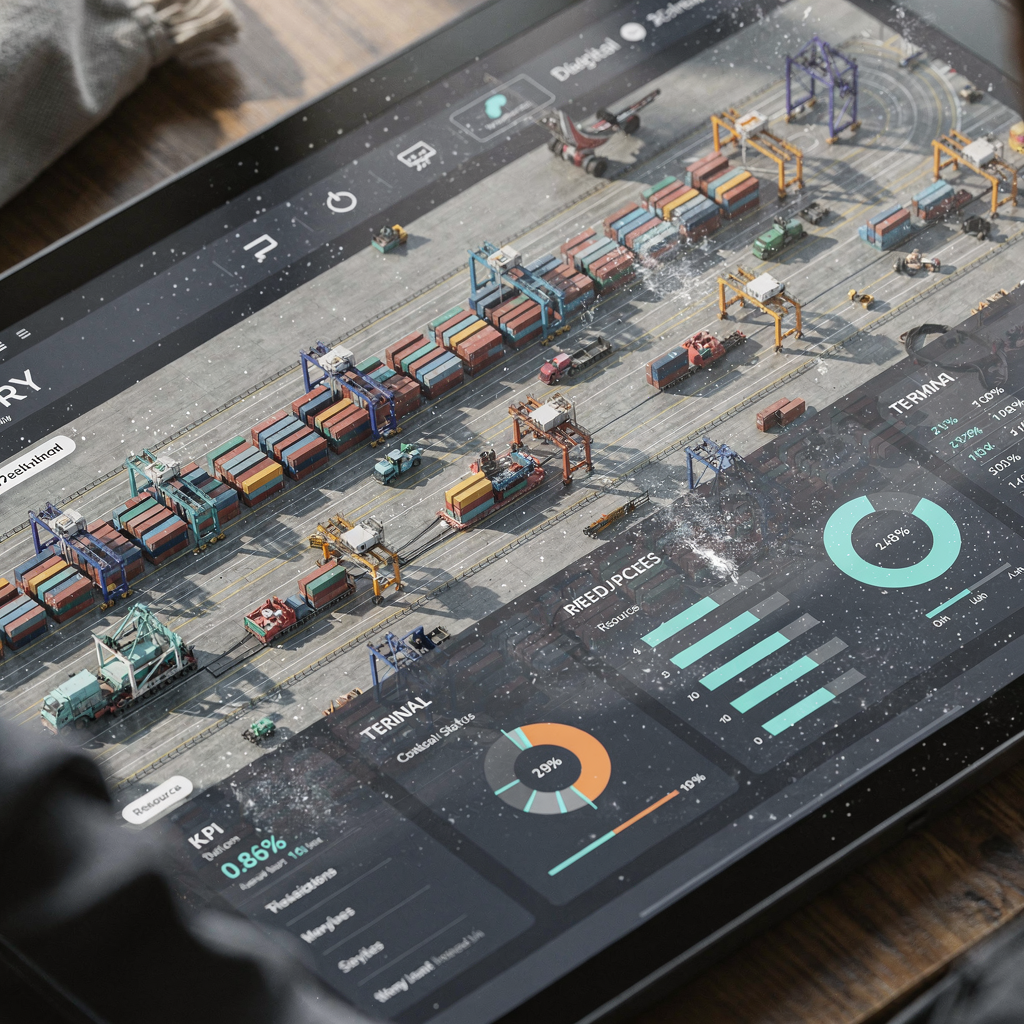
Future operations will blend AI, machine learning and IoT to automate many routine decisions. Predictive algorithms will anticipate equipment failures and enable predictive maintenance for cranes and yard trucks. Also, AI policies will adapt to changing vessel mixes, arrival windows and landside peaks. This reduces firefighting and helps terminal managers move from reactive responses to planned strategies.
Integration with wider port systems will link quay cranes, rail connections and road links into one coordinated plan. For container ports that handle transshipment, synchronising vessel schedules with yard allocation optimises container flow. In addition, intermodal scheduling reduces dwell times and increases yard throughput. Emerging concepts such as multi-agent control will let individual agents coordinate moves, which improves resource utilisation and cuts travel distance.
The forecast for productivity and environmental performance is optimistic. Smarter assignment of cranes and stacks reduces unnecessary moves and fuel use. Also, automated systems can limit emissions by avoiding idle time for diesel tractors. Future research directions should include robust algorithms, safer human-AI interfaces and pilot studies across different terminal types. For designers, particle swarm optimization and other heuristics remain promising tools, as do reinforcement learning approaches that train in a simulation environment. To learn how pilot-to-production is managed, review our guide on terminal digital twin software. Overall, the shift to virtual terminal automation will improve operational efficiency and resilience while supporting maritime trade and the broader supply chain.
FAQ
What is the role of a TOS in yard operations?
The terminal operating system issues work orders, tracks moves and links quayside with the storage yard. It also aggregates real-time data so planners can manage arrivals, resource allocation and gate flows.
How does simulation help reduce container handling time?
Simulation allows planners to test sequences, stacking rules and dispatch policies before implementing them. As a result, studies report up to 15–20% reductions in container handling time when simulation-based optimization is applied (study).
Can a digital twin improve resilience at my terminal?
Yes. A digital twin that mirrors current operational conditions helps test recovery plans and assess disruption impacts. For instance, digital twin-enabled decision support has demonstrated faster recovery and better contingency coordination (case).
What types of simulation models are used for terminals?
Common types include discrete event simulation, agent-based models and hybrid models that mix both approaches. Each type models events, resources and workflows to evaluate policies and predict yard congestion.
How do AI agents learn terminal strategies safely?
AI agents train inside a simulation environment or virtual terminal so they can explore millions of scenarios without risking live operations. After training, policies are tested in a sandbox twin and then deployed with operational guardrails.
Is TOS integration difficult with existing equipment?
Integration requires adapters for different data formats and reliable real-time connectivity. Change management and phased rollouts reduce risk and help staff adjust to automated processes.
What gains can operators expect from automation?
Terminals often gain higher throughput, fewer rehandles, better balance across cranes and reduced travel distance for yard trucks. Studies also note notable reductions in yard congestion and improved capacity utilisation (research).
How do you handle unpredictable vessel arrivals?
Simulation and predictive models help evaluate multiple arrival scenarios and recommend robust plans. Also, adaptive agents can reprioritize tasks in real time as arrival patterns shift.
What equipment feeds matter most for an integrated TOS?
Gate scanners, crane telemetry, yard truck trackers and sensor-based status for yard equipment all provide crucial real-time data. Together they support accurate scheduling and optimal resource allocation.
How can I learn more about digital twin pilots and tools?
Start with vendor whitepapers and pilot case studies that show sandbox deployments and measured KPIs. For practical resources and tools, see our pages on simulation software and port terminal simulation tools.
our products
 stowAI
 stackAI
 jobAI
jobAI
Innovates vessel planning. Faster rotation time of ships, increased flexibility towards shipping lines and customers.
Build the stack in the most efficient way. Increase moves per hour by reducing shifters and increase crane efficiency.
Get the most out of your equipment. Increase moves per hour by minimising waste and delays.
stowAI
Innovates vessel planning. Faster rotation time of ships, increased flexibility towards shipping lines and customers.
stackAI
Build the stack in the most efficient way. Increase moves per hour by reducing shifters and increase crane efficiency.
jobAI
Get the most out of your equipment. Increase moves per hour by minimising waste and delays.