
Terminal simulation and simulator: introduction to operator training
Terminal simulation refers to the practice of creating a digital replica of terminal devices and environments so engineers and operator teams can test, train, and validate systems before deploying changes. In telecommunications, terminal simulation helps teams emulate telephones, fax machines, and CUSTOMER PREMISE EQUIPMENT (CPE) to check signaling, protocols, and compatibility without needing racks of physical hardware. This approach reduces time and cost, and it speeds up problem detection and remedy cycles. For example, the AI-5620 Terminal Equipment Simulator reproduces a single-port two-wire analog terminal and measures signals from central office line cards, which lets developers test line-quality metrics before manufacturing or field trials (Advent Instruments – AI-5620).
Training a terminal operator or a team begins with scenario design, and then trainees run those scenarios in a risk-free digital environment. A simulator lets instructors inject faults, change line conditions, and repeat tests quickly and efficiently. This process shortens development cycles and reduces time and cost for labs and trials. As Christopher Saavedra explains, “Simulation and emulation tools provide invaluable insights at various stages of a terminal’s lifecycle, enabling operators to optimize resource utilization and anticipate operational challenges before they occur” (Kalmar).
This chapter frames why teams adopt simulation: cost savings, accelerated fault detection, and early-stage testing. It also introduces how the same methods apply to port and container planning where digital models let planners test crane cycles and yard strategies. Companies building AI for terminals often start by creating a digital twin of the layout and then run reinforcement learning in simulation to generate policies that improve operational KPIs. At Loadmaster.ai we spin up a digital twin and train RL agents so planners can safely try new strategies without risking live operations. This approach helps train operators, upskill staff, and improve decision-making while preserving safety and operational standards.
Key features of terminal simulation software
Good terminal simulation software combines protocol coverage, signal analysis, and repeatable test automation. It supports analogue lines and modern VoIP, and it captures fine-grained line metrics such as SLIC analysis and caller ID timing. A flexible simulation software stack supports multi-protocol testing so teams can validate interoperability across legacy and IP-based equipment. In telephony labs a single simulator can emulate many device types, which reduces hardware needs and shortens test setup time. The AI-5620 documentation highlights precise measurement of line signals that assists device makers in meeting tight quality standards (Advent Instruments – AI-5620).
Key features that matter include support for digital twin models, automated test scripts, and scenario libraries. Teams can create simulation models that mirror physical layouts, then run batch scripts to exercise thousands of conditions. A software tool that supports injecting faults and logging results streamlines root-cause analysis. This capability makes it easier to identify potential bottlenecks in terminal operation and to measure utilization and throughput under controlled loads. For teams working on port and terminal projects, port and terminal simulation software provides specialized modules for berth allocation and crane cycles; see advanced examples at CAST for passenger and terminal planning (CAST Terminal).
Other desirable traits are user-friendly interfaces, customizable scenario editors, and a high-fidelity physics layer for equipment motion and collision avoidance. Simulation tools should integrate with TOS and telemetry so results map to real KPIs. For container-side optimization, Loadmaster.ai pairs digital twin training with multi-agent RL to improve quay productivity and yard balance. Finally, being able to export logs and dashboards makes simulation training and certification fast and repeatable for new operators.
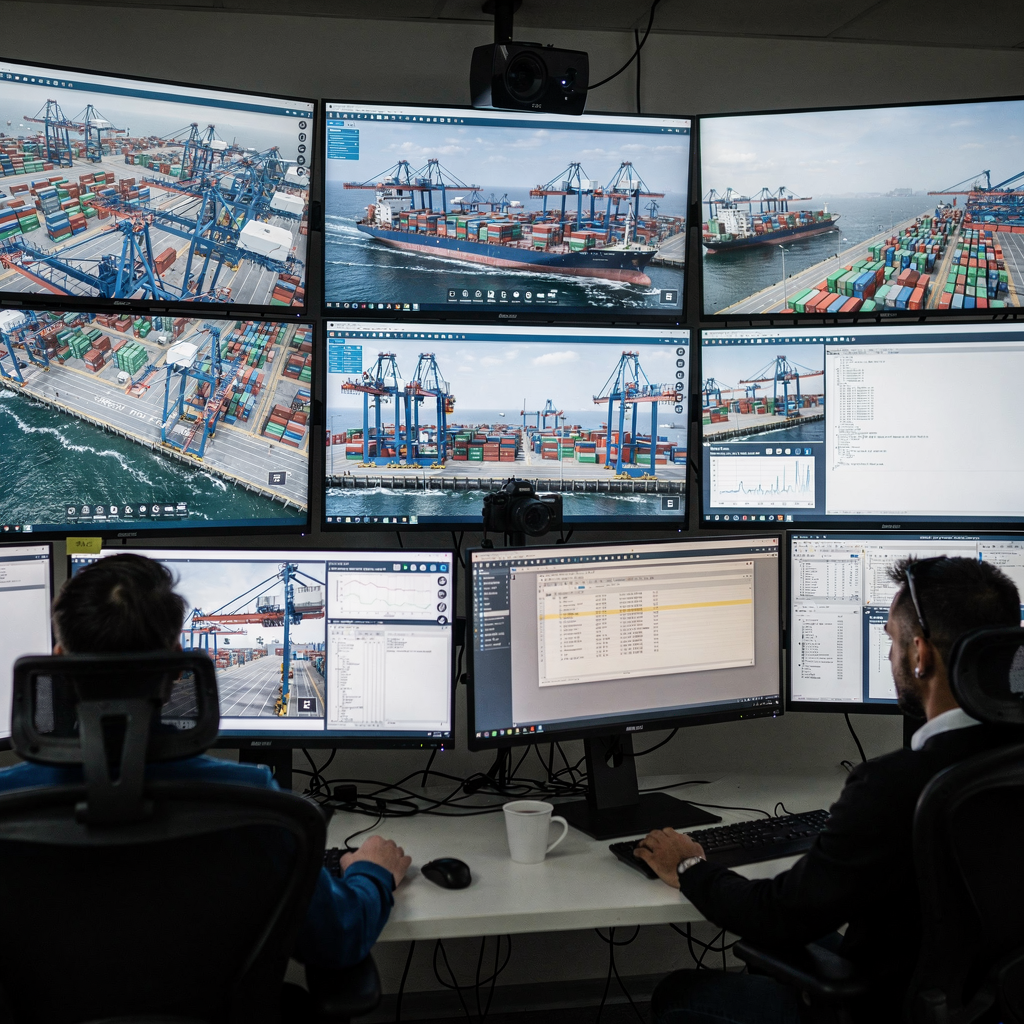
Drowning in a full terminal with replans, exceptions and last-minute changes?
Discover what AI-driven planning can do for your terminal
Using simulation models and digital twin for workflow optimisation
Simulation models replicate real-world equipment and process interactions so stakeholders can forecast effects and validate changes before rollout. Digital twin integration enhances that by streaming live telemetry into the model and comparing simulated outcomes with actual performance. The result is a closed-loop environment where planners can test policies and then measure the real impact afterwards. Many terminals use digital twin setups to forecast capacity and to compare scheduling options across quay and yard resources. At Loadmaster.ai we spin up a digital twin, train agents in simulation, and then deploy tested policies that improve consistency across shifts.
Workflow design starts with discrete-event and agent-based models that represent cranes, trucks, RTG and RTG drivers, and ship-to-shore operations. These simulation models let designers inject faults or spikes in gate traffic, and then observe whether the plan holds. Simulation can be used to stress-test sequences and to calculate time and cost implications of layout changes. Teams compare scenarios to identify potential bottlenecks and to measure utilization metrics for cranes and yard equipment. The insights help decision-makers prioritize investments and to optimize crane assignments.
Integrating digital twin telemetry makes the models more predictive and adaptive. Operators can run what-if studies, then implement incremental changes with confidence. For example, a container terminal might test new stacking rules or different RTG allocations in the twin, and then monitor live KPIs such as throughput and travel distance when the change deploys. This approach reduces rehandles and improves predictability. Ultimately, using simulation and digital twin tools helps terminals balance quay productivity and yard congestion while keeping execution practical and auditable.
Simulation-based training and simulation training with equipment training packs
Simulation-based training uses scenario-driven exercises and repeatable test cases to upskill staff and to standardize procedures. Training scenario libraries help instructors run sessions for new operators, and equipment training packs bundle hardware emulation with software scenarios so trainees experience realistic faults and traffic mixes. These packs typically include virtual RTG controllers, ship-to-shore logic, gate systems, and scripted incidents so learners can practice responses. Simulation training gives trainees a chance to practise emergency steps and to refine coordination with other teams in a risk-free environment.
A common design for training uses graduated scenarios: basic tasks first, then complex operations with disruptions. This iterative learning loop—test, review metrics, refine procedures—helps trainees internalize decision heuristics and improves response times. Trainers can inject faults and measure reactions, which lets them assess who requires more practice and which SOPs need updates. The approach used to train new operators often pairs a classroom module with hands-on simulator sessions and debriefs that focus on metrics and behavior change.
Equipment training packs are useful because they standardize what each operator sees and does. These packs are customizable, and they let instructors create targeted lessons for equipment operators, crane teams, and dispatch staff. Simulation is a powerful tool for safety scenarios because instructors can reproduce hazardous conditions without real risk. Training also supports automation adoption: as automation technologies arrive, simulation-based courses teach staff how to oversee systems and how to intervene. Finally, the combination of virtual practice and metrics-driven feedback helps improve efficiency and reduce waiting times in real operations.
Drowning in a full terminal with replans, exceptions and last-minute changes?
Discover what AI-driven planning can do for your terminal
Port simulation software for container terminal and quayside operations
Port simulation spans vessel planning, berth allocation, crane scheduling, yard stacking, and gate flows. Port simulation software is used to model container terminal operations and to test different staffing or layout strategies. These packages let planners run long-term forecasts and short-term what-if analyses to assess the impact of changes on quay productivity. With a reliable model, teams can predict how a change will affect crane productivity, RTG workload, and yard congestion. For many ports, a blend of simulation models and live telemetry provides the best plan validation.
Quayside management covers berth windows, crane assignments, and the sequencing of ship-to-shore moves. Simulation tools help assign cranes to vessel bays, and they help balance crane workloads so no single crane becomes a bottleneck. Accurate port and terminal simulation software supports quay-level decisions and helps reduce waiting times for vessels. In addition, planners can model the impact of additional cranes, changed shift patterns, or equipment downtime to see the impact of changes before spending capital.
Port and terminal simulation software also ties into the wider supply chain by modelling truck queues, inland connections, and yard release patterns. By simulating gate peaks and varying vessel mixes, teams can identify potential bottlenecks and improve throughput at each handover point. Vendors such as CM Labs have built solutions that focus on training and equipment interaction in a port environment; see industry examples of terminal digital twin and simulation at CAST for passenger contexts and at Advent Instruments for telephony lab analogies (CAST Terminal, Advent Instruments – AI-5620). For terminals looking to move from pilot to production, tools that support discrete-event tests and agent-based scenarios provide the fastest route to measurable gains in quay moves per hour.
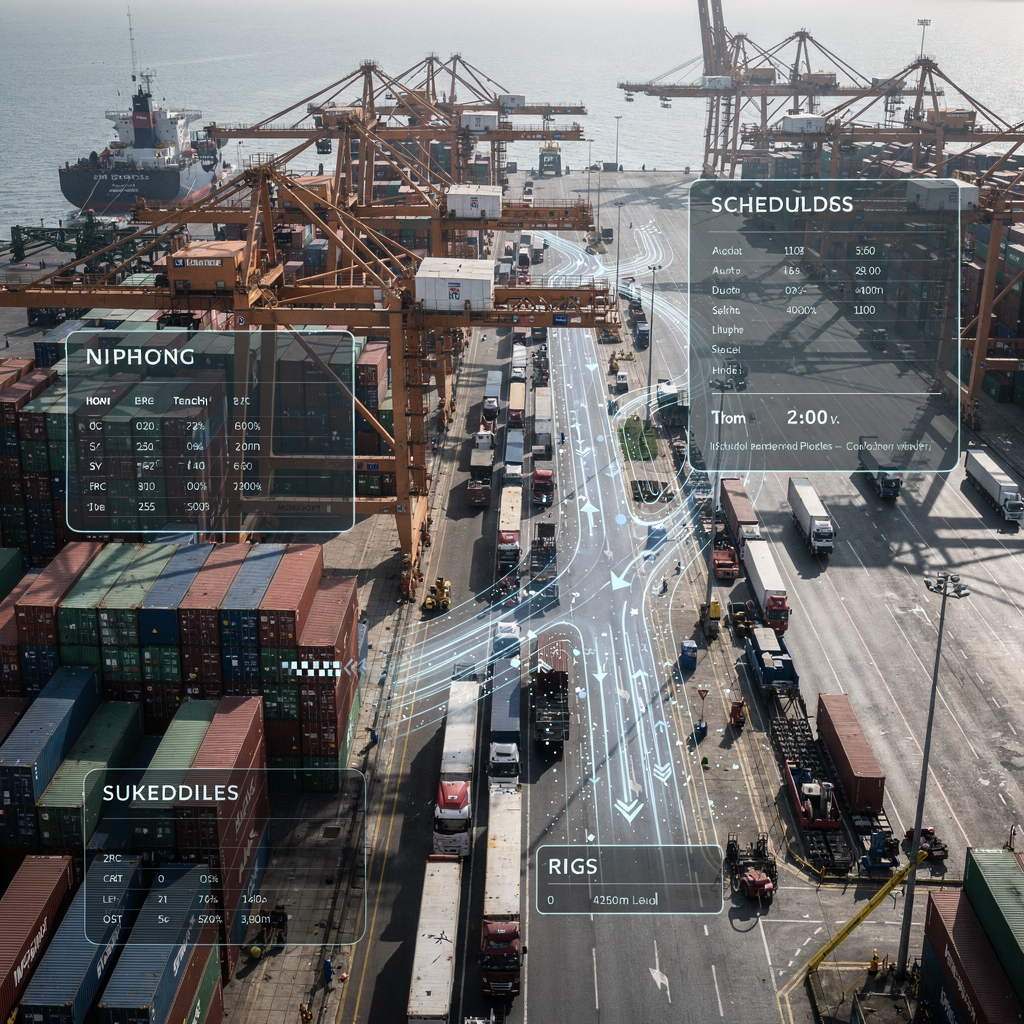
Airport terminal and supply chain: simulate passenger flow
Airport terminal planners use simulation to model passenger flow through check-in, security, retail, and boarding. Airport terminal simulation helps staff forecast queue lengths and staffing needs and to redesign passenger routing to reduce congestion. A high-fidelity model can include baggage handling, ground vehicles, and staff allocation so the supply chain of passengers and bags works in sync. Simulation can be used to test how changes to check-in kiosks or security lanes affect queue times and overall experience.
Simulation models for airports represent individual passengers and groups, and they measure how long people spend at touchpoints. Planners run peak-time scenarios to test robustness and to improve throughput. For example, a model might show that small adjustments to staffing patterns reduce average queue by minutes, and that in turn speeds boarding and reduces flight delays. The same approach supports baggage handling planning where delays in one area cascade through the supply chain. By running different scenarios, airport operators can forecast capacity and choose investments that deliver the highest returns.
Simulation-based training prepares airport operators and frontline staff for surges, disruptions, and unusual events. Training scenario packages allow trainees to practise rerouting passengers, reallocating staff, or operating alternate baggage flows. Simulation is a powerful tool for safety drills because staff can rehearse without impacting real passengers. As airports adopt automation technologies for bag drops and self-boarding, simulation helps ensure the human-machine handover remains smooth. Using simulation and digital twins together allows teams to plan for current and future needs, to identify bottlenecks, and to gain valuable insights that improve service levels and operational resilience.
FAQ
What is a terminal simulator and why is it used?
A terminal simulator is a software or hardware setup that emulates terminal devices and environments so engineers and trainees can test systems without real hardware. It reduces hardware costs and lets teams inject faults and run repeatable training scenarios.
How does a digital twin differ from a model?
A digital twin is a live, instrumented model that receives telemetry and updates to mirror an operational asset, while a model is often a static or configurable representation used for planning. The twin supports closed-loop testing and helps teams compare simulated outcomes with real metrics.
Can simulation be used for operator training?
Yes, simulation can be used to create risk-free training scenarios that train operators on normal and exceptional events. Equipment training packs let trainees practise procedures, and instructors can measure performance using objective metrics.
Do simulation tools help reduce time and cost?
Yes, by avoiding physical setups and by catching faults earlier, simulation reduces time and cost associated with testing and training. Industry reports show hardware testing costs fall substantially when teams adopt simulation-based methods (Advent Instruments – AI-5620).
How do port planners use simulation?
Port planners run port simulation to check berth allocation, crane scheduling, and yard stacking under different vessel mixes. This modelling helps planners optimize crane use and reduce yard congestion across port and terminal operations.
What role does simulation play in airport planning?
Airport planners use simulation to model passenger flow, queue times, and baggage handling to improve throughput and service. Simulation helps airport operators test peak scenarios and update staffing patterns without disrupting passengers.
Can simulation improve crane utilization?
Yes, simulation allows teams to test crane sequences and reassignments to boost utilization and throughput. By modelling crane cycles and traffic, planners can reduce idle time and balance workloads among cranes.
Is simulation useful for automation projects?
Definitely. Simulation allows teams to test automation technologies, human-machine interactions, and safety procedures before field deployment. It supports a risk-free validation phase and helps mitigate integration issues.
How long does it take to set up a digital twin for a terminal?
Setup time varies with complexity, but many pilots spin up a basic digital twin in weeks and refine it over months. Starting with core layout and key KPIs speeds early learning and lets teams upskill while the model matures.
Where can I learn more about container terminal simulation solutions?
For focused resources, see vendor and research pages such as Loadmaster.ai’s guides on container terminal simulation software and terminal digital twin approaches (container terminal simulation software, terminal digital twin software). These pages include examples, technology choices, and integration tips.
our products
 stowAI
 stackAI
 jobAI
jobAI
Innovates vessel planning. Faster rotation time of ships, increased flexibility towards shipping lines and customers.
Build the stack in the most efficient way. Increase moves per hour by reducing shifters and increase crane efficiency.
Get the most out of your equipment. Increase moves per hour by minimising waste and delays.
stowAI
Innovates vessel planning. Faster rotation time of ships, increased flexibility towards shipping lines and customers.
stackAI
Build the stack in the most efficient way. Increase moves per hour by reducing shifters and increase crane efficiency.
jobAI
Get the most out of your equipment. Increase moves per hour by minimising waste and delays.